LIST CANDIDATE: THE VISITOR (1979)

DIRECTED BY: Giulio Paradisi

FEATURING: , Paige Conner, Joanne Nail, , Mel Ferrer, Glenn Ford,

Still from The Visitor (1979)

PLOT: Years ago, a cosmic menace known as Sateen escaped his alien captors and wreaked havoc across the stars. The forces of good and their army of birds vanquished him, but not before he reached Earth and impregnated multiple human women. The children born from those couplings would become mutants, telekinetic beings with the power to rule the world encoded in their genes. Much later, the mysterious being known as the Visitor (John Huston) dreams of a towering figure in black trudging across otherworldly sands. The figure turns into a young girl, and through this vision the Visitor realizes that Sateen’s abilities have resurfaced on Earth within eight-year-old Katy Collins (Paige Conner).

Katy’s hapless mother Barbara (Joanne Nail) recognizes the evil growing inside her daughter as well, as does the cabal controlling Barbara’s boyfriend, Raymond (Lance Henriksen). Seduced by his employers’ promise to fund his pro basketball team, Raymond agrees to impregnate Barbara with a second child in order fulfill their plans for world domination. Will Raymond succeed and help bring the world to its knees, or will Barbara exercise her right to choose (not to be an incubator for mankind’s destruction)?

Also, will the Visitor ever intervene, or will he spend most of his time wandering aimlessly to theme music that is a bit too dramatic and funky for a man who takes forever to walk down a single flight of stairs? And why is Jesus blonde and surrounded by bald children? The answers will surely surprise you, because if nothing else The Visitor is a story that nobody could ever see coming.

WHY IT MIGHT MAKE THE LIST: One might read a summary of The Visitor’s plot about a possessed little girl and dismiss it as a rip-off of The Exorcist—which it is—but what’s really special about Giulio Paradisi’s film is that it also rips off Close Encounters of the Third Kind and The Birds. In a story where the Satan’s origin as an interstellar felon merits only the briefest attention, director Giulio Paridisi combines a range of ideas from across the spectrums of sci-fi, horror, and religion with such inspired fervor that he could almost be accused of originality. Yes, this is a film that steals parts of very recognizable movies and puts them together with the grace of a child forcing LEGO bricks into a jigsaw puzzle, but the uneven hodgepodge born from The Visitor’s plagiarism is utterly unique in its weirdness.

COMMENTS: From an overqualified cast whose presence could’ve only resulted from blackmail to a plot that immediately requires you to accept that Jesus Christ lives in outer space, very little about The Visitor makes sense. As with many of the so-bad-they’re-weird films, though, that incoherency is the source of the film’s charm. To sit down and explain The Visitor, either by rationalizing its production choices or clarifying its plot scene by scene, would reduce it by turning it into something knowable and common rather than the masterpiece of the bizarre that it is.

The best way to describe The Visitor is to instead just recount a few of its many insane twists, all of which are delivered with the abruptness and enthusiasm of someone making it up as he goes along. This is a movie that casts celebrated director John Huston as a second-fiddle messiah known as the Visitor, whose efforts to stop the possessed Katy Collins soon detour into posing as her babysitter and losing to her in a game of Pong. The threat posed by the girl lies in her telekinesis and a murderous pet hawk whose presence and ability to open doors is never questioned, at least until a maid played by Academy Award-winning actress  kills the bird with her bare hands. However, even more dangerous than Katy is the prospect of her mother, Barbara, giving birth to a son. That second child promises to usher in the end of times, but luckily Barbara lives in post-Roe v. Wade America. After getting pregnant she averts the apocalypse with a timely abortion, leaving the Visitor and his conscripted army of pigeons to take care of Katy and save the day once and for all. Of course, one may wonder why the Visitor didn’t simply take care of Katy as soon as he arrived on Earth, but the answer is clear. That would mean denying us a pretty awesome movie.

After leaving the film’s premiere, Huston reportedly walked up to director Giulio Paradisi and said, “You know what, I had no idea we were making that kind of movie. Congratulations.” Therein lies the wonderful essence of The Visitor, an undertaking so strange that even the people making it could not understand it. It veers from one crazed idea to the next without a care in the world. The results are inscrutable, but within that inscrutability lies a kind of magic. Ultimately, it’s a movie that proves that, when you don’t need to justify yourself, anything is possible.

Drafthouse Films is re-releasing The Visitor to theaters through January 2014, with a new DVD release to follow.

WHAT THE CRITICS SAY:

“…too messy and weird to have hit back in the day but too inventive and accomplished to have been rotting for so long.”–Alan Scherstuhl, The Village Voice (2013 re-release)

REVIEW WRITING CONTEST #5: WIN A SIGNED COPY OF THE GHASTLY LOVE OF JOHNNY X

It’s been over a year since our last review writing contest, and we’re itching for some new blood. To encourage you guys to chip in (and possibly earn a spot as a junior contributor—we get a lot of low-budget screeners we could use help sorting through), we’re offering a Ghastly PackTM, consisting of a DVD copy of The Ghastly Love of Johnny X with the cover signed by director , two promotional postcards, and a video production diary (a separate DVD-R disc of  behind-the-scenes material that is not commercially available). This is a great pack for anyone interested in low-budget movie making. All you have to do to earn this ghastly (and wonderful) prize is to submit the best movie review, following the rules set out below:

The Ghastly Love of Johnny X poster

  1. Write a review of a movie that you think should be on the List of the 366 Best Weird Movies, but that we haven’t added yet.  Including the following sections: DIRECTOR, FEATURING (listing the most important actors), PLOT (a one sentence synopsis), WHY IT DESERVES TO MAKE THE LIST (a one sentence to one paragraph description of why you think the movie is weird), COMMENTS (one to two paragraphs describing the movie in more detail). If you have a suggestion for a still to represent the movie and/or a quote from a critic on the film, you can include those, but they are not required.
  2. Alternatively, a well-thought out “second opinion” on a movie that we have already considered, but that you think we got wrong (either by putting it on the List when it shouldn’t have made it, or rejecting a film that should have made it), will be acceptable.
  3. Submit your work on our contact form. By submitting your entry on this form, you agree to allow 366weirdmovies.com to publish your work, either whole or in edited form, on this website. Your work may be selected for publication even if you are not chosen as the winner.
  4. The contest is open to anyone whose work has not previously been published on 366weirdmovies.com.
  5. You may not write a review promoting a film which you were involved in the production of, or in which you have a financial interest.
  6. This site strives to remain “PG” rated; try not to use profanity in your review.
  7. The contest will remain open for one month, until Jan 2, 2014, at which time the editor will select the best entry. The winner will be chosen on the basis of writing style, insight, and appropriateness of the movie chosen.  The deadline may be extended, depending on the number of entries received.
  8. In order to be eligible to receive the prize, you must supply a valid email address and a valid mailing address. International addresses are acceptable. If the winning entrant does not supply a valid mailing address, or declines the prize, the DVD will be given to a randomly selected entry with a mailing address in the United States. If no entries are from the United States, then the deadline to complete the contest will be extended.

TIPS: Avoid merely summarizing the plot in your comments. Avoid giving away “spoilers” in your descriptions that might ruin the enjoyment of the film. Obscure titles are fine—in fact, they may be worth bonus points—but try to pick a film that is available on DVD, or is at least likely to be released. If you write on a film no one will be able to view or locate, the movie may be judged as inappropriate. Try to keep your review to under 1000 words total—more is not always better when it comes to movie recommendations.

One final tip: don’t be scared away by thinking you have to write something profoundly insightful. Simply consider it as a chance to describe and recommend a film to that narrow audience of people who are interested in the same kind of weird movies as you are.

Chances of winning depend on the number of entries received.

WEIRD HORIZON FOR THE WEEK OF 11/29/2013

Our weekly look at what’s weird in theaters, on hot-off-the-presses DVDs, and on more distant horizons…

Trailers of new release movies are generally available on the official site links.

IN THEATERS (WIDE RELEASE):

Oldboy (2013): A man is imprisoned in a hotel room for twenty years without explanation, then just as inexplicably set free to seek revenge on his captor. Early notices on this seemingly-doomed Spike Lee remake of the shocking Korean original have been every bit as tepid as we expected. In particular, a woman named Grace did not like it. Oldboy official site.

FILM FESTIVALS –  Cine-Rebis Porto Underground Film Festival (Porto, Portugal, Nov. 29-Dec. ):

Most of the movies playing at the Porto version of this festival of two cities are identical to the ones we reported on in the London version of the event, including Kelly Hughes’ zombies n’ drag queens mashup La Cage Aux Zombies, Brontis Jodorowsky in Tau, the -inspired Ritual: A Psychomagic Story, and the modern Expressionist horror The Demon’s Rook. Notable changes: no Escape from Tomorrow (Portugal is obviously not considered one of the happiest places on Earth), but to compensate there is a rare screening of Bruce Bickford’s surreal claymation short “Prometheus’ Garden.” Cine-Rebis Porto Underground Film Festival program (in Portuguese).

NEW ON DVD:

Animals (2012): A maladjusted gay teenager falls in love for the first time, but what will become of his only friend, a talking teddy bear named Deerhoof? The description makes it sound like Ted done as a psychological coming-out drama. Buy Animals.

The Horror Show (1989): See description in Blu-ray below.

“Mystery Science Theater 3000: 25th Anniversary Edition”: The four main episodes included in this edition of the cult movie-mocking series are the Hammer-produced space opera Moon Zero Two, the epic fantasy The Day the Earth Froze (a confusingly dubbed and edited international cut of a serious Russian/Finnish fantasy film),  the Universal horror snoozer The Leech Woman, and Gorgo (which is something like the British Godzilla). The bonus disc is a double-feature of two historically important series episodes: Mitchell, original host Joel Hodgson’s final bow, and The Brain That Wouldn’t Die, which introduced new frontman Mike Nelson. Buy “Mystery Science Theater 3000: 25th Anniversary Edition”.

NEW ON BLU-RAY:

The Horror Show (1989): A killer continues to bedevil a detective and his family even after being executed in the electric chair. This absurd ripoff of Nightmare on Elm Street was titled House 3 overseas, even though it had nothing to do with the House series. Available in a DVD/Blu-ray combo pack only. Buy The Horror Show [Blu-ray/DVD Combo].

What are you looking forward to? If you have any weird movie leads that I have overlooked, feel free to leave them in the COMMENTS section.

CHAPLIN’S CITY LIGHTS (1931) (CRITERION COLLECTION)

The most recent  feature to see a Criterion treatment is City Lights (1931).

Released three years after the advent of talkies, City Lights remains, for many, quintessential Chaplin. It was possibly inspired, in part, by ‘s The Strong Man (1926), starring . 

Chaplin labored on City Lights for three years, in part due to difficulties with leading actress Virginia Cherrill, in the role of the Blind Flower Girl (which is how she is billed. Like everyone else in the film she has no name, just a simple description). Chaplin spotted her at a prize fight. She was acutely near-sighted and had the look and personality he was seeking. She was not however, a professional actress. Cherril, being an adult of twenty, was far too old for Chaplin to be interested in romantically. Thus, their relationship off-screen was purely platonic, which, probably added to Chaplin’s dismay of not being able to manipulate her. Cherrill was far from starstruck. She was often tardy and frequently challenged Chaplin. At one point the director fired his leading lady, only to bring her back after realizing that starting anew would be disastrous. A clip (from the Criterion edition) reveals the director once put Cherrill through 342 takes. Yet, despite all this friction, Chaplin extracted a remarkable performance from her.

All of Chaplin’s films are primarily actor’s films, rather than being the work of an accomplished director. Montgomery Clift was among those who intensely studied Chaplin’s performance in City Lights. Indeed, Chaplin’s performance here is quite possibly his best.

However, to say City Lights approaches perfection, or is Chaplin’s best film, proves an exaggeration. It is as maudlin as The Kid (1921) and nearly as episodic as Modern Times (1936), but it’s beauty lies in simplicity; and, as far too many hack artists have proven, simplicity, done well, requires consummate craftsmanship and intelligence. Chaplin still serves as the blueprint for simplicity done right.  This “comedy romance in pantomime” opens with The Tramp discovered sleeping on a city statue, after it is unveiled. Making minimal use of sound, Chaplin’s politico spews garbled gibberish.  Naturally, chaos follows, and it ends, not so subtly, with the Tramp thumbing his posterior at American capitalism before embarking on his city promenade.

The Tramp is menaced by a couple of Newsies, and stops to admire a beautiful statue of a nude woman (a frequently used bit in Chaplin’s film), which everyone else ignores. Shades of things to come. The Tramp is immediately and noticeably more genteel here; far more so than he was when stealing food from babies in his last feature, The Circus (1928).

Still from City Lights (1931)Behind the scenes Chaplin was a case study in manic depression and an obsessive perfectionist. For weeks on end, he agonized to come up with a way the Blind Girl could mistake the Tramp for a millionaire. Then, as he was apt to do, he found his source of inspiration from one of his own earlier shorts. The Tramp, avoiding the Kops, zigzags his way through open doors of unoccupied  limos. The Blind Girl  hears a limousine door open and the Tramp emerging. Thus, he becomes her imagined millionaire. When the Tramp discovers the Girl is blind, he lays on the sentiment in a way only he could pull off. It is the Tramp alone, in an apathetic society, who sees the ethereal beauty and spirit in her Dickensesque poverty.

With Her possessing his thoughts, the Tramp comes upon a self-pitying alcoholic millionaire who is attempting to commit suicide by throwing himself into the river. Predictably, slapstick follows. Some of it is awkward, but serves the narrative and conceptual purpose of mocking the super rich.

The millionaire gives the Tramp money to buy more flowers from the Blind Girl and even loans his limo out, but it is only when he’s drunk that he’s so generous. Sober, the millionaire is true to his elitist, miserly ways, does not recognize his new friend, and kicks the Tramp out. In order to obtain money for an operation which cures blindness (remember, it is a fairy tale), our protagonist rummages through a series of jobs, including a gig as a prize fighter. Chaplin had used the employment plot device in his Keystone, Essanay, and Mutual shorts. In City Lights, it serves as a distraction. (He would be more innovative with it in Modern Times). Still, it is not a critical detour, and Chaplin regains his footing for the final act.

The millionaire, having returned from an extended European tour, is drunk again, and runs into the Tramp. After the tramp explains he needs a thousand dollars for the Blind Girl’s operation, his inebriated friend donates to the charity, only to have a fumbled burglary and sudden sobriety transform him into an Indian-giver. Desperate, the Tramp flees, money in hand. Pressing the wad of cash into Her hands, the Tramp secures her operation and prevents Her impending eviction.

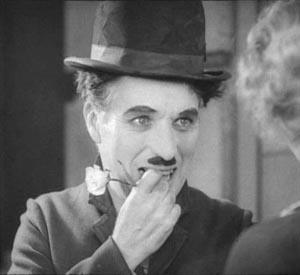
With a warrant out for his arrest, the Tramp has an inevitable date with the penitentiary. Time served, he shuffles the streets, an object of ridicule and failure until he happens upon a flower shop, run by the now sighted Flower Girl. She, too, joins in ridiculing the transient. But empathy overcomes her and she gifts the Tramp a single flower, which requires touching him. Recognition means pathos and tragedy and per Chaplin’s creed, cue closeup (Chaplin used closeups for tragedy and reserved long shots for comedy. Naturally, he sometimes broke his own rules, but he generally kept to them). This is the divine mother of all cinematic endings. Despite Chaplin’s (increasing) tendency towards schmaltz, he still does it in a far less dated way than other films of the period. Indeed, his silent features have enough identifiable human drama and strengths to outweigh their shmaltzy weakness in far better than virtually any of the saccharine Hollywood productions of the forties and fifties. His own Limelight (1952) is far more passé, perhaps because Chaplin was really only suited to the art of silent cinema (despite claims that his transition to sound was successful).

As expected, the Criterion Collection is extensive. In its HD treatment, City Lights has never looked better, making it even more timeless. Audio commentary from a Chaplin biographer, a (rare) deleted scene, the documentaries Chaplin Today and Chaplin Studios, beautiful cover art, and Gary Gidden’s massive booklet are priceless.

Celebrating the cinematically surreal, bizarre, cult, oddball, fantastique, strange, psychedelic, and the just plain WEIRD!