FELLINI SATYRICON (1969): THE CRITERION COLLECTION ON BLU-RAY

“The quintessential Fellini film. There are orgies, murders, abductions, rituals, all presented coolly, without editorial comment—as might a Warren Commission Report from Mars.”—Vincent Canby

Although Fellini Satyricon (1969) has already made the List, its re-release as a Criterion Collection Blu-ray warrants additional coverage. The previous MGM DVD Edition was threadbare, and although it thankfully kept the film in circulation, you can now donate your copy to a  virgin (although making Satyricon your first would be unwise).

Actually, my MGM DVD has proven quite handy over the last decade, being one of my most coveted films for the bourgeoisie to walk out on. More than once it has been useful in ridding myself of unwanted guests, or those who have overstayed their welcome. Rather than repeatedly looking at the Seiko on my wrist, all I had to do was slap Satyricon into the player and within a half hour I would, without fail, find myself alone enjoying the company of my dear, beloved, beautiful late Siamese cat, Betty.

The last time I pulled it out was possibly the most beneficial to me: a family member, for some reason, decided to drop by; which would have been fine, except that he brought with him his hopelessly constipated Bible-beating fundamentalist girlfriend, who proceeded to “enlighten” and “warn” me about the upcoming rapture, lest I be “left behind.” I neither argued nor even looked at my watch. I merely smiled, popped in Satyricon and—bam—in a record time of seventeen minutes, sister So-and-So was outta my door. I gave Betty her trout and lay back, thanking both St. Federico and MGM. Although Betty broke my heart by suddenly, and without warning, flying off this mortal coil, she can now join Federico and my wife and I (in spirit), looking down from trout heaven at a crystal clear Criterion Satyricon. I am willing to bet that, with this release, I can beat my seventeen-minute record the next time an uptight cinematic illiterate or artless boob darkens my door.

Of course, the film was loosely based on Petronius’ ancient satire, and all that history is covered here. As with Roma (1972) Fellini includes his name as part of the title, not out of ego, but to inform the view that this is Fellini’s personal interpretation of the satire, not Petronius. Conventional wisdom says that with Satyricon Fellini entered a whole new plane of eccentric (some would say excessive) personal filmmaking, daring to produce a work which does not strive to be populist. Fellini counted this, with 1976’s tragically unavailable Casanova, as his most perfectly realized film.

Director of Photography Giuseppe Rotunno supervised Criterion’s digital restoration, which renders the viewing experience an entirely new film. The difference is almost akin to seeing a painting in the flesh as opposed to looking at in an art history reference book. From the rich pigments of the clothing to the caked face paint of the extras, the vivid background colors, reddened skies, bluish serpentine caverns, and even the subtitles (a new and improved English translation), this is a radical improvement over MGM’s release. As a product of the late 60s, Satyricon is mesmerizingly psychedelic. The fabric of Fellini’s hellish milieu never looked so sumptuous and inviting. Additionally, its absurd dialogue, spoken in multifarious languages, and the Nino Rota score are at their most cacophonous.

Starting with the audio commentary track, the extras are aptly idiosyncratic. Not recorded directly for the Blu-ray release, it is instead an expansively informative “Behind the Scenes Diary,” recorded in 1971 by Eileen Lanouette Hughes. She covers Fellini’s original vision for the film, how that vision evolved during production, provides behind the scenes descriptions, the history of the film’s funding, explains Fellini’s processes and casting decisions, and compares Petronious’ satire to Fellini’s finished adaptation.

“Ciao Federico,” is an hour-long documentary produced by Gideon Bachmann in 1970. Showing the behind the scenes interaction between director and cast, it reveals Fellini as something of a taskmaster, albeit one who quickly apologizes for belittling his actors. Among the visitors to the set, we see  and his doomed wife, Sharon Tate.

The director discusses everything from the latent morality of the film (aka godless violence) to Gene Shalit’s waxed mustache in a series of interviews. An interview with DP Rotunno reveals the director’s aversion to creating a realistic ancient Roman world; he desired instead a mythical, artificial look.

Classical scholars, film consultants Joanna Paul and Luca Canali expand on Hughes’ commentary in the “Fellini and Petronious” supplement. On set photographer Mary Ellen Mark amusingly recounts anecdotes of working with Fellini (and the director’s sycophants).
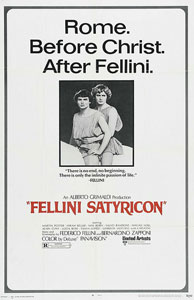
Fellini Satyricon Poster“Felliniana” is a hi-res slideshow from Dan Young’s epic Satyricon memorabilia, including a collection of provocative posters.

An extensive essay booklet by film scholar Michael Wood accompanies the original theatrical trailer, closing this release. It is enough for several nights’ worth of cozy, entertaining, academic foreplay before consummating with the film itself. A wholeheartedly recommended, essential release.

197. VAMPYR (1932)

Vampyr – Der Traum des Allan Grey; Castle of Doom (alternate English version)

“I just wanted to make a film different from all other films. I wanted, if you will, to break new ground for the cinema. That is all. And do you think this intention has succeeded? Yes, I have broken new ground.”–Carl Theodore Dreyer on Vampyr

Recommended

DIRECTED BY:

FEATURING: Julian West, Jan Hieronimko, Rena Mandel, Sybille Schmitz

PLOT: Allen Gray, a student of the occult, wanders to the small hamlet of Courtempierre. There, he witnesses ghostly visions and meets an old man who is soon killed by an assassin’s bullet. The man’s sickly daughter lies in bed, her blood drained by a vampire, and Gray takes it upon himself to find the source of the contagion.

Still from Vampyr (1932)
BACKGROUND:

  • The story was inspired by tales from Sheridan Le Fanu’s 1872 Gothic short story collection “In a Glass Darkly,” the most important of which is “Carmilla” (a vampire tale with lesbian undertones).
  • Vampyr was produced in three versions: one with the cast speaking English, one in French, and one in German. Complete prints of the English and French versions no longer exist, although parts were used in restoring the German version. Some say the English version was never completed. Filming the same script in multiple languages was a trend at the time—see also the Spanish-language version of Dracula—although this practice was soon abandoned as too costly.
  • Star “Julian West” is actually Baron Nicolas de Gunzburg, who funded the production in exchange for the leading role. Gunzburg used a pseudonym to avoid the embarrassment that would result from having an actor in his Russian expatriate noble family.
  • Vampyr was shot through a layer of gauze positioned in front of the camera to create the soft, dreamlike visuals.
  • The film was booed at its premiere in Berlin, and in Vienna crowds rioted, demanding their money back. Vampyr lost money and at the time was seen as an embarrassment in its distinguished director’s career, although now it is regarded with near universal acclaim.

INDELIBLE IMAGE: The translucent astral body of our protagonist, peering down at his doppelganger as it lies in a coffin.

WHAT MAKES IT WEIRD: A nearly irrational, mood-based horror gem with imagery that verges on the surreal, Vampyr is a grim and restless death parable made in the brief age when the melodramatic structures of silent films were slowly being fleshed out with the new colors and textures afforded by sound. This experiment in terror by a master filmmaker, made in a unique period that cannot be recreated, is an artifact of its time that paradoxically seems all the more universal because of the age-bound specificity of its style.


Clip from Vampyr (1932)

COMMENTS: “It was an eerie moonlit night. Lights and shadows, Continue reading 197. VAMPYR (1932) →

CAPSULE: AN AMERICAN HIPPIE IN ISRAEL (1972)

Ha-Trempist

DIRECTED BY: Amos Sefer

FEATURING: Asher Tzarfati, Lily Avidan, Tzila Karney, Shmuel Wolf

PLOT: Pursued across the globe by mysterious figures, an American Vietnam vet turned hippie goes to Israel and founds a small commune on an island.

Still from An American Hippie in Israel
WHY IT WON’T MAKE THE LIST: There are a few very weird (and even more very stupid) moments in this earnestly bizarre Israeli/hippie artifact. But working against An American Hippie in Israel is the fact that the vast majority of the film is so damn boring. Frankly, this is the only movie I’ve ever seen where I could honestly say: it needed more mimes. It’s worth seeing once to mark off your bad-film bucket list, but it’s no forgotten treasure.

COMMENTS: It’s easy to see why film fans were desperate for An American Hippie in Israel to be a hit. So-bad-they’re-good films are rare treasures, providing an intoxication that competent films can’t replicate, but once you’ve seen the obvious classics––Plan 9 from Outer Space, Robot Monster, Troll II, The Room—pickings get slim. So when word gets out about a lost trash classic, hopes get high. And Hippie boasts a uniquely twisted take on its botched universe, including some “thoughtful”/”mind-blowing” revelations, flat amateur acting, ponderous quality dialogue (“you fools… stop pushing buttons… you fools!”), a balding Israeli hippie who doesn’t speak English and looks twenty years older than his companions, nonsensical scenes and plot twists (sharks!), and mimes with machine guns.

And yet, I don’t think Hippie is truly a lost cult classic, because its numerous delights are buried in a morass of slow, arid scenes of Israeli hippies being groovy. When our American arrives in Tel Aviv, he’s picked up by an incipient flower child who proceeds to take him home and make him coffee—in real time. There are lots of scenes of the characters driving through the desert in a convertible, grooving to folk songs, and doing the frug at a dance party (which is happily interrupted by mimes with machine guns). That’s right, I said mimes. Two silent white-faced characters, who symbolize (pick one) death/the Vietnam War/man’s inhumanity to man are tracking our globetrotting hippie across the globe. These marauding Marcel Marceaus, who appear without rhyme or reason, are a surreal intrusion into a movie that is otherwise a rather lame fable of youth in revolt.

The other really noteworthy section of the film is our hippie’s dream as he rides across the desert towards his island utopia. It’s a totally silent, totally slo-mo, totally symbolic montage that begins with lavender-tinted lashing and ends with our protagonist whacking a couple of cassette-tape-headed aliens (?) in three piece suits with a giant oversized novelty sledgehammer. Those fools won’t be pushing any more buttons after that bashing, you can be sure. Unfortunately, the film goes downhill from there, as the bohemian quartet make increasingly stupid choices, choosing to permanently locate to a desert island without scouting it first for food or water, or bothering to secure their precious inflatable raft when the land. Stranded on the island, they descend into savagery in a weekend, with the two male hippies quickly turning into territorial rapists. The downer ending is meant to demonstrate, we gather, that even hippies become monsters when their very survival is at stake, and that man’s darker nature is stronger than his idealism. What it really demonstrates, I think, is that stupidity is stronger than either, and that if you’re an American hippie trapped in a dumb script, you are truly doomed. What a bummer.

An American Hippie in Israel was made by one Amos Sefer, who never made another movie (his only other credit is a short which is included as a bonus on the Blu-ray). Unsurprisingly, the execrable Hippie never found distribution. Somehow, Grindhouse Releasing discovered a print of this oddity and made a trailer, which generated interest in the flick. Israelis tracked down prints and began showing the movie as an interactive midnight event, complete with commentators, folk singers (singing mocking new lyrics to the instrumentals) and performance artists, turning it into a homegrown Hebrew version of The Rocky Horror Picture Show. Grindhouse  screened the film at American festivals and brought out a DVD in 2013.

WHAT THE CRITICS SAY:

“This weird inept movie was made by a former lifeguard with no training as a filmmaker… The film is so perplexing and maddening, that one can say without any trepidation that the filmmaker is a meshugener.”–Dennis Schwartz, Ozus’ World Movie Reviews (Blu-ray)

(This movie was nominated for review by Ryan Marshall. Suggest a weird movie of your own here.)

366 UNDERGROUND: ALEISTER CROWLEY’S THE RITE OF MARS: A ROCK OPERA (2014)

Eleusyve Productions

FEATURING: Jon Sewell, Sunnie Larsen, Kristin Holsather, Richard Cardone, Leith McCombs

 PLOT: Part of a larger series of works, this installation features an ensemble of leather clad, deadpan, sexually androgynous and glittering cast members who act out Aleister Crowley’s “Rite of Mars” on a darkened sound stage as a rock opera.

Aleister Crowley's Rites of Mars
COMMENTS: Theater can be a difficult medium in which to stage ambitious concepts, especially when the form has been grossly over-saturated with trite, treacly fare targeting audiences looking for some token of tourist prestige when sightseeing on Broadway. This type of creative environment could engender creative stagnation, but due to a lack of lavish budgets, theatrical performances often rely on their own intuition and invention to flesh out their imaginative designs.

Initially, what caught my attention about this filmed performance was the sheer nuttiness of its concept: Aleister Crowley’s “Rite of Mars” re-imagined as a rock opera a la Roger Water’s The Wall or Queensrÿche’s “Operation MindCrime” (which, by the operatic vocal stylings and shredding 80’s progressive metal guitar riffs, seems to be where Rites‘ sonic influences lie). The jams can sound kind of goofy, but your reaction depends on whether you find the musical design endearingly nostalgic or insufferable (I found it amusing, yet impressive in its technical prowess).

Before I begin my critique of the recording of the performance, allow us to review the thesis of this production. The following statement of intent appears on the producers’ website:

Our goal at Eleusyve Productions is the presentation of the seven plays comprising Aleister Crowley’s Rites of Eleusis as musical theater pieces in a manner that will render them more fully accessible to a broad and discriminating audience, using music, light, dance and drama to enhance the poetry and symmetry of the original works. It is further our goal to make these completed productions available in as many formats and to as many markets as possible, in order to more widely circulate our artistic interpretations of this material.

The Rites of Eleusis (a series of invocations, penned by the most wicked man dead, Aleister Crowley) are elaborately designed to instill religious ecstasy into the audience. By its very nature, it is intended to be a metaphysical provocation to the sensibilities of the bourgeoisie, calling upon occult theology and decadent subversion to titillate and bring about a spiritual awakening in the viewer—in Crowelian terms at least.

Although the story is not conveyed directly to the audience through a conventional form, it could be described as a piece of inspired storytelling told through bombastic imagery, gestures, kick-ass guitar riffs, and Wagnerian tableaux. Militaristic motifs recur, often spliced with inspirational cues from S&M fashion design (God, do I love me some artfully-crafted sleaze).

All of this makes it all sound rather dreary and humorless, but here’s where this particular passion project delivers: it’s pretty goddamn funny.

Straddling a median between camp and deadpan, the acting ensemble should be commended for displaying a quiet sense of humility about their performance. The gender-bending make-up design was also very attractive and always delightful. The set design, bare and minimal, uses the blackened negative space to eliminate the excess layers of artifice between the audience and the performance—Bertolt Brecht’s “alienation effect,” similar to the gutted, chalk-etched set designs of ’s Dogville. A dystopian science-fiction influence is also present, and the  juxtaposition of military uniforms and violent acts with archival war footage—images of bloodshed, conquest, and advancement—have a hypnotizing effect upon the viewer.

The music ranges from interesting to very good, even kickin’ at times. For those who prefer their rock & roll with a little flair, flamboyancy and delicious kitsch flavoring those tasty tunes, you might find yourself doing air guitar while you’re alone and no one else is watching.

The performers are obviously indebted to the Crowleian experiments of , the seminal American avant-garde pariah and homoerotic poet of independent cinema (and basically the inventor of the modern music video medium); especially to the mind-meltingly trippy works Invocation of My Demon Brother and Lucifer Rising.  Both Anger and Eleusyve Productions strive to inspire a controllable chaos in their audiences and attempt to render vast esoteric mythologies and personal obsessions in a digestible form. The liberated sexuality, free-form slipstream of imagery, experimental impulses, and dalliances with rock-and-roll culture as a medium to present occult theology is also akin to Anger’s early works.

I wouldn’t say that there is anything here that is conceptually radical or deliberately offensive to Juedo-Christian sensibilities, but if you don’t mind some decent 80’s inspired jams, want to grab a beer after a long day, smoke some grass, and relax, then why not watch a low-budget rock opera? It sure beats having to watch “Cats” or some other sanitized dreck.

Follow this link for clips from Rite of Mars, and other performances in this cycle.

Celebrating the cinematically surreal, bizarre, cult, oddball, fantastique, strange, psychedelic, and the just plain WEIRD!