The ever-dependable madcatlady (Wendy Vainity) proved just as capable of uncovering the inherent madness of dogs.
POD 366, EP. 138: RETURNING FROM ABROAD TO FIND WEIRD MOVIES STACKED LIKE CORDWOOD
366 Weird Movies may earn commissions from purchases made through product links.
Discussed in this episode:
Dogtooth (2009): Read the Canonically Weird entry! As we expected, Dogtooth‘s recent 4K restoration and theatrical re-release ends with a 4K UHD set (and standard Blu-ray). Buy Dogtooth.
“Drug-O-Rama Video Party”: Four sex & drugsploitative features from the 1960s. The titles are Help Wanted Female (1968), the mondo-ish Hedonistic Pleasures (1969), Alice in Acidland (1969), and The Hard Road (1970–some sources say 1973). Groovy. Buy “Drug O-Rama Video Party.”
The Ice Tower (2025): Read Giles Edwards’ review. Lucile Hadzihalilovic‘s fairy tale variant opens this week at IFC Center, and maybe other hoity-toity art-houses across the country. No official site (in English) located.
Perfect Blue (1997): Read the Canonically Weird entry! A “remastered” version of Satoshi Kon‘s groundbreaking psychological thriller in the form of anime is now in cinemas across the nation. Perfect Blue listing at Fandango to find a cinema near you.
“Phantasmatapes” (2025): Glitchy remixed versions of the public domain creature features The Revenge of Dr. X and The Brain That Wouldn’t Die, presented as a TV double feature complete with local commercial parodies. From Bleeding Skull, with additional short films. Buy “Phantasmatapes.”
Sgt. Kabukiman NYPD (1990): A detective turns into a superhero based on Japanese stereotypes in this early entry from Troma‘s extended universe. The movie is notable for originating the Troma car crash, and the 4K UHD + Blu-ray set comes with the usual trove of bonus features (many new). Buy Sgt. Kabukiman NYPD.
She Loved Blossoms More (2025): A Greek indie about two brothers building a time machine to bring back their dead mother that, by all accounts, gets super-weird. In limited theaters and simultaneously debuting on VOD. She Loved Blossoms More official site.
The Toxic Avenger (2023): Read Gregory J. Smalley’s review. If you ever wanted to know what a Troma movie would look like with Hollywood actors like Peter Dinklage, Kevin Bacon, and Elijah Wood, the extremely gory (but less offensive) remake is now available on-demand (with a Blu-ray dropping later this month). Buy or rent The Toxic Avenger (2023).
V/H/S/Halloween (2025): Another installment of the retro horror anthology series, this time with a Halloween theme. Directors involved include a bunch of relative newcomers, Alex Ross Perry, and the name that brings this project to our attention: Casper Kelly (the friendly ghost). It might show up in a theater or two, but mainly you can watch it on Shudder. V/H/S Halloween official Facebook page.
“The Wes Anderson Archive”: Uncle Wes‘ weirdest (Asteroid City) unfortunately isn’t represented in this box set from the Criterion Collection. What you get is a hefty 10 4K UHD and 10 Blu-ray set of Anderson’s first ten films: Bottle Rocket, Rushmore, The Royal Tenenbaums, The Life Aquatic with Steve Zissou, The Darjeeling Limited, Fantastic Mr. Fox, Moonrise Kingdom, The Grand Budapest Hotel, Isle of Dogs, and The French Dispatch. (Pro tip: wait for the 50% off sale in November). Buy “The Wes Anderson Archive”.
WHAT’S IN THE PIPELINE:
No guest (definitively) scheduled for next week’s Pod 366, but Greg and Giles should return to discuss the week’s weird news and new releases. Also on YouTube , Pete Trbovich revives his “Ten Weird Things” clip series with Dead Leaves (just in time for Autumn)! In written content, Shane Wilson takes on Chile’s Pinochet-as-a-vampire fantasy El Conde (2023), while Gregory J. Smalley also stays scary with a look at the strange Japanese horror Best Wishes to All (2022). Onward and weirdward!
CAPSULE: THE ICE TOWER (2025)
La tour de glace
366 Weird Movies may earn commissions from purchases made through product links.
DIRECTED BY: Lucile Hadzihalilovic
FEATURING: Clara Pacini, Marion Cotillard, August Diehl, Marine Gesbert, Gaspar Noé
PLOT: Jeanne, a fifteen-year-old orphan, leaves her foster home and comes across a film shoot for a dark fairy tale.

COMMENTS: In the realm of the Ice Queen, the snow is vibrant, ethereal—and menacing. Drifts of crystalline flakes reflect muted light as it swirls aimlessly, falling upon and around the Queen, whose dusky gaze is a terrible, beautiful thing to behold. Jeanne beholds this gaze, and is immediately entranced by the fictional queen, as well as the actress who portrays her. Lucile Hadzihalilovic’s new film is as atmospheric as it is contemplative, unfolding Jeanne’s journey toward womanhood with all the portentous flair that cinema can offer.
If one were feeling glib, The Ice Tower could be described as “art- haunted-house”; but perhaps the film is too serious for that. That’s not to say it isn’t permeated by camera magic, on display for the viewer, and for Jeanne, who serendipitously falls into a film studio (almost literally) as the team there attempts to re-bottle lightning caught in a previous adventure featuring the cold, enigmatic Ice Queen. The Queen is played by Cristina, a cold, enigmatic actor interchangeable with her on-screen persona. As troubled as she is beautiful, Cristina relies on her “doctor” to help her through the her quotidian routine of performance, and curb her ambitions for an unreachable perfection. (This perfection, unattained, is the responsibility of the film-within-the-film director, played with graceful frustration by none other than Gaspar Noé.) While Cristina cannot abide flaws, the director lives in the real world—even if he is a magic-maker of cinema—and is quick to recognize that “good enough” is, by definition, good enough.
The Ice Tower is primarily about the bond between Jeanne and Cristina, the former replacing the actress who was cast as the queen’s protégé. By the finish, after all the narrowly framed widescreen shots, scant illumination, and a hauntingly dangerous venture to a remote cliffside, a fissure splits open; Cristina sought a lover, Jeanne sought a mother, and neither ends up contented. The clash between innocence and despondence worms through the gloomy corridors of Hadzihalilovic’s vision, with bright, minute illuminations crowded on all sides by murk. She has conjured a melancholy view from her dark crystal ball—with the sorcery of cinema forcing its light through the umbra.
The Ice Tower is in theaters now. We’ll let you know when it comes to home video.
WHAT THE CRITICS SAY:
CAPSULE: WARM WATER UNDER A RED BRIDGE (2001)
Akai hashi no shita no nurui mizu
366 Weird Movies may earn commissions from purchases made through product links.
DIRECTED BY: Shôhei Imamura
FEATURING: Kôji Yakusho, Misa Shimizu, Kazuo Kitamura
PLOT: An unemployed salesman intends to steal hidden treasure from a confectionary shop, but complications arise when he falls for the elderly owner’s caretaker, a woman with a unique condition.

COMMENTS: Sasano is already down on his luck when his only friend, Taro, passes away. The architectural firm he worked for has folded, leaving him unemployed, and his wife only calls to insult him while demanding his unemployment check. Taro, known as the “Philosopher,” lived as a hobo in a tent filled with rare books, but he was the only person to treat Sasano with respect and to offer him advice gleaned over the course of a misspent life.
Taro once told Sasano of a buried treasure, secreted in a pot, in a house with a view of a red bridge, in a summer resort town on the Sea of Japan. At an impromptu funerary meal held in his honor, Sasano mentions Taro’s claim to this improbable treasure. His hobo companions laugh it off; Taro told the rest of them about it, too. But after a series of unpromising job interviews, Sasano decides to leave Tokyo for the seaside, in search of Taro’s supposed pot of gold.
Arriving in the off season, Sasano stands out as an unlikely tourist. He locates the red bridge, and the house, which Taro had worried wouldn’t still be standing. Sasano spies a woman leaving the building and tails her to the grocery store. There, he catches her stealing cheese while awkwardly standing in a puddle of water. A dropped earring gives him an excuse to follow her back home. She hesitantly welcomes him in, then their chance meeting rapidly becomes a rather. . . aqueous sexual encounter.
Saeko, as she reluctantly explains, suffers from too much “water,” and when it overflows, she’s driven to commit crimes like petty theft. Thoroughly shocked by the whole thing, Sasano hypocritically reproaches her for stealing, while the relationship provides him convenient opportunities for him to search the house for Taro’s treasure.
As Sasano spends more time in the town and comes to know its quirky residents, the story heads in a predictable direction; but its tale of two unlikely romances is tinged with metaphysical symbolism surrounding the element of water. In one scene, Saeko takes Sasano to meet a nuclear physicist who studies neutrinos. He explains to them how the particles have to be shot through “superpure water” in order for their experiments to work. The town’s pure water also provides the key ingredient to making the perfect sweet cakes, though as Saeko eventually reveals to Sasano, their river was once dangerously polluted with cadmium.
Director Imamura’s enduring interest in the connection between human beings and their environment, as well as his explorations into the influence of crime and nonconformity on Japanese society, surface here again, in his final film. The flights of philosophical fancy lead into brief moments of CGI-animated imagery, but most of the scenes remain rooted more or less firmly in reality. Ultimately, Warm Water makes for a slightly kinky but heart-warming tale of how to find purpose, meaning, and happiness in life, along with sex without shame.
WHAT THE CRITICS SAY:
![Warm Water Under a Red Bridge [Blu-ray]](https://m.media-amazon.com/images/I/51P8+i47gzL._SL500_.jpg)
- Region A Blu-ray
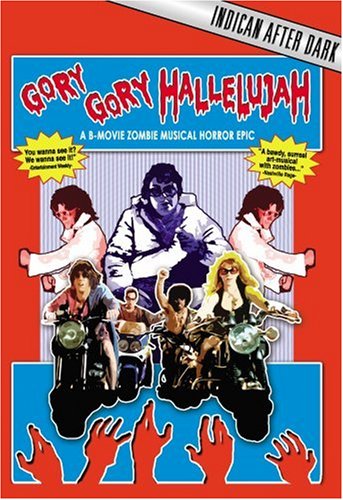
IT CAME FROM THE READER-SUGGESTED QUEUE: GORY GORY HALLELUJAH (2003)
366 Weird Movies may earn commissions from purchases made through product links.
DIRECTED BY: Sue Corcoran
FEATURING: Angie Louise, Tim Gouran, Jeff Gilbert, Todd Licea, Joseph Franklin
PLOT: Four aspiring actors on their way to New York run afoul of increasingly dangerous obstacles, including a group of rowdy Elvis impersonators, a backwards fundamentalist hick town, and a zombie apocalypse.

COMMENTS: Satire, the playwright and Algonquin wit George S. Kaufman opined, is what closes on Saturday night. Nevertheless, aspiring filmmakers frequently turn to satire as a means to walk the line between mass-appeal populism (near-parodistic references to familiar material) and fringe-appeal provocation (harsh critique of sociopolitical foes). All of which is to say, Gory Gory Hallelujah has the aspirational sweat of satire all over it. Unfortunately, Kaufman seems to have its number; Gory Gory bleeds out quickly.
Gory Gory has so many targets for its smug disdain that it plays like a sketch film. The opening salvo takes on the insular and pretentious world of theater, which is admittedly made even more amusing with the reveal that this delusional production of the Gospel is being staged in the theatrical mecca of Seattle. But that’s all forgotten once we set off on a road trip, a genre that revels in wacky mismatched personalities. From there, the targets are set up like the shooting gallery at a fair: here’s the crazy fight with a gang in a bar, here’s the hypocritically moralistic small town, here’s the evil lurking in the woods. The scenes are mileposts, rather than logical stops along the way.
This is a film that is not the slightest bit interested in nuance. Consider our central quartet of heroes, who check an impressive collection of boxes for character stereotypes: militant black man who nonetheless endures countless indignities; self-proclaimed feminist whose sexual and materialistic impulses frequently overrule the cause; nebbishy Jew who finds every opportunity to remind you of his faith; blissed-out hippie flower child whom the film wants to position as closeted, but who is actually ravenously omnisexual. That’s all there is to them; barely 24 hours after having watched the film, I’ve completely forgotten their names, and that’s just fine. They’re not characters; they’re trope delivery systems.
Title notwithstanding, Gory Gory Hallelujah isn’t really a horror film. The screwed-up small town feels like a low-rent retread of Nothing But Trouble, the witches’ coven is just an excuse to take a jab at man-hating lesbians, and the undead are lumbering actors with Green Goddess dressing smeared on their faces. I suspect if you asked director Corcoran and screenwriter Louise, they’d tell you they were making a comedy, a Troma-esque everyone-is-awful romp that lets them flirt with edginess without having to catch any flack. Every once in a while, the film threatens to go somewhere truly daring, like the smarmy land baron’s reference to some “accidental lynchings” that hints at a truly vengeful motivation for the zombie uprising. Most of the time, though, the targets are only the most obvious, offering variations on the theme, “Aren’t these people just awful?” They are. It’s not a revelation.
The closest the film gets to a point-of-view comes in the admittedly unexpected finale, when the death of absolutely everyone presages a revival-hymn closing number that suggests we’ll all be equal in the great beyond. Whereas before everyone was greedily nasty to each other, now they’re all dancing arm-in-arm, united in brotherhood after they’ve cast off the pesky need to breathe. It would make for a solid mission statement if there’d been even a hint of it prior to the closing minutes of the film. As it stands, it’s just one more radical shift in tone for a movie that has already lurched awkwardly from one setpiece to the next. Gory Gory Hallelujah has a lot to be angry about, but just doesn’t have the heart for it. Maybe in the next life.
WHAT THE CRITICS SAY:
(This movie was nominated for review by Christopher Fox. Suggest a weird movie of your own here.)