LIST CANDIDATE: ALMA (2009)

DIRECTED BY: Rodrigo Blaas

PLOT: Young Alma encounters a toy shop containing a doll bearing an uncanny resemblance to her.

Still from Alma (2009)

WHY IT MIGHT MAKE THE LIST: In communicating its tale of terror in a style and medium almost uniformly associated with mainstream family-friendliness, Alma stands out as weird amidst today’s persistent stream of digital animation.

COMMENTS: As this site’s regular Saturday Short feature has proven, animation is one of the most fitting mediums for short-length cinematic weirdness. Whether minimalist or elaborate, animation offers a strong opportunity to evoke a particularly singular visual concept within a short frame of time.

Former Pixar employee Rodrigo Blaas—whose name appears in the credits of some of the studio’s most beloved features—has, with Alma, added his own particular twist to this well-established cinematic convention. Drawing on his past work, Blaas bring us his simple, independent tale of surreal horror in the bright, stylized CGI that’s now all but synonymous with modern mainstream animation.

In its themes and narrative, meanwhile, Alma recalls a more antiquated form of family entertainment. Its components—the snow upon slanted rooftops and narrow cobblestone alleys; the toy shop, at once quaint and sinister; the protagonist, a mischievous little one with the air of a vagabond—bring to mind the classical elements of old children’s’ books. The plotline, which imposes a nightmarish fate upon its young protagonist as punishment for a petty misdeed, evokes the Victorian cautionary tales that Hilare Belloc so famously lampooned.

Needless to say, this results in a strikingly unique piece of short cinema; especially considering that, despite mashing together conventions of children’s entertainment from opposite ends of the 20th century, it is very clearly not intended for children. The simple plot follows young Alma, who, prancing merrily down a snowy alleyway one day, encounters a toy shop, with a doll precisely resembling her in the window. Unable to resist this singular temptation, she heads into the unattended shop to take the doll for herself, and meets horrifying consequences—ones that add a twist to the primal fear of endless damnation.

Told, like many short works of weirdness, entirely without dialogue, the story of Alma is, as befitting the nature of Blaas’ past work, communicated via five minutes’ worth of highly expressive visuals that quietly convey basic narrative and subtle details alike. Alma’s slightly ragged appearance hints at her humble background, lending context to her sticky-fingered nature. Hundreds of children have chalked their names on the wall in the alleyway in which she finds the shop. It’s also lined with what might be interpreted as a number of “Missing” posters, ominously hinting at the shop’s scourge of terror. And the store window, picturesque upon first glance, takes on the appearance of a leering monster’s gaping maw when examined more closely.

In terms of weirdness, Alma has its more obvious elements: most notably, flashes of surreal, nightmarish images when Alma seizes the doll. The genuine uniqueness of the short, however, is found in its bold effort to render an artistically-driven work of cinema in a style that’s become emblematic of mega-budget commercial family cinema. The contrast is striking. As an artistic choice, it’s not unprecedented, but Blaas, having come directly off the set of some of the industry’s leading titles, evokes the style with particular authenticity.

Development is currently underway for a Dreamworks-backed feature-length adaptation of the short. As many have already predicted, even with Blaas himself at the helm, it seems highly likely that this horrifying tale, effective chiefly for its simplicity, will lose more than a little of its punch when stretched into feature-length. If nothing else, however, said feature might draw a little more much-deserved attention to the original short.

WHAT THE CRITICS SAY:

“…this is a fairytale of the old kind, and if you have any sensitivity at all, you’ll be shivering as the snow drifts down at the end.”–Jennie Kermode, Eye for Film (contemporaneous)

Alma from Rodrigo Blaas on Vimeo.

WEIRD HORIZON FOR THE WEEK OF 3/3/017

Our weekly look at what’s weird in theaters, on hot-off-the-presses DVDs, and on more distant horizons…

Trailers of new release movies are generally available at the official site links.

FILM FESTIVALS – MidWest Weird Fest (Eu Claire, Wisc., Mar. 3-5):

A relatively new, small three-day offering that’s an offshoot of a sister festival in Australia. We can’t vouch for everything here—a lot of it looks like the usual low-budget sci-fi/horror tide desperately searching for an audience—but there are a couple of films we can recommend as weird.

  • Atmo HorroX – Read our festival review; an indescribable dialogue-free microbudget horror (?) worthy of the tag “” Screens Sun, Mar 5.
  • Bad Black – Tongue-in-cheek Ugandan action/comedy made for about $200. Also Mar. 5.

Midwest Weirdfest official site.

NEW ON DVD:

A*P*E* (1976): A 36-foot tall ape (despite the title, it’s not an a*p*e*) falls in love with a blonde actress and destroys Seoul. This King Kong ripoff, rushed out to try to exploit interest in Dino DeLaurentiis’ 1976 Kong movie (which turned out to be a flop itself), often shows up on “worst of all times lists,” and famously includes a shot of the giant monkey giving the audience the finger. Buy A*P*E*.

Doctor Strange (2016): Read Alfred Eaker’s review. This “psychedelic” superhero movie is kinda, sorta weird for a Disney-backed blockbuster, if you squint real hard. Buy Doctor Strange.

We Are the Flesh (2016): Read the List Candidate review! Arrow Films gives this ultra-perverse, early weirdest movie of 2017 contender the deluxe treatment, with multiple interviews and two of the director’s short films included in the package. Buy We Are the Flesh

NEW ON BLU-RAY:

A*P*E* (1976): See description in DVD above. Will play in 3D, if your player can handle it. Buy A*P*E* [Blu-ray]

Doctor Strange (2016): See description in DVD above. Buy Doctor Strange [Blu-ray].

We Are the Flesh (2016): See description in DVD above. Buy We Are the Flesh [Blu-ray].

What are you looking forward to? If you have any weird movie leads that I have overlooked, feel free to leave them in the COMMENTS section.

AMICUS ANTHOLOGIES, PART TWO (1972-1974)

Part Two of a two-part series on Amicus horror anthologies; Part One is here.

Tales from the Crypt (1972, directed by and written by Milton Subotsky) is the first of two anthologies directly adapted from Amicus’ spiritual inspiration, EC Comics.

A group of five explorers encounter a crypt keeper (no, not that one, but rather as a hammy monk) in an underground cavern. Each are shown the fate that awaits them.

“And All Through the House” taps into Francis’ best qualities, making for an excellent opening segment. While her daughter is sleeping fitfully upstairs waiting for Saint Nicholas to arrive on Christmas Eve, Joan Collins is smashing a poker over her husband’s skull so she can collect his insurance money. Meanwhile, an inmate has escaped from a nearby asylum, dressed as Santa Claus, and someone is going to open the door. Collins is, naturally, perfectly cast as a bitch from hell in the guise of a sex bomb. The dialogue is pared down to bare minimum, making this a visual segment, alight in Christmas colors and blood, and choreographed to holiday music. It’s the original Silent Night, Deadly Night.

“Reflection Of Death” is the weakest link here, about an adulterer (Ian Hendry) who leaves his wife and kids and suffers the consequences when his car crashes. Its twist ending is disappointingly inevitable, but Francis (barely) holds our attention with some innovative POV perspectives.

Still from "Poetic Justice" from Tales from the Crypt (1972)“Poetic Justice” features a superb, moving performance from as Grimsdyke. He’s one of those despicable poor people: you know the ones who are always looking for free stuff, health insurance, and government handouts, just like the ones Jesus used to kick in the ass. Although a little senile, he’s kindhearted, loved by the neighborhood children, and communicates with his deceased wife (who is poignantly represented by a portrait of Cushing’s actual late wife). He’s also hated by his neighbors, especially the greedy, uptight James Elliott (Robin Phillips), who drives Grimsdyke to suicide and… this may be the first and only film of a zombie with an elegiac heart, forced to rip out the heartless. Cushing channels his grief to craft what may be his finest character acting.

“Wish You Were Here” is a pallid reworking of “The Monkey’s Paw,” and delivers a “moral lesson” about being careful what you ask the genie for and how you ask it. Neither Richard Greene (as a zombie) nor Barbara Murray can salvage it.

“Blind Alleys” features delivering a strong performance as a blind nursing home resident revolting against dictatorial director Nigel Patrick, who is so adept at patriarchal evil that we Continue reading AMICUS ANTHOLOGIES, PART TWO (1972-1974) →

272. CITY OF WOMEN (1980)

La città delle donne

Recommended

“It’s the viewpoint of a man who has always looked at woman as a total mystery.… Through the ages, from the beginning of time, I’m certain man has covered woman’s face with masks. They are, however, his masks, not hers.”–Federico Fellini defending City of Women

DIRECTED BY:

FEATURING: , , Ettore Manni, Bernice Stegers, Donatella Damiani

PLOT: Waking on a train across from a seductive woman, Snàporaz pursues her into the carriage’s wash-room. Abruptly, the train stops and the woman de-embarks, heading across a field with Snàporaz in close pursuit. During his long journey he explores an hotel teeming with Feminists, hitches a ride with a crew of drugged-out teenage motorists, and meets a doctor whose “manly” villa contravenes local law.

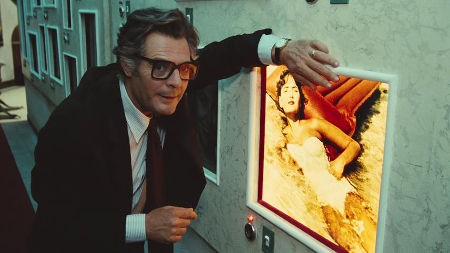
Still from City of Women (1980)

BACKGROUND:

  • A massive re-work of the story was required when the second male lead (Ettore Manni, who played “Dr. Katzone”) died from a fatal, self-inflicted gunshot wound to the groin.
  • Before returning to his reliable proxy Marcello Mastroianni, Fellini offered the role to Dustin Hoffman. Hoffman declined, as he was concerned about the post-dubbing process being detrimental to his performance.
  • Though it received largely positive reviews on its general release, it fared poorly at Cannes. , in Rome at the time working on Nostalghia, dismissed City of Women in his diary, saying “…it’s true, his film is worthless.”
  • Production designer Dante Ferretti was kept on his toes while making of the film, as Fellini would constantly request that new, elaborate sets be whipped up in a small amount of time. Farretti invariably obliged the director’s requests, and his success allowed him sole billing as “Production Designer,” a title usually nabbed by Fellini himself in the movie’s credits.

INDELIBLE IMAGE: After the brief introduction of the train ride turning into a romp across a field, virtually everything that follows in Fellini’s City of Women starts globbing on to the memory. From a long list of choices (addled Feminists fomenting in an hotel, drugged-out [?] minors driving the middle-aged protagonist to a haunting techno-pop tune, and an aged Lothario blowing out 10,000 candles among them), perhaps the best choice is the joy-filled sequence in the museum of women at Katzone’s villa. Snàporaz darts back and forth with an innocently lecherous glee as he flicks on the photographs’ illumination and hears a snippet from that woman’s sexual history. The visual and sonic overload goes up to eleven when Snàporaz’s ex-wife appears at the end of the corridor and turns on all of the displays. Women, women everywhere—in sound and vision.

THREE WEIRD THINGS: The hall of sexual conquests; memory lane slide; ideal woman escape balloon

WHAT MAKES IT WEIRD: Traipsing along for two and one-half hours, City of Women somehow combines the sugary charm of a light-weight musical with the non-stop adventure of an epic film. Beginning with a tone bordering on the mundane (the tediousness of travel), Fellini quickly pushes things from believable, to somewhat believable (the feminist convention), then onwards and upwards to a literal and metaphorical peak of disbelief as our hero escapes an arena full of spectators by clinging to a hot-air balloon. Between the jostling in the train car and the flight into the unknown, it would be faster to answer the question, what isn’t weird about it?


Original Italian trailer for City of Women

COMMENTS: Obsession can be a dangerous thing, but it can also be Continue reading 272. CITY OF WOMEN (1980) →

Celebrating the cinematically surreal, bizarre, cult, oddball, fantastique, strange, psychedelic, and the just plain WEIRD!