SLAMDANCE 2021: APOCRYPHA CANDIDATE: MAN UNDER TABLE (2021)

366 Weird Movies may earn commissions from purchases made through product links.

DIRECTED BY: Noel David Taylor

FEATURING: Noel David Taylor, John Edmund Parcher, Ben Babbitt, Katy Fullan

PLOT: A nameless screenwriter tries to write a movie (the movie we’re watching), while his peers’ careers seem to be taking off faster than his.

Still from Man Under Table (2021)

WHY IT MIGHT JOIN THE APOCRYPHA: This microbudget meta-movie about a nameless screenwriter unabashedly gazes at its navel until that navel becomes a self-contained universe teeming with surrealism and satire.

COMMENTS: Ever since 8 1/2, directors have been making movies about the trials and tribulations of being themselves making a movie. It’s an ambitious undertaking, fraught with pretension, but the subgenre is not tapped out yet. Man Under Table relocates the conceit to a new milieu: the fringes of the indie movie scene, a world which itself exists on the fringes of Hollywood. It’s a purgatory for creatives. Everybody urgently wants rush out a movie about “identity politics” or “fracking” or, preferably, the intersection of the two—but they actually spend most of their time in bars, at parties, or in men’s rooms, talking about their hopefully soon-in-development projects. The film doesn’t really have much of an idea how to end itself, and it plays around with some intriguing possible plot angles (such as the suggestion that another character is the real author of the screenplay) only to abandon them. But that abandonment itself is both a meta-joke and an honest reflection of the script: the movie consistently, from being to end, does not know what it is, and it is all about its own lack of insight.

Such a premise would be insufferable if played straight; it can only work as a comedy. And Man Under Table has a nasty comic bite, with the movie itself, and its screenwriter, as much the target of the satire as the phonies who hang out in this plague-ridden alternate Los Angeles. Our nameless (itself a plot point) antihero is writing a movie, but he spends most of his free time bragging to all his acquaintances about how he’s writing a movie. He’s arrogant, short-tempered, neurotic, presumptuous, whiny, and obviously angry at himself but taking it out on everyone around him. His targets include screenwriting rival Ben (who looks a lot like David Foster Wallace stripped of his bandana), up-and-coming director Jill Custard, a vapid but omnipresent YouTuber, and a pair of buzzword-devouring—producers? Agents? He’s also taking advantage of Gerald, an older man with money who has an idea for a movie but needs help with the “technical part” (i.e., writing it), and who insists that there shouldn’t be any of that “modern movie gay stuff.”  You personally don’t know any characters like this, and characters like this could in fact never exist, yet you believe they are caricatures of real people—or at least, that they’re caricatures of real caricatures.

Man Under Table plays out on minimal sets—a bathroom, a barroom, an apartment, a warehouse, a blank void—and moves from scene to scene with little flow or causality. The order of incidents could be shuffled about without making much difference; it’s set in a netherworld of eternal project development. “This isn’t a movie, it’s just random scenes about some guy,” our screenwriter complains midway through. At one point, he finds himself unwittingly cast in—and cut from—someone else’s project, which breaks out around him as he’s trying to order a beer. The movie also draws attention to its own movieness by introducing deliberate continuity errors (a disappearing drink becomes a running gag).

Where Man Under Table shines, and sometimes becomes laugh-out-loud funny, is in writer/director Taylor’s charmingly obnoxious performance as his own alter-ego, and especially in his ear for cutting dialogue that exposes the shallow ambitions of his characters. His generic pitches to the movie-producing couple are brilliant (he throws the word “content” in at random and their eyes get huge). A parody of a competitor’s production shows a knack for capturing ridiculously poetic indie dialogue (“I always imagined that leaving prison was like being ripped from the womb all over again—you emerge screaming, wet, and pale.”) Other great lines include “I didn’t really want to talk about it either, I was just asking you questions I wanted you to ask me” and “I’d like to be suicidal again, but I can’t even get there with all the garbage you’re saying.” Some of the dialogue even achieves poignancy: “Sometimes I get excited about all the possibilities there are, until I realize none of them are available to me.”

As boorish and self-absorbed as our hero is, you gradually begin to feel for him. He is trapped in an absurd, dystopian world peopled entirely by poseurs, a universe that seemingly exists only to crush his dreams. Oh yeah, and then there’s all the weird stuff that happens to his character in the movie, too.

Man Under Table is currently playing Slamdance (online).

WHAT THE CRITICS SAY:
“This film is definitely weird.”–Lorry Kitka, Film Threat

SLAMDANCE 2021: APOCRYPHA CANDIDATE: NO TRACE (2021)

Nulle trace

366 Weird Movies may earn commissions from purchases made through product links.

DIRECTED BY: Simon Lavoie

FEATURING: Monique Gosselin, Nathalie Doummar

PLOT: After a smuggler escorts a woman and infant across the border, her draisine is stolen; she encounters the woman she smuggled on her trek back north.

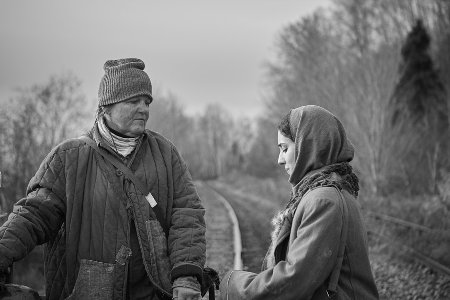
Still from No Trace (2021)

COMMENTS: If Andrei Tarkovsky had made a film about a human smuggler in a post-civilization world, it would look (and feel and sound) like Simon Lavoie’s No Trace. The mystical energy of Canadian wildlands is punctured only by a pair of iron rails as our nameless protagonist navigates her track-bound wagon through the soft palette of black and white trees and scrub. Religion and doubt vie for dominance. And soft aural cues warn of danger. As with the journey into the heart of “the Zone“, metaphysicality in No Trace flourishes the farther our hero travels from her anchor to civilization.

What little civilization She (Monique Gosselin) comes from is made abundantly clear at the start. There is no state, just men with guns. But men with guns are often open to bribes, and so She has a living. Her latest job is transporting a young mother (Nathalie Doummar, credited as “Awa,” though I do not recall her name ever mentioned) and an infant girl across a border whose demarcation is all too unclear. The smuggler’s vehicle breaks down after She receives another assignment, and She is forced to hide in the wilds near the rails. Awa is there. And, in a tragic way, so are her daughter and husband.

No Trace‘s strangeness is carried primarily by its steady drip-drip-drip of unlikely filmic characteristics. The score is spartan, but when the “doom western” chords swell and plang, it’s all the more powerful for it. I’m at a loss for another example in which the primary musical cues climax after a fade to black. The black and white cinematography is as beautiful as the world is bleak, with soft greys highlighting the lush variance of the ever-present forest. And the dialogue, scarcely present in the first half (maybe half-a-dozen brief lines), merely elucidates what little exposition that isn’t made clear in the image.

The subtlety of the action and the actors further renders No Trace a contemplative picture. The slightest raising of the smuggler’s hand in a key scene resonates far more than any flailing histrionics or wild gyrations could. This and the surrounding quietude scream Tarkovsky, yes, but it’s the film’s climax that swerves No Trace into spiritual wonderment. Awa and the smuggler are in a ragged shack, and Awa— a devout Muslim—asks the smuggler, “You are not a believer?,” to which the smuggler coldly replies, “I’m not that desperate yet.” The closing scene, with Awa embraced by leaves and the smuggler embraced by her precious railway, culminates in a theological twist worthy of the late Russian master.

No Trace is currently playing Slamdance (online).

WHAT THE CRITICS SAY:

“By stripping away artifice and taking a surrealist route and view, Lavoie ponders what lies beyond what we think we know, about an uncertain and obscure future.”–Shelagh Rowan-Legg, Screen Anarchy (festival screening)

SLAMDANCE 2021: THE BIG SHORTS COMPENDIUM

I’m a bit old to dance the “Slam”, but I still like to keep tabs on what the young people are up to. Please join me as I dive headlong into the short-form cyberspace transmissions of SlamDance 2021. (The festival’s entire slate, shorts and features can be watched online through February 25 for a $10 pass, $5 for students).  Some films may be online, in whole or in part, in other online venues; we’ve sprinkled in the occasional link or trailer.

For those who may be overwhelmed by my thoroughness, I can quickly (and highly) recommend the following for a 1/2-hour-or-so of programming: Opera (for awe), Passage (for weird), and The Danger in Front (for fun).

THE EXPERIMENTAL LOUNGE:

Letters from Your Far Off Country (dir. Suneil Sanzgiri; 18 min.)—It is doubtlessly mere coincidence that I watched this so soon after Hitler: a Film from Germany, but their parallel structure, and even general message, sync up uncannily. This movie explores “how history moves through us, and how we move through it”; and it asks, “What is one’s claim to the past?” It concludes “How we connect, how we comprehend, is up to us.” With a combination of contemporary news footage, 8mm-style home movies, song snippets, recorded speeches, and even what appears to be a Zoom conversation, Letters primarily addresses the Kashmir uprising in 1989, though the urgency of recent events is never far in the background. A thoughtful, moving video document, which I’m guessing will be banned by the local authorities.

Morning Sickness in the USA (dir. Cristine Brache; 3 min.)—Brache’s recorded phone conversation with her mother plays over a series of alternately odd and alarming images of pregnant women undergoing various observations. The mother’s anecdote about how she was sent to a mental institution for two weeks because doctors were unable to diagnose her strange nausea (“morning sickness”, as the title indicates) is amusingly related. The unsettling  photo-video undercurrent… less so.

Passage (dir. Ann Oren; 13 min.)—An androgynous foley artist sonically morphs into the horse for which they’re creating effects, and grows a handsome tail. I can’t help but think of Berberian Sound Studio brought to its (il)logical conclusion. Passage examines obsession through observation, but also illustrates the importance of sound design for the art of illusion. After clomping softly into the “Passage” theater, our protagonist views the fruits of their labor before disappearing. What begins with human feet ends with a horse’s eye.

Rumi and his Roses (dir. Navid Sinaki; 5 min.)—Navid Sinaki tells the story of his first boyfriend using the unlikely medium of DVD menu Continue reading SLAMDANCE 2021: THE BIG SHORTS COMPENDIUM →

SLAMDANCE 2021: APOCRYPHA CANDIDATE: A FAMILY (2019)

Родина

366 Weird Movies may earn commissions from purchases made through product links.

Recommended

DIRECTED BY: Jayden Stevens

FEATURING: Pavlo Lehenkyi, Liudmyla Zamidra

PLOT: Emerson hires a cast of amateurs to play his family in his home movies, but a walkout derails his ambitions.

COMMENTS: “Protagonist” describes A Family‘s leading man on only a technical level. (Even the term “leading man” lends him a bit too much weight.) Emerson is in his late 40s (I’m guessing) and has no real family to speak of (I’m guessing). I’m guessing a lot because other than what’s shown on screen, there is no backstory for this oddball—a man who appears to be one bad day away from becoming Erwin Leder’s serial killer in Angst. If you’re looking for an awkward “family” comedy, nothing could be more apt than Stevens’ feature debut.

Located just before the cutoff for “antisocial” on the personality spectrum, Emerson (Pavlo Lehenkyi, channeling some sort of After Last Season dramatic persona) is a perfectionist with a knack for inept communication. The affable folks he’s hired to play his “father”, “mother”, and “brother” all try their best (the “brother’s” scripted reaction to his Christmas gift, “A puzzle! Seven-hundred-and-fifty pieces!”, is picture-perfect over-enthusiasm), but the newly cast “sister”, Olga (Liudmyla Zamidra), throws a spanner in the works. Her personal life interferes with Emerson’s strange production, and after a wage dispute, the others quit in exasperation. This forces Emerson into the unlikely position of auditioning for the role of “husband and father” in Olga’s own dysfunctional family.

A Family‘s strength lies in its social-realist approach and complete lack of explanation for any character. The opening shot of Olga’s “sister” audition cements the distance right from the start. The “scripted domesticity” scenes are, oddly, the most conventional-feeling element in Family. With the “home movies,” we see what we’d expect to see, for example, a family Christmas get-together (albeit a sad, sad, awkward one). The corny acting on display whenever the “family” is filmed rings true to the thespionics gracing millions of home movies the world over.

Emerson is a perfect example of the “how is this person even real?” archetype. That’s not to say there isn’t an authenticity to his character—I believed every moment with him—but by focusing on one of the oddest of ducks ever captured by film, Stevens constantly wrong-foots the viewer. His unscripted conversation suggests almost alien behavior (“My car travels up to ten times the speed of the average cyclist”; “You should never blame a frozen treat for your form”; “Do you serve nachos? I’ve never eaten them, but I’ve seen them on television”). The fact that these statements come from such an obviously broken man spikes the hilarity with sadness. A Family seems to be about life’s quiet desperation and the importance of loved ones. At the same time, it’s probably best to hire good actors if you want a quality family life.

A Family is currently playing Slamdance (online).

WHAT THE CRITICS SAY:

“Unfolding in spaces shared with Atom Egoyan, Yorgos Lanthimos, Aki Kaurismäki, and Charlie Kaufman, A Family nonetheless finds an unsettling absurdity that is all its own.” -Anton Bitel, Eye For Film (contemporaneous)

WEIRD WATCH PARTY POLL FOR FEBRUARY 20 AMAZON PRIME SCREENING

Here’s the poll to vote for Febrary’s Amazon Prime Weird Watch Party, which will start on Feb. 20 at 10:15 PM ET. If you plan on virtually attending, please vote for the movie we’ll be watching below. We’ll screen the movie that get the most votes; your host, Gregory J. Smalley, will personally break any ties. Note that unlike our other polls, you can only vote once. Poll closes at midnight ET on Wednesday, Feb. 17. You may vote for multiple movies, but not for every movie (because that would be pointless).

Now vote!


Celebrating the cinematically surreal, bizarre, cult, oddball, fantastique, strange, psychedelic, and the just plain WEIRD!