Category Archives: Capsules

CAPSULE: INFLATABLE SEX DOLL OF THE WASTELANDS (1967)

Kôya no datchi waifu; AKA Dutch Wife in the Desert

DIRECTED BY: Atsushi Yamatoya

FEATURING: Yûichi Minato, Shôhei Yamamoto, Masayoshi Nogami, Noriko Tatsumi, Mari Nagisa, Miki Watari

PLOT: A shady real estate agent hires a hitman haunted by the killing of his girlfriend to take out the gang responsible for the kidnapping and torture of his mistress.

COMMNETS: Every day at three o’clock in the afternoon a woman screams and the phone rings. It rings while off the hook, it rings when disconnected, it rings even half-buried in the sand of a desert wasteland. Shô always knows when three o’clock strikes because Rie tells him so. At three o’clock five years ago Shô murdered Rie—when she tried to call him and no one answered the phone.

Real estate agent Naka wants to hire a hitman, so Shô waits for three o’clock in a sunblasted middle-of-nowhere. The client needs to know the assassin of his choice can hit his target in three shots or less. Rie screams as Naka leads Shô to a lone evergreen tree, the only one around for miles, because the blood of “snitches” waters it. Shô chops it down in thirteen shots.

After this display of marksmanship, Naka takes Shô back to his city office. He shows the hitman a disturbing film reel of black-hooded goons recording their sexual abuse of Sae, the woman Naka wants Shô to rescue. Naka himself can be glimpsed in the background, tied to a chair and blindfolded, forced to listen while his girlfriend screams. Shô complains about the poor quality of the entertainment. He can’t see anything in a picture so grainy. Naka admits the film might be wearing out. He must have watched it a hundred times by now.

Shô agrees to take the case. He returns to his hotel room to find a naked woman waiting in his bed. He smells more than cheap perfume and forces her into a bathtub. Mina serenades him with a song overflowing with double entendres. Of course she’s part of the trap, she admits it, but Shô’s not like other gangsters. She wants to help him. He clutches his gun while succumbing to her advances, aiming at the door, ready to fire whenever his enemy enters the room.

Wastelands contains all the classic tropes of film noir—an emotionally compromised detective, a slightly seedy and suspect client, a femme fatale—and then some. Fans of may notice eerie similarities to Branded to Kill, also released in 1967 (they make a perfect double feature). Director Atsushi Yamatoya was one of the Guru Hachiro writers responsible for Branded‘s script. Callbacks ricochet like a volley of gunshots across both story arcs: three o’clock, rings (expensive in Branded, cheap in Wastelands), insects, an antagonist named Kô, hitmen obsessed with their reputations, a (maybe snuff) film within the film.

Both movies share a similar sense of fatalistic black humor and a dynamic visual style. The cinematography always goes for the unusual. Odd camera angles enhance ambiguities of space and perspective, adding to the disorientation. A scene with a character walking up a flight of stairs rotates so “down” becomes left with “up” heading to the right. When a henchman gets shot and slumps over a bar counter the camera tilts with him. The rest of the scene remains skewed as though we’re now viewing the film through the lifeless eyes of a corpse.

Plentiful shoot-outs punctuate the action and every actor who gets shot milks his death scene for all it’s worth. By contrast, the female characters lie around motionless and silent. Whether drugged or sleeping, or worse, it’s hard to tell. Aside from Mina, who radiates a voluptuous vitality (repeatedly rejected as untrustworthy), the others, both living and dead, become indistinguishable.

The final confrontation between Shô and the target of his revenge occurs as a protracted contest recalling Branded‘s Hanada and No. 1. After some creative trash talk (“I can see your heart” – “What color is it?” – “Sickly green” – “You’re colorblind”), they vow that by 3:30 pm tomorrow one of them will die.

Like a fly struggling to escape from a forgotten whiskey glass, time traps people in its vise. Outside a window Shô now sees the desert wasteland surrounding him, the same tree still there standing by its lonesome, as if he never shot it down in the first place. Even Sae and Rie begin to resemble each other. Can Shô save the one if death has already claimed the other?

One possible interpretation of the title implies the entire story takes place in a hellish afterlife where ghosts doomed by their former selves relive their last agonizing moments on earth. A blast of fire burns behind the opening credits. Everyone complains about the heat, but there’s never any air conditioning to cool their tempers. There’s nothing but heat (except for Shô’s lighter, which never works whenever he needs a cigarette). This inferno reduces not only women to puppets. The men jerk each other around by strings, but they’re all tangled together, everyone incapable of escaping their own personal purgatory.

WHAT THE CRITICS SAY:

“..an enigmatic and paradoxical title, perhaps capturing something of the film’s hybrid, even contradictory nature… It should come as no surprise that Yamatoya, directing from his own script here, had previously helped write Seijun Suzuki’s similarly surreal and abstract take on hitmen, Branded to Kill…”–Anton  Bitel, Little White Lies (2020 screening)

IT CAME FROM THE READER-SUGGESTED QUEUE: FELIX THE CAT: THE MOVIE (1988)

366 Weird Movies may earn commissions from purchases made through product links.

DIRECTED BY: Tibor Hernádi

FEATURING THE VOICES OF: David Kolin, Chris Phillips, Maureen O’Connell, Peter Newman, Alice Playten

PLOT: When Princess Oriana is kidnapped by the sinister Duke of Zill, only Felix the Cat and his magical bag of tricks can save the day—so long as his arch-frenemy The Professor doesn’t interfere.

COMMENTS: It’s fun to imagine a Sunset Boulevard scenario wherein Felix the Cat hearkens back to better times, angrily reminding anyone who will listen that, back in his heyday, he was bigger than Mickey Mouse. He’d go on about how he moved so much merchandise in the silent era, but faltered when talkies came in. How he got his groove back when television snapped him up, jump-starting his career with a voice, new supporting characters, the introduction of his iconic bag of tricks, and an insidiously infectious theme song. How the lack of a deep-pocketed studio to protect him and dust him off every so often (like that infernal mouse had) left him floundering, and how his chief animator and owner of his copyright, Joe Oriolo (and later Joe’s son Don), struggled to keep Felix in the game with ever-growing levels of desperation, including a bizarre misguided attempt at a live-action series and even a Baby Felix cartoon made exclusively for Japanese television. And here’s where Felix would ball up his fist and pound it on the table, lamenting that if anyone knows him at all today, it’s as a clock.

Maybe that can be the scenario for Felix’s next feature. For now, we’re stuck with this one, probably his thirstiest bid at a revival. Felix is a simple character, a monochromatic feline with a classic stretch-and-squash movement and a seeming immunity to misfortune. But to wring 80 minutes out of him, it’s essential to complicate, complicate, complicate, first with a prologue presenting a proto-CG version of Felix’s disembodied head, then by launching an elaborate plot to save a fairy-tale kingdom from an evil overlord, with a panoply of odd characters including a heavily rotoscoped princess, a gun-toting yokel, a host of psychedelic wildlife, and an army of robot trash cans led by what appears to be an ape with a bubble for a head.

The animation, from Hungary’s Pannonia Studio, is wildly erratic, veering from elaborately detailed landscapes and imaginative creature designs to obvious looped animations and jumpy movement. Case in point: Princess Oriana is sometimes shown in the kind of fine detail one associates with the Disney Renaissance, but then is seen in a herky-jerky, poorly drawn style one associates with direct-to-truck-stop mockbusters. But even at its best, the animators’ work is undercut by a script that spends inordinate amounts of time on exposition and setup, forcing the artists to vamp to fill time. In fact, Felix the Movie is almost allergic to anything that stays focused on the plot. The vile Duke is supposedly seeking to conquer the kingdom as revenge against the Princess, but instead of showing us his schemes, we watch him make her do interpretive dance. Numerous scenes are dedicated solely to watching one cartoon beast or another go about their business, even while we’re aware of an impending danger happening somewhere way offscreen. Even the musical numbers seem completely separate from the proceedings, such as a showcase for a family of foxes who have nothing to do with anything, or an extended dance break for a pair of rat/lizard hybrids. (This latter sequence lasts for more than two minutes, almost 3% of the film’s runtime.)

Adding to the muddle is the decision to include two of Felix’s foes from the TV series, the nefarious Professor and his hyper-nerdy nephew Poindexter. They have the potential to throw another obstacle in Felix’s path, but they spend most of the film trailing behind their quarry and end up helping once they finally catch up. One presumes they represent the movie’s attempt to cater to Felix nostalgists, but they’re meaningless to the young, adventure-hungry kids who are the most likely audience for this kind of thing. The movie aims for everyone and hits no one.

Given how uninterested it is in anything logical and linear, it’s fitting that the movie just sort of stops, with Felix saving the day by throwing a book at a giant robot. (That’s literally the whole solution. Deus ex libro. He doesn’t even use the bag of tricks.) Felix the Cat: The Movie should have been a chance for the once-famous feline to get his groove back, but the film never finds a way to let him be the hero he once was, and it doesn’t have a solid idea of what it wants to do instead. So somebody buy the old guy another drink and let him rant and rave about his cruel fate. He deserves another shot at the big time, and this ain’t it.

WHAT THE CRITICS SAY:

“The original Felix cartoons were always surreal in some way, but not in a studied manner, more of an organic, natural development out of the character’s quirks and goodnatured ingenuity. Here, however, there is an attempt to plonk him down into a world that is already weird, almost a post-apocalyptic version of a fairytale land that suffers too many digressions into strangeness for its own sake without furthering the plot… You can see it entertaining the very young who are not aware of Felix’s history, but as a tribute to him it falls flat when it really could have been any generic character starring here: he doesn’t even take off his tail and use it as a cane.” Graeme Clark, The Spinning Image

(This movie was nominated for review by Jayzon. Suggest a weird movie of your own here.) 

CAPSULE: AN EVENING SONG (FOR THREE VOICES) (2023)

366 Weird Movies may earn commissions from purchases made through product links.

Recommended

DIRECTED BY: Graham Swon

FEATURING: , , Peter Vack

PLOT: Barbara and Richard, married writers from the East Coast, move to the Midwest and hire Martha, a quietly pious local, as their maid.

COMMENTS: One narrator evokes simple matter-of-factness; the second narrator segues into a reminiscence of another world; and the final narrator readily apologizes for what he’s about to do. These three voices in Graham Swon’s feature, An Evening Song, are its body, spirit, and mind; with the three characters—an innocent country local named Martha, the disillusioned writer-prodigy Barbara, and her mentally restless husband, Richard—conveying the film’s philosophical pull and tug. Events do literally happen in An Evening Song (indeed, it is loosely based on real events and individuals), but Swon has crafted more of a meditation oscillating around a narrative through-line than a traditional drama.

Over the course of eighty-odd minutes, Swon’s players perform the strange and gentle decline of a marriage on the rocks. Relocating to the Middle of Nowhere, Iowa, two different writerly types observe their hired help from their own perspectives. Barbara, having begun to give up on life more than a decade prior, has reached a critical stage of ennui that is only slightly alleviated by the discovery of this mysterious, scarred country girl, who seems to embody a delightfully unsolvable riddle. Richard, devoid of any bent towards mysticism, is commendably observant and empathetic, and entranced by Martha as well—but as a riddle to attempt solving. Under the couple’s gaze, Martha gazes back: she perceives Barbara’s ethereality with admiration, but also perceives Richard’s constantly ticking pragmatism with appreciation. We have here a love triangle, of sorts.

But in what way? Swon raises many questions in this film—and wanders (with purpose) down many avenues. Richard, bless his heart, accommodates to his utmost, and for all we can observe is impossible to offend, disappoint, or anger. (This is for the best, no doubt, as he has found himself dropped right in the middle of two particularly conundrous individuals.) Barbara does love Richard (maybe, probably), but longs for a life in the mystical “nowhere” reminisced throughout her narrations—which Richard cannot provide. Martha, on the other hand, does: her piety and humility raise her to ineffable heights in a dream she conveys to Barbara during a climactic, quiet encounter in a placid field, after which the story pivots and moves irrevocably toward the dissolution of Barbara’s will to remain on this plane of existence.

The song continues, narrations bump up against one another and fuse, with all three becoming harmoniously concurrent during a contemplative, sleepless night-and-day meshing of perspectives. This film is no Eraserhead, to be certain; but it is a curious experience. With full marks for dreamy ethereality, Swon’s pocket-sized meditation manages a tension from its competing and complementary voices, creating something nearly imperceptible, maybe close to a nothing, but which lingers in the mind like a mystifying apparition.

An Evening Song (for Three Voices) completed a short run in New York last week and will play at the Acropolis in Los Angeles for one night only, May 29. We’ll let you know when it’s available online.

WHAT THE CRITICS SAY:

“Stylistically, Swon’s film shares an aesthetic kinship with some of Guy Maddin’s films, but it is far less accessible… The ambition and craftsmanship are laudable, but the hallucinatory haze too often produces a sensation of narrative drift. Recommended with the above caveats for experienced patrons of unconventional cinema” — Joe Bendel, J.B. Spins (contemporaneous)

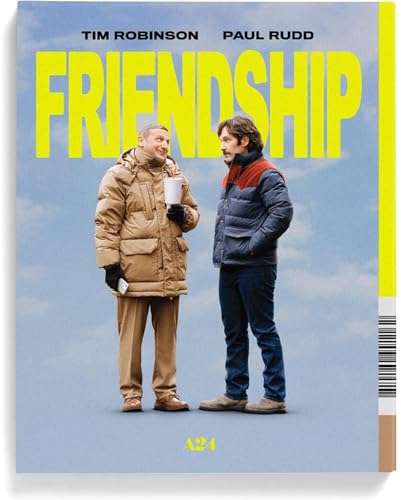
CAPSULE: FRIENDSHIP (2024)

366 Weird Movies may earn commissions from purchases made through product links.

DIRECTED BY: Andrew DeYoung

FEATURING: Tim Robinson, , Kate Mara

PLOT: A middle-class family man develops a bro-crush on his new neighbor; after a series of faux pas drive a wedge between them, he undertakes increasingly desperate measures to get his friend back.

Still from FRIENDSHIP (2024)

COMMENTS: Tim Robinson’s comedy speaks to that part of the brain that worries about the men’s room faucet malfunctioning and splashing your pants so it looks like you wet yourself right before you have to deliver a speech in an important business meeting, so you draw attention to it and try to make light of the situation, only to have the joke bomb as you stand there in a silent room in wet slacks. In a way, he’s the perfect guy to take on the trending topic of “male loneliness.”  But then again, if you are interested in a cathartic take on this troubling phenomenon, Tim Robinson is precisely the wrong guy to look to.

Robinson’s Craig seems relatively normal at first, if a bit boring and nerdy, but grows increasingly deranged as the pic progresses. The object of his Platonic affections is a grown-up “cool guy”; new neighbor Austin, a TV weatherman who plays guitar in a rock band on the weekends, knows a secret entrance to City Hall that runs through the sewers, and sports a great head of hair and a mean mustache. Before meeting Austin while dropping off a misdelivered package, Craig seems content to work his corporate gig designing ultra-addictive apps and to stay home in the evenings reading the paper. But there are hints of discontent: his wife, a cancer survivor, confesses to their support group that she hasn’t had an orgasm in months, and she’s constantly ditching Craig to hang out with her ex. (Craig is also disconcerted that his teenage son still kisses mom on the mouth). Craig initially doesn’t think he needs Austin in his life, but he’s almost immediately smitten after hanging out a few times. But when Austin tries to incorporate him into his wider circle of friends, Craig screws things up, and then his behavior grows increasingly deranged as he becomes obsessed with winning his friend back: breaking and entering, literally abandoning his wife, toad-licking. You know, guy stuff.

Friendship sits in a liminal space between mainstream comedy and an absurdist comedy. There is enough structure to ground audiences, but it gets shaggier as it goes along . It’s biggest asset is its unpredictability, but that is also its biggest failure. Craig doesn’t seem real, or like a comic exaggeration of a real person: he’s too biopolar, pathetic and mopey one minute, manic the next as he lashes out in misdirected anger at a big client after being upstaged at a pitch meeting. That inconsistency gives the project the feeling of a bunch of sketches strung together—sketches that might have worked better as isolated bits on Robinson’s Netflix show. Robinson’s persona seems like it would be perfect for a supporting role as the quirky best friend of a film’s protagonist, but he makes for an uncomfortable anti-heroic central presence—which I suppose is the point.

Friendship ultimately has little to say about male friendship; read literally, the movie suggests that men are better off without male friends. Although Craig’s downfall begins with humiliating gaffes—e.g. walking into a patio window—he gradually becomes the victim of his own pride. He becomes less goofy and more narcissistic—he’s not so much upset at missing out on Austin’s companionship as he is offended at being rejected. Rather than being a lament on the pitfalls of male friendship, Friendship becomes more of a character study of a selfish, shallow jerk whose family suffers while he obsessively pursues a pal as the status symbol he thinks he needs to add to his pile of job, wife, son, and house. At first, Craig screws up his chances by missing the proper social cues, but he increasingly turns to perverse self-sabotage. He goes through a lot of pain and disgrace, but ultimately deserves it all. And this is a less interesting direction than what the premise originally promised. When a despairing Craig anxiously decides to take a psychedelic trip, he’s promised an awe-inspiring death and rebirth, but the actual experience is rather a letdown. That’s not quite a metaphor, it’s just a laugh—and that’s the best way to take Friendship. It’s an odd comedy coming from a skewed perspective, but not a particularly incisive or game-changing one. But the laughter in the theater proves that the right audience will want to hang out with it.

WHAT THE CRITICS SAY:

“…he truly odd thing about ‘Friendship’ is that while we may think, at first, that we’re watching a comedy about a sad-sack geek who’s drawn out of his shell, the film always makes sure that Craig, as inhabited by Robinson, is a notch weirder and more off-putting than we expect… the movie, after a while, starts to feel like it’s for Tim Robinson cultists only. Robinson’s brand of middle-class psycho surrealism works perfectly in bite-size sketch-comedy doses. Stretched out to feature length, a character like Craig simply stops making sense.”–Owen Gleiberman, Variety (contemporaneous)

Friendship [Blu-ray]
  • Paul Rudd
  • Tim Robinson
  • Andrew DeYoung
  • 2025
  • A24

CAPSULE: THE GOLDEN FERN (1963)

Zlaté kapradí

366 Weird Movies may earn commissions from purchases made through product links.

DIRECTED BY: Jiří Weiss

FEATURING: Vít Olmer, Karla Chadimová, Daniela Smutná

PLOT: When a lazy and amorous shepherd steals a golden fern bough from deep in a malevolent forest, a mysterious young woman appears begging him to return it lest dire consequences befall him.

COMMENTS: If fairy tales have taught us anything, it’s that going into the woods at night can be dangerous. The Golden Fern ominously begins in medias res in a dark and moonlit forest. A handsome young man races through the trees; it seems like he’s running from someone, but then he stumbles upon a grove of ferns and triumphantly picks the largest frond. He’s immediately attacked by a flock of angry birds whose screeching fills the air. He fights them off and manages to escape back to his humble peasant’s hut, where he gloats over his trophy. Was this an admirable act of bravery or simply foolish bravado?

There are no easy answers in Weiss’ film, but when a sudden knock sounds at the door, the latter seems more likely. He opens the door and at first only a shadowy figure appears, barely visible in the distance. “Give it back,” a voice urges him. “Give back the fern.”

Our protagonist, Jura (Olmer), hesitates to comply. He wants to know who would command him. Eventually the speaker reveals themselves, and to his surprised delight, the forbidding figure turns out to be a very pretty blonde (Chadimová). This being a fairy tale, he’s not going to give back the fern unless she kisses him first. She continues to insist he must give it back, but he ignores her warnings, and she relents to his clumsy overtures.

What seems like a poor start to a relationship briefly becomes a romantic idyll. The girl, whom Jura calls “Lysanka” because she has no other name, falls in love with him. In her devotion, she steadfastly protects him from the ambiguous influence of the golden fern, which he, of course, fails to return.

Fern was made at the beginning of the , although Weiss represents an older generation than the young film makers who would make names for themselves as part of the innovative and rebellious movement that yielded the Canonically Weird gems The Cremator,  Daisies, and A Report on the Party and Guests. While not quite as anarchic and freewheeling, Weiss displays the absurdist and irreverent black humor that’s a common denominator among Czech directors. This is a pretty dark fairy tale; however, the only truly weird element is the fern itself (unfortunately glimpsed in action in only one scene). Half plant, half beast, and blossoming with mysterious flowers before sprouting a tentacular vine replete with talon-like thorns, this fern looks like a worthy adversary to a monster from one of ‘s cheapo creature features (and I mean that as a complement). In a suspenseful and creepy scene, Lysanka fights the fern in what becomes a battle of wills. She emerges victorious, the possessor of one of its golden seeds.

The clever mix of basic low-budget effects utilized throughout the film enhance the otherworldly atmosphere, and the black and white cinematography fits the ominous tone. Lysanka never explains where she came from or who exactly she is; her pleas on behalf of the fern make her initially appear as its ally, until it reveals itself to be an opposing force. Jura remains oblivious of the magical powers surrounding him, simply losing himself in Lysanka’s love and beauty.

After defeating the golden fern, Lysanka sews the golden seed into a seam in Jura’s shirt. When he gets drunk at a tavern and ends up shanghaied into the army, it spells the end of their affair. She begs him to never exchange the shirt for another. He promises he won’t, but it’s Jura’s inability to follow good advice that landed him in this dire situation in the first place.

The setting then shifts to the frontier of the Austrian-Hungarian Empire, where the Empress’ forces are at war with the Turkish military. This second half of the film has prompted comparisons to  The Saragossa Manuscript , but Golden Fern never reaches levels of surrealism. After a somewhat minor act of courage (literally capturing a flag from the enemy), the general promotes Jura to officer.

While the upper ranks continue to ridicule him for his slow-witted peasant ways, Jura unwisely begins a flirtation with the general’s gorgeous and aloof daughter (Smutná). First inspired by the possibility that she’ll convince her father to release him from his military service so he can return to Lysanka, she predictably beguiles Jura into attempting a series of increasingly dangerous tasks.

Learning from a fortune teller how to capture the general’s daughter’s heart, Jura risks his life to infiltrate the enemy camp. When he’s caught half-dead and disguised as a Turk after completing his mission, his commanders immediately assume Jura has turned traitor. The general’s daughter coldly abandons to him his fate as the gears of military justice grind into action; laws which seem as cruel and arbitrary as the mysterious rules of the forest. Even in a world of magic ferns and fae spirits, people still kill each other, mock each other, and fall in love—human nature is both triumph and tragedy.

WHAT THE CRITICS SAY:

Czech writer-director Jiří Weiss’s The Golden Fern is a dark and haunting fairy tale, albeit one that’s grounded in an earthy naturalism. Rather than lean heavily into the surreal, as these films often do, Weiss subtly weaves elements of the magical or miraculous into an otherwise straightforward narrative, thereby cannily introducing aspects of the uncanny.”–Budd Wilkins, Slant Magazine (Blu-ray)

The Golden Fern [Blu-ray]
  • Czech director Jiří Weiss's breathtaking B&W fantasy about a stunning young forest fairy who falls in love with a handsome but selfish shepherd