Category Archives: Capsules

CAPSULE: “DIRK GENTLY’S HOLISTIC DETECTIVE AGENCY, SEASON 2” (2017)

Recommended

DIRECTED BY: Douglas Mackinnon (episodes 1 & 2), (ep. 3 & 4), Richard Laxton (ep. 5 & 6), Wayne Yip (ep. 7 & 8), Alrick Riley (ep. 9 & 10)

FEATURING: , , , Amanda Walsh, , , , , John Hannah, Alan Tudyk

PLOT: After the events of Season 1, Todd and Farrah are on the run and Dirk is a prisoner in a secret military facility; a new mystery begins when a visitor from the magical land of Wendimoor reveals that Dirk is prophesied to save their world from an evil Mage.
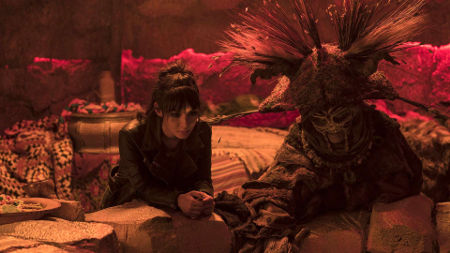
dirk_gently's_holistic_detective_agency_season_2

WHY IT WON’T MAKE THE LIST: TV series, not movie. But it’s a series you may want to take note of: otherwise, we wouldn’t be reporting on it, would we? “Dirk Gently”’s mix of absurd humor, bewildering but addictively complex plotting, and fanboy-friendly sci-fantasy tropes was just intriguing enough that that BBC America took a chance on it as potential cult item, but also so weird and difficult that it was cancelled after only two seasons.

COMMENTS: “Have you noticed an acceleration of strangeness in your life?”

The following synopsis may not make much sense to a lot of you. This includes veterans of “Dirk Gently Season 1” as well as newcomers to the series. The one advantage Season 1 viewers have over total neophytes is that they understand “Gently”’s method—throw about a dozen subplots and random events at the viewer in episode 1, then spend the rest of the season slowly connecting the dots, with every little detail merging in a “holistic” (and fantastic) fashion. So, I’ll just lay it out: season 2 introduces a gay pink-haired hero with a scissor sword. A train in the sky. A fishing boat run aground in a field in Montana. A friendly, sort of slow sheriff and his hard-partying deputy. A beleaguered middle-aged woman with a limp, a crummy son, a crummy husband, and a crummy job at the quarry where her crummy boss is making shady deals. A dashing gangster in a snappy white suit with a black tattooed hand and a fabulous mustache. A magic wand. A car stuck in a tree. (The literal Purple People Eater won’t show up until episode 4).

It does all connect, naturally. This high-fantasy based plot is perhaps not as satisfying as Season 1’s time-travel yarn, but on the other hand the show devotes more time to building up its underlying infrastructure, dropping hints about Project Blackwing and introducing new “anomalous individuals” like Dirk and the Rowdy 3. (They’re all sort of a team of metaphysical X-Men gone renegade.) Rather than dominating the plot with his clueless exuberance, Samuel Barnett’s Gently is sidelined a bit this season, moping through most of the story in an existential crisis. He and Elijah Wood’s Todd Brotzman invert their Season 1 dynamic, with Todd now eager to solve the case for his own reasons, dragging the reluctant detective along with him. Other characters pursue their own arcs. Farrah shows more vulnerability, and there are hints of burgeoning romance between her and Todd. Todd’s sister Amanda develops magical powers, making her character more relevant—although this development feels a little forced. Ken is set up for a heel turn. And holistic assassin Bart (Fiona Dourif) remains the most fascinating entity. Her fans will be thrilled with her opportunities to prove she is the ultimate badass killing machine, and she gets by far the best lines: “I think that sometimes when you’re killing people they don’t like it, and it makes them unhappy, and scared, and also dead, which they don’t like, I don’t think…” If that monologue doesn’t intrigue you, then “Dirk Gently” isn’t the show for you.

Unfortunately, the series has been canceled, and we’ll never get to see where creator was ultimately headed with all of this. The most bittersweet part of what turned out to be the series finale is that the last shot sets Bart up for a dramatically increased role in the unmade Season 3.

WHAT THE CRITICS SAY:

“…a show where weird things happen in literally every frame…”–Hahn Nguyen, IndieWire (season premier)

CAPSULE: SAMURAI RAUNI REPOSAARELAINEN (2016)

Weirdest!

AKA Samurai Rauni

DIRECTED BY: Mika Rättö

FEATURING: Mika Rättö, Reetta Turtiainen

PLOT: Rauni, a homicidal Finnish samurai, searches for the mysterious “Shame Tear,” who has placed a price on his head.

Still from Samurai Rauni Reposaarelainen (2016)

WHY IT WON’T MAKE THE LIST: This deliberate cult item, with Nordic ninjas and Scandinavian samurai, plays like a low-grade acid trip and raises its artistic sights in the mystical and mystifying final act, but ultimately it’s more Sgt. Kabukiman N.Y.P.D. than El Topo.

COMMENTS: As much a cross between and  as it is between Finnish and Japanese culture, Samurai Rauni Reposaarelainen is a messy would-be cult item that may be too off-putting in its mishmash of tones and its despicable anti-hero for all but the most adventurous audiences. Rauni the Finnish samurai is a scraggly, drunken rapist with bad teeth, clad in a fisherman’s wool sweater and a “Popeye the Sailor” cap. He’s a dick who terrorizes the locals of Meri-Pori, a frozen marsh overlooked by a coal plant and wind turbines, during his drunken rampages, but he’s also a magical fighter who decapitates ninja assassins with a blade of grass. This makes him a problem with no easy solution; thus, a mysterious enemy puts a price on his head.

The inhabitants of the movie’s insular Nipponophilic world randomly wear white pancake makeup like geishas or noh actors, and/or have bizarre accoutrements like a wire-frame headdress draped with a strand of pearls, suggesting the costume designer was either a Finnish thrift store genius or a deranged drunk the crew found wandering in a junkyard. One character is spray-painted gold. The costumes and sets have a punkish, esuqe feel to them, although the exceptional cinematography belies that dime store ambiance.

Most of the movie is an extended quest that’s shaggier than Rauni’s beard, as the samurai tracks down various suspects and former masters and slaughters them. Each scene exists in its own little world, rather than serving the whole. Most impressive is a well-choreographed battle at a buffet table (with a servant who keeps filling up Rauni’s glass as he fights); it alternates between slow and fast motion and, although mock epic in intent, still suggests how clever camerawork and planning can create an thrilling action sequence on a minimal budget. Other sequences drag, like the training montage, or seem pointlessly out-of-place even in this rambling movie, like Rauni dancing on stage at a post-wedding rave. It ends with a true Surrealist flourish, by turns horrific and poignant, as Rauni loses the power of speech and, prompted by nonverbal goblins in a canoe, dives through a door in a lake into an underwater world to finally learn the truth about the price on his head.

Though likely intended as a comedy, most of the humor is either bone dry, or perhaps so inherently Finnish that I couldn’t catch it (when Rauni challenges one ex-master to a series of contests that include a game of “Risk,” it’s about the closest thing to a conventional joke you’ll find). The movie is so odd and personal that it’s almost impossible to predict who will like it and who will hate it, a feature that the marketing campaign cleverly plays up by putting a selection of critics quotes on the back of the Blu-ray that range all the way from one star to a perfect score, and every rating in between. Obviously, if you’re one of those readers who prefers movies marked to ones marked , then this is for you. It will be interesting to see if Mika Rättö will grow as a director—he seems like he could benefit from a more disciplined structure—or whether he’s the kind of auteur who only had one strange movie in him dying to get out.

WHAT THE CRITICS SAY:

“…a batshit-weird work of art with a surprising amount of heart.”–Andrew Todd, birth. movies. death (contemporaneous)

(This movie was nominated for review by director , who called it ” one of the most satisfyingly odd movies that has come out recently.” Suggest a weird movie of your own here.)

CAPSULE: DEVILMAN CRYBABY (2018)

DIRECTED BY:

FEATURING: Voices of Griffin Burns,  Kyle McCarley, Cristina Vee, Cherami Leigh (English dub)

PLOT: High schoolers are being eaten by demons bent on conquering the world; crybaby Akira is convinced to merge with a devil in order to become a superhero and oppose them.

Still from Devilman Crybaby (2018)

WHY IT WON’T MAKE THE LIST: We could rule it out simply due to format (TV miniseries rather than feature film). Even if we considered it as a longform movie, however, Devilman only distinguishes itself from other anime in its exceptional, often trippy, visuals. It’s simply not that weird, especially by the elevated standards of its baseline-strange genre.

COMMENTS: “Devilman Crybaby” begins with an androgynous blonde in a cosmic ball dropping onto earth, like an egg fertilizing a larger egg, then segues into protagonist Akira’s childhood flashback, where the young crybaby bawls over the fate of a wounded rat while his friend Ryo tries to euthanize it with a wicked box cutter. Years later, Ryo is a machine-pistol toting prodigy anthropology professor investigating a demon infestation who convinces Akira to serve as an experimental subject: he takes him to a “sabbath” party (basically, the world’s tightest rave) so the mild-mannered teen can be deliberately possessed by a demon. Director/animator Yuasa goes nuts at the orgy, giving us huge glowing wire sculptures, topless high school chicks lit in aqua gyrating like strippers on ecstasy, another topless girl passing out pills to everyone who enters the party, and in-the-open pansexual couplings everywhere. Then, things get weird: Ryo starts slashing random dancers with a broken champagne bottle because the party’s “too tame” and devils “love the smell of blood.” This somehow leads a (topless) girl to urinate (while keeping her panties on) while her boobs turn into a head-chomping tentacles, giant bugs and spikes burst out of other copulating teens, and Akira to turn into Baal as teenybopper heads and limbs fly around a party that suddenly looks like a high school massacre set in a neon cathedral. The last time you want to get possessed by a devil is when you’re peaking on acid at the club.

The orgiastic scenes and various mutant devil designs—including one who incorporates the lamenting heads of his victims into his torso—are the best part of “Devilman.” During breaks in the battles between Devilman and the monsters, Akira fantasizes (in explicit fanservice detail) over his surrogate sister (they grew up together in the same household, but are not related by blood). We also follow a subplot involving rapping teenagers. At times, “Devilman” alternates so much between awesome tentacle battles and Akira using his Devilman x-ray vision to check out pseudo-sis’ undies that it almost seems like a parody of anime conventions. You won’t be surprised at all by the identity of the main villain, but you might be a bit confused about how the Devilmen fit into the scheme.

Besides the standard angsty superhero tropes, there’s also a bit of genuinely weird stuff, some of it intentional (a bug-eating coach) and some of it unintentional (they expect us to buy that regional high school track and field meets are so popular in Japan that they pack Olympic stadiums for them?) The anime genre works according to its own internal conventions, and requires a heightened ability to suspend disbelief from its audience. In general, however, I thought the storyline (a reboot of a popular anime series by the legendary Go Nagai) was juvenile (in theme and form, not in its not-for-kids sex and violence) and beneath Yuasa’s talent. The characters are predictable types, if affectionately drawn, and the theme of human empathy is not particularly deep. It’s Yuasa’s next-level visuals, best displayed in the bacchanalia of Episode 1 and the apocalypse of Episode 10, that raise “Devilman” above its brethren. Even some of the minor sequences, like a minimalist nighttime drive in Ryo’s white sports car, with streetlights lights strobing by like regiment of precise fireflies in the side view mirror and windshield, are of superior design compared to the industry standard. Yuasa borrows a good deal of “exotic” Christian imagery, particularly the cross, horned devils, and a mangled eschatology (which has been a thing in anime ever since and pioneered it in the 1980s). The final episode features an twelve-winged “angel” riding a seven-headed dragon, weaponized rainbows, and other stuff that got left out of the Book of Revelation but would have looked really cool on an Iron Maiden album cover. Devotees of the style looking for action-oriented psychedelic thrills with a little teenage drama on the side will groove to it, but it’s not the best pool of anime goo for a newbie to dip his or her toe into.

“Devilman Crybaby” made a small splash as Netflix’s “first original anime” when it debuted in January 2018. Actually, it was only the first of twelve new original anime series (of a planned thirty) to roll out.

WHAT THE CRITICS SAY:

“…for as grotesque as it regularly gets, Devilman Crybaby is bizarrely easy to love… a peak example of director Yuasa’s brand of balancing surrealist art and a real love for young people.”–Allegra Frank, Polygon

(This series was nominated for review by Benjamin Rubin, who asked “where else are you going to get psychosexual imagery, a mid-air fight scene that is also a sex scene, the end of the world, and of course, a gay hermaphroditic Satan who causes said end of the world, yet still remains a (slightly) sympathetic antagonist”? Suggest a weird movie of your own here.)

CAPSULE: IMAGES (1972)

“I think, when I grow up, I’m going to be exactly like you.” – Susannah (Cathryn Harrison)

DIRECTED BY: Robert Altman

FEATURING: , , Marcel Bozzuffi, Hugh Millais,

PLOT: An author finds herself plagued by visions of lovers past and increasingly losing her grip on reality.

Still from Images (1972)

WHY IT WON’T MAKE THE LIST: Images is a mystery of the mind, providing a striking visual representation of the heroine’s mental collapse. The subject matter provides a platform for unmoored imagery and encourages confusion, which heightens the WTF effect of the movie. But it’s not so strange that it defies understanding or logic, and its oddities now play as innovations for thrillers and psychological horror stories to come.

COMMENTS: Robert Altman is one of those filmmakers distinctive enough to have merited his own adjective. “Altmanesque” sits comfortably on the shelf alongside “ian” and “ian” and “Spielbergian.” But Altman himself seems to resist such easy categorization. You think he’s about sprawling casts, like in Nashville or M*A*S*H? Surely his fingerprints are just as evident in the one-man powerhouse Secret Honor. Appreciate his focus on real but insular universes, as in The Player or Pret-a-Porter? How about the cartoony Popeye or obtuse Quartet? It’s important to remember that defining Altman is as much about his unwillingness to be defined.

Images does not, at face value, seem like a comfortable fit in the Altman oeuvre. Filmed abroad, centered around a single character with a small supporting cast, incorporating surreal and supernatural elements, it doesn’t outwardly share much DNA with, say, Short Cuts. But his trademark use of improvisation (Altman is credited as screenwriter, but evidently he came to the actors with a rough outline each morning as a jumping-off point for the day’s filming, an approach he would use again in 3 Women) and found materials (York herself wrote her character’s children’s book, which serves as a quasi-narrator) are both indicative of the director’s modus operandi. That he was able to marry this decidedly freewheeling approach to a genre and subject matter that would seem to demand deliberate plotting and rigid oversight are a strong measure of his skill.

Altman manages to be both clever and pretentious with some of his stylistic choices. The simple mechanism of having one actor go behind a wall and another emerge from the other side is used to great effect here, constantly surprising us and Cathryn, our increasingly unstable heroine. (She even manages to surprise herself more than once, both literally and figuratively.) On the other hand, tricks like jumbling the actors’ names to come up with the characters’ monikers only call attention to themselves, making the film’s issues seem trite. York’s towering performance manages to meld the excesses of a nervous breakdown with deft emotional subtlety, but her work is frequently undercut with blatantly obvious symbolism, like the prisms, lenses, and mirrors that practically litter the screen, broadcasting her fracturing psyche at the highest volume. For every moment of delightful surprise, there’s also an eye-roll to match.

It’s a sign of York’s strength in the role that she is so convincing and deserving of our empathy, especially considering how her mania is evidently inspired by three very dull men. Marcel is a callous bully, Rene an obtuse void, and Hugh a complete and utter drip. In fact, Hugh is such a dishrag with his cavalier dismissals of his wife, his perfunctory affections, his witless repetitions, and his truly wretched jokes, that his ultimate fate does not hit as hard as it probably should. These vacuous men only serve to highlight her much more interesting relationship with adolescent Susannah, who pulls off a mix of precociousness and mystery while still being believably young.

Altman has crafted a perfect atmosphere; the breathtaking Irish countryside is an appropriately solid spooky backdrop for the story, while the combination of John Williams’ jump-scare score and the jarring soundscape (credited with weird bluntness thusly: “Sounds – Stomu Yamash’ta”) keep everything on edge throughout the film.

For a time, Images was thought to be lost, and its rediscovery and availability on Blu-ray and streaming video is welcome, both for completists Altman fans and for anyone who wants to see how a cinema legend tackles an unexpected genre. But it’s ultimately good-not-great, and whatever else we may expect of Robert Altman, we definitely don’t anticipate landing somewhere in the middle.

One piece of verisimilitude to which I must tip my cap: the opening credits depicts Cathryn trying to write her latest book. In the process, she drapes herself over the couch, curls up on the floor, turns everything into a writing desk, contorts herself every which way in her search for the right words. I recognize all of these actions, all of these behaviors, as part of the agonizing process of turning thoughts into text. Writing is a physically taxing struggle, she seems to say. Girl, I feel you.

WHAT THE CRITICS SAY:

”’Oh, we’re in for one of those movies,’ I thought as Images trotted out strange doppelgangers, obsessively peering cameras, and phantoms that either aren’t there at all, or are taking the place of real people. It’s frustrating until Susannah York’s sensitive performance starts to sink in. These Twilight Zone-inflected weird tales usually end up in a trite twist of fate, or fold in on themselves in solipsistic self-worship. Images has real intelligence beyond its cleverness… It’s not a picture for a lazy viewer, that’s for sure.”–-Glenn Erickson, DVD Savant (DVD)

CAPSULE: KING OF HEARTS (1966)

DIRECTED BY: Philippe de Broca

FEATURING: , , Françoise Christophe, ,

PLOT: Signal Corps pigeon-keeper Charles Plumpick is mistakenly sent into the recently abandoned town of Marville to defuse German explosives, but his mission hits a road block when released members of the local insane asylum adopt him as their king.

WHY IT WON’T MAKE THE LIST: King of Hearts is whimsical, farcical, pacifist, fairly amusing and even sometimes tense—but not weird. Film-maker Phillippe de Broca lets his hippie-freak flag fly high, but the tone and story are altogether too bright and straight-forward for this to parade anywhere near List candidacy.

COMMENTS: It is altogether natural that a movie like this—an atypical period film (WWI) made during a disruptive decade (the 1960s) concerning a small French town taken over by the inmates of an asylum—appeared on our radar. Though filmed during the (stage) theatrical run of another asylum-themed drama, King of Hearts is preaching more to the pacifist/anti-establishment choir than dealing, cinematically, with any madness other than the folly of war. While it is set during the first World War, it’s more of a fluffy predecessor to other counterculture anti-war films like Altman‘s M*A*S*H or ‘ Catch-22.

It is safe to presume that in contemporaneous times, Charles Plumpick (Alan Bates) would have been a draftee. The Great War was a strange beast, though, and as an Englishman there’s every reason to believe that this bookish lover of birds would have volunteered the minute he heard that Jerry was on the march. As a signals officer for the military (specialty: carrier pigeons) with a name similar to a bomb disposal expert, he is sent off to the recently evacuated—and recently booby-trapped—town of Marville. Feeling guilty, one of the townsfolk unlocks the insane asylum as he flees. After wandering out, the inmates find all kinds of diversions: dressing up fancifully, enjoying shaves and haircuts, and staging ad hoc parades. Our hero Plumpick is mistaken for their King, and spends the movie being feted, scurrying madly to find the bomb trigger, and getting seduced by a cinematically antediluvian manic pixie dream girl.

I was reminded of my love of darker cinema when I first watched King of Hearts: it is entirely missing any aura of unease, much less menace. The “insane” people are all highly functional, charming, and seemingly guilty of nothing more than harmless delusions and a capacity for wonder. The British soldiers are Scottish, the only reason for which I could deduce was so the film-maker could have a bunch of kilted yobbos running around (there’s a trio of soldiers sent after Plumpick that wouldn’t have been out of place amongst the constables in The Pirates of Penzance). The Germans are boobs in the “Hogan’s Heroes” mold. The showdown between the two sides when they descend upon the city is the only bit of violence, and its orchestrated in a manner that screams, “Hey! I think war’s stupid!”

What kind of movie would it have been if Plumpick were infiltrating a bomb-laden city peopled by actually insane citizens? Obviously the movie would have been very different; and almost certainly much less beloved. King of Hearts was received lukewarmly at its release, but developed a considerable cult following since. There are some decent laughs, some clever lines, and yes, despite my complaints, I largely enjoyed the thing. However, throughout it all I couldn’t help but wonder, “How much darker, troubling, and altogether more glorious could this have been if the inmates had been more like those found in Charenton?” Ah well.

WHAT CRITICS SAY:

“…a surrealistic jewel of a comedy which you realize, when you can catch your breath between laughs, has made the case for the sanity of the lunatics and the madness of the war-waging sane.”–Charles Champlin, The Los Angeles Times (DVD)