Category Archives: List Candidates

LIST CANDIDATE: ANGEL’S EGG (1985)

Tenshi no Tamago

DIRECTED BY:

FEATURING: Voices of Mako Hyôdô, Jinpachi Nezu, Kei’ichi Noda

PLOT: In a desolate city, an angelic young girl cherishes an egg.

Still from Angel's Egg (1985)

WHY IT MIGHT MAKE THE LIST: This haunting animation more or less entirely forgoes dialogue and narrative for a large helping of theistic symbolism and rich visuals.

COMMENTS: It’s often said that we anime fans fetishize the “otherness” of anime—or, put less pretentiously, it’s often said we like stuff simply because it’s Japanese.

To be honest, there’s some accuracy to that. But can you blame us? As one of the only non-Western entertainment mediums to gain measurable popularity here, anime represents, for many of us, the one substantial deviation from our entertainment norms. Hell, for many people, it’s more or less the only reminder that a norm even exists.

Of course, it’d be obscenely simplistic to say that’s what makes a work like Angel’s Egg so deeply engaging—but it’s definitely a factor.

Released in 1985, this 71-minute OVA (non-theatrical video feature) is the brainchild of director Mamuro Oshii (best known, at least around here, for his sci-fi philosophy-fest Ghost in the Shell) in collaboration with artist Yoshitaka Amano. One of the earlier efforts—and his second OVA—on Oshii’s extensive resume, Egg showcases that familiar blend of surrealism, introspection, and distinctly grit-flavored sci-fi that defines not only Oshii’s own work, but also a great deal of anime’s other “weird” offerings (End of Evangelion and “Serial Experiments Lain” come to mind).

Like so many of the movies featured here, Angel’s Egg largely supplants narrative with hefty symbolism and visual indulgence. Set in a grey and empty city of desolate Victorian/Gothic architecture—every single frame of it rendered with almost dizzying artistic excellence—the film follows a young girl who ekes out a lonely existence scavenging among the ruins and, for reasons known only to her, collecting hundreds of glass bottles of water. The girl tends to a large egg, carrying with her everywhere, believing that it holds a beautiful bird within it.

One day, a young man wielding a cross-shaped staff intrudes on the girl’s lifeless world, following her to her lonely abode. Other stuff happens, but really, to try and describe any aspect of this film with words is to sell it short.

Angel’s Egg is—again, like so many of the List’s films—a work of cinema defined by more than what happens on screen. It is defined by its atmosphere; a heavy, heavy atmosphere. The Gothic elements of this animation extend well beyond the architecture. Every frame of this film oozes ghostliness and desolation. The girl and the young man exist in a world of crumbling greyness and deafening silence, and every moment of the film’s striking visuals, ominous choral soundtrack, and heavy, lingering shots ensures that the viewer shares in every bit of the characters’ haunting isolation. Some may Continue reading LIST CANDIDATE: ANGEL’S EGG (1985) →

LIST CANDIDATE: LI’L QUINQUIN (2014)

P’tit Quinquin

Recommended

DIRECTED BY: Bruno Dumont

FEATURING: Alane Delhaye, Bernard Pruvost, Philippe Jore, Lucy Caron

PLOT: A big city detective with facial tic disorder comes to a remote French beach village to investigate a bizarre double murder: parts of the victims were found inside the bodies of cows.

Still from Li'l Quinquin (2014)

WHY IT MIGHT MAKE THE LIST: Bruno Dumont’s sprawling (206 minute) longform Gallic mystery is quirky and ominous in about equal measure, with an ambiguous non-conclusion that adds to the weirdness while also making the entire enterprise feel strangely incomplete.

COMMENTS: Because of its quirky dark humor and strange-outsider-in-a-stranger-town mystery plot, L’il Quinquin almost always dubbed “the French ‘Twin Peaks.'” Indeed, it shares many of that series’ strengths and weaknesses: absurd, dark humor; meandering subplots that can become more interesting than the main thread; fascinating rural eccentrics; a hint of the supernatural; and an unsatisfactory resolution.

That last part bears keeping in mind. Although L’il Quinquin is presented as a mystery, beginning with the macabre discovery of human body parts inside of cows, the murders are, most frustratingly, not solved at the end. This fact is in accord with the director’s wishes—he presents a world where evil is allowed to triumph, even to the extent of remaining anonymous—but, after such an amazing buildup, the anticlimax inevitably leaves a bit of an unpleasant aftertaste.

That disappointment won’t arrive until the very end, however, and there is much to savor up until then. We’ll start with the performance of Bernard Pruvost as Commandant Van der Weyden, a detective who looks like Albert Einstein with uncontrollable facial tics—his expression changes an average of two times per second. Pruvost projects a weird sort of competence, and serves as the film’s disapproving moral center, but shares the limelight with Alane Delhaye as the titular Quinquin, a mischievous “bad kid” who absorbs the town’s unreflective racism, but is redeemed by his innocence and his genuine love for a neighbor girl (Lucy Caron, whose penetrating stare recalls the blank intensity of Kara Hayward in Moonrise Kingdom). There’s also an African Muslim boy who snaps when a popular white girl rejects him; a beautiful and talented young chanteuse who seems bound for the big city; Carpentier, Van der Weyden’s dim and nearly toothless second-in-command; Quinquin’s uncle, a speechless, nearly catatonic wreck just back from the institution, given to wandering around in circles; and dozens of other weirdos in brief bits (like the developmentally-disabled English man who throws dishes in a restaurant while the detective is giving a status report to his superior officer). Offbeat comic touches, often quite absurd, break up the serious dramatic sections: a pair of priests preside over an awkward funeral and giggle inappropriately; Quinquin is bedeviled by a costumed younger boy calling himself “Speedyman!” who shows up on his doorstep without explanation; a car careens down the street on two wheels. But in the midst of all this everyday madness, things grow ever darker, as secrets are uncovered and more and more bodies are found, leading the detective to his eventual, apparently final, conclusion: “l’enfer, ici” (“this is Hell, here”).

But for all L’il Quinquin‘s assets, it ends on little more than that involuntary eyebrow shrug by our detached detective. I appreciate an ambiguous ending, when well done, but the idea of a mystery that is never resolved, yet is wrapped up in a way that the audience will find emotionally satisfying, remains cinema’s elusive white whale.

WHAT THE CRITICS SAY:

“…a wonderfully weird and unexpectedly hilarious murder mystery.”–Scott Foundas, Variety (festival screening)

LIST CANDIDATE: THE ATROCITY EXHIBITION (2000)

DIRECTED BY: Jonathan Weiss

FEATURING: Victor Slezak, Anna Juvander, Michael Kirby, Rob Brink, Diane Grotke, Caroline McGee, Robert Morgan, Mariko Takai

PLOT:  In a mental institution, a doctor has enticed patients and staff into staging bizarre microdramas and recording them on film. Is he recording his own mental breakdown, or the larger ills of society?

reagan_sex_s7

WHY IT SHOULD MAKE THE LIST: Inasmuch as cult author J.G. Ballard can still be called “weird” nowadays, the film perfectly captures the clinical nature of his themes and uneasy alliances. One scene is a fashion shoot in the midst of a surgical operation. Another memorable sequence has Traven emerging from a 1950s  black sedan on an airport runway shouting “Marilyn Monroe” and breaking into a run with the sound of helicopters on the soundtrack; he inexplicably ends up back at the sedan, vomiting over the front hood.

COMMENTS: The Atrocity Exhibition is another one of the many “unfilmable” novels that some filmmaker, at some point, takes on as a challenge. first took the plunge, being the first to adapt Ballard’s other “unfilmable” novel, Crash, in the mid-90’s, and largely succeeding. “The Atrocity Exhibition“, however, was slightly more challenging for an adapter: there’s no real plot, just linked incidents; the main character is undergoing a mental breakdown affected by mass media; each chapter represents an aspect of the protagonist’s psychosis (his name changes in each segment); and most of the action is psychological. The book is a collection of themes and ideas showing up in Ballard’s work at the time (the mid to late 1960’s), some of which would be fleshed out/explored further in works like “Crash” and “High Rise,” and is much more fragmentary than most novels.

Jonathan Weiss’s approach in adapting Ballard’s work is geared to the experimental film work in the 1960’s and 1970’s. Using stock-film sequences interspersed with new footage, the film is presented as the artifact from Dr. Traven’s project, staged mini-dramas reflecting his obsessions (assassinations, war, celebrity, plastic surgery, the Space Race) which document his—and by extension, society’s—surrender to psychosis. But is it a surrender, or merely an adaptation to the new order?

Exhibition is perhaps the purest adaption of Ballard’s work to date. The low-budget, as well as the unusual nature of the main role, excluded any casting of name stars, and the movie was shot over the period of several years. It’s not as polished or sexy as Cronenberg’s Crash, but it’s even more intellectually rewarding.

the-atrocity-exhibition

DVD INFO: The Atrocity Exhibition had limited festival screenings in the early ’00’s, but no true theatrical release. It seemed it would languish in obscurity until its release on DVD in 2006 by Reel 23, a European company—Region 0, but on the PAL system—now a pricey import, if you do some hard looking. You get a good transfer of the film in picture and sound, highlighting the score by J.G. Thirwell (“The Venture Bros.”, “Foetus”), subtitles in French, Spanish, German and Dutch, and an informative commentary track by the director. But what makes this release special is a second commentary track with the director and J.G. Ballard together. Ballard doesn’t stick around for the last 20 minutes of the film, pretty much having said whatever he needed to.

A contentious interview with Jonathan Weiss can be found on the “Ballardian” website, along with the review that touched things off.

Oswalds Mill Audio (OMA), selling high-quality and high-end audio equipment, is Jonathan Weiss’ current venture.

WHAT THE CRITICS SAY:

“Weiss works superbly with the material here, creating the most Ballard-like visual representation of the author’s work on the screen… They are all meaningfully integrated into the screenplay – if not in any immediately comprehensible way, at least in a way that is true to how Ballard envisioned it in his writing – and thankfully not in any pretentious rapid-fire montage.”–Noel Megahy, The Digital Fix

LIST CANDIDATE: SYMBOL (2009)

Shinboru

DIRECTED BY:

FEATURING: Hitoshi Matsumoto, David Quintero, Luis Accinelli

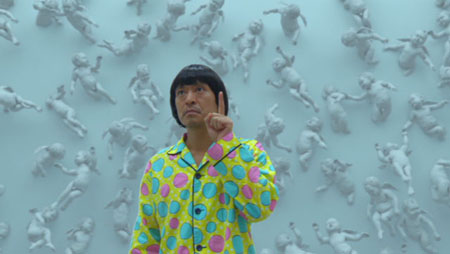
PLOT: A Japanese man wakes up in an enormous white chamber whose walls and floor are littered with cherubic phalluses; meanwhile a Mexican luchador, “Escargot Man,” prepares for a wrestling match.

Still from Symbol (2009)

WHY IT MIGHT MAKE THE LIST: The main narrative, following the action in the white room, is so absolutely removed from reality it demands a place on the List, while the Mexican wrestling scenes remain incongruous and weirdly exotic throughout.

COMMENTS: It’s difficult to talk about why Symbol is so arresting and oddly rewarding without spoiling details of the story or the reveals near the film’s end. Suffice to say the two seemingly unrelated narratives come together in a most unexpected and ridiculous way, and the torture experienced by the Japanese protagonist in the white room leads to a truly transcendent revelation by the film’s end.

The film is structured under three headings: “Learning, Practice and Future.” Learning refers to the rough education the Japanese man receives in the white room from the mischievous owners of the Cherubic phalluses, while the particulars of Practice and Future I’ll leave viewers to discover on their own.

Much of the early joy of the film involves watching Matsumoto interact with the white room and the objects released therein, seeing his mounting frustration at the “bait and switch” as the Cherubs deliver alternately helpful or useless items. They give him an endless stream of sushi rolls, but no soy sauce until after he’s eaten the very last one; 3D glasses direct him to press a particular button, only to have an enormous Cherub behind break wind on him. Another scene sees him releasing an endless pile of chopsticks before he finally presses a different phallus, sending an office trolley careening into his shin. This comedic torment in the vein of silent film comics like or Harold Lloyd continues until Matsumoto recognizes a means of escape…only to be led to earth-shattering alternatives.

There is very little to fault in this film; from its production values to its execution it is equally unique, vibrant and visually arresting. The pacing is surprisingly jaunty for an episodic film, and it actually rewards a re-watch to see how all the various threads build towards the film’s close. Some viewers may find the ridiculous payoffs a little too surreal to be satisfying; to them I can only recommend the consolation to be found in the philosophical treatise “In Praise of Silly,” the book never written by comedian Mike Myers’s father, who believed silliness “was our natural state, and we only get serious to get to silly.” Symbol contains moments of textbook Japanese cinematic weirdness.

A possible weak element of the film (other than two unnecessary moments of flatulence humor) could be identified in Matsumoto’s performance; while his timing is excellent and he works as a hapless, unassuming everyman, his constant screaming is often irritating. A more skilled slapstick performer like , Lee Evans or Rowan Atkinson could have made the physical comedy transcendent and ballet-like rather than merely solid and amusing. This is a rare case where I would not mind a U.S. remake.

I know little about director and star Matsumoto, other than he is one half of a comic duo—the boke or “funny man” of a team called “Downtown”—on Japanese television, just like his contemporary Takeshi “Beat” Kitano (Hana-bi, Violent Cop) was at the beginning of his career. The comparison to Kitano is apt due to the similar career trajectory the two men have followed, although Matsumoto only has four feature film directorial credits to his name and none of the Kitano’s international recognition—at least for the time being. Also, from a cursory YouTube glance, Matsumoto’s TV persona appears to be that of a histrionic, put-upon weed (the character he develops here follows a similar vein) whereas Kitano’s comedy always came from his role as bully.

WHAT THE CRITICS SAY:

“…one of the most bizarre, impenetrable films of the year. That doesn’t mean it is not funny, intriguing and visually impressive, just don’t expect to come out being anything less than baffled.”–Owen Van Spall, “Eye for Film” (contemporaneous)

(This movie was nominated for review by many people, but “Roy” was first when he advised us in 2010 “You gotta check out this flick ‘Symbol’ by the director of Big Man Japan.” Suggest a weird movie of your own here.)

LIST CANDIDATE: I [HEART] HUCKABEES (2004)

DIRECTED BY: David O. Russell

FEATURING: , Dustin Hoffman, Lily Tomlin, , ,  , ,

PLOT: Albert (Schwartzman) is an activist fighting the gigantic Huckabees corporation, which is building a Target-style store in the nearby woods. Enlisting the help of a pair of “existential detectives” (Tomlin and Hoffman), Albert soon encounters two Huckabees operatives—the beautiful blonde couple Brad (Law) and Dawn (Watts)—as well as a disillusioned fireman (Wahlberg). Eventually, everyone’s lives are changed.

Still from I [Heart] Huckabees (2004)

WHY IT MIGHT MAKE THE LIST: Because it is so willfully, obstinately pretentious, unfunny and heavy-handed as to be all but impenetrable. Still, fans of the bizarre will likely get something out of it, as it definitely goes all-out in its manic insanity and breaks a ton of storytelling rules.

COMMENTS: Director David O. Russell once said that I [Heart] Huckabees was his least favorite of his own films. It may not have been fun to make (find the YouTube videos that show Russell throwing a tantrum—among other things—at Tomlin), because it certainly isn’t fun to watch.  A labyrinthine mess, Huckabees makes no sense and doesn’t seem to want to. Despite fine performances (particularly Wahlberg’s) from its all-star cast, the movie is (apparently intentionally) unappealing from beginning to end. Granted, this is a polarizing picture (no one is likely to have a “meh” reaction to it), but yours truly could barely sit through the film.

After this debacle, Russell made Nailed, which was left unfinished and shelved for years, but followed it up with three artistic and commercial triumphs in a row: The Fighter (also with Wahlberg), Silver Linings Playbook, and American Hustle. I [Heart] Huckabees, by contrast, is like a transmission beamed in from an alternate, unpleasant universe in which nothing means anything. (Perhaps that was the point of the “existential detectives”). The film reaches one its many nadirs when Albert has a -like vision of Brad as a lactating Virgin Mary, or something.  Meanwhile Dustin Hoffman sports a hairstyle reminiscent of the Beatles circa 1964, Tippi Hedren drops an F-bomb, Schwartzman’s real-life mother (Talia Shire) shows up to play Albert’s mother, and Shania Twain pops up as herself (I can’t see her fan base enjoying this picture). None of this is amusing or at all entertaining. It is, however, genuinely bonkers. What the point of this silliness is  remains a mystery, but one that most people didn’t care to find out when the film opened in 2004. That was the same year that the equally challenging , but far superior, Eternal Sunshine of the Spotless Mind was released. That film had a heart as well as a brain. Huckabees, on the other hand, is like an endless series of interlocking puzzle pieces that can never be put together correctly. It’s not a good movie, but it’s definitely a weird one, and it just might make it onto the List.

WHAT THE CRITICS SAY:

“Weird does not necessarily equal funny.”–Linda Cook, Quad City Times (contemporaneous)

(This movie was nominated for review by “sam.” Suggest a weird movie of your own here.)