Category Archives: List Candidates

FANTASIA FILM FESTIVAL 2020: LABYRINTH OF CINEMA (2019)

366 Weird Movies may earn commissions from purchases made through product links.

Recommended

DIRECTED BY:

FEATURING: Takuro Atsuki, Rei Yoshida, Yukihiro Takahashi, Takato Hosoyamada, Yoshihiko Hosoda,

PLOT: Japanese teenagers find themselves thrown into the movies screening at a cinema on the last night before it closes.

Still from Labyrinth of Cinema (2019)

WHY IT MIGHT MAKE THE APOCRYPHA LIST: Nobuhiko Obayashi’s final movie, completed only months before his death, is an exuberant, monumental, poetic and surreal ode to the power of cinema.

COMMENTS: I’d advise letting yourself get lost inside Nobuhiko Obayashi‘s Labyrinth of Cinema. Due to the way it hops around between eras and genres, the story may be easier to follow for those familiar with pre-WWII Japanese cinema; but given that the movie begins by introducing one Fanta G, a time-traveler who arrives in modern-day Onomichi, Japan, in a spaceship with goldfish floating inside it, it’s fair to say that narrative logic is not uppermost on Obayashi’s mind. This is a movie with atmosphere to absorb and imagery to intoxicate.

“Movies are a cutting edge time machine,” Fanta G tells us. “You’ll experience time lags in this movie.” You have been fairly warned. After he lands his spacecraft in the harbor and makes his way to Onomichi’s only cinema for the all-night war movie marathon, we’re introduced to the rest of the main characters. Noriko is a 13-year old schoolgirl from a nearby island who almost always appears onscreen bathed in an idyllic blue light. Teenage film buff “Mario Baba” is smitten with her; he sits in the audience with two companions, a nerdy aspiring historian and the son of a monk who intends to become a yakuza. As the first feature begins, Noriko climbs onstage and begins tap dancing in front of the screen; when she hops into the film itself, no one in the audience bats an eye. The three boys soon find themselves mysteriously absorbed into the screen, as well. But the movie keeps changing, and the trio find themselves involved in musicals, samurai films, and wartime adventures, playing out various scenarios, but always pursuing Noriko, who serves both as damsel in distress and an ever-receding symbol of the epiphanic power of cinema itself. The skipping-through-film-history format plays out like a live action variation on Millennium Actress, but with an even more dislocated plot.

Most long movies are slow-paced, languorously stretching out to fill the available time, but Labyrinth of Cinema jets like a rocket through its three-hour tour of Japanese cinema. This makes it exhilarating, but also a little exhausting. Besides the constantly shifting plots—the teenage trio find themselves in new roles, facing new adversaries, every five minutes or so—Obayashi constantly switches styles. He recreates traditional genres, but also throws his own immersion-breaking visual trickery onscreen: vertical wipes, big blocks of primary color, actors enclosed in circular irises that resemble the Japanese flag, blazing computer-generated sunsets, and sidebar text commenting on the action (when one character first appears, he shows us a legend cheekily explaining “we don’t know his name yet”). Along the way we get plenty of the surreal touches we’d expect from the mind that gave us Hausu, including a piano tune played by bullets, and an emotional death scene with a woman who just happens to be sporting a Hitler mustache. Many such surprises lurk inside this maze of movies.

The pace slows a bit after intermission as the story makes its way towards its climax at Hiroshima. A strong and consistently humanist anti-war theme runs through the entire film, but the main focus is always on the cinematic form itself. Labyrinth of Cinema is an ode to the ways in which movies both distort and inform reality; it’s Obayashi‘s love letter to the art to which he devoted his life, shown as much from the perspective of a fan as of a craftsman. While doubtlessly the epic could have been edited down for clarity—and might have been, had Obayashi survived to tinker with it further—much of the movie’s ramshackle extravagance would have been lost. I’m not sure we would want to lose a single second of Obayashi’s last gift to the world.

WHAT THE CRITICS SAY:

“…bursting with energy, passion and dreamlike invention… the border between reality and fantasy dissolves into a colorful alternative universe that is uniquely Obayashi’s.”–Mark Schilling, Japan Times (contemporaneous)

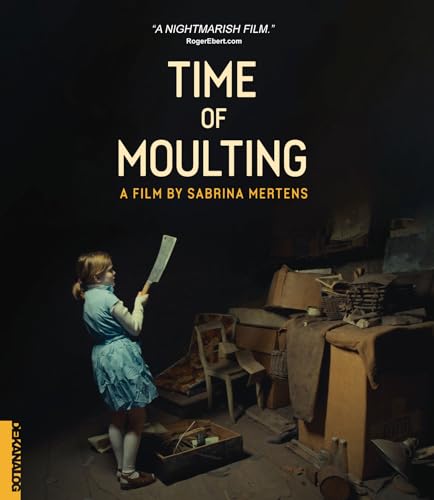
FANTASIA FILM FESTIVAL 2020: TIME OF MOULTING (2020)

Fellwechselzeit

366 Weird Movies may earn commissions from purchases made through product links.

Screening online for Canadians at 2020’s online Fantasia Film Festival

DIRECTED BY: Sabrina Mertens

FEATURING: Zelda Espenschied, Miriam Schiweck, Freya Kreutzkam

PLOT: Stephanie grows up with her eccentric, sickly mother and her “present-but-absent” father, becoming a troubled teenager.

WHY IT MIGHT MAKE THE APOCRYPHA LIST: Teutonic-degrees of mise-en-scène fastidious, tormentingly oblique dialogue, and an unflinching obsession with medium shots make Time of Moulting far too enigmatic and unnerving to fall into mere “arthouse”-levels of weirdness.

COMMENTS: The stifling warmth in this room and the ominous thunder and lightning outside is an appropriate environment for writing this review of Sabrina Mertens’ directorial debut. Time of Moulting is dark, oppressive, and ominous. It’s a slender movie, merely eighty minutes long, but every slice of it—dozens of fixed-camera, “photograph”-style cuts—drip a slow build of tension, like a viscous ooze that is gradually filling a dust-covered bottle. By the finish, I was torn between scratching my head in confusion and hugging myself in despair.

Stephanie (played by a charming Zelda Espenschied as a young child, and a surly Miriam Schiweck “tens years later”) is raised by two parents who have no business having children. The mother (Freya Kreutzkam, never far from despair-induced collapse) suffers from an unspecified medical condition—one both mental and physical, probably. The father makes it clear early on he has no patience for his daughter. Young Stephanie takes solace in exploring the mysteries hidden away in the increasingly untidy house, particularly the trunk full of her grandfather’s butcher’s equipment; older Stephanie takes far more sinister “comfort” in the tools found therein.

By IMDb’s count, there are 57 vignettes adding up to a cryptic whole. By my count, there are only two close-ups: one shot of false teeth creepily snapping shut, and one of liver curling while being fried upon a skillet. The recurrence of meat—always raw—is never a good sign in movies. In Time of Moulting it takes on a more abstract but equally sinister imagery. Young Stephanie arranges two slices of something almost origami-like on a plate; later in life she takes to drawing some truly grisly scenes of death, and even cannibalism.

But Time of Moulting’s horror elements take a back seat to the oppressive formalism of the whole affair, lingering in the many shadows with a quietly sadistic grin. I have never felt so unnerved by medium shots. You see everything going on in the scene, but that only makes the goings-on eerily detached. By this point in the review, I’ve realized that I am not communicating the movie’s aura as well as I would like; but that just reaffirms my position that Time of Moulting is a truly strange take on horror, art-house, and melodrama.

WHAT THE CRITICS SAY:

“The film is subtle to the point that we lose many of the narrative points that lead to the character feeling how she feels and doing what she does. It comes across as unqualified and strangely out of place as the film plods towards its underwhelming finale..” -Hunter Heilman, Elements of Madness (festival screening)

Time of Moulting [Blu-ray]
  • New interview with writer/director

FANTASIA FILM FESTIVAL 2020 CAPSULE: FRIED BARRY (2020)

366 Weird Movies may earn commissions from purchases made through product links.

DIRECTED BY: Ryan Kruger

FEATURING: Gary Green

PLOT: Heroin addict Barry is possessed by a creature from outer space.

Still from Fried Barry (2020)

COMMENTS: Looking like a pre-mortem Crypt Keeper but with a glorious goatee, Gary Green’s gaunt visage may be Fried Barry‘s greatest asset. It’s not surprising that someone would want to build a film around that face, even if for most of the movie it does nothing but stare blankly. Balding, but with long stringy hair (and thin, but with a surprisingly cut physique), Green looks the part of a deteriorating addict under constant threat of eviction. I enjoyed looking at that face even when the attached film dragged it into shaggy, often improvised vignettes.

The movie begins with “adults only and no one else!” content disclaimer promising (er, I mean, warning of) “explicit language, nudity, and strong scenes of high impact sexual violence…” The explicit language box is simple enough to check off. There is nudity—and some awkward fully-clothed sex—because, apparently, bedraggled aliens with bug-eyed stares attract the ladies like flies. There is also plenty of violence, but not really any “high impact” sexual violence (it’s indirect, homophobic sexual violence). There is, on the other hand, a lot of senseless non-sexual violence—including an uncharacteristic detour into torture porn that ends in a chainsaw battle—if that counts for anything. What the presenter in the opening didn’t warn about was the public toilet sex, hospital corridor pooping, or adult breastfeeding. Or the hard drug porn: whether it be old-fashioned shooting up, complementary club ecstasy, or random junk smoked out of a light bulb, all of Barry’s friends (and about half of the random strangers he meets on the street) want to get him high for free. And what the presenter especially doesn’t warn you about is the insta-birth alien conception scene…

In other words, Fried Barry‘s exploitation credentials check out. There are also decent dollops of weirdness in its nearly structureless runtime. Ten minutes into the movie Barry shoots up, finds himself submerged underwater, has flashbacks, sees colored lights, and levitates into the heavens. Then, some weird stuff happens in what we assume is an alien spacecraft. After returning to Earth, he takes a few more psychedelic trips, becomes a dad, uses his eyelids as remote controls, has visions of an old guy singing in tongues while doing a soft-shoe routine, and makes a highly illogical escape from the loony bin. These snatches of madness break up his odd encounters with various prostitutes, lowlifes, and eerily cheerful cheese-sample pushers.

Fried Barry is part of a mini-tradition of movies about mute or verbally challenged outsiders/aliens wandering about urban areas, holding up mirror to society. There’s more than a little Bad Boy Bubby (1993) here: Barry speaks no dialogue save what he repeats, and his son is even named “Bubby,” in what surely must be a tribute. Barry also can heal like the Brother from Another Planet (1984); at least, he does so once. There’s a touch of Under the Skin (2013), too, and maybe even a drop of Liquid Sky (1982). For all the nods, Fried Barry brings nothing new to this particular table. What it especially doesn’t bring is any kind of visible ideas. Barry’s ordeal is most naturally viewed as one long, drug-induced psychosis. If you take the story at face value, it’s a sci-fi film about aliens who travel across the inky blackness of space to South Africa so they can possess heroin addicts and… who don’t have much of a plan beyond that. Fried Barry won’t give you any great sociological or existential insights, but if it’s a mindbending trip to the outer limits of consciousness you’re after, it’s a lot safer than sticking a needle in your arm—or being beamed up by saucers.

Giles Edwards adds: Fried Barry left me feeling that pleasantly odd, detached sensation I get when I watch a weird movie, and so I make this pitch on its behalf for Apocryphizing. The lead’s performance alone is a continuous oddity–almost 100 minutes of jittery reactions. Gary Green is always interesting to look at, and observing his “Barry” go through four drug overdoses (that I could count) was impressive. With virtually no dialogue for his character, it was like watching the half-awake facsimile of Dale Cooper of Twin Peaks: the Return stumble, dance, and twitch through two jam-packed days full of run-ins with thugs, unlikely escapes, and even the daring rescue of a dozen kidnapped children.

The lighting and score of Fried Barry supplement Green’s spastic tics, rendering his forty-eight-hour (?) journey somewhere between reality and unreality, further rendering the unreal somewhere between an exalted and sinister dream. In particular, Barry’s abduction comes across as an unsettling fusion of 2001: A Space Odyssey and a H.R. Geiger-saturated nightmare. The pulsing electro-score and violently-hued color schemes add a shining varnish to Barry’s jerking physical flow. When the ominous “Intermission” sequence spooled on-screen, I finally gave up on trying to guess where the heck this movie was going and let myself sit back to enjoy the wild fried.

WHAT THE CRITICS SAY:

“…a trippy exploration of mankind.”–Norman Gidney, Horror Buzz

APOCRYPHA CANDIDATE: CAPONE (2020)

366 Weird Movies may earn commissions from purchases made through product links.

DIRECTED BY: Josh Trank

FEATURING: Tom Hardy, Linda Cardellini, Kyle MacLachlan,

PLOT: Released to his Florida home on humanitarian grounds, Al Capone spends the last year of his life rapidly deteriorating in body and mind, while trying to remember where he hid ten million dollars.

WHY IT MIGHT MAKE THE APOCRYPHA LIST: Capone alternates between being uncomfortably realistic and markedly dreamy, with the former often seamlessly segueing into the latter. By the time we see Al Capone, clad in diaper and dressing gown, chomping on a carrot and madly firing a gold-plate Thompson submachine gun at his staff, it’s hard to guess what’s actually happening.

COMMENTS: Capone plays like an anti-biopic: there’s no glamorization, and virtually no sympathy elicited for its protagonist. As a star vehicle for Tom Hardy, it also veers off the beaten path. Hardy’s performance is a strange hybrid of tin-pan-alley grandiosity and bloodshot malevolence. Capone‘s reception by the common viewer has been unsurprisingly frigid—it holds a damning 4.7 rating on IMDb. But for those who want a haunting, sickly, and uncomfortable dissection of the mental deterioration of history’s most notorious gangster, Capone is as priceless as the treasure that eludes the titular character.

Al Capone’s sentence for tax evasion is cut short to allow him to spend his final days in his sprawling mansion surrounded by a sprawling swamp. His homestead’s grounds are infested with crocodiles of the literal variety; its hallways are infested with metaphorical ones. Al Capone sounds like a dying horse, croaking out random threats and random pleas. He is prone to incontinence—so much so that his doctor (Kyle MacLachlan, both slippery and terrified) supplies Capone’s long-suffering wife (Linda Cardellini, emanating frustration) with diapers for her husband. When not staring at his lake, while puffing endless cigars and listening to his radio, Capone endures encounters with friends both past and present. On a fishing trip with an old criminal associate, he casually lets slip that he has hidden ten million bucks, but he can’t remember where.

As in Bronson, Tom Hardy makes this movie, delivering an unnerving performance of a former kingpin suffering from syphilitic dementia and the effects of two strokes. The film begins with a wild-eyed Capone in night attire, wandering a dimly lit hallway while holding a fire poker, pursuing someone. He finds his target—a little girl—and makes a play at attacking her. She screams, then laughs, then runs, and soon Capone is chasing a bevy of little ones through his mansion, out to his rain-drenched yard, and ending up the playful victim of a pile-on. This is, alas, the high point for the frail gangster. Waking dreams and hallucinations occur with increasing frequency as his mind and body shut down.

Capone’s mental fragility contrasts with the precise formality of the rest of the movie. Each scene is impeccably orchestrated around Hardy’s characterization, the surrounding cast providing the struts on which Capone’s quiet madness is displayed. The dream sequences often manage to be unpredictable—the final blow-out only showing its hand at the scene’s watery collapse—while at other times there’s obvious pathos. The recurring symbol of gold—in the form of a balloon held by a boy, the metal trim of a shotgun Capone uses to shoot a crocodile that stole his fish, or the gaudy submachine gun used on his rampage—acts as a clue to the viewer, but also as a metaphor for what Capone has lost. His youth and power are gone forever; what’s left is a tragic cartoon ever veering between rage and collapse.

WHAT THE CRITICS SAY:

“…an odd little film, at times weirdly engaging but often so bizarrely muddled that you might identify a little too closely with its perpetually unglued protagonist.”–Stephanie Zacharek, Time (contemporaneous)

APOCRYPHA CANDIDATE: THE ADVENTURE OF DENCHU-KOZO (1987)

Denchû kozô no bôken; AKA The Great Analog World

366 Weird Movies may earn commissions from purchases made through product links.

Recommended

DIRECTED BY: Shinya Tsukamoto

FEATURING: N. Senba, Nobu Kanaoka, , , Shinya Tsukamoto

PLOT: Young Hikari is bullied because of the electric pylon growing out of his back, but he’s got a time machine; after using it to impress a girl, he finds himself twenty-five years in the future in a land plagued by cybernetically enhanced vampires.

WHY IT SHOULD MAKE THE APOCRYPHA: Seeing as how Tetsuo: the Iron Man is Certified and this film has all the same weird ingredients–and then some–it would be remiss if this did not elbow its way into the growing Apocrypha crowd.

COMMENTS: For those with a smattering of Japanese, the title explains the premise: this movie is about the adventure of “electric rod boy”. Within the movie, he is given the more formal (and heroic) title by a mysterious servant of the time-tunnel: The Electric Pylon Boy! (“The” added for saga-worthy emphasis.) When the most normal character in a time-travel-cyber-vampire story has a metal rod growing out of his back, you know you’re in “weird” territory.

Of course, we’d expect nothing less from Shinya Tsukamoto. Two years before he graced the world with his chef d’oeuvre, Tetsuo: the Iron Man, he put together this pint-sized sci-fi epic that, visually at least, laid quite a bit of groundwork for his more famous tale of technological transmogrification. Not content to merely be the writer, director, and nearly every other role behind the camera, Tsukamoto puts in a turn as one of the doomsday vampires with a performance that fully develops his “fetishist” character in Tetsuo.

Back to The Adventure of Denchu-Kozo. Our hero, Hikari, is the butt of jokes—not just because he’s a nerdy weakling, but also because of the strange, prominent (and totally, totally non-phallic, I swear) growth on his back. He’s beaten up, because “boys will be boys,” but said boys get thwacked themselves by the protective Momo, ever armed with her stick. Thanking his savior, Hikari says, “I’ve got a time machine”, and before you can say, “Are you sure this is a good idea…?,” he zaps himself into the future!

What ensues after that involves a lot of wires (growing and otherwise), some highly self-consciously silly montages, and vague allusions to the explosive substance “Adam Junior” (not to be confused with “Atom…”) whose explosions block out the sun sufficiently for the Shinsemgumi vampires to emerge from hiding and conquer humanity. There’s also the first glimpse of the notorious drill-bit penis that everyone knows and loves from Tsukamoto’s follow-up, as well as plenty of that stop-motion/high-speed character movement that I personally can’t get enough of. And just in case you didn’t think this movie was serious, it also takes La Jetée-esque logic into consideration.

But no, this movie is not remotely serious. Denchu-Kozo‘s respect for coherent time loops is fused with so much random crazy metal junk (figuratively and literally) that any pause for intellectual or emotional reflection is almost immediately derailed by synthesizer-backed action platitudes, pylon bonking humor, or Tsukamoto’s character hamming things up even beyond the main course of Ham with Ham. Incidentally released the same year as science fiction classics RoboCop and Bad Taste, The Adventure of Denchu-Kozo nicely bridges their respective tones of cyber-science-fiction and silly-savage-slapstick.

WHAT THE CRITICS SAY:

“….[an] insane forty-six minute short… For such a brash and often perverse effort, it is curious to note that it is sweetly naive: it’s really a child’s story, a superhero origin story, wrapped up in a post-Apocalyptic nightmare, only with violence, nudity, and a woman turning into a doomsday machine.” -Mark Cole, Rivets on the Poster (DVD)