Category Archives: List Candidates

APOCRYPHA CANDIDATE: CRUMBS (2015)

366 Weird Movies may earn commissions from purchases made through product links.

DIRECTED BY: Miguel Llansó

FEATURING: , Selam Tesfayie, Mengistu Berhanu, Tsegaye Abegaz

PLOT: A long-dormant spaceship hovers over an apocalypse-blasted earth, so Candy goes on a quest to secure himself a seat on board.

WHY IT MIGHT MAKE THE APOCRYPHA LIST: Plenty of post-apocalyptic movies capture the dregs of civilization as well as Crumbs, but no others that I can think of have a “raised-hand” spaceship, Michael Jordan the god, or Santa Claus inside a bowling alley ball-return.

COMMENTS: Smirking absurdism and epic pathos are in constant tension in Miguel Llansó’s directorial debut. This friction is perfectly encapsulated during an encounter near the end of Crumbs, when we watch the protagonist, Candy, unbutton his shirt—in a display of machismo directed at a burnt-out Santa Claus—to reveal the iconic “Superman” garb. Only, Santa doesn’t recognize it, saying “it looks like a Nazi symbol.” This quip cuts right to the chase: the “superman” was a Nazi ideal, and it was such displays of toxic machismo that brought about the nuclear war.

“Crumbs” aptly describes of what civilization has been reduced to: scavenging and subsistence-level survival, all man’s machines crumbled to rust. Crumbs intersperses its quest narrative with history-laced interludes courtesy of a pawnbroker to whom various wanderers try to sell their findings. A cheap plastic “Max Steel” sword toy is not, as is commonly presumed, from the great artist “Carrefor“, but by “Mattelo“; a Samurai Turtle dated “third century” was “worn by Molegon warriors as a lucky amulet”; “Dangerous“, by Michael Jackson—a third-century farmer—is a gift worthy for a wedding. These items, and more, are crumbs left along Candy’s path as he travels to find Santa Claus in an abandoned pond in the old city.

The narrative is triggered by ominous signs at the bowling alley which Candy (Daniel Tadesse) and Birdy (Selam Tesfayie) have adopted as their home, untold numbers of years after a hinted-at world war. Birdy is convinced that the spaceship—which had hitherto been idling in the sky—has begun to start its engines, and the magnetic field being emitted has triggered the alley’s lights to flicker and the ball-return machine to reactivate. Candy goes off to find the one man who can secure their place on board, while Birdy stays home. She regularly prays at their shrine to Michael Jordan, but is haunted by the voice coming from the ball-return. Investigating it, she finds Santa Claus inside, pacing around a display of toys, asking what her Christmas wish is.

While Llansó’s sophomore feature tickled with its high energy and zany surrealism, Crumbs is a more contemplative work. Its tongue-in-cheek tone is couched within a soft, dreamy tone. The natural beauty of Ethiopia’s wildlands, alongside decayed industrial hulks of machinery, is on full display at the hands of an able and loving cinematographer. Candy is an unlikely hero, a deformed (though not un-handsome) fellow trying to do right by his lover. The weight of Crumbs‘ reality anchors the absurdity until the final moments of the credits. The spaceship sails peacefully toward the æther as two men inside talk about vintage music; then it explodes. Even if reduced to crumbs, Earth is all we’ll have.

Crumbs is available for separate purchase, but it was also released as a bonus feature on Arrow’s 2020 Limited Edition Blu-ray of Jesus Shows You the Way to the Highway.

WHAT THE CRITICS SAY:

“…it’s hard not to succumb at least somewhat to this sci-fi whatsit’s strange, whimsical spell.”–Ben Kenigsberg, The New York Times (contemporaneous)

APOCRYPHA CANDIDATE: THE WILD, WILD WORLD OF JAYNE MANSFIELD (1968)

366 Weird Movies may earn commissions from purchases made through product links.

DIRECTED BY: Charles W. Broun Jr., Joel Holt, Arthur Knight

FEATURING: , narrated by Carolyn De Fonseca

PLOT: Jayne Mansfield narrates her visit to Rome, Paris, New York City, and Hollywood.

WHY IT MIGHT MAKE THE APOCRYPHA LIST: This brazen cash grab (and virtual grave-robbing) flits along with an airy-but-bizarre tone of narration and titillation, before a jarring interruption in the final minutes. Laughably odd becomes wrenchingly tragic at the drop of a hat.

COMMENTS: For almost an hour and a half, we go on a guided tour of a couple of European cities and a couple of coastal American ones, before a coup-de-grace deflates the whole affair. Jayne Mansfield, dead—and nearly decapitated—in a car accident. Before this movie was even completed. So who have we been listening to? Having begun this film with no knowledge of it (and only passing knowledge of the starlet), I have to tip my hat to Carolyn De Fonseca for her dead-on characterization (please pardon that accidental pun [that one, too]) of Jayne Mansfield. Simultaneously, I have to wag my finger and tut-tut at the trio of directors who went ahead with this project.

The Wild Wild World of Jayne Mansfield claims to be a “documentary.” I took a semester about documentary film in my college days, with a focus on the reliability of documentaries and their makers. In this film, we witness Jayne Mansfield traveling around trendy European hot spots–that much can be gleaned from the footage. According to this “documentary,” Rome is (in 1968, anyway) teeming with handsome sexual harassers to a slightly greater degree than Paris is teaming with homosexuals, transvestites, and lesbians. New York City in 1968 had its share of convincing transvestites as well. And Hollywood? Like the rest of the world, it was going through a “topless women do various mundane things” craze. Everything, however, is undercut by the fact that we’re lied to from the beginning about who’s talking to us.

There was probably a respectful way to make this movie. The filmmakers sat on a pile of footage of Mansfield’s recent jaunts, and there must have been people she spoke with who could have fleshed out a real documentary. Instead, there’s a continuous rush of ditzy observations and a laser-keen focus on society’s fringe element—all set to a jaunty score at times reminiscent of Goodbye, Uncle Tom and at others, the James Bond theme.

Broun, Holt, and Knight show as much of Mansfield as they can, show as many other breasts as they can, and pepper it all with daydreams ostensibly from Mansfield (for example, her vision in the Colisseum of her dream-man gladiator). There was also a nigh-untenable degree of faux-modesty—“Mansfield” remarking in wonder at how shameless/fearless all these women/love-making couples/etc. were, and how she simply could not work up the nerve to go fully nude at a nudist colony.

But then it gets weird. There’s a crash-montage of photographs, accompanied by a rubber-burning/metal-crunching sound effects, and the tone slips into maudlin garishness. Suddenly all the mind-numbingly banal remarks (my favorite being, “Poor Caesar! Brutus was his friend!”) are brought into focus: this was a person. Who died horribly. Melodrama worthy of Guy Maddin, I’d say, coming out of the blue, and interrupting my dismissive chuckling.

Severin re-released The Wild Wild World of Jayne Mansfield on DVD and Blu-ray in 2020, with your choice of two different, equally flawed transfers, and a host of extras including a short interview with Satanist and Jayne hanger-on Anton La Vey. The tame 1966 mondo feature Wild, Weird, Wonderful Italians is also tossed in to make the bottom half of a double feature.

WHAT THE CRITICS SAY:

“Once it gets to the car crash… the movie is surprisingly dark and serious in tone, clearly cashing in on the very real, and very tragic, event that took the life of its star (and, as the photos clearly document, her dog as well)…  Recommended for those with a taste for misguided vanity projects and bizarre documentary features.
” -Ian Jane, Rock! Shock! Pop!

APOCRYPHA CANDIDATE: I’M THINKING OF ENDING THINGS (2020)

I’m Thinking of Ending Things has been promoted to the Apocryphally Weird List. Please read the official entry.

366 Weird Movies may earn commissions from purchases made through product links.

DIRECTED BY:

FEATURING: , , , , Guy Boyd

PLOT: A young woman goes on a trip to meet her new boyfriend’s parents at their farmhouse on a night when a blizzard is brewing; the night grows increasingly strange and unsettling as it becomes unclear what is real and what is imaginary.

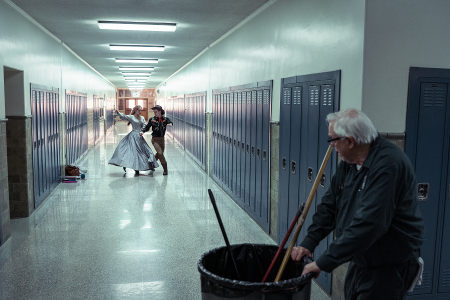
Still from I'm Thinking of Ending Things
I’m Thinking of Ending Things. Guy Boyd as Janitor in I’m Thinking of Ending Things. Cr. Mary Cybulski/NETFLIX © 2020

WHY IT MIGHT JOIN THE APOCRYPHA: By the time the pig shows up at Jake’s old high school, it becomes apparent that this maze of awkward interactions, faulty memories, and uncertain identities may just be Charlie Kaufman’s most surreal film.

COMMENTS: The first inkling that something is not quite right in I’m Thinking of Ending Things comes when the young woman (who is first introduced as “Lucy,” although it turns out that may not be her real name) thinks to herself, “I’m thinking of ending things.” “Huh?,” says Jake (that is his real name), from the driver’s seat. Can he hear her thoughts? She denies speaking. “Weird,” says Jake. “Yeah,” she answers.

Things will get weirder. She’s unsure why she wants to break up with him. Her backstory doesn’t add up. And she’s getting a lot of phone calls, which she’s not answering. When they arrive to meet Jake’s parents at their remote farmhouse, things get even stranger. As it turns out, Jake’s parents would creep out Henry Spencer‘s in-laws. Dinner is uncomfortable, full of small talk that often sounds like hidden accusations, and—once more—competing backstories that contradict each other. Jake’s parents age, almost before her eyes… Nothing explicitly supernatural or menacing happens, but the creaky farmhouse emanates a horror movie vibe, intensified by Jake’s passive-aggressive insistence that his girlfriend stay out of the basement. Meanwhile, Lucy—or whatever her name is—anxiously suggests that Jake take her home before the coming blizzard snows them in and traps her there.

Charlie Kaufman‘s latest mind-massager is another intensely subjective and literate tour of the lonely corridors of the mind, where nothing is as it seems. It’s one of his strangest offerings— particularly when it reaches an irrational finale that departs from the source novel—but perhaps what distinguishes it the most is the exceptional ensemble acting, best seen in the four-way sparring at the dinner table. Their expressions are priceless: Collette smiling to herself at private jokes only she can hear, Thewlis aggressively incredulous at the idea that a landscape could appear sad, Plemmons understandably embarrassed by his parent’s odd behavior, and trying to coax his girlfriend into revealing the correct details about how they met. We expect accomplished performances from those three celebrated actors, but relative newcomer Jessie Buckley is a revelation. She mutates throughout the film, portraying everything from a nervous recalcitrant girlfriend to an angry feminist to an apparent victim of very early-onset Alzheimer’s. She even slips into a Pauline Kael impression. Remarkable.

As with all the best trips, it’s the journey that’s most memorable, not the destination. There is a reveal at the end, but the twist, while satisfying, is hardly the point. Each scene is structured as an individually confounding moment: on the long ride there and back, Jake and his girlfriend discuss everything from the human experience of time, bad movies as viruses, with citations to Wordsworth, David Foster Wallace, Guy Debord, and musical theater (familiarity with “Oklahoma!” will enrich your experience). Jake says he like road trips because “it’s good to remind yourself that the world’s larger than the inside of your own head”—but does the movie believe this thesis? As they travel, the couple learn less about each other, and more about the slipperiness of human memory, fantasy, and identity.  It’s Kaufman’s favorite theme: the loneliness of our inherent interiority. The paradox is that our inescapable subjectivity is the one thing we all share and bond over.

WHAT THE CRITICS SAY:

“If that sounds confusing, or even downright hostile to the audience, well, that describes the Charlie Kaufman experience… There’s a weird thrill to getting lost inside this movie, only so you can study every odd detail from new angles, over and over again.”–David Sims, The Atlantic (contemporaneous)

FANTASIA FILM FESTIVAL 2020 APOCRYPHA CANDIDATE: UNDERGODS (2020)

366 Weird Movies may earn commissions from purchases made through product links.

Recommended

DIRECTED BY: Chino Moya

FEATURING: Johann Myers, Géza Röhrig, and ensemble cast

PLOT: “K” and “Z” drive their van around a clapped-out shell of a city collecting dead bodies and telling each other about their dreams.

Still from Undergods (2020)

WHY IT MIGHT MAKE THE APOCRYPHA LIST: The various stories in Undergods interlock with a dreamy (at times, literally) logic worthy of Luis Buñuel. The various future-creepy scenarios are haunting, unsettling, and puzzling, but anchored by two of the most pleasant corpse-haulers one could hope to meet.

COMMENTS: Only the most fragile of barriers protect civilization as we know it today form the looming dystopia of tomorrow. Undergods two guides, body collectors “K” and “Z,” illustrate this point through their narrative dreams, which occasionally bump into reality and each other. Our affable van drivers share a camaraderie forged by their grisly work and offset by their friendly banter and shared can of rum. Moya’s stories unfold and unsteady us in the finest tradition of H.G. Wells, George Orwell, Phillip K. Dick, and the Black Mirror television series.

Undergods opens with an ill-boding narrative about a mysterious 11th-floor neighbor, Harry, who is locked out of his apartment and crashes with Ron and Ruth for the weekend, distressing the former and romancing the latter. After a bender, Ron encounters the apartment’s superintendent and learns that he and Ruth are presently the building’s only occupants. Harry is a charlatan. Ron and Harry scuffle in the elevator. The superintendent begins a tour, opening the door to a father and daughter prospective tenants with Ron’s corpse on the floor.

And so it goes in Undergods. That segment segues into a bedtime story being told by that father to his daughter, a story that itself segues back into the world of van-men K and Z. Like a game of “Sammy the Snake,” the chain of narratives grows and twists until, Ouroboros-style, it feeds back into to the conversation about dreams. The vignettes are invariably sad. Perhaps the happiest event is Dominic’s promotion to “head engineer”–which is small comfort, seeing as his wife’s first husband, presumed dead fifteen years prior, has just been released from a prison facility (found in K’s and Z’s milieu) and now she wants to leave him (Dominic, that is, not her recently returned husband). Undergods‘ plot is just begging for a diagram; but unfortunately I don’t make art, I review it.

Even before the first fully-fleshed story unfolds, the dystopia is firmly established. I don’t know what wreck of an old Soviet town Moya filmed in, but it is beautifully run-down and oozing with creepy grandeur. Ashy snow (or snowy ash) falls continually over the nearly-abandoned streets. The film score feels lifted from an early John Carpenter movie, providing further alienation whenever the electro-pop tones sound off. Undergods never seems to stop moving forward, until we find we never left the van. That’s all right: it’s scary outside, and K and Z have rum to share.

WHAT THE CRITICS SAY:

“Chino Moya’s feature debut is a haunting, almost impenetrable film, one billed as a dark fantasy but that in reality resists categorization. It will leave you with more questions than answers, but if you let it suck you into its strange world, you might not end up minding that.” –Thomas O’Connor, Tilt Magazine (festival screening)

FANTASIA FILM FESTIVAL 2020: #SHAKESPEARE’S SHITSTORM (2020)

Shakespeare’s Sh*tstorm

366 Weird Movies may earn commissions from purchases made through product links.

Screening online for Canadians at 2020’s online Fantasia Film Festival

Recommended

DIRECTED BY:

FEATURING: Lloyd Kaufman, Kate McGarrigle, Erin Miller, Monique Dupree, Abraham Sparrow, Amanda Flowers

PLOT: Very loosely following the plot of ‘s “The Tempest,” the story involves a party ship packed with pharmaceutical executives washed up on the shores of Troma, New Jersey, after a storm of whale feces.

Still from #SHAKESPEARE'S SHITSTORM (2020)

WHY IT MIGHT MAKE THE APOCRYPHA: You’ll get more out of it if you know “The Tempest” (and know Troma well enough to catch Easter eggs like the “Kabuki flip”)—but, Shakespeare’s Shitstorm should shock and amaze anyone with a sense of cinematic adventure and strong stomach. It’s one long hedonistic orgy of grossout comedy and Bardic references. It’s got Lloyd Kaufman in two roles, including one in drag (in a Snow White costume, for reasons never explained); William Shakespeare telling a donkey show joke to a panel of Ph.Ds; and a climax that is accurately characterized as “like a Hieronymus Bosch painting” (if Bosch had been just a bit fonder of green slime, prosthetic boobs, and punk rock anthems). It’s the stuff that dreams are made of—at least, the kind of dreams you might have if you ate an entire herring pizza laced with ketamine as a midnight snack before going to bed.

COMMENTS: “The Tempest” was not William Shakespeare’s final play, but it was his last masterpiece. Its closing acts are widely interpreted as the Bard’s farewell to the theater. At 74 years of age, Lloyd Kaufman has already outlived Shakespeare, but the feeling that Shakespeare’s Shitstorm is intended as his final trashterpiece is inescapable.

Something about Shakespeare inspires Kaufman and his Troma team to heights of lunacy even beyond their usual excesses. Shitstorm may not be quite as surreal as Troma’s weirdest feature, Tromeo & Juliet, but it represents a capstone of their transgressive punk aesthetic. One affinity between Stratford-upon-Avon’s favorite son and New Jersey’s least reputable film studio is the large cast of characters: Troma has always favored maxamilized plots and as many odd-looking extras as they can convince to work for a mention in the rolling credits. The discipline (such as it is) imposed by being forced to parody the Bard’s sprawling plots enforces some structure on Kaufman, whose tendency is to make his movies as digressive and improvised-looking as possible. And of course, the tension between Shakespeare’s humanistic aspirations and Troma’s scurrilous antics is inherently amusing. The combination gives the studio the chance to argue, “sure, we may be lowbrow… but we’re smart lowbrow.” After all, they quote from the play’s text and throw in references to other plays and sonnets (always undercut by a corny or obscene joke), along with bits of Shelley and bawdy couplets of their own devise. It reminds us that there is an intelligence hiding under the layers of shit jokes.

Shakespeare’s Shitstorm isn’t just offensive; it’s an ode to offensiveness. It starts off with a toddler spattered with blood from her mother’s suicide. There’s a “diversity hire” stripper in a wheelchair, two separate subplots involving crack whores (including one who sings a musical number with the lines “suck her in and blow her out, my crack pipe never screams and shouts”), and bloody oral rape scene performed by an animatronic chicken. After all that, the nauseating scenes of characters getting lapdances while being showered by brownish buckets of cetacean “fecal bloom” seem positively quaint. The only real suspense is whether—or rather, when and how—they’ll drop the N-word. That’s all standard practice for Troma, though I daresay that Shitstorm breaks all previous Tromatic records for repulsion. But this time, offensiveness itself is the front-and-center theme of the movie; it makes the studio’s boldest case that causing offense is a social service. Shitstorm‘s chief satirical targets are entitled “SJW” bloggers with no sense of humor. Shitstorm‘s final moral is delivered as a string of ethnic jokes—with accompanying visual metaphor—an argument that mocking everyone and everything equally is a better route to solidarity than contorting our speech awkwardly to avoid stepping on any one group’s toes. In other words, lighten up. We’re all here to laugh, and if your in-group gets lambasted, it will be someone else’s turn in about 30 seconds.

And thankfully, the movie is funny. They even insert what I think is a joke for early reviewers only. Often, when you watch pre-release screeners, there will be a legend that periodically appears warning “for review purposes only.” In Shitstorm, that reminder instead reads “for bootlegging purposes only.”

Shakespeare’s Shitstorm is a monumental movie. When you sit through the nine minutes of end credits—taking care to watch those amazing outtakes and read the jokes hidden in the text—you’ll realize that it takes an enormous pile of money to make something that looks this cheap. We are unlikely to see a Lloyd Kaufman movie on this scale ever again, and it’s a shame that Covid-19 prevented it from having the grandiose premiere to a packed house that it deserved. Troma has worked its way up from a disreputable B-movie studio to an underground institution. I haven’t always been the biggest fan of their approach, but Kaufman and team have worked ceaselessly doing their own thing their own way for 35 years now—and that deserves a celebration. Of course, Kaufman’s Prospero might actually like it better this way. He doesn’t deal well with sudden popularity near the end of Shitstorm: “You’re supposed to be triggered! Do not put me on a pedestal!” So instead, let’s send him off with a quote from Shakespeare: “As you from crimes would pardon’d be,/Let your indulgence set me free.” We’ll indulge you, Mr. Kaufman, in one last glorious barf fest.