All posts by Michael Diamades

GREEK WEIRD CINEMA BEFORE THE “WEIRD WAVE”

Greek directors were weird long before made his feature debut with Kinetta (2006) and soon after found great success with Dogtooth (2009). From the late ’60s and 70s, while Greek commercial cinema was in decline, new directors emerged with singular voices and a modernist approach, many of them inspired by the teachings and international appeal of the Nouvelle Vague. Among these unique visions, there were many controversial ones, and even some really weird ones. This article is a short introduction to the weirdest aspects of Greek cinema of the 20th century, through five notable examples that traverse a wide range of styles and genres, each weird in its own unique way.

Let’s leave films that are just subversive and creative aside, and focus on movies with a WTF-level of weirdness. Subversiveness in Greek cinema starts about 1967 with works like Nikos Papatakis’ The Shepherds of Calamity, a drama famous for its social critique through the controversial portrayal of a slightly kinky love affair between a poor peasant and a girl from a wealthy family. It was a favorite of Lanthimos. In the following decade, many movies used an eccentric style to portray the rock and roll spirit, or to tackle subjects regarding Greek counterculture, like ‘ The Wretches Are Still Singing (1979), or ‘ entire filmography. As both these directors have been mentioned previously on this site, I won’t expand on them. There are many more and bizarre hidden gems out there, waiting to be discovered!

Still from Idlers of the Fertile Land (1978)

Let’s start with Idlers of the Fertile Land (1978) by Nikos Panayotopoulos, a director clearly inspired by the style of . This film more closely resembles the contemporary Greek Weird Wave in the way it builds an elliptical allegory of the absurd. We follow a wealthy family, a father and his three sons, as they isolate themselves in a mansion along with a maid played by sensual Olga Karlatos. They decide to pass the rest of their lives by sleeping and by doing literally nothing else, becoming increasingly idle. The central concept of rich guys isolating and destroying themselves by indulging in their vices is of course similar to ‘s La Grande Bouffe (1973); it’s a caustic morality tale parodying laziness in exactly in the same way Bouffe parodies gluttony.

Still from Mania (1985)

Our next selection is Mania (1985), an anarchic and oneiric parable commenting on our need to escape from “civilized” society, even if just for a bit. Haunting shots follow a young woman named Zoe, a program analyst for a big company, who finds herself in a series of escapades and dreamy encounters while strolling at a park. Her Bacchanalian odyssey and transformation have been compared with “Alice in Wonderland.” Suntan director Argyris Papadimitropoulos claims this movie as a favorite. As Zoe navigates through her surreal experiences, she grapples with the constraints of her daily life, leading to moments of profound introspection and liberation. This film’s rich visual style and evocative storytelling invite viewers to question the boundaries between reality and fantasy, making it a memorable exploration of the human psyche.

Continue reading GREEK WEIRD CINEMA BEFORE THE “WEIRD WAVE” →

CAPSULE: THE BLOODY LADY (1980)

Krvavá pani

366 Weird Movies may earn commissions from purchases made through product links.

Recommended

DIRECTED BY: Viktor Kubal

FEATURING: Voice of Jela Lukesová

PLOT: A young maiden transforms into a sadistic lady after a short affair leaves her heartbroken, and the myth of Erzsébet Báthory, the Blood Countess, is born.

Still from The Bloody Lady (1980)

COMMENTS: It starts innocently, with vivid and warm color palettes, visual gags, and a young princess dancing and playing with the forest animals, like something out of a Disney movie. But do not be fooled; this lady is Elizabeth Bathory, and things will suddenly take a turn for the grim, the weird, and the macabre.

When the young girl falls sick while in the forest, a peasant takes her under his protection and care. Something akin to love blossoms. But this love is doomed to remain unrequited, as the princess will have to return to the palace eventually, leaving behind as a memento… her heart.

This slightly grotesque gesture is not  only a symbol of her love and devotion towards the peasant, it underlines the grief their separation brings. With the gift she becomes figuratively and literally heartless. She stops caring about others—people or animals—and her hardened feelings transform her gradually into a cruel beast, finding comfort and joy only in tormenting others.

The drawings, till this point vibrantly recalling 60s and 70s psychedelia, grow darker with and an ominous night color palette emerges.  Like the mythical Snow Queen, our heroine develops cruel instincts as a way to cope with her frustrations. She turns into what we would call “evil”, although she is never just a caricature, retaining her humanity even in the movie’s most WTF moments.

She turns a servant into a pawn for her evil doings. His job will be to seduce young virgins and lure them inside the castle, where the countess awaits ready to turn them into a bloodbath for her own pleasure and self-care. More murders and mayhem follow, climaxing in a suggestive scene combining nudity, seduction, and sharp nipples.

Although dialogue is mostly absent, the soundscape is a major part of the world-building. Orchestral music, often melancholic and with a slow tempo,  introduces us to the darkest moments of our tale. Psalms, resembling satanic calls, accompany the grotesqueries. And everything culminates in a deeply lyrical ending.

This is not a sensationalist portrait of the legend of Bathory, but one that strives to find her humanity. Humans are revealed as deeply flawed creatures, but with a prospect of salvation sometimes—but not always. The story can be considered as a parable, an allegorical commentary on the perpetual fight of good vs evil inside our psyche. The Countess’ young servant, a dirty-looking dark-haired man, is a symbol of impure evil. The blond, angelic peasant Elizabeth fell in love with at the first place is a vessel of light, a messenger of bliss and pure good—even when he fails to make a difference.

WHAT THE CRITICS SAY:

“[Kubal’s] trademark style involving very simple lines, shapes, and colors was first put to use in commercials and child-friendly short subjects, but here he lends it to something much stranger and darker that feels like a Saturday morning cartoon splashed with nudity and blood.”–Nathaniel Thompson, Mondo Digital (Blu-ray)

I think this movie is weirder than average
I think this movie is better than average

The Bloody Lady [Blu-ray]

  • A collection of feature and short films by the influential Slovak animator, Viktor Kubal.

List Price : 19.99 $

Offer: 19.98 $

Go to Amazon

CAPSULE: THE THING WITH FEATHERS (2025)

366 Weird Movies may earn commissions from purchases made through product links.

DIRECTED BY: Dylan Southern

FEATURING: , Sam Sprueli,

PLOT: After the loss of his wife, a widowed man comes in contact with a mysterious human-sized crow.

Still from The Thing with Feathers (2025)

COMMENTS: Dimly-lit interiors and catatonic acting clarify from the beginning that this will be a grim watch. And it is, as we follow an unnamed man, dealing with complex emotions after the passing of his wife, struggling with denial while trying to care for his two sons and to find comfort in his work as a comic artist. This is not a realistic tale, but an allegorical and elliptical one, with gothic flourishes as a human-sized crow gradually makes his appearance.

The narrative, based on Max Porter’s novel “Grief is the Thing with Feathers,” is divided into four chapters, each dealing with a different perspective. The first, focusing on Dad, remains close to typical horror conventions, with its slow-burning atmosphere culminating in a series of violent confrontations with the aforementioned crow. The intensity of one of those encounters is underlined by an excellent 360°  shot. The aggressive, grotesque bird mocks our hero for his self-pity, and evens becomes physically violent, while calling him generic names like Sad Dad and English Widower. At the same time jump cuts bring us back into reality to create an ambiguity regarding the nature of the crow, which could just as well be a figment of the protagonist’s imagination.

The next chapters focus on the bird, the kids’ perception of the events, and a new demon plaguing the family’s home, seemingly an enemy of the crow. Events are open to interpretation as different monsters come to symbolize different aspects of the mourning process, drawing, through allegory, a distinction  between grief, as a healthy way of dealing with loss, and total nihilistic despair.

We don’t have the most original and unique premise here. The central metaphor isn’t exactly something we haven’t seen before. However, thanks to a competent main performance by Benedict Cumberbach and an emphasis on dimly-lit interiors, the execution doesn’t completely disappoint. For fans of art-house psychological horror, in the vein of The Babadook  and similar movies distributed by A24, this is an okay recommendation.

WHAT THE CRITICS SAY:

“…the perfectly cast Cumberbatch effortlessly moves between fever dream, painful reality and apparent hallucination with every cell in his body present in the character… It’s a strangely beautiful, well paced and moving film…”–Annete Basile, Film Inc (contemporaneous)

I think this movie is weirder than average
I think this movie is better than average

The Thing With Feathers

  • Blu-ray and digital

List Price : 17.8 $

Offer: 16.98 $

Go to Amazon

CAPSULE: DRACULA (2025)

366 Weird Movies may earn commissions from purchases made through product links.

Recommended

DIRECTED BY:

FEATURING: Adonis Tanta, Oana Maria Zaharia, Gabriel Spahiu

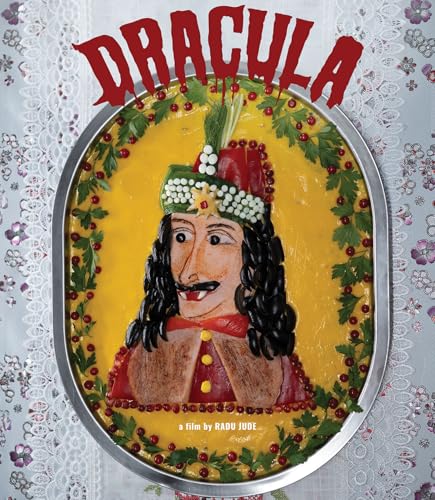
PLOT: A film director narrates the tale of a washed- up actor playing Dracula, while AI- crafted sketches inspired by the vampire myth play as interludes.

Still from Dracula (2025)

COMMENTS: When a movie starts with shots of the historical Dracula—also known as Vlad the Impaler—clearly made by AI, you know you are in for a treat. Romanian director Radu Jude, one of the most uncompromising voices in European cinema today, proves once again his willingness to be weird and sarcastic. Dracula is a spiritual successor to some of his most controversial works, especially the infamous Bad Luck Banging or Loony Porn (2021).

A film director narrates the tale of an actor performing Dracula through a structure somewhere in between sex-show and participatory theater. Jude intersperses a plethora of interludes among this story as the in-film director occasionally asks AI for inspiration and help in creating embedded narratives. This complex form of tales-within-tales recall everything from “The Arabian Nights” to ambitious cinematic projects like Mariano Llinás’ colossal La Flor (2018).

Dracula is a Frankenstein of a movie, a pastiche of vastly different genres and styles. There are adaptations of Romanian vampire tales, love stories set in different time periods, a hyper-stylized farce about a farmer harvesting cocks, a vulgar song, and ads inspired by Nosferatu (1922). Some sketches place Dracula in contemporary Romania to comment on the re-emergence of extreme right and nationalism, while another uses the vampire as an allegory for bloodsucking capitalism, in the vein of Julian Radlmaier’s Blutsauger (2021).  There is even a realistic slice-of-life episode towards the end.

Jude works here with a wide range of styles, from grim realism to surrealism. Some things remain constant, however. The acting is mostly over-the-top with rapid dialogues, as if we were watching a variety show. Jude applies Brechtian techniques, with fourth wall breaks reminding us of the artificiality of everything portrayed here. The theatrical props and AI shots further the theme. Dracula is Jude’s most ambitious work yet, a cinematic mammoth lasting almost three hours and an exemplary labyrinth of narrative complexity.

WHAT THE CRITICS SAY:

“Jude combines A.I., dark humor, tongue-in-cheek humor and unhinged zaniness that creates a surreal experience that might be enjoyed more while drunk or high.”–Avi Offer, The NYC Movie Guru (contemporaneous)

I think this movie is weirder than average
I think this movie is better than average

Dracula [Blu-ray]

  • Region A Blu-ray

List Price : 36.97 $

Offer: 22.36 $

Go to Amazon

CAPSULE: BARBECUE THEM (1981)

Souvliste tous! Etsi tha paroume to kouradokastro

366 Weird Movies may earn commissions from purchases made through product links.

Recommended

DIRECTED BY: Nikos Zervos

FEATURING: Konstantinos Hristidis, Dimitris Poulikakos, Thekla Tselepi

PLOT: The daily escapades of a group of hippies, two men and two women, in 1980s Athens.

Copy Barbecue This! (1981)

COMMENTS: The tale begins after the clumsy introduction of our protagonists, each presented with a distinct musical theme. We follow a group of wannabe hippies with weird names like Daisy, Oratios and Kyros, as if taken out of Mickey Mouse comics.  This group, vagabonds in the eyes of society, live without regular jobs, indulging in free love, listening to rock and roll, and finding money mainly by asking their middle-class relatives. They wander through Athens and the surrounding countryside without clear purpose at first, but find one towards the end of the movie when they attempt to save a friend of theirs from a satanic psychiatrist. Yes, it is as silly as it sounds.

What we have here is a free-form, not exactly coherent, almost improvisational narrative portraying the underground rock music scene of 1980s Greece. Segments attack middle-class hypocrisy, from the pseudo-intellectual reporters who approach our characters pretending to be interested in the underground rock scene to portraits of traditional nuclear families hiding  wild instincts and a myriad of pathologies under a pretense of normalcy. This becomes the main focus of the second half of the film when one family’s daughter, Elenitsa, is put in a psychiatric hospital against her will. Our deadbeats attempt to save her.

This is not a movie that takes itself or its main characters too seriously, however. Daisy, Oratios, Kyros, and even Elenitsa claim to be idealists, but are proven hollow in the end, unable to bring about real social change. An alternative title of the movie roughly translates as “This is how we are waiting to take the castle made of shit?” This is exactly what one of group wonders about himself and his friends, underlining the hollowness of their rebellion. Their fight against the castle made of shit is in vain—because they do not really want to fight, they just want to have fun.

Dimitris Poulikakos, a well known rock musician in Greece, narrates the tale in voice-over. Polikakos also appears in Aldevaran (1975), an earlier Greek movie of a similar style portraying the underground art and music scene of the 1970s.  This movie also shares some DNA with other works of its director, Nikos Zervos, like Exoristos stin kentriki leoforo ( 1979). Not only are there common themes like the hollowness of the hippie lifestyle, but they share similar narrative approaches, defying traditional structures.

If it is not already clear, this is not exactly a surreal movie. It is a parody and deconstruction of middle-class morality and of counterculture idealism, but this only makes it slightly eccentric. It should be noted that technical aspects make it a difficult watch, as the audio quality is really bad. It will also be a real challenge for non-Greeks to find this one. Copies exist online—though not in well-known legit platforms—and some DVDs can be found, but without English subtitles.

WHAT THE CRITICS SAY:

No other reviews found.

I think this movie is weirder than average
I think this movie is better than average