All posts by Alfred Eaker

Alfred Eaker is the director of Jesus and Her Gospel of Yes!, voted Best Experimental Film in the 2004 New York International Film and Video Festival (which can be downloaded from DownloadHorror.com here), and the feature W the Movie. He writes the column "Alfred Eaker's Fringe Cinema" for this site, covering the world of underground film, as well as regularly contributing essays on other subjects.

ROGER CORMAN’S THE INTRUDER (1962)

The Intruder (1962) is a film that , star William Shatner, writer Charles Beaumont (who penned numerous Twilight Zone episodes) and a cast of relative unknowns can put atop their resumes. Predictably, Corman’s most progressive endeavor was his only commercial flop. The Intruder can also lay a considerable claim to being Corman’s best film. Shot in 1961, during the very early stages of the civil rights movement, The Intruder was extraordinarily risky, so much so,  that AIP, Corman’s studio, would not touch it. Corman and his brother Gene produced by refinancing his home. A few gutsy critics lavished admiration and praise, and, after Cannes banned it, a few smaller overseas festivals gave it awards. Alas, awards do not count as a return on investment, and a desperate Corman and his initial distributor Pathé made the drive-in rounds with four different titles in a vain effort to recoup costs. Whether under the moniker Shame, The Stranger, or I Hate Your Guts, it was a hopeless cause. Pathé eventually backed out and Corman distributed the film itself, securing the loss of his own investment.

The filming was no less tumultuous. Corman could have shot the film on back lot, but wanted Southern realism. While the leads were Hollywood actors, the crowds were made-up of townspeople, many of whom were as bigoted as the characters they played. Corman produced a watered down, alternative script for locals to read. Even with the script’s subdued version, the production was filled with tensions.

For the part of the sociopathic bigot, Corman picked the unknown newcomer William Shatner. Shanter later said he would have paid Corman for the part and despite being a Canadian Jew, Shatner embodies Cramer like an evangelical snake oil salesman.

For the incitement-to-hatred crowd scenes, Corman shot all of the long shots with Shatner silently delivering his fascistic speech (adding dialogue in post-production) so the crowd had no idea what he was saying. The closeups, shot after much of the crowd had dispersed, were filmed with Shatner actually delivering his lines. Corman saved the cross burning scene until last, after which director, cast, and production crew immediately drove North, getting out of Dodge.

Still from The Intruder (1962)The Intruder has a refreshingly complex script. Two familiar character actors here have surprisingly three dimensional roles: Frank Maxwell as Tom McDaniel sides with integration, but only in loyalty to the law, not from moral conviction. Leo Gordon was typically known as a stock western heavy. Here, he plays the rowdy and uncouth Sam Griffin,driving his wife straight into the arms of  extrovert charmer Cramer. When the infidelity is discovered, Griffin does not retaliate, or seek revenge. Rather he advises Cramer to leave town. We do not expect this out of Griffin. Nor do we expect this crass vulgarian (or so he seems at first) to be the only local intuitive enough to see Cramer for what he is. Additionally, Griffin shoulders some of the blame for is wife’s unfaithfulness. This is Gordon’s best role and one of the few times he was given a part worthy of his skills.

Other character roles are fleshed out well by actors such as Robert Emhardt and Joey Greene. The writing is complex enough to invite comparisons to the /Burt Kennedy collaborations.

Shatner turns in a great, commanding star performance (no, I am not kidding). Like the script itself, Shatner’s Cramer is fast-paced and smart. He utterly convinces, making one wish he had more roles like this. Beaumont adapted the script from his own novel and actually surpasses his source material.

It is easy to look back and point accusatory fingers long after mores have changed, but Corman and company had the guts to go face-to-face with racial issues in their contemporary climate. It took him 40 years to break even with this film. That he was that far ahead of his peers is true horror.

ROGER CORMAN’S A BUCKET OF BLOOD (1959)

The cult favorite Bucket of Blood (1959) was ahead of its time, literally pioneering the phrase “supplemental feature.” Having finished A Bucket of Blood ahead of schedule, Corman fashioned his supplemental material in a second cult favorite feature, Little Shop of Horrors (1960), shot on an old  set.  As a producer, Corman’s oeuvre is, naturally, outrageously varied, from Z-grade potboilers to arthouse films. Corman’s output as a director was almost as varied, but the quality of his work took an improved turn with this film (with no small assistance from writer Charles B. Griffith, who also penned Shop). Corman’s directing career essentially ended with 1971’s Von Richthofen and Brown, although he returned nineteen years later  for Frankenstein Unbound (1990), which was mostly panned. Like the director himself, Frankenstein Unbound may be underrated; as underrated as some of Corman’s Poe films are overrated.

Still from A Bucket of Blood (1959)Producers Samuel Z. Arkoff and James Nicholson challenged Corman to break his own record of a six day shoot, quality be damned. Despite the five-day shoot, Bucket of Blood remains one of Corman’s best efforts. It is essentially a reworking of House Of Wax (1953) transplanted to a beatnik coffee shop.  (in his only starring role) plays the geek busboy Walter who wants to become as hip as the beatniks, poets, jazz musicians, and artists at the Yellow Door Cafe. Walter not only want to impress his customers, but also his unrequited love: hostess Carla (Barboura Morris). He gets his opportunity when he accidentally kills a cat, panics, and covers up the evidence in clay. He becomes an artistic sensation. Before you can say “Sweeney Todd,” Walter’s next masterpiece is of the two-legged mammalian variety. An irksome detective joins the list of victims turned masterpieces; and, naturally, Walter’s posthumous fame will supersede his homicidal proclivities.

Although Griffith’s humor is obvious and caters to two-dimensional stereotypes of artists and beatniks as insufferably pretentious, the movie wins due to admirable cynicism in the writing, combined with Corman’s staid directorial style and a cast with personality. Although Little Shop of Horrors is probably the better film, Bucket of Blood has earned its status as an authentically quirky cult film.  What may be Corman’s most ambitious “B” film was three years away: The Intruder (1962), a different type of horror altogether, which will appear in this space next week.

I BURY THE LIVING (1958)

 exemplifies the star of yesteryear. He was not a twenty-something, pretty Twilight boy chiseled out of wax. He was craggy and already middle-aged when cast as Paladin in “Have Gun Will Travel,” television’s greatest westerns series. Boone was a perfect anti-hero and a memorable, complex villain in countless films, including ‘s The Tall T (1957). Despite his rough exterior, Boone was an erudite actor, and his proudest accomplishment may have been the tragically short-lived “Richard Boone Show” (1963) which brought repertory theater to small screen American audiences (even if, predictably, the fare was too original for that audience). Boone’s way to starring roles from character parts was a slow one, and his early body of work included low budget genre films, such as the quirky, flawed gem, I Bury The Living (1958).

Boone, one year into the iconic “Have Gun Will Travel,” is as understated in I Bury the Living as the movie’s title is trashy. The film was directed by prolific Z-movie director Albert Band (father of Full Moon Productions’ Charles Band), who gives it a brooding, British noir milieu, employing psychedelic montages (shot by cinematographer Frederick Gatelyand) and expressionist sets (from Edward Vorkapich). It plays like an extended “Twilight Zone” episode with one noticeable difference: an ending which almost kills it.

Still from I Bury the Living (1958)Bob Kraft (Boone) inherits the family graveyard. Former groundskeeper Andy McKee (, who gives a good performance despite an awful Scottish accent) is retiring after 40 years. McKee shows Kraft a large map of the cemetery. The map is basically a pin board: white pins indicate an empty plot, and black ones an occupied plot. When Kraft accidentally places a black pin in the plot assigned to a living person, that person dies. And so it goes. Kraft goes mad after multiple deaths, believing he has the power of life and death via those pins.
What is most remarkable about the film is its low budget style (shot almost entirely in a L.A. cemetery), including what may be the creepiest map in celluloid history. The map transforms several times, growing menacingly. It is like Doran Grey’s canvas as if painted by Franz Kline. In one effective vignette, the map looks like a giant mirror adorned in black pins. Kraft’s mental state and Gerald Fried’s thrashing score parallel the mirror.

A film like this should have gone out in a blaze of glory. Instead, a cop-out finale unconvincingly reveals a disgruntled employee and we don’t buy it one bit. The final montage pulls out all the “Twilight Zone” stops in a imitative way. Despite the flaws, I Bury the Living  is deserving of its sleeper status. Unfortunately , the producers did little to promote it, and the film became buried until it became a mild cult favorite, fell into the public domain, and was lauded by that Fort Knox of obscure genre gold: Sinister Cinema.

BILL MORRISON’S SPARK OF BEING (2010)

Spark of Being can be watched in its entirety for free on IMDB.

Spark of Being (2010) is an example of an artist resisting an aesthetic anchor. ‘s films are often categorized as non-narrative and experimental, so the idea of this artist tackling such a perennial chestnut such as “Frankenstein; or, the Modern Prometheus” leads us to wonder exactly how he is going to deconstruct such a familiar narrative. Throwing out all preconceived assumptions, Morrison pays homage to Mary Shelly and makes her Gothic creation fresh again with a startlingly literal interpretation. Indeed, Spark of Being may be one of the most faithful cinematic adaptations of the book to date.

Using found footage, Morrison teams with jazz trumpeter Dave Douglas and his electric sextet, Keystone, to illustrate Shelly’s tale. Douglas is an eclectic trumpeter who once worked as a sideman with the John Zorn ensemble Masada. With an original score that is simultaneously mercurial and animated, it is hard to imagine a more perfect composer for Spark of Being. 

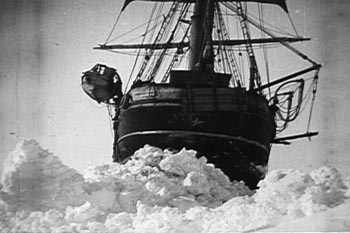
Still from Spark of Being (2010)A frequent (and sometimes justifiable) criticism in films this textured is that the style becomes so all-important the end result is a viewer deprived of a heart to identify with. In short, often, a human element is missing. Morrison has referred to this film itself as “the Creature,” and given the agonized condition of footage chosen, Morrison’s creature may be the most pathos-laden performance of the character since . One can only imagine the painstaking process it took in assembling Morrison’s creation into a cogent psyche, imbued with personality as predominant “presence.” A popular comparison might be the collaboration between  and Claude Rains in producing a personality-driven Invisible Man (1933), but Morrison’s approach is more innovative, while still being true to the author’s tenets. Douglas’ music provides an informative touch of flesh stretched over the cranium supplied by archival footage from Ernest Shackleton’s film of an Antarctic expedition. As in the novel, the film opens here in the segment titled “The Captain’s Story.” The viewer steps with the Captain in his interaction with creator and created and the unfolding tragic drama.

Through laboratory footage we meet “A Promising Student” and adopt his sense of ambition and wonder. Educational footage and decayed nitrate, which looks hauntingly like an intensely animated closeup of an Emilio Vedova canvas, bring “The Doctor’s Creation” to violent life.

In “The Creature Watches” antiquarian city crowds, desolate landscapes and achingly lonely images of a child endow the creature with a Chaplinesque essence. The psychedelic beauty of “The Creature’s Education” is extended and sublime. The heartbreaking “Observations Of Romantic Love” segues into the bitter sting of ‘The Doctor’s Wedding” and the inevitable dejection of “The Creature in Society.” In “The Creature Confronts His Creator,” the new Adam dares to accuse a negligent father, and in “The Creature’s Pursuit” it is God who is tried and condemned. A justifiable patricide is, perhaps, the greatest burden of all. It is the stuff of horror, even nearly 200 year old horror served up in our own mythological consciousness.

BILL MORRISON’S LIGHT IS CALLING (2004) AND JUST ANCIENT LOOPS (2012)

’s Light Is Calling (2004) opens the prestigious 2013 Orphans Midwest Film Symposium at Indiana University, setting an avant-garde tone for the event.

Morrison’s credentials as a experimental filmmaker are considerable, having received widespread critical recognition for the feature Decasia (2002). Morrison’s collages are composed and juxtaposed to music, often by his frequent collaborator composer, Michael Gordon. This technique, combined with Morrison’s obsessive use of decaying silent film and newsreel footage, makes him one of the most startling, original homegrown artists since New Englander Charles “take your dissonance like a man” Ives. Comparing this twenty first century filmmaker to an early twentieth century composer is not as fanciful as might be first imagined, since inherent musicality abides in both, as does a shared aesthetic of deconstructionist Americana.

Light Is Calling will be shown Thursday night at 830 pm. It is part of an evening of film and music, which will include Just Ancient Loops (2012) and the world premiere of Morrison’s All Vows (2013). Israeli American cellist and Bang On A Can founding member Maya Beiser will supply live musical accompaniment. (Beiser’s reputation for collaborating with composers such as Louis Andriessen, Steve Reich, and Brian Eno may prove to be refreshing in a city whose symphony rarely defines progressive art-music beyond the nineteenth century).

Light is Calling, like many of Morrison’s films, follows an existential arc witnessed through layer after layer of resplendently cruel textures produced by severely decomposing nitrate film stock. Here, Morrison uses footage from The Bells (1926), focusing on stars Lola Todd and Edward Phillips. Slithering through the visceral sepia gangrene is the haunting fragility of love, life and, ultimately, meaning. Once fully fleshed, figures become as fragmented and as meaningful as the simple images of riders we find in a late Gauguin canvas. Through the cinematic milieu, accompanied by Gordon’s shimmering, haunted music, Morrison demands more than the lack of attention one might succumb to while whisking through an art gallery; he takes us deeper than the surface paint, to the very texture of the burlap canvas.

Just Ancient Loops breaks down into three sequences: Genesis, Chorale, and Ascension. It is a collaborative work between composer Michael Harrison, soloist Beiser, and Morrison. Nineteenth century symphonist Anton Bruckner described Harrison’s work as “boundlessly expansive.” The Harrison/Beiser opus, “Time Loops,” constructs a homogenous, Brucknerian cathedral. The artists’ refreshing consistency of purpose embraces the transient station of a paradisaical hour. From a solar eclipse to consummating cells, and the expulsion from paradise, the three artists dance with their putrefied avatars: hand tinted witnesses to the resurrection and ascension.