
Neither director William Keighley nor actor Errol Flynn are remembered as heavy-hitters in the Western genre, but the two collaborated for a low budget, remarkably grim effort in 1950’s Rocky Mountain. Flynn is, of course, remembered for being the king of the sound swashbucklers, even though he did a total of seven westerns. Flynn justifiably felt he was ill-suited to them, and with commendable self-depreciation he referred to himself as “the rich man’s Roy Rogers.” In his earlier westerns, Flynn’s disdain shows in his performances. However, it is in two later films, when the actor was well into personal and professional decline, that he briefly became an interesting, weathered star in the genre.
Flynn’s plasticity as an actor mars many of the films from his first decade, even including his certifiable masterpieces such as The Adventures of Robin Hood (1938). Modern audiences understandably have a difficult time with Flynn’s phallic brandishing and thrusting of his chest while he eeks out lines like, “come on men, let’s win one for Her Majesty, the Queen!” One can easily understand Bogart’s dismissal of the young Flynn’s acting as “phony.” Later, in his last three years, Flynn was a too-far-gone, cirrhosis-ravaged caricature in films like The Sun Also Rises (1957) and Too Much, Too Soon (where he played his idol, John Barrymore). Critics of the time praised Flynn’s performances in these films as authentic, but today they register as a final, pathetic stab by an actor who realized that his hedonism had defeated his potential as an artist. In between these two extreme phases, Flynn gave a number of interesting, world-weary performances in mostly mediocre films.
Starting in the late forties, the plasticity in Flynn’s acting diminished in favor of a more subtle realism. He is much more interesting and mature as an actor in The Adventures of Don Juan (1948) than he is in his swashbucklers of the thirties, even if the film, as a whole, is not as good. Critics rightly praised his earthy acting abilities in the war melodrama Objective Burma (1945), but that film offended the British by omitting their contributions to the war effort, and it was yanked off screens after a short run. Likewise, Flynn is far better in the underrated Raoul Walsh directed Silver River (1948) than he is in any of his earlier Westerns, including the lavishly budgeted and decorated Dodge City (1939), in which Flynn’s superficiality is woefully apparent.
 As good as Flynn is in the still frustratingly unavailable Silver River, he is equally effective in Keighley’s Rocky Mountain. Keighley is mostly known for being fired as director of the aforementioned Robin Hood. Apart from that, he competently directed a number of routine efforts, but never really showed a vision for any of his projects. Perhaps re-teaming with Flynn for Rocky Mountain was an inspiring chance to make amends for Robin Hood, since this is a cut above Keighley’s normal standard, even though his lack of an imaginative directorial touch is still apparent.
A poor choice was made in the film’s narration, and it is a serious flaw, even if there is a bit of unintentional irony in the movie being narrated by a character who dies. However, the producers made a good choice to omit the usual comic relief found in most of Flynn’s movies. Thankfully, the hammy antics of an Alan Hale are nowhere in sight to disrupt the decidedly downbeat milieu.
Flynn is the grizzled Lafe Barstow, captain of a ragtag Confederate army detachment, sent by his superiors to California to raise a guerrilla force. The New Mexico desert landscape is bleak, barren and strikingly expressionist, echoing the fate in store for Barstow and his unsavory team. Rocky Mountain prefigures the stark, flawed protagonists and character-driven, fatalistic plots that populated the Western genre in its 1950’s jubilee.
Barstow and his men sidetrack their mission to come to the rescue of a stagecoach being attacked by Shoshone warriors. Joanna Carter (Patrice Wymore, who became the third and last Mrs. Flynn shortly after filming) is the lone survivor of the stagecoach. She is also the fiancée of a Union officer who will soon appear to further disrupt plans. One expects a romance to follow between Barstow and Carter but, thankfully, that never materializes. Instead, Carter is taken hostage by the empathetic Barstow.
Wymore is effective in her equally empathetic performance, as is Slim Pickens and Flynn regular Guinn “Big Boy” Williams. Keighley admirably keeps the extroverted antics of those two character actors in check, eliciting surprisingly low-key performances. Keighley may not have been the most assured director in Hollywood, but he was an actor’s director who gave his star and cast well-rounded roles, making one wish Flynn had been able to work with this director more often. Flynn rises to the occasion, proving he could be a hell of an actor when given the opportunity by a director who wanted a bit more than the typical role of merely being “Errol Flynn.”
Rocky Mountain ends on a true blue note, but not before Barstow engages in a last act of heroic gallantry. However, this time Flynn’s on-screen heroism springs not from chest-beating, flashing teeth, or a Captain Blood-styled patriotic call to arms. Instead, his chivalry is a shrug, a final gasp, fully accepting the consequences for choosing a human life over the good of the cause. Barstow’s choices even impress Carter’s sourpuss of a fiancée. Of course, there is nothing more gallant than placing the individual over the movement. It’s downright Biblical.

 Fifty-year-old NYU film grad Pablo Berger chose a familiar story: the Brothers Grimm’s “Snow White and the Seven Dwarfs.” This adaptation came on the heels of Hollywood’s pedestrian Snow White And The Huntsman (which predictably made a gazillion dollars) but represents a much darker, idiosyncratic telling of the tale. Berger grasps an important aesthetic of silent film: its sense of otherworldliness. Berger clearly relishes a hallucinatory texture akin to silent artists such as
  As young Carmen grows, she is never allowed to visit her father. After her grandmother’s death, Carmen is transferred to her father’s estate and sadistic stepmother Encarna. Chopping off Carmen’s hair, butchering her pet rooster, and separating a daughter from her imprisoned, suffering invalid father are the tenets of this quintessentially evil fairy tale mommie dearest.
 Presley followed G.I. Blues with Flaming Star (1960), a progressive western, directed by that taut craftsman,
  Presley’s acting in Flaming Star is simple and not bogged down with the type of dialogue he would have been ill-suited for. While Brando would have given an excellent performance, Presley delivers a commendably natural one. As a half breed, he has divided loyalties in this tale about racism. Thankfully, Siegel and scriptwriter Nunnally Johnson do not lose focus. For the first and only time, Presley has no love interest. Here the trailers, again, were misleading, making it look as if a King was romantically entangled with a genie. Actually, Roslyn (Barbara Eden) is the “britches wearin'” girlfriend of brother Clint (Steve Forrest).
 One cannot approach High Noon without addressing its political themes, both within the film’s text and those raised in its aftermath. Along with writer Formean, co-star Lloyd Bridges and cinematographer Floyd Crosby were also awarded with temporary blacklists until the FBI cleared them of Communist affiliations. The fifty-one year old Gary Cooper was engaged in an affair with his twenty-three year old co-star Grace Kelly (putting an end to Coop’s affair with Patricia Neal.) Kelly’s fling with the long established Republican protected her from McCarthyism’s scrutiny. Cooper was friendly with the HUAC, and testified before them (without ever naming names), but he only did what was expected of him, then returned to his top priority of resuming his romance with a future princess.
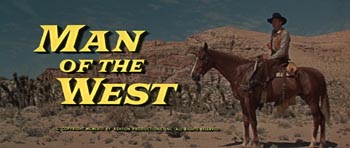 Link Jones is about to catch a train headed for Texas. He is on a mission to find a school teacher for his small town’s new school, and is carrying the funds to pay for her. A Marshall at the local train station thinks he recognizes Link, asks Link his name, inquires into Link’s past, and asks him if he knows the fugitive Doc Tobin (Lee J. Cobb). Link cautiously shakes his head, lies, squints, and evades the Marshall’s penetrating looks. Mann’s expert manipulation of Cooper’s personality traits is so subtle as to be believable and, thus, unnerving. It was unsettling enough for 1958 audiences to reject it, and even contemporary critics have often lamented the casting of Cooper, as opposed to Stewart, in this film. Stewart would not have worked nearly as well, simply because his casting would have been acceptable, even expected.