All posts by Alfred Eaker

Alfred Eaker is the director of Jesus and Her Gospel of Yes!, voted Best Experimental Film in the 2004 New York International Film and Video Festival (which can be downloaded from DownloadHorror.com here), and the feature W the Movie. He writes the column "Alfred Eaker's Fringe Cinema" for this site, covering the world of underground film, as well as regularly contributing essays on other subjects.

HENRY KING’S THE BRAVADOS (1958)

Henry King may be the most quintessentially American of American filmmakers. Compared to the likes of the stylized extrovert John Ford, King is a straightforward director and, therefore, remains one of the underrated American symphonists (putting him in good company with forever underrated fellow American symphonists, such as David Diamond and Paul Creston). Twelve O’ Clock High (1949), The Gunfighter (1950) and The Bravados (1958) are all integral canvases of the American frontier landscape that King made with Gregory Peck, yet the latter two languish in near obscurity.

King often directed Peck, and in Peck King had his best collaborator. Gregory Peck was the real deal. With Peck, one does not have to separate the artist or the persona from the actual person (as we have to do with ). Gregory Peck fit the bill of integrity and nobility on and off-screen and, thus, personifies the best and most honestly masculine qualities in the Western (which, along with jazz, is one of the two great American art forms).

Together, King and Peck vividly imprinted these qualities into each film without flinching from the flaws, warts and frailties which flesh out and give resonance to well-rounded characters. King and Peck had created their previous Western, The Gunfighter, eight years earlier. That is a film which deserves all the accolades it has received. The Bravados has less of a reputation. It is a very different film than The Gunfighter, yet it deserve a wider audience. While The Gunfighter was shot in stark black and white, in color The Bravados benefits greatly from cinematographer Leon Shamroy’s sense of composition and use of ethereal blue filters.

Still from The Bravados (1958)The Bravados, at first, seems to be another standard revenge film, but it is the juxtaposition of faith and violence that gives this film its tense individuality. Here again, we have the authenticity of Peck, the man of a deep Catholic faith that informs his role, imbuing it with a striking intensity. Peck conveys emotions with expert skill, acting with his eyes and an internal hesitancy. He stops short of speaking several times. Peck makes this a remarkable role.

Then, in direct contrast, is Joan Collins. Playing the old flame, Collins was still fairly early in her career, and it shows. Despite her reputation, Collins did eventually sharpen her acting skills considerably, but that improvement is not yet in evidence here. In several scenes, such as her initial reunion with Peck, discovering his past via a local priest, or pleading with him to take revenge, Collins is stiff. Her part is also underwritten and awkward, rendering her mostly decor, a role she does succeed in filling out. Still, Peck’s attraction to her never registers.

Future Stooge Joe DeRita is quite good in his eccentric characterization. His is a small role, but he fleshes it out with personality, making one wish he had taken this Western character actor route instead of being a comic fill-in. Of the four antagonists, only Stephen Boyd and Henry Silva have any real personality. Boyd is a real, slimy threat. Silva is admirably restrained when face-to-face with his hunter.

The shifting landscapes make for interesting expressionist parallels. The rugged, rocky canyon terrain gives way to an ominous forest in which Peck both murders and escapes murder. A waterfall provides temporary sustenance. A small, claustrophobic cabin houses the ugly, terrible truth. The unrealistically large Catholic parish contains the vast possibilities of sanctuary and redemption, but that is only reached after revelation at the home of the good thief, where Peck meets surprising hospitality and familiarity.

The Bravados is a harsh, brooding, tautly paced example of the 1950s western at its most adult. Despite some minor flaws, it is a stand-out in its genre, during a great decade.

RUDOLPH MATE’S BRANDED (1950)

Rudolph Maté’s Branded emerged at the dawn of the 1950’s. It stars Alan Ladd and is little remembered today, due in part to Ladd’s being cast in George Stevens’ phenomenally popular Shane a mere three years later. I do not side with the consensus of contemporary criticism in the reassessment that says Stevens’ classic is overrated, just as I will not concede to revisionist opinions regarding High Noon (1952), although I do believe there were, and still are, better westerns: Henry King’s The Gunfighter, ‘s The Tall T, or Anthony Mann’s Naked Spur. However, Branded is as almost as good as the film which sealed the surprising superstardom of Ladd.

There is something quintessentially cinematic and mythic in the image of a man on a horse under an expansive sky. Branded fills that bill to the Technicolor brim, contradicting an often held opinion that Westerns simply look better in black and white. Sydney Boehm’s unpredictable screenplay comes from a Max Brand novel and meshes well with Maté’s sense of pacing.

Alan Ladd was an actor of limited range, and came off best when his persona of icy precision was used to full advantage, as it is here in the role of Choya. This film literally starts off with a bang. Choya holes up in a general store, surrounded by enemies. He pulls off an exciting escape and teams up with T. Jefferson Leffingwell (Robert Keith) and his aptly named partner, Tattoo (John Berkes). Leffingwell has a guaranteed get rich scheme. Leffingwell knows of a wealthy ranch family with a long lost son who was kidnapped 25 years ago. The son had a unique birthmark, which Tattoo tattoos on Choya’s shoulder. Once Tattoo’s services are no longer needed, Leffingwell brutally murders his partner to increase his share. Choya doesn’t seem to care.

Choya arrives at the Bar O-M Ranch looking for work. The ranch foreman, Ransom (Tom Tully) recognizes a gunslinger when he sees one and is reluctant to take Choya on, but does so at the insistence of the rancher’s daughter Ruth Lavery (Mona Freeman). Choya plays the chip on his shoulder to the hilt, resulting in a fight in which he conveniently loses his shirt, revealing his “birth mark.” Upon seeing Tattoo’s handiwork, the family is convinced that Choya is their long lost son.

Poster for Branded (1950)Along the way however, Choya starts developing a conscience after coming to like his new family. Additionally, falling in love with his “sister” doesn’t help. After feeding Choya enough background information to fool the ranchers, Leffingwell, tired of the long wait, pops up to make a nuisance of himself and throws a monkey wrench into the unfolding plot. Keith registers trashy slime to perfection in the role. Ladd is equally impressive in the role of Choya and has, in Maté, a rare director who expertly knows how to utilize his actor’s limitations and personality. Matte draws a tormented, internalizer fire out of Ladd, by keeping it under a layer of thick, exterior ice. Ladd’s character is so apt at piling lie upon lie while increasingly sympathizing with the victimized family that we genuinely do not know which way he will go and, indeed, initially find him to be no better than Leffingwell. Branded is a film which does not flinch from conveying a struggle towards spiritual redemption, and Matte enhances the message with his cinematographer’s eye for sumptuous composition.

Branded is a bit like discovering music from the Gil Mellé Quartet after repeated exposure to the better known masterpieces from Miles Davis & John Coltrane (and there is something so right in likening the western genre to jazz) . Compared to the likes of Ford, Mann, Boetticher, Peckinpah, or Leone, Rudolph Maté is barely a blip on the radar, but his Branded is a worthwhile blip.

DAY OF THE OUTLAW (1959)

The films of Andre De Toth are slowly being paid their due recognition in the DVD market. As prolific and versatile as De Toth was there are, of course, hits and misses. While some of De Toth’s weaker films, such as The Stranger Wore a Gun (1953) and The Indian Fighter (1955), are readily available, other, far more notable works such as Ramrod (1947) and The Bounty Hunter (1954) still languish in obscurity. De Toth is best known for being the one-eyed director of the 3D House of Wax (1953), the noir classic Crime Wave (1954), and as one of the great Western revisionists of the 1950s (he wrote the story for 1950’s The Gunfighter).

Snow sets the extraordinarily bleak tone in Day of the Outlaw, even more than it did in De Toth’s previous Springfield Rifle (1952). Here, as is often the case in a De Toth film, an older hero is at the center of the story. Blaise (noir fan favorite Robert Ryan) and Dan (Nehemiah Persoff) are traveling to the aptly named town of Bitters. They are frostbitten and struggling to move through the thick snow drifts. Blaise whips his horse with determined intensity. The horse stumbles lethargically. Blaise, a rancher and gunfighter, is furious over the barbed wire fence that has been put up by farmer Hal Crane (Alan Marshal) and vows to kill Crane. A very tired Dan tells Blaise (in a hoarse voice), “A wire fence is a poor excuse to kill a man.” Blaise’s motive runs deeper. He has been having an affair with Crane’s wife Helen (Tina Louise).

The scene shifts from the seemingly endless snowy abyss to a claustrophobic saloon where, it seems, confrontation looms. First, Helen confronts Blaise. She tells him the affair is over and warns him not to harm her husband. Blaise promises nothing. Blaise then confronts Hal, provoking an inevitable showdown. Blaise represents the seasoned renegade spirit (a frequent De Toth theme) at odds with the arrival of civilization in the form of younger, weaker men (Hal and the farmers).

Still from Day of the Outlaw (1959)Despite Helen’s pleas, Blaise fully intends to kill Hal. She reprimands Blaise for his lack of mercy. “You won’t find mercy anywhere in Wyoming” he retorts. Bitter indeed. Blaise is about to leave Helen a widow and rid himself of an annoying farmer, but he is suddenly interrupted by a true threat in the form of outlaw Jack Bruhn (Burl Ives) and his gang. At this point, De Toth’s narrative takes a dramatic and refreshingly unexpected shift.
Bruhn, like Blaise, is a dying breed—literally dying, from a gunshot wound received in a recent bank robbery. Stark tension permeates Day of the Outlaw as Bruhn faces certain death while struggling to maintain control of his gang and the situation. The claustrophobia is a prison for both Bruhn and Blaise. They engage in a battle of wills while finding an uncomfortable identifying ground. Both men discover their own fallibility in the process and willingly take a contrarian, fatalistic course of action, which shifts the narrative to its bleak and cynical finale.

The final quarter of the film is replete with desolate symbolism. Insatiable greed is juxtaposed against Russel Harden’s sumptuous camera capturing the merciless, ominous landscape. Underneath the shifting terrain lies a steely goal of self-obliteration.

Day of the Outlaw stays with you long after the credits have faded, imprinting an indelible image of coarse whites. It may indeed be De Toth’s finest work, and that is saying quite a bit.

THE ADVENTURES OF PRINCE ACHMED (1926)

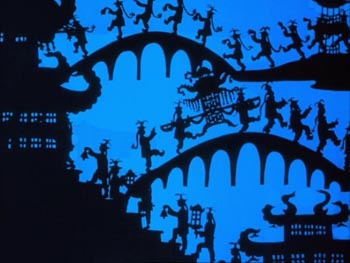
Historians, film buffs, and Disney fanatics all cite Snow White and the Seven Dwarfs (1937) as the first animated feature. While it is the first animated feature as we Americans tend to think of animation, actually that “first” honor goes to a little known, innovative oddity from eleven years earlier. The Adventures Of Prince Achmed (1926) is a labor of love from the pioneering female German filmmaker Lotte Reiniger and her husband, Carl Koch.

What makes Achmed still unique 88 years later is animation entirely composed of cutout silhouettes. The result  was one of the silent era’s most enchanting and captivating films. It is also a lucid reminder that the medium of film was at its most innovative in its infancy, before the rules were set and the mediums defined.

Reiniger lucked into a patron for her artistic efforts: Louis Hagen supplied her with enough film stock and financing to proceed with her project. Using scissors and black construction paper as her primary tools, Reiniger spent three years meticulously working in an attic on Achmed with a small crew that included her husband/cinematographer, Koch.

Influenced in part by Georges Méliès and Arabian Nights, Reiniger created a world of sensuous, exquisitely detailed beauty. The film has an almost surprisingly coherent and linear narrative, given that Reiniger was embraced by the European avant-garde. Unfortunately, the director had difficulty booking Achmed, and with the exception of Dr. Doolittle And His Animals (1928), the rest of her career was relegated to short films. There was work on a third feature, to be based on Maurice Ravel’s enchanting opera, “L’Enfant et les Sortilèges”; unfortunately, rights to the music could not be secured and the film was abandoned. The Adventures Of Prince Achmed is the only one of Reiniger’s films to date that has seen a home video release. Some of her shorts occasionally appear on television, but often in truncated versions. One such example is Doolittle, which has aired with added (and intrusive) voice over narration, coupled with woefully inadequate projection speeds. Fortunately, YouTube has been more respectful. The Star of Bethlehem (1921), Cinderella (1922), The Adventures of Prince Achmed, Papageno (from Mozart’s “The Magic Flute”) (1935), The Magic Horse (1953), and Jack and The Beanstalk (1955) along with a short documentary of her work can all be found there. The documentary shows her storyboarding techniques and the almost rapid-fired speed at which she crafted her baroque figures.

Still from The Adventures of Prince Achmed (1926)There is a noticeable gap of activity in Reiniger’s filmography from 1938 to the early 1950s. With the rise of Fascism, Reiniger and Koch struggled to flee Germany. Although not Jewish, politically they leaned left, which marked them as subversives. Jean Renoir was among those who aided the couple, but they lived in abject poverty until finally being able to settle in England in 1949. Despite the initial financial failure of Achmed, Reiniger and Koch were respected in film circles and were able to be relatively prolific.

Achmed is of its time in its portrayal of the good guys as completely good, bad guys as completely bad, and the pretty girl as in need of saving (Reiniger’s later films frequently had biblical, Victorian, fairy tale, and operatic themes). Still, it’s put over so beautifully, even the most hardened cynics will hardly care. The color tinting renders the film a phantasmagoric smorgasbord of gemstones. Achmed is awash in emeralds, sapphires, rubies, garnets, aquamarines, amethyst, topaz, citrine, tanzanite, and fire opal.

The Adventures of Prince Achmed weaves interrelated narratives involving our protagonist, his princess sister, their Caliph father, an erotic heroine (who Achmed voyeuristically spies on while she is bathing), a flying horse, a malevolent shape shifting African magician, the Witch of the Fiery Mountain, dancing harlequins, sphinxes, terrifying demons, Aladdin, and the genie of the magic lamp. Locales include an exotic island, a majestic palace, Peru, and China.

Reiniger was  master of her medium and an innovator. Every step through her unique world is an enchanting one.

FELIX THE CAT 1919-1930

In 1999 Image Entertainment released a DVD compilation of “Felix the Cat” cartoons, from the character’s debut in 1919 to 1924. Inexplicably, Image never followed up with a second collection, and allowed Presenting Felix the Cat to go out of print. Naturally, used copies now fetch high prices. This leaves us with another, briefer collection from Slingshot Entertainment, also from 1999, to take up the slack. The Slingshot release can be purchased for slightly less than a McDonalds Happy Meal, and it will not clog your arteries. The presentation is not as extensive as that from Image, but neither edition is ideal.

Felix the Cat predates Mickey Mouse by a decade but was just as popular in the 20s as Walt’s rodent was in the 30s. There is a longstanding dispute over who exactly created Felix, but he was born in the studio of Pat Sullivan. Sullivan’s animator, Otto Messmer, usually (and probably rightfully) receives the bulk of the credit. Felix shot to stardom rapidly, but faded in the 30s when Sullivan was reluctant to make the move to sound, thus paving the way for Mickey’s meteoric ascent. The Felix character was revived in a weak, imitative TV series in the 1950s, and has appeared in two execrable feature films.

Although the quintessential compilation of Felix at his earliest (and best) remains to be released, the still-available Felix The Cat 1919-1930 will have to suffice until then.

In his original incarnation, Felix is boxy looking, almost a cubist parody, as are the dialogue balloons. It adds to the surreal quality of the films. Like most early animation icons, Felix evolved. In 1924, he would become lithe and more appealing, as we recognize him now. Although rounder in looks, Felix has not yet lost his sharp aesthetic edge, although that was to come.

Felix’s debut is in 1919’s Feline Follies. It is an undeniably primitive effort, but does have a surprisingly dark finale. Felix is named “Master Tom” here (he would be renamed shortly). Master Tom is feeling amorous. Luckily for him, a white feline shows up to pacify his raging libido. Naturally, nothing is easy, and Tom is required to serenade his new lady love. With all this activity, Tom neglects his mousing work, leaving his house vulnerable to an army of destructive Mickeys. This gets Tom booted out of home sweet home and, to make matters worse, Tom discovers his feline is unfaithful. What’s a Tom cat to do? Kill himself at the gasworks, of course!

Felix Saves The Day (1922) beings with Felix emerging from his ink pen to play baseball. A runaway ball lands his human playmate in hot water, with Keystone Kops flying over (live action) skyscrapers to make their arrest! Racial stereotyping in the 1920s movies was certainly not exclusive to live action films: with our human baseball hero in a Tower of London like penitentiary, the team is losing to the “Tar Hills,” a team of mammy-styled caricatures. Felix climbs up a row of question marks to alert his bosom mate. The only hope is rain, so Felix pinch hits for the team, driving his baseball straight up to Jupiter, who angrily decides to send a downpour to spoil the game. Felix saves what turns out to be a surreal day.

, Ben Turpin, Douglas Fairbanks, and Will Hays all show up in Felix In Hollywood (1923), making it a delightful time capsule. Felix’s owner is a serious stage actor who laments having to go to Hollywood to ply his trade. Felix transforms into his master’s handbag, hitching a ride. Once in Tinseltown, Felix encounters the celebrities and, removing his tail, turns it into the Tramp’s cane. Felix’s act of plagiarism incurs Charlie’s wrath, but after saving Fairbanks from a mesquiteer, Felix earns the coveted studio contract. (This short was listed in Jerry Beck’s famous “50 Greatest Cartoons,” and was the only Felix cartoon to make the list).

Felix plays a good, if questionably effective, Samaritan in Felix Dopes It Out (1924). A down-on-his-luck alcoholic laments the curse of his gin-blossomed schnoz. Ready to eat a bullet, the Felix stops the act of self-murder with a promise of a cure for the poor fellow’s red nose can be found on the isle of Boola-Boola. With handy question mark in hand, a tub, and some long johns, Felix sets sail. The island is populated by cannibals, who are depicted as ape-like savages. Felix steals the secret cure: “Drink more til your nose turns blue.”

Futuritzy (1928)  is not prime Felix. The cat has his fortune told by a gypsy, and does not like her prediction of misfortune. He goes to an astrologer next, who predicts riches and a pretty girl. There is an interesting homage to Charles Lindbergh (who had made his famous flight the year before). Unfortunately, yet another racial caricature dates Futuritzy in the worst possible way.  

Still from Woos Whopee (1928)In sharp contrast, Woos Whoopee (1928) engages in full-throttled surrealism, with a narrative excuse: Felix gets smashed out of his skull at the Whoopee Club. In his intoxicated, hallucinatory state, Felix has a run in with a frisky street light, various animals, smokes his own tail, gets swallowed by Jonah’s whale (which mutates into an aggressive trumpet), and has to come home to a wife, who mimics his own crouched pacing.

Comicalamites (1928) is inventive, slapstick surrealism. Felix interacts with the animator throughout. Drawn but not inked, our hero gets fleshed out with the aid of a shoeshine man. Felix stumbles upon a weeping feline whose boyfriend has left her. Finding the girl not so pretty, Felix erases her faces a draws her a new one. Now, the potential girlfriend cops a Julie London attitude and catapults Felix in the role of sugar daddy. This means a pretty dress, fine jewelry, and a fur coat. Felix’ scavenger hunt takes him to the bottom of the ocean, making it the most visually sophisticated of the lot.

Despite the title, there are, oddly, no actual 1930 shorts here (the latest dates 1928). However, there is brief footage of Messmer designing billboard animation. The new musical accompaniment is by Jell Roll Morton and His Red Hot Chili Peppers. This release barely makes a dent in Felix’s extensive silent oeuvre, but it is a worthwhile dent.

Comicalamites (1928)