All posts by Gregory J. Smalley (366weirdmovies)

Gregory J. Smalley founded 366 Weird Movies in 2008 and has served as editor-in-chief since that time. He is a member of the Online Film Critics Society, and his film writing has appeared online in Pop Matters and The Spool.

BEHIND THE REAL WORLD: JOHANESS NYHOLM ON KOKO-DI, KOKO-DA

Note: The following interview may contain slight spoilers for Koko-di, Koko-da.

Koko-Di Koko-Da Director Johannes Nyholm_sm
Johannes Nyholm (photo courtesy Fantasia Film Festival)

is a Swedish animator and filmmaker with two features under his belt: the humanistic fantasy The Giant [Jätten] (2016) and 2019’s horrific Koko-Di, Koko-Da (read Giles Edwards’ complete review).

Koko-di debuted at Sundance, won the “Camera Lucida” prize at Fantasia, and is currently playing at Austin’s Fantastic Fest (catch the final screening on September 26). Dark Star Pictures has acquired the movie for a November 15 U.S. theatrical release.

The title comes from a macabre children’s nursery rhyme (“my rooster is dead, he will never sing koko-di koko-da”). The story involves a married couple—once loving, now squabbling—who go on a camping trip in the woods four years after a tragedy ripped their lives apart. Once there, they wake in the middle of the night to find the same events repeating themselves. Three figures trudge out of the woods: an old man dressed in white, a tall female leading a vicious dog, and a unibrowed giant with a dead dog slung over his shoulder. The trio terrorize the campers; then, they wake up in their tent, as if from a dream, and the cycle repeats itself. The man becomes conscious of what is happening and futilely tries new strategies to avoid their fate. All the while there is also a mysterious white cat running around in the woods, and scenes from a bizarre shadow play where animal puppets reenact a peculiar fable that seems relevant to the couple’s personal history. Will they escape this treadmill of horror and recrimination?

Koko-d Koko-da Key art
(c) 2019 Johannes Nyholm Produktion

366 Weird Movies’ spoke with Mr. Nyholm via telephone.

366: Would you consider this a Swedish or a Danish film? According to IMDB both languages are spoken in the film.

Johaness Nyholm: Mostly Swedish. We shot most parts in Sweden, and most of the team was Swedish as well. But I have a Danish co-producer who helped a lot on the film, and there is quite a lot of Danish spoken, especially from one character in the film.

366: I think it’s fair to say that this is a mysterious movie, in many ways, and I wanted to know if you thought there were any cultural references that Scandinavian audiences might pick up on that people in other countries might not get.

JN: No, I don’t think so, actually… the music is a French lullaby.

366: I was wondering if the “Koko-di Koko-da” song was written specifically for the movie or if it’s a traditional folk song.

JN: No, it’s a traditional folk song. Of course, we made many different versions of it.

366: Peter Belli is a well-known Danish singer. Did you have him in Continue reading BEHIND THE REAL WORLD: JOHANESS NYHOLM ON KOKO-DI, KOKO-DA →

APOCRYPHA CANDIDATE: BERLIN ALEXANDERPLATZ (1980)

DIRECTED BY:

FEATURING: Günter Lamprecht, , ,

PLOT: After four years in prison, wife-murderer Franz Bieberkopf is released into Weimar Germany; he tries to go straight, but with no means of employment, he soon returns to the criminal underworld, with tragic results.

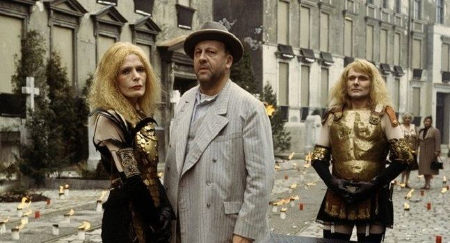
Still from Berlin Alexanderplatz (epilogue) (1980)

WHY IT MIGHT MAKE THE LIST: We’ve toyed with the idea of considering self-contained TV miniseries as “movies” for classification purposes before; Berlin Alexanderplatz, a celebrated masterpiece of world cinema from an auteur with eccentric tendencies but nothing on the List, makes perhaps the best case for loosening our criteria—especially since the result would be classified as “apocrypha” rather than canon. A miniseries adapting Alfred Döblin’s modernist novel, first broadcast on German television, Alexanderplatz is a fifteen hour dive into an enigmatic character told through a fluid mix of straight drama, melodrama, poetic monologue, and surrealism. The two-hour capstone installment, a frenzied passage dubbed “My Dream of the Dream of Franz Biberkopf by Alfred Döblin, An Epilogue,” could well stand alone as a weird movie classic—but it can’t be appreciated without first seeing the thirteen hours that came before.

COMMENTS: Oddly, it was the second episode that sold me on Berlin Alexanderplatz. The first introduced our protagonist, Franz, newly released from prison after a four year stay, briefly suffering from disabling agoraphobia until a friendly Jew tells him an obscure parable, visiting—and raping—an old acquaintance, and finally swearing an oath to go strait. It was strange stuff, setting up intriguing possibilities, but I was not all-in just yet.

That second episode was, in a way, comparatively ordinary. Desperate for a job, with legitimate employment in 1920s Berlin rare in even for non-felons, Franz agrees to put on a swastika armband—reluctantly—and sell newspapers for the newly-formed Nazi party. This decision causes him trouble when a fellow vendor, who happens to be Jewish, confronts him, followed by an old friend who’s now a dedicated Marxist. Franz, who is proud to be German but has nothing against the Jews (or anyone), eventually quits the job, but not before the gang of Communists accost him in a bar. He almost smooth talks his way out of the confrontation, but can’t resist responding to their taunts by singing a Nationalist song as a response to their chorus of the “Internationale.” Angered, they back him into a corner. In a frightened fury, one man against a gang, he is forced to raise a chair to defend himself.

It was at this point that I realized that I’d gone from simply following Franz’s story to rooting for the poor reprobate. Fassbinder brought me, slowly, to sympathize with a killer, a rapist, a pimp, and a Nazi Continue reading APOCRYPHA CANDIDATE: BERLIN ALEXANDERPLATZ (1980) →

3*. SINGAPORE SLING (1990)

Singapore sling: O anthropos pou agapise ena ptoma

AKA Singapore Sling: The Man Who Loved a Corpse

“You know the feeling of something half remembered,
Of something that never happened, yet you recall it well;
You know the feeling of recognizing someone
That you’ve never met as far as you could tell…”–Johnny Mercer, “Laura”

Recommended (with caution)

DIRECTED BY: Nikos Nikolaidis

FEATURING: Meredyth Herold, Panos Thanassoulis,

PLOT: A detective is searching for a missing girl, Laura, a supposed murder victim with whom he was in love and who he believes is still alive. Suffering from an unexplained bullet wound, he follows the trail to a villa where a psychotic “Daughter” and an equally insane “Mother” live in a sick relationship, hiring servants whom they later kill. When the enfeebled detective stumbles to their door, the two women capture him, dub him “Singapore Sling” after a cocktail recipe they find in his pocket, and use him in their sadomasochistic sex games.

Still from Singapore Sling (1990)

BACKGROUND:

  • Much of the plot references ‘s classic thriller/film noir, Laura, including prominent use of the famous theme song.
  • Director Nikos Nikolaidis is well-known in Greece and is sometimes considered the godfather of the “Greek Weird Wave” films (best known in the work of ). Singapore Sling is his only work that is widely available outside of Greece.
  • Singapore Sling was one of the top three vote getters in 366 Weird Movies first Apocryphally Weird movie poll, making it one of the most popular weird movies left off the 366 Weird Movies canon.

INDELIBLE IMAGE: Warning: there are a lot of images in Singapore Sling which you would probably like to forget, but will be unable to. Among the least objectionable (believe it or not) is Daughter’s memory (?) of losing her virginity to “Father”: he appears as a bandage-swathed mummy.

TWO WEIRD THINGS: Earrings on organs; mummy incest

WHAT MAKES IT WEIRD: Imagine a cross between Laura and Salo, as directed by a young dabbling in pornography, and you’ll have some idea of what you’re in for—but it’s slightly weirder than that.


Short clip from Singapore Sling (1990) (in Greek)

COMMENTS: Singapore Sling blatantly references Otto Preminger’s Continue reading 3*. SINGAPORE SLING (1990) →

REPORT: MIDSOMMAR DIRECTOR’S CUT (2019)

First, the bottom line: if you saw Midsommar (review) in its original summer run, there’s no pressing need to revisit it so soon. In all likelihood you’ll barely even notice the new director’s cut material. If you missed it the first time around and a theater near you is showing it, however, this is a nice opportunity to catch the summer’s sunniest folk horror on the big screen. (Apparently, the only other way to see the extended cut will be via Apple TV beginning on September 24, where it will screen exclusively—for the time being, at least.)

Midsommar (2019) Promotional imageAs far as what’s new: twenty five minutes of restored material is not a lot, but it pushes the overall runtime to a taxing 2 hours 50 minutes. The additions change nothing significant, and maybe in one case blunt the film’s impact. Some of the early scenes, such as the trip from Stockholm to the Hårga commune, are extended for character development purposes. Christian, Josh and Mark all come off worse.  There are also a few additional scenes of pagan rites.

The most noteworthy departure occurs when the commune stages another pageant, but this time set during the few hours of midsummer darkness. The ritual itself is effective, playing with our expectations, but will only surprise those who didn’t see the theatrical cut. It’s followed by an explosive argument between Christian and Dani, which I think was too on-the-nose, and likely a minor mistake. The movie works better when we glimpse the rift between them as just a hairline for as long as possible, making the final crack more devastating. I appreciate the appearance of a nighttime scene, which dramatically breaks the film’s sunshine motif, almost exactly at the film’s midpoint; but the payoff doesn’t justify such a dramatic formal departure.

Overall, I think the extended version proves that the cuts the studio requested of writer/director were wisely chosen. Given the choice, I’d save twenty-five minutes and watch the shorter theatrical cut.

The bigger question, I think, is why did A24 bother to re-release Midsommar to theaters at all? They aren’t going to squeeze enough juice out of this specialty berry to pass Avengers: Endgame in the all-time receipts race. I think it signals one of two things: either Aster’s two hits for the studio have given him enough pull to dictate programming strategy (maybe he made the extended theatrical release a condition for accepting the requested cuts); or, A24 thinks that they have a long-shot awards season contender on their hands (), and want to keep Midsommar fresh in the minds of critics. I’m going with the second explanation.

WHAT THE CRITICS SAY:

“Most of the additional footage serves to reiterate or unpick points that landed better as hints and asides.”–Ryan Gibley, The Guardian

“…the newly released Extended Cut expounds on the misery felt by both members of the couple and allows a deeper glimpse into the alien culture they are drawn into.”–Brad Gullickson, Film School Rejects

CAPSULE: DIAMONDS OF THE NIGHT (1964)

Démanty noci 

DIRECTED BY:

FEATURING: Ladislav Jánsky, Antonín Kumbera

PLOT: Two Jewish boys escape from the Nazis and flee through the German countryside.

Still from Diamonds of the Night (1964)

WHY IT WON’T MAKE THE LIST: A minimalist mix of almost-documentary realism with disorienting fantasies and flashbacks, there are rewards to be had in digging up the buried narrative gems in Diamonds of the Night. But despite its impressive pathos, it’s easy to see why this dour, low-budget sleeper wasn’t one of the enduring international breakout titles of the . Nemec would deliver better films.

COMMENTS:We open on two boys running into the woods with a train clacking in the background. They ditch overcoats painted with the letters “KL” (for “konzentrationslager,” indicating they are bound for Nazi concentration camps) as they flee the sound of gunfire and cries of “halt!”

This thrilling opening soon loses steam, however, as the boys continue to run, then slow to a walk, then walk, and walk, and walk, occasionally pausing to lap water from a stream like dogs or take off their boots to check on their spreading blisters. It’s all shot with documentary-style shaky handheld cameras. There is no dialogue for the first fifteen minutes (and little thereafter).

The drudging pace and gray tedium of this opening will lose many viewers. The increasing confusion of the story will lose even more; but it is here is where Diamonds of the Night starts to get interesting. A few mysterious flashbacks—one of the boys climbing through cars in an empty passenger trolley, random scenes of the two trekking through almost deserted cities—are spread throughout the film’s first half. These increase in frequency as the movie progresses, and start to overlap with fantasy scenes, creating layers of memory, dreams and reality that blend together. When one of the boys barges in on a farm wife as she prepares lunch, for a while it’s unclear what really happens. We see alternative scenarios, one in which she silently hands him bread to eat, and one in which he kills her and takes the loaf. It’s immaterial whether he really strikes her down or not; he’s hungry and desperate enough to kill, and it’s only a question of fate whether he raises his hand or not.

In the second half of the film, the fugitives are hunted by a posse of German men too old to serve at the front; it’s grimly amusing to see the aged squad arthritically stalk them through the forest. An extended, chopped-up sequence of flashbacks shows one of the pair strolling through Prague streets that were deserted in previous flashbacks, wearing the coat that destines him for the death camps, running through the trolley once more, thinking of a dark-haired girl, pressing a doorbell and getting no answer; impressions of a life just before the Nazis seized him that conveys a sense of oppression without telling a coherent story. They are caught by their doddering pursuers when one of the boys can no longer run on his injured foot and the other stops to help him; a flashback shows the healthy one trading his boot to the injured one for food on the concentration camp train.

Matching the nonlinear storyline, the film is also out of phase aurally: sometimes the sounds of memories will lap over into the current times, and sometimes the opposite happens, further blurring the boundary between past and present, fantasy and reality.

Diamonds was adapted from Arnošt Lustig’s autobiographical novel; Nemec’s student graduation thesis film (1960’s “A Loaf of Bread,” included on the Criterion disc) was also a Lustig adaptation. As a first narrative feature, Diamonds of the Night plays like a very advanced student film; even it’s padded-yet-barely-over-an-hour runtime fits the bill. There are fascinating moments, but probably only a half and hour of truly interesting material here, interspersed with long stretches of the boys trudging joylessly through the woods. The 2019 Criterion release supplements the film’s short running time with two short documentaries featuring Nemec, a visual essay, Czech New Wave expert Irena Kovaroa, the aforementioned student short, and of course a booklet with an essay by critic Michael Atkinson.

WHAT THE CRITICS SAY:

“… a realistic Czechoslovak film about two escapees from a German concentration camp; it makes one realize just how valid and necessary absurdism, particularly the austere absurdism of great dramatists like Beckett or even Pinter, is.”–Renata Adler, The New York Times (contemporaneous)