Tag Archives: Twist ending

225. ADAPTATION. (2002)

CHARLIE KAUFMAN: I’ve written myself into my screenplay.

DONALD KAUFMAN: That’s kind of weird, huh?

Adaptation.

Must See

DIRECTED BY:

FEATURING: , , Chris Cooper, Brian Cox

PLOT: Screenwriter , fresh off the hit Being John Malkovich, is contractually and mentally trapped as he is forced to plow his way through an impossible project: “writing a movie about flowers.” Things go from bleak to bizarre as he finds himself competing with his endearingly oblivious twin brother, Donald, who also aspires to be a screenwriter. Charlie slips further and further past the deadline, until things come to a head in the film’s swampy denouement where he comes face-to-face with both the writer of and titular character from “The Orchid Thief,” the book he is adapting for the screen.

Still from Adaptation. (2002)

BACKGROUND:

  • The screenplay for Adaptation. was on Charlie Kaufman’s to-do list since the late ’90s. Tasked with adapting Susan Orlean’s novel-length essay “The Orchid Thief” and suffering the same problems as his doppelganger, he kept his progress secret from everyone other than Spike Jonze until 2000, when the movie was green-lit for production.
  • Screenwriting guru Robert McKee and his seminars are real. He personally suggested Brian Cox play him in the movie.
  • Adaptation. handily recouped the producers’ investment, with a return of $32.8 million worldwide on a $19 million outlay.
  • Nominated for four Oscars: best actor for Cage, supporting actor for Cooper, supporting actress for Streep, and adapted screenplay for Charlie and Donald Kaufman. Cooper was the only winner.
  • Though “Donald” Kaufman’s serial killer script The 3 was never shot, the idea may have inspired two subsequent movies, 2003’s Identity and 2006’s Thr3e.

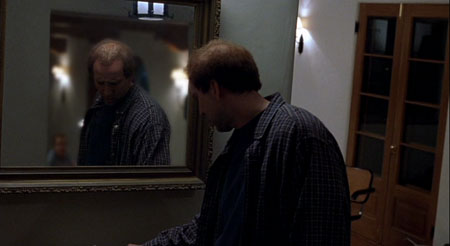
INDELIBLE IMAGE: Returning from a misfired date, Charlie finds his twin brother already back home from a writer’s seminar, brimming over with newly adopted wisdom. As Charlie stands in front of his hallway mirror, Donald’s face is captured in the reflection as he expounds upon his own screenplay’s “image system” involving broken mirrors. Charlie’s expression goes from dour to disbelieving at this inanity, and the viewer sees the movie mock both itself and screenplay tricks. A further twist is added by the fact that the blurry reflection in the mirror is the face of the actual Charlie Kaufman talking to Nicolas Cage.

THREE WEIRD THINGS: Film-within-a-film-within-a-screenplay-within-a-screenplay ; Ouroboros; orchid-snorting

WHAT MAKES IT WEIRD: For all its unconventionality, Adaptation is amazingly self-deprecating. Spoilers unravel in opening scenes and are tossed aside, coastal city elites are presented as real people with the petty little problems real people have, and Nicolas Cage gains a bit of weight and loses a bit of hair to provide the compelling double performance as the Kaufman brothers. Events seem scattershot, only to have their purposes later clarified as the tightly structured flow keeps the viewer jumping from moment to moment, always questioning which parts of this convoluted tale are actually true.

COMMENTS: Between its thorough description of the protagonist Continue reading 225. ADAPTATION. (2002)

CAPSULE: WHITE RABBIT (2013)

Beware

DIRECTED BY: Tim McCann

FEATURING: Nick Krause, Britt Robertson, Sam Trammell

PLOT: Things start to go rapidly downhill for Harlon, an emotionally abused boy, after his father makes him kill an injured white rabbit; years later he hears the voices of characters from his favorite comic strip urging him to stand up for himself.

Still from White Rabbit (2013)

WHY IT WON’T MAKE THE LIST: If “angsty” meant “weird”, this would have been the weirdest movie I have ever seen. However, it doesn’t, and this wasn’t. White Rabbit‘s occasional dips into pseudo-schizophrenic hallucinations are very few and far between, and for better or worse the movie burns up its first two-thirds blandly exposing just how horrible life can be when you’re stuck in a rural backwoods with nothing to do but shoot, drink, and beat on anyone who is remotely different.

COMMENTS: There is a problem with a twist-based movie when by the end one just can’t care less. While the ambiguity provided a bit of relief, a movie hingeing on a final minute that misfires is nothing short of disappointing. There are a number of things that Tim McCann is trying to achieve with White Rabbit; however, they’ve already been accomplished in other, superior, movies. Rural life is terrible? Check out Gummo. Society overlooks the mentally ill? Check out Clean, Shaven. Angst is a sure-fire path to outburst? Check out Angst. Whatever you do, don’t check out White Rabbit.

McCann’s cautionary (?) tale of abuse and detachment begins at the end, with the goth-y protagonist’s back-story fleshed out confessional-style. Young Harlon’s home life is terrible: his father Darrell is a volatile drunk, his brother teases him mercilessly, and his mother’s best efforts to make things “okay” are welcome but insufficient. At a tender age, his father buys him a gun and goes hunting with him. Cue the film’s metaphor. In the middle of the woods, Harlon sees a white rabbit, which his father immediately orders him to dispatch. The boy misses, and they pursue the animal until they find it stuck in a briar. Taunted by his father, Harlon shoots the now-defenseless rabbit. Dead white bunny = innocence lost.

Growing up in Rural, USA, the boy has one friend, Steve, who is even more abused than he. Otherwise alone, Harlon takes comfort in a comic book series called the Scarlet Widow. Its characters begin talking to him, using words of malevolent encouragement. Then there’s Harlon’s father. As nasty as the father generally is, he is the only fleshed-out character. Though “charming” would be far too strong a word to describe him even in his better moments, Darrell stands as the movies most relatable figure. Improbably, his disappointment and ridicule are interrupted by intermittent bursts of kindness and understanding. In one scene, having just gotten high on crack, Darrell takes his son to a nearby strip club after the boy’s had a rough day. Darrell’s own life obviously has been pretty dismal, but he has a kind of flippant charisma that made him the only character worth watching.

Anyhow, things get nasty at an accelerating rate. Steve suffers a nebulous fate after a dog-adoption goes awry. The depressive-pixie-dream-girl whom Harlon fancies cleans up her act and gets together with the now reformed jock that Harlon (rightly) abhors. Unfortunately, the best twist of the movie never happens. There’s a point where everyone around him has reformed and become a decent person; had McCann explored the greater isolation Harlon would have experienced after this, things might have traveled down an interesting psychological path. As it goes, White Rabbit ducks out of this route almost before it begins, ending on a “Hey, maybe there’s some redemption going on here. Or not. Or maybe.” Or whatever.

WHAT THE CRITICS SAY:

“…the voices he soon hears in his head are as muddled and underdeveloped as the rest of the film, which falls back on the easiest answers available to explain its protagonist’s fractured psyche.”–Nick Schrager, Film Journal International (DVD)

CAPSULE: PREDESTINATION (2014)

Recommended

DIRECTED BY: The Spierig Brothers (Micheal Spierig, Peter Spierig)

FEATURING: , Sarah Snook

PLOT: While posing as a bartender on a mission to stop a mad bomber, a “Temporal Agent” who travels to the past to stop crimes before they happen meets a man who promises to tell him the strangest story he’s ever heard.

Still from Predestination (2014)
WHY IT WON’T MAKE THE LIST: Predestination is a fine, twisty-plotted mindbender, but not really any weirder than Looper, Timecrimes, Primer, or other movies that depend entirely on time travel paradoxes for their uncanny effect.

COMMENTS: Predestination is one of those movies that is so dependent on its twists for its effect that it becomes hard to review. Certainly, I would like, if nothing else, to praise Sarah Snook’s star-making performance here; but it’s difficult to discuss what’s so impressive about it without giving away the secret (I will say she shows great range). Nominal protagonist Ethan Hawke is serviceable as the time-weary agent who’s been doing this way too long, but despite being top billed he is essentially the frame for Snook’s bizarrely tragic story. There is not much money here for spectacular visuals—they blow most of the FX budget on a single virtual reality simulator in the movie’s first thirty minutes—but not much is needed to tell the story correctly. Predestination also dances around some big ideas without really addressing them directly. There’s the title conundrum, and a testing of the limits of pragmatism—sure, most everyone agrees it’s ethical to kill one man now to save the lives of one hundred innocents later, but what about killing one guilty party and nine harmless civilians to save one hundred people later? Those ruminations aside, the pleasures here are almost entirely of the unraveling-the-tangled-plot-skeins variety, with Snook’s impressively sympathetic performance as a noteworthy bonus.

When you feel embargoed from discussing the plot at all for fear of mentioning spoilers, a movie becomes hard to discuss; although that very reluctance is also a good sign, since you are implying that there is some pleasure to be spoiled. I will make an observation that it is neat how the Spierig’s script keeps some elements from Robert Heinlein’s original 1958 short story (titled “All You Zombies”) to create an alternate version of the past (specifically, Heinlein imagined a 1960s world where women were barred from becoming astronauts, but allowed to go into space as state-sponsored courtesans!) If Temporal Agents were really running around changing the past, surely they’d be messing up little sociological tidbits like that by accident. More of those sorts of details would have helped kick the film up another notch and added to the feeling of disorientation. Still, Predestination is a solid time travel movie of impeccable lineage, one that is not too difficult to follow despite its complexity. What in another movie might appear to be a plot hole here seems like a rigorous exploration of an alternate understanding of causality. Well done.

WHAT THE CRITICS SAY:

“Like all time-travel stories, this inevitably trips on its own causal illogic – but not before it’s offered you a taste of something genuinely rich and strange, and probably toxic.”–Peter Bradshaw, The Guardian (contemporaneous)

(This movie was nominated for review by “ jeandeaux” who argued that it “explores, in its own weird way, the ultimate concerns of human existence: meaning, loneliness, freedom, and mortality.” Suggest a weird movie of your own here.)

LIST CANDIDATE: SLEEPAWAY CAMP (1983)

DIRECTED BY: Robert Hiltzik

FEATURING: Felissa Rose, Jonathan Tiersten, Karen Fields

PLOT: Eight years after her father and fraternal twin were killed there in a boating accident, introverted teen Angela Baker (Felissa Rose) returns to Camp Arawak alongside her protective cousin and adopted brother, Ricky (Jonathan Tiersten). Children and counselors alike bully the girl for her shyness, but those tormenters soon begin dying under bizarre circumstances. Meanwhile, Angela’s budding romance with a fellow camper awakens her dormant sexuality, and with it troubling memories of what truly happened eight years ago.

Still from Sleepaway Camp (1983)
WHY IT MIGHT MAKE THE LIST: By incorporating a wistful portrayal of summer camp into the sleazy slasher mold, Sleepaway Camp offers a uniquely schizophrenic experience of a horror film. Furthermore, its plot ultimately explodes in an extremely violent and sexual metaphor of an ending, which remains controversial to this day.

COMMENTS: Riding on the coattails of Halloween and Friday the 13th, Sleepaway Camp neither invented the slasher genre nor the idea of the summer camp as a killing ground. Furthermore, Hiltzik’s film falls short of its predecessors through amateurish performances, disjointed storytelling, and deaths that are slightly more goofy than frightful. In the annals of ‘80s horror, Sleepaway Camp therefore seems less an original than a misbegotten child.

However, by combining the juvenility of his setting and main characters with the adult themes of a slasher, Hiltzik still produces a memorably off-kilter film. As visceral moments like the disfiguring of a pedophile crudely segue into mirthful scenes of camp life—such as Ricky pranking a nerd named Mozart—Sleepaway Camp embraces rather than hides its incoherence. In turn, Camp Arawak becomes an unreal place where the vulgar and innocent both exist, not in conflict, but as mismatched companions to each other. Sleepaway Camp’s lack of style thereby becomes its signature style, creating an unwieldy and dissonant tone that, in the end, perfectly reflects the troubled, divided mind of its killer.

That killer’s identity is now the stuff of legend, in a final twist that makes an already fractured story snap. Through that one last disturbing image, the film transcends its low budget and even lower quality to become a classic oddity among slasher fans. While Sleepaway Camp is not one of the best horror films out there, it continues to be one of the weirdest.

Shout! Factory’s recent “Sleepaway Camp Collector’s Edition” comes with an array of extras, two of which could qualify for a list of 366 Weird Special Features. The first is a short made by sleepawaycampmovies.com’s webmaster Jeffy Hayes starring Sleepaway Camp supporting actor Karen Fields, who murders a deadbeat dad and his girlfriend using, among other weapons, a turkey baster. The second is an uncomfortably earnest music video featuring the vocal talents of Jonathan Tiersten, the now middle-aged actor who played Ricky. As Tiersten somberly croons in an empty theater, and Fields wields a deadly curling iron in a nod to her famous role, one wonders if the two still haven’t gotten over their roles in Sleepaway Camp.

Joining those shorts are several bonuses that more directly relate to Sleepaway Camp, including an album of on-set photographs, multiple commentaries, and a 45-minute documentary about the making of the movie. Each of those extras show the person who loves Sleepaway Camp most may be its star; Felissa Rose beams nostalgically while recounting the friendships, drama, and fun she experienced during filming. Despite the presence of cameras and microphones, production stills of the teenage cast smiling in those idyllic woods and cabins suggest a summer to remember for decades to come.

174. VERTIGO (1958)

“If Vertigo remains, unchallengeably, Hitchcock’s masterpiece, this is surely because there the attitude to the unknown and mysterious is not simply one of terror but retains, implicitly, a profound and disturbing ambivalence.”–Robin Wood, “Hitchcock’s Films

“Only one film had been capable of portraying insane memory, impossible memory: Alfred Hitchcock’s Vertigo.”—Sans Soleil

Must See

DIRECTED BY:

FEATURING: James Stewart, , Barbara Bel Geddes

PLOT: During a rooftop pursuit of a fleeing suspect, John “Scottie” Ferguson finds himself hanging from a drainpipe; the uniformed cop who tries to save him slips and falls to his death. Suffering from debilitating acrophobia and vertigo, as well as survivor’s guilt, Scottie quits the police force. An old college acquaintance offers him a job tailing his wife, and Scottie becomes obsessed with the beautiful and mysterious woman who believes she is possessed by the spirit of a suicidal ancestor.

Still from Vertigo (1958)
BACKGROUND:

  • The source of Vertigo was the novel “D’Entre Les Morts” (translated in English as “The Living and the Dead”), by the French writing team of Pierre Boileau and Thomas Narcejac. Hitchcock had wanted to adapt the pair’s first novel, “Celle qui n’était plus,” but the rights were sold to a French company and it was made as Les Diaboliques by Henri-Georges Clouzot. Boileau-Narcejac would later write the screenplay for Les Yeux Sans Visage [Eyes Without a Face] (1960).
  • Hitchcock bought the rights to Vertigo back from Paramount (along with four other 1950s-era films), then willed them to his daughter. The film went out of circulation for many years. The rights eventually ended up with rival studio Universal, who restored and re-released the film theatrically (in 1983 and again, after a major restoration, in 1996) to great acclaim.
  • The dizzying “vertigo” effect (sometimes known as the “dolly zoom” or “trombone shot”) is the film’s most famous technical innovation: the camera tracks backwards on a dolly while simultaneously zooming the lens, resulting in  a disorienting visual experience of moving backwards and forwards simultaneously.
  • Abstract Expressionist painter John Ferren designed the dream sequence.
  • A controversial flashback scene reveals the “twist ending” about two-thirds of the way through the movie. Before the film’s release Hitchcock decided to remove this sequence, over the strenuous objections of his producer, Herbert Coleman. After preview audiences were unimpressed by the flashback-free cut, the studio ordered Hitchcock to return the film to the way it was originally shot.
  • Vertigo, which was exceedingly dark compared to the average Jimmy Stewart vehicle, was not as successful as Hitchcock’s previous hits such as 1954’s Rear Window, and barely broke even at the box office. The scale of its initial failure is often exaggerated, however, for the sake of a good story: it qualified more as a minor disappointment than a flop. The contemporaneous reviews were also mixed (leaning towards positive with reservations about plausibility and pacing), rather than universally negative, as is sometimes implied.
  • In the 2012 Sight & Sound critics poll, Vertigo replaced Citizen Kane, the top vote getter every year since the poll’s inception in 1962, as the greatest movie of all time. (It ranked #7 on the director’s poll, where Tokyo Story took the top spot).

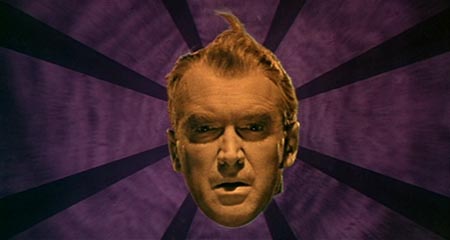
INDELIBLE IMAGE: It has to come from the dream sequence. Although we chose Jimmy Stewart’s head floating against a shifting kaleidoscope background to illustrate this review, the most thematically significant image is the male shadow falling, first onto a terracotta rooftop and then through a white void (this figure is incorporated into the original Saul Bass-designed poster, where it combines with the movie’s other significant motif, the spiral).

WHAT MAKES IT WEIRD: Vertigo may be one of the most subtly strange movies out there. It’s entirely possible to watch it and see it as no more than a conventionally (if implausibly) plotted mystery. But peer into its vortex closer and you’ll see why this brightly lit but oddly dreamlike tragedy has fascinated generations of moviegoers: in its depths hides madness, illusion, necrophilia, sexual domination, a perverse longing for death, guilt, and the grinding gears of merciless fate. There’s a reason Vertigo is a cult movie. It doesn’t give up its secrets easily. Watch it again, with your weird eyes.


Re-release trailer for Vertigo

COMMENTS: Did any movie produced under the Hollywood studio system ever torture its protagonist as mercilessly as Vertigo torments Scottie Continue reading 174. VERTIGO (1958)