Tag Archives: Twist ending

CAPSULE: SHUTTER ISLAND (2010)

Recommended

DIRECTED BY: Martin Scorsese

FEATURING: Leonardo DiCaprio, Mark Ruffalo, Ben Kingsley, Michelle Williams

PLOT: A U.S. Marshall with a tragic past investigates a mysterious disappearance at an asylum for the criminally insane on a craggy, isolated Massachusetts island in the 1950s.

Still from Shutter Island (2010)

WHY IT WON’T MAKE THE LIST:  Scorsese sprinkles a few flakes of weirdness into his mainstream thriller for flavor, but it’s carefully tailored for the mild tastes of the masses.

COMMENTS:  Atmosphere and suspense rule as Scorsese leaves film’s mainland to investigate the genre islands.  With a horror movie aesthetic, a film noir hero and a brainteaser mystery plot, Shutter Island is a mini-history of popular movie mechanics, with some psychology and dark drama thrown in to provide a sense of gravitas.  It’s no masterpiece, but it does effectively draw you into its mysterious labyrinth for two hours.  Overwrought in the best way, this is the type of movie where portentous strings keep coming at the viewer like driving sheets of rain in a hurricane, key scenes take place in darkened cells filled with the criminally insane or in ruined cemeteries, and Nazis, lobotomizing surgeons, and drug-induced hallucinations all play a part in the paranoid plot.

DiCaprio puts in a fine performance as Teddy Daniels, a tough guy whose callous exterior may just be scar tissue from the wounds he’s suffered in a tough life.  A war veteran who was present at the liberation of the Dachau death camps, Daniels may have committed acts that still haunt him; returning home, he turns to booze and then quickly suffers further tragedy when he loses his young wife to violence. Guilt, regret and lust for revenge haunt our hero, and impede his investigation of the murderess who’s disappeared from her locked cell as surely as does administrator Ben Kingsley’s odd reluctance to hand over patient medical files to the two federal marshals.

Scorsese plumbs DiCaprio’s psyche for spooky dream sequences, such as one where he embraces his dead wife while ash falls around them like snow; as the scene progresses her back turns into a burning cinder, while a cascade of blood simultaneously soaks the front of her dress.  As the flick progresses, reality becomes plastic and the seeming illogic of the plot increases; DiCaprio’s flashbacks and dreams take up a larger portion of the action and sometimes bleed into the real world.  Despite a mounting sense of weirdness, though, all is resolved rationally at the end.

You may guess the final twist, or you may not. The true test of a mystery/thriller is not whether the twist ending surprises you. It’s a bonus if it does and will make the movie a classic, but there are only so many unthought-of tricks that a director can deploy without cheating, and our capacity to be caught off-guard depends more on cinematic inexperience than anything else.  The true virtue of a thriller is not to fool us but to put us inside the endangered shoes of the protagonist, and fill us with doubts as to our own safety, understanding, even sanity.  When this movie’s clicking, the suspense is high and the Gothic atmosphere is thick and beautiful, making it well worth the short ferry ride out to Shutter Island.

WHAT THE CRITICS SAY:

“…like a Hardy Boys mystery directed by David Lynch.”–Andrew O’Hehir, Salon.com (contemporaneous)

BORDERLINE WEIRD: DARK COUNTRY (2009)

DIRECTED BY: Thomas Jane

FEATURING: Thomas Jane, Ron Perlman, Laurie German

PLOT: Two newlyweds returning from their Vegas wedding hit a man in the middle of the road; he lives, but the couple finds he is not all that he seems.

Still from Dark Country (2009)

WHY IT’S ON THE BORDERLINE: Dark Country is a bit obtuse at times, and it frustratingly delights fans of the obscure by not explaining its motives or workings very often, but I hesitate recommending mainly because it relies a little too heavily on genre standbys and noir reverence instead of blazing new fantastic territory. It is a 50s thriller/noir mixed with a modern horror, but it doesn’t create its own identity between the two stylings. There are moments of heavy cinematic distortion and interesting ideas that run through the story like a highway across the hungry desert, but it can’t quite escape some level of mediocrity as it bends prostrate for that which has already been done.

COMMENTS: Dark Country represents a promising debut effort from a director who is willing to try new things. What’s really impressive from the start is the writing. It is intense and full of good, genuine human touches that help the movie flow from scene to scene. From the first scene to the end, I felt rapt with attention to these immersive characters and their odd relationship, especially after the drive out of Las Vegas.

It is a journey through dark and unforgiving territory, perhaps a metaphor for the new marriage between main characters Gina and Dick, newlyweds who don’t really know what they’re in for. The young couple just made it official in Vegas, and are ready to go home, but even before their fateful accident, things aren’t what they seem between them. There is tension, there are incidents between the two that are hinted at, and they have secrets from each other right off the bat. After their encounter in the desert with the strange man they hit, things only get worse between them. From an artistic standpoint, Dark Country can be commended as a smart thriller with some brains to back up its craziness.

Visually, it’s a feast for the eyes, and it’s tonally interesting. Thomas Jane wants a very engrossing visual experience, but he is also on a budget here, so we are caught in a limbo of many special effects, none of which really hit the mark in a spectacular way. The CG is on the cheap side (it looks like a violent episode of “Reboot” when they wreck the car near the end!) The green screen is not very successful in melding the real and fake, but the color effects are interesting, not to mention plentiful, and we are treated to some good old fashioned camera trickery with slick editing and nifty shots.

But while it’s a solid debut for Jane, and an offbeat one at that, we’re still not treading across any bold new frontiers with Dark Country. This is a movie I have seen before, in bits and pieces: intense psychological implications, a noir aesthetic, and the lush, frightening mysteries of the deep desert. It’s not anything breathtaking or unflinching. It’s a good and often disturbing take on some classic thriller ideas, and it has a twist in the story that will have you on your toes, but I wouldn’t consider this to be one of the weirdest movies I’d ever seen. With a good cast, a taut script, some interesting effects, and a more intelligent angle than your average thriller, Dark Country has a lot going for it. Just don’t expect it to be too weird, because you might be disappointed.

WHAT THE CRITICS SAY:

“The developments in Tab Murphy’s script are never quite as shocking to us as they are to Dick and Gina, and the story eventually builds the feeling of marking time on the way to its TWILIGHT ZONE-esque resolution… Jane’s visual sense assures that the film is always a spooky pleasure to watch, though…”–Micgael Gingold, Fangoria (contemporaneous)

38. MALPERTUIS (1972)

AKA The Legend of Doom House; Malpertuis: The Legend of Doom House

“For sure, one of the weirdest films you’ll ever see, a cult film above and beyond anything else; a film for those initiated into midnight screenings. Where else do such dreams take place?”—Ernest Mathjis, DVD liner notes for the Barrel Entertainment edition of Malpertuis

DIRECTED BY: Harry Kümel

FEATURING: , Susan Hampshire, , Michel Bouquet,

PLOT:   When his ship sets anchor in a Flemish town, Jan, a sailor, goes looking for his childhood home, only to find that it burned down years ago.  Seeing a fleeing woman he believes to be his sister, he chases her into a brothel where he is knocked unconscious in a brawl.  He awakens in Malpertuis, a massive estate ruled by his Uncle Cassavius (Orson Welles) from his sickbed.  Cassavius reads his will to his very strange extended family, and its provisions set them at deadly odds with one another.

Still from Malpertuis (1972)

BACKGROUND:

  • Malpertuis was an adpation of the only novel written by the Belgian fantasist Jean Ray, who was famous for his macabre short stories (and is sometimes compared to Edgar Allen Poe or H.P. Lovecraft). The novel was complex, composed of four separate narratives told by four characters, and therefore presented a challenge to adapt.
  • Kümel’s previous film was the dreamlike, erotic vampire tale Daughters of Darkness [Les lèvres rouges] (1971).  Hired to make a sexy commercial horror movie, Kümel delivered a memorably bizarre film that pleased exploitation audiences looking for blood and breasts, but was also a crossover hit in the arthouse circuit.  The success of Daughters convinced United Artists to back the Malpertuis project, which was the film Kümel personally wanted to make.  UA’s financial backing enabled Kümel to hire Orson Welles for the key role of Cassavius.
  • Orson Welles was hired for three days of shooting.  An irascible, elderly eccentric by this time in his career, Welles asked for his fee to be delivered in cash in a suitcase.  Welles was drunk and rude on the set, interfering with Kümel’s attempts to direct and, in one case, repeatedly ruining one of Michel Bouquet’s takes until the director agreed to give Welles a closeup he had requested.  At the end of Welles’ three-day contract, the project was well behind schedule due to the legendary actor’s drunkenness, extended lunch breaks and general peevishness.  Apologizing for his behavior, Welles volunteered to work for a fourth day free, and performed all his remaining scenes perfectly in a single morning, putting the production back on schedule.
  • Malpertuis was selected to compete for the Palme d’Or at Cannes in 1972, but United Artists did not like Kümel’s two-hour cut and submitted a dubbed, re-edited 100 minute  version of the film rather than the director’s preferred version.  The film was not popular with the jury, then bombed in both the United States and Europe when UA released its preferred version (misleadingly marketed as a horror pic) as The Legend of Doom House. Not only did the film tank, but Kümel’s promising young career was cut short.  Disgusted with studio interference, he began directing in television and teaching, and has directed only a few unremarkable feature films (including some arty softcore pornography) in the last twenty-eight years.
  • The director’s cut of the film was unavailable on video for many years, and was not seen until the film was re-released in 2002.  This cut was not available on home video until 2005, and not available on Region 1 until 2007.

INDELIBLE IMAGE: The weary face of the legendary Orson Welles, grumpy and gray but still regal, as he reclines in tuxedo-like pajamas against scarlet bedsheets. The bed-ridden Welles embodies the decaying secret center of the wickedness of Malpertuis.

WHAT MAKES IT WEIRD: Even before we get to the psychedelic-era Chinese puzzle-box of an ending(s), Malpertuis has created a disorienting sense of oddness. Both the film and the titular estate are labyrinthine mazes filled with enchanting and mysteriously decorated rooms, with little explanation of how these dazzling individual pieces fit together into the grand layout.


Original French trailer for Malpertuis

COMMENTS: “It’s pretty, but it’s a bit difficult to understand… Somehow, it makes me Continue reading 38. MALPERTUIS (1972)

CAPSULE: STAY (2005)

DIRECTED BY:  Marc Forster

FEATURING: Ewan McGregor, ,

PLOT:  A private practice psychiatrist takes over the case of a suicidal art student after his regular therapist takes a leave of absence due to stress, and discovers the case has metaphysical as well as psychological implications.

stay

WHY IT’S ON THE BORDERLINEStay gets a pretty weird vibe going through its trippy second act—not coincidentally, the part of the movie many mainstream critics complain grows tiresome—but ultimately this mindbending plot has been handled more elegantly before in more memorable films.

COMMENTS: Stay is often a feast for the eyes and a masterpiece of meaningfully employed techniques. Shots are packed with subliminal detail, and everyone notices the amazing transitions that flow seamlessly from one scene into the next (a character gazes out the window to see the person they’re talking to sitting on a bench, having already started the next scene, or wanders out of an art department hallway that magically becomes an aquarium).  The artistic editing and camera tricks all lead up to a beautiful visual climax on the Brooklyn Bridge, where Sam (Ewan McGregor) and Henry (Ryan Gosling) deliver their “final” speeches while engulfed in a sea of waving strings, as if small filaments of cable have broken off the bridge and are drifting in the wind.  Unfortunately, the story, while clever at times, can’t justify the enormous care devoted to the production design.  Long time fans of psychological thrillers will guess the twist from the first shot, although through directorial sleight of hand and a shift of protagonists the film constantly suggests that it’s just about to head in a novel direction.  In the end, the story is both resolved and unresolved—the unresolved parts being those leftover scraps of the script that relate not to the mystery’s solution, but to the screenplay’s attempts to misdirect the viewer from that solution.  These questions wave around in the mind like those wavy filaments from the Brooklyn Bridge: not part of the supporting structure, just there to add atmosphere.  The end result is a series of admirable tricks strung together, without a huge narrative or emotional payoff.

A curious and disappointing feature of the DVD release is that the widescreen version of the film, with limited commentary by director Forster and star Gosling, is hidden on side B of the double-sided DVD, with a fullscreen version with no commentary taking up side A.  Renters who don’t have the opportunity to read the box cover or who miss the note on the disc’s label may view an inferior presentation of the movie by default.  Ironically, one of the B-side commentators advises, “Never watch this in 4:3.  You’ll miss too much.”

WHAT THE CRITICS SAY:

“Sam can’t figure out why Henry wants to kill himself, but it probably has something to do with his inability to differentiate between his hallucinations and reality. Despite his professional training, Sam fails to come to the obvious conclusion: the movie around him has been hijacked by an overzealous D.O.P.”–Adam Nayman, Eye Weekly

(This movie was nominated for review by reader “Melissa.” Suggest a weird movie of your own here.)

21. THE WICKER MAN (1973)

“I think it is a film fantastique in a way… a film fantastique can have almost anything in it, it’s based on facts but it can take flights of fancy which are still rooted to the truth, to the reality of the story, so the imagination can roam.”–Robin Hardy

Must See

DIRECTED BY: Robin Hardy

FEATURING:  Edward Woodward, Christopher Lee, Diane Cilento, Britt Ekland,

PLOT:  A devout Christian policeman flies to the isolated island of Summerisle off the coast of Scotland to investigate a report of a missing girl.  When he gets there, everyone denies knowledge of the girl, but he notices with increasing disgust that the entire island is practicing old pagan rituals and licentious sex.  As his investigation continues, he uncovers evidence suggesting that the missing girl was a resident of the island, and may have met a horrible fate.

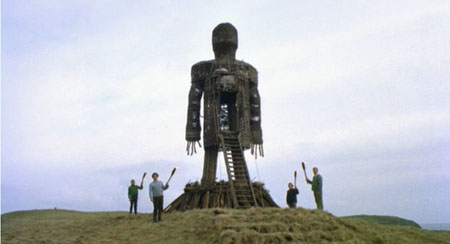
the_wicker_man_1973

BACKGROUND:

  • Screenwriter Anthony Shaffer was a hot property in 1973 after adapting his own successful mystery play Sleuth into a 1972 hit movie with Laurence Olivier and Michael Caine, and penning the screenplay for Frenzy (1972) for Alfred Hitchcock.  His clout was so great that this film was released under the official title Anthony Shaffer’s The Wicker Man.  He later adapted Agatha Christie novels such as Murder on the Orient Express (1974) for the big screen.
  • Director Robin Hardy, despite doing an excellent job on this film, did not direct a feature film again until 1986’s Wicker Man variation, The Fantasist.
  • Christopher Lee, who had just come to the end of his run as Hammer’s Dracula, donated his acting services to the production.  He was quoted in 1977 as saying, “It’s the best part I’ve ever had.  Unquestionably.”
  • The “wicker man” was a historically accurate feature of Druidic religions that was first described to the world by Julius Caesar in his “Commentary on the Gallic Wars.”
  • In Britain the film was released on the bottom half of a double bill with Don’t Look Now, perhaps the most impressive psychological horror double feature in history.
  • Shaffer and Hardy published a novelization of the film in 1976.
  • “Cinefastique” devoted an entire 1977 issue to the film, calling it “the Citizen Kane of horror movies.”
  • In 2001, an additional 12 minutes of deleted scenes were added to create a “Director’s Cut” version.
  • Some of the original footage is believed to be lost forever, including part of the scene where Sgt. Howie first meets Lord Summerisle.  The original negative was accidentally thrown away when original producer British Lion Films went under and cleaned out its vaults.
  • The climax was voted #45 in Bravo’s list of the “100 Scariest Movie Moments.”
  • The 2006 Neil LaBute remake starring Nicolas Cage had as little as possible to do with the original story, was universally reviled, and was even accused of being misogynistic.  Some argue that it is so poorly conceived and made that it has significant camp value.
  • Hardy released a “spiritual sequel,” The Wicker Tree, in 2011.

INDELIBLE IMAGE:  The wicker man itself (although, for those of a certain gender, Britt Ekland’s nude dance may be even harder to forget).

WHAT MAKES IT WEIRD:  Hardy and Shaffer create an atmosphere like no other; it’s an encounter of civilized man with strange, primeval beliefs.  Select scenes are subtly surreal—observe how the villagers break into an impossibly well-choreographed bawdy song about the innkeeper’s daughter preternaturally designed to discomfit their sexually repressed guest.  Other weird incidents are more outrageously in the viewer’s face: the vision of a woman breastfeeding a child in a graveyard while delicately holding an egg in her outstretched hand.  Almost invisible details such as the children’s lessons scribbled on the classroom blackboard (“the toadstone protects the newly born from the weird woman”) saturate the film and reveal how painstakingly its makers constructed a haunting alternate world of simultaneously fascinating and repulsive pagan beliefs.  The rituals Sergeant Howie witnesses don’t always make sense (and when they do, their significance is repulsive to him), but they tap into a deep, buried vein of myth.  The viewer himself undergoes a dread confrontation with Old Gods who are at the same time familiar and terrifyingly strange.

Original trailer for The Wicker Man

COMMENTS: CONFESSION: The version reviewed here–horrors!–is the 88 minute theatrical Continue reading 21. THE WICKER MAN (1973)