Tag Archives: The creative process

CAPSULE: FREE RADICALS: A HISTORY OF EXPERIMENTAL FILM (2012)

DIRECTED BY: Pip Chodorov

FEATURING: Stan Brakhage, Hans Richter, Ken Jacobs, Jonas Mekas, Peter Kubelka, Robert Breer, Stan Vanderbeek

PLOT: A survey of 90 years of abstract experimental film, from its Dadaist origins to its NYC heyday, with rare interviews and plentiful examples, including a few full-length shorts.

Still from Free Radicals: A History of Experimental Film (2012)

WHY IT WON’T MAKE THE LIST: Some of the filmmakers profiled here might have a shot at getting a flick or two onto the List of the 366 Best Weird Movies; this relatively un-weird overview of their lives and works, however, has no chance.

COMMENTS: Covering eighty years of film experiments in eighty minutes of film is a daunting task. Free Radicals can’t provide more than a sample platter of this enormous and ill-defined field, but the spread brings us some exotic flavors and tasty bits worth chewing on. The historical appetizer is Hans Richter’s 1921 “Rhythmus” series, movies which are nothing more than drawings of white rectangles on a black field that advance and recede; they aren’t startling in themselves, but they draw attention to the nature of film as rhythm, the articulation of time through manipulation of light. Later courses include the entire 4-minute hand-scratched Len Lye film that gives the doc its name, “Recreation,” Robert Breer’s “completely nonsensical” experiment in projecting 24-objects-per-second, and Stan Vanderbeek’s comic animated collages (a big influence on ). Lye’s 1936 color film “Rainbow Dance” is like visual candy; nutrition comes from the interviewees, who muse about art, art history, and the roles of World War I and Fascism in shaping the avant-garde. The final interviews of Richter and Stan Brakhage (who describes his life’s work as trying to reproduce the images that flash through his hypnagogic vision as he falls asleep) are rare treats for refined palettes. Although it seems like a low blow to criticize a heartfelt documentary praising artists who sweat blood to create works that almost no one ever sees, Free Radicals does have its issues. It’s a personal view of the subject rather than an objective overview. The doc begins with footage of the Chodorovs’ home movies: Super 8 footage of a normal looking kid climbing a tree and hugging his mom, except that the celluloid is folded and discolored in random patterns (a result, we are told, of a happy accident—the dog peed on the film). That personal history informs the rest of Free Radicals, and Chodorov’s preferences prevail: at times, he seems to be mainly interviewing his buddies (or his dad’s buddies), sometimes literally over a beer. This subjective approach is honest and helps convey the director’s passion for experimental films, but it also inevitably distorts the field. Chodorov favors the abstract, visual arts, scratch-on-the-film school of experimental filmmaking, and glosses over narrative or conceptual experiments.   is glimpsed floating through Meshes of the Afternoon for about a minute, but there’s no real discussion of her importance; the uninitiated might leave Free Radicals thinking a relative unknown like Peter Kubelka was just as influential. Major figures like Jack Smith and  are merely name checked, while other icons are snubbed entirely (did sleep with Pip’s girlfriend or something?) To get the most out of it, go into Free Radicals as if you were watching Pip Chodorov screen some of his favorite films from his personal collection, not as a lecture designed to give you a working knowledge of the history of experimental film. If you have the slightest hunger for new sights, you should find something satisfying in this potluck picnic of images.

Pip Chodorov has been making films since he was a child, encouraged by his father, frequent Free Radicals interviewee Stephan Chodorov. Besides making films himself, Stephan worked extensively in television and hosted a series on experimental film. Pip founded a video label to showcase experimental films and has organized film festivals at art galleries, including at the 2004 Whitney Biennial.

WHAT THE CRITICS SAY:

“You may wonder, as I did, why there are no subtitles for French filmmaker Maurice Lemaître, but it’s interesting just letting the French wash over you, wondering what it means — an experience not unlike that of watching an experimental film.”–Moira Macdonald, The Seattle Times (contemporaneous)


121. 8 1/2 (1963)

AKA Otto e Mezzo; Federico Fellini’s 8 1/2

366 Weird Movies may earn commissions from purchases made through product links.

CLAUDIA: Let’s leave this place. It makes me uneasy. It doesn’t seem real.

GUIDO: I really like it. Isn’t that odd?

Must See

DIRECTED BY:

FEATURING: , , Sandra Milo, Claudia Cardinale, , Edra Gale

PLOT: Full of doubts and very near to suffering a breakdown from stress, a director is planning to make his next movie, never making much progress. The story is continuously interrupted by flashbacks to his boyhood and dream sequences, including one where he imagines all the women in his life living together in a harem. The production is complicated further by the arrival of his wife on the set, who is humiliated to find that his mistress is also there.

Still from 8 1/2 (1963)

BACKGROUND:

  • By Fellini’s count, this was the 8 1/2th film he directed (counting shorts and co-directing gigs as 1/2 of a movie each).
  • This was Fellini’s first feature after the incredible international success of La Dolce Vita (1960). In the movie, Fellini’s alter ego Guido has just come off of a great success, and everyone around him is expecting him to produce another masterpiece.
  • After making La Dolce Vita and before 8 1/2, Fellini became involved in Jungian psychoanalysis and started keeping a dream diary.
  • 8 1/2 won an Academy Award for Best Foreign Film in 1964. It played out of competition at Cannes, because the Italians split up their two 1963 prestige pictures, 8 1/2 and Luchino Visconti’s The Leopard, between Cannes and the Moscow Film Festival (a successful strategy, as Visconti took Cannes and Fellini Moscow). 8 1/2 has since far surpassed its companion and become a staple of “best movies of all time” lists. It ranked #9 on the 2002 version of Sight & Sound’s critic’s poll of the greatest movies ever made, and #3 on the director’s poll.
  • The “dance” ending was originally intended as a promotional trailer, but Fellini decided he liked the optimistic tone of this sequence better than the dark ending he had originally planned.
  • Unaccountably, this intellectual meditation on artistic doubt was adapted as a Broadway musical (!) called “Nine,” which was then made into a mediocre Hollywood musical.

INDELIBLE IMAGE: It is with great reluctance that I select the image of Marcello Mastroianni flown like a kite above the beach as 8 1/2‘s representative image; not because it isn’t a fascinating and beautiful invention, but because I have to pass on so many other worthy candidates. In particular, I would have loved to pick a shot of Guido with a whip trying in vain to tame the women in the harem of his mind; but that ten minute sequence flows so beautifully and seamlessly from polygamous bliss to infantilism to feminist rebellion that it unfortunately can’t be summed up in a single still.

WHAT MAKES IT WEIRD: Watching 8 1/2 is like being dropped inside Federico Fellini’s brain and wandering around inside its convoluted folds. As self-centered stream-of-consciousness filmmaking, this wonderfully masturbatory masterpiece has never been equaled. The film flows smoothly from anxiety-ridden nightmares to wish-fulfillment daydreams to some state we could safely call “reality” (although some new magic is always creeping up on even the most mundane moments of Guido’s confused existence).


Opening scene from 8 1/2


COMMENTS: Expressing my disappointment with the middelbrow conventionality of 2009’s Continue reading 121. 8 1/2 (1963)

90. BLACK SWAN (2010)

“It’s a Polanski movie, and then it becomes a Dario Argento movie. And maybe a little bit of David Cronenberg too.”–Vincent Cassell

Must See

DIRECTED BY: Darren Aronofsky

FEATURING: Natalie Portman, Mila Kunis, , Barbara Hershey, Winona Ryder

PLOT: Nina, a goody two-shoes ballerina, wants to dance the lead role in a production of “Swan Lake,” but although she’s perfect for the role of the White Swan, she lacks the seductiveness to portray the Black Swan. Lily, a sexy, irresponsible dancer newly arrived from a San Francisco troupe, becomes her primary competition for the part, but also helps her loosen up by talking her out on the town for a night of drinking and meeting guys. Nina starts physically break down and hallucinate as the stress of preparing for the role takes its toll; by opening night, she can’t distinguish reality from the story she dances of the princess trapped in the body of a swan who takes her own life.

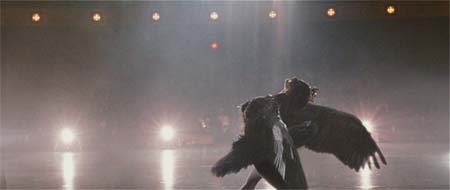
Still from Black Swan (2010)

BACKGROUND:

  • Natalie Portman danced many of her own parts, and actually dislocated a rib while dancing during the shoot. More difficult moves were performed by professional ballerinas, and for two sequences Portman’s face was digitally superimposed on dancer Sarah Lane’s body. There was a minor controversy over how much of the dancing Portman actually did herself and how much was performed by doubles; Aronofsky estimated that the actress executed more than 80% of the dance moves that appear onscreen.
  • Portman won the 2010 Best Actress Oscar for her role as Nina. The film was also nominated for Best Picture, Director, Cinematography and Editing.
  • Aronofsky received “The Understudy,” the original script that became Black Swan, while he was making Requiem for a Dream (2000). He described the script as Dostoevsky’s “The Double” meets All About Eve. Aronofsky combined that script, which was set in an off-Broadway production, with an idea he had to shoot a movie in the New York ballet world to create Black Swan.
  • Aronofsky and Portman had discussed doing a ballet movie together 8 years prior to shooting.
  • Made on a relatively small budget of about $12 million, Black Swan has grossed more than $300 million worldwide as of this writing.

INDELIBLE IMAGE: Nina’s “triumphant” onstage transformation into the Black Swan: as she pirouettes, feathers sprout from her arms, thickening with every swirl, until her limbs have been replaced by wings.

WHAT MAKES IT WEIRD:  Up until opening night, Black Swan is a backstage melodrama about backstabbing ballerinas, with an exaggerated, lurid psychopathology that’s thrust even further over-the-top by lesbian love scenes, hints of horror, and mirrors, mirrors, mirrors.  When the curtain rises on the big night, we experience the performance through the subjective perspective of an overworked, paranoid, demented dancer, whose psychology has been shattered by the film’s sledgehammer symbolism.  No avant-grade choreographer could stage as disorienting a “Swan Lake” as the one she hallucinates for us through her obsessed eyes.

Promotional Music Video for Black Swan

COMMENTS: Black Swan is the weirdest movie ever to win a major Academy Award (Natalie Continue reading 90. BLACK SWAN (2010)

KEN RUSSELL’S MAHLER (1974)

This is Ken Russell‘s most personal film, and he admirably does Gustav Mahler proud by refusing to treat the composer with phony reverence. Mahler is no plaster saint here. Instead, he is a neurotic, obsessive Jewish composer, a hen-pecked husband and an artist whose drive stems from the flesh.

Unknown to him at the time, actor Robert Powell’s role as the composer was his audition to play one Jesus of Nazareth for Franco Zeffirelli three years later. Powell’s Mahler is not the Mahler of a Mahler cult. Mahler’s composing is clearly an immense struggle, as are his relationships with his wife, family, colleagues and admirers.

Russell pays Mahler homage in not succumbing to the type of pedestrian biopic cultists tend to favor. That type of bio treatment can be seen in Richard Attenborough’s Chaplin (1992), the kind of well-intentioned but hopelessly unimaginative film one expects from a “fan.” Julie Taymor‘s Across the Universe (2007) takes the opposite approach in her stubborn insistence that the Beatles are not sacred and, thus, aptly produced a film as experimental as were the Beatles themselves (she did Stravinsky and Shakespeare the same honors with Oedipus Rex in 1993 and Titus in 1999).

Still from Mahler (1974)Ever the renegade spirit, Russell, like Taymor, digs into his highly personal interpretation of the artist’s core. Mahler (1974) opens to the first movement of the existential Third Symphony (conducted by Bernard Haitink) juxtaposed against the composer’s hut on a lake bursting into Promethean flames. Mahler’s mummified wife, Alma (the resplendent Georgina Hale) emerges from a cocoon on the beach and crawls on jagged rocks, struggling to free herself of her bindings. Atop a rock is a bust of her husband, which she embraces and kisses. This dream imagery is explained by a terminally ill Mahler to Alma, who is not amused, and misinterprets the dream as symbolic of a marital power struggle. Mahler himself fatalistically interprets it as signifying her birth, made possible by his inevitable, impending death. The entire film takes place on Mahler’s final train ride and is interwoven with dreams and flashbacks, piling one existential layer upon another.

Mahler is returning home to Vienna after a disastrous season in at the Metropolitan Opera in New York. The conductor was ousted for his unorthodox ways by a Big Apple accustomed to the literalism of a Toscanini. Mahler, however, is not about to publicly go into the reasons for his return home, especially with a meddlesome reporter who takes the composer’s answers strictly at face value. “Why is everyone so literal these days?” Mahler retorts, dismissing the hack interviewer.

Instead of focusing on documentary points, Russell probes the visions and a past idiosyncratically filtered through Mahlerian hues which are, in turn, filtered through Russell’s equally eccentric interpretations.

Mahler espoused big ideas and when asked his religion, he answers defiantly, “composer.” Indeed, Russell (himself a convert) probes Mahler’s sell-out conversion to Catholicism; clearly, this was strictly a career move on the composer’s part in a blatantly anti-Semitic society. Russell does not shy away from criticism in this sequence (filmed with silent film aesthetics). The cross of Christ and the star of David are placed with the Nazi swastika in an enshrined cave. Mahler bows before money, and Cosima Wagner (Antonia Ellis, dressed as an S & M Nazi she-devil) rewards his rejection of Judaism with a roasted (non-kosher) pig, which Mahler bites into with wild abandon. Predictably, Mahler proves to be as agitated a Christian as he was the agitated Jew.

No suffragist, Mahler is as demanding on his wife as he is on orchestra, insisting that she forgo her own aspirations as a composer and slave in silent servitude to his art, himself, and their children (in that order). This is a hard thing for Alma to forgive; but she also feels her husband’s composition of “Kindertotenlieder” (“Songs on the Death of Children”) is an unforgivable case of tempting fate that leads to the death of their beloved daughter. Alma is consistently tormented by the image of herself as shadow of the genius Gustav. She is left at the bottom of the stairwell as fans adore her returning husband, emphasized by a funeral march movement straight out of Poe. Alma rewards Gustav for all this with an impassioned affair (one of many). It is a feverishly ill, insecure, humiliated and desperate Mahler here who is trying to win back his wife. Powell and Hale are superb in their roles. Hale is delightfully fickle, icy, frustrated, wayward, and conveys every fiber of a woman loved by artisans. Powell looks the image of terminal sickness, especially in a symbolic vignette with the reaper facing him in the form of a female African passenger (in voodoo dress) who likens his music to a dance with death. In one sequence Mahler is depicted as a (Stan Laurel-like) clown. Russell spares no one in the funeral nightmare, fittingly choreographed to what many consider Mahler’s most surreal work: the Seventh Symphony.

Russell’s film mirrors much in the Seventh. It is a five movement work which begins with an allegro that is part kitsch Viennese waltz, part grotesque military march, energetic and, finally, bittersweet. This opening is followed by the first night music: a child-like walk through the night, replete with cowbells, a giddy dance, and ending with silence. The third movement is the phantasmagoric scherzo; essentially, another night movement that is, by turns, amusing and frightening. Yet another night movement follows the scherzo, this one amorous. The Rondo finale is a psychedelic pageant which many critics feel dissipates into complete banality; it can be a fitful assertion of life, or a dance-til-your-death frenzy.

Naturally, Russell utilizes the scherzo for Mahler’s overheated funeral, brought on by the composer’s heart attack, but the structure of the Seventh could be seen as a blueprint for Russell’s film. Alma mockingly spreads her legs before her dead husband’s coffin and follows that with a nude, coarse grinding striptease with Teutonic beefcakes. Her beau, Max (Richard Morant), represents all of her lovers, and he is decked from head to toe as a stormtrooper. Gustav has been buried alive, but this is of no concern to Alma, who is lusted after and sensuously pawed over only now, after she has emerged from her husband’s domineering shadow. Mahler is cremated in an oven, but his eyes remain untouched to witness her having the time of her life after his demise, climaxing with Alma having sex with a gramophone. High art, low camp, sex and death. How better to serve up Gustav Mahler? Mahler’s epic works can be tantalizing, self-absorbed, seemingly disparate mixes of banality and nobility, the profound and the asinine, the intimate and the boisterous, sincere seeking drenched with equally sincere cynicism, and, finally, insatiable curiosity permeated with a whiff of pathos, or, often, deadly bathos.

Composer Arnold Schoenberg hailed the Seventh as the death of romanticism, but he was only half correct. Mahler was still the romantic, and Russell is equally vivid in that depiction as well. Mahler truly loves his wife above all, and he casts a slight smile when he silently looks away from the train (as he often and tellingly does) to observe a couple deep in love at the terminal.

Despite our knowledge of Mahler’s imminent fate; his tumultuous relationship with his wife and his obsession with her many infidelities; his fear of his own mortality; his hallucinatory, self-indulgent expressions; his pathos-laden memories of the past; his insincere conversion; his child-like questioning of existential themes; and his fevered, zealous drive, it is the composer’s buoyant embrace of life that encapsulates Russell’s wonderfully symbolic, baroque vision of an undeniably great and influential artist.

This article was originally published in a slightly different form at Raging Bull Movie Reviews.