Tag Archives: Surrealism

278. I WILL WALK LIKE A CRAZY HORSE (1973)

J’irai Comme un Cheval Fou

“…where you go look for the grotesque, the dirty, you find God, happiness, beauty…”–Fernando Arrabal

Weirdest!

DIRECTED BY:

FEATURING: George Shannon, Hachemi Marzouk, Emmanuelle Riva

PLOT: Accused of killing his mother and stealing her jewels, Aden Rey flees to the desert. There, he discovers a mystical dwarf shepherd named Marvel who offers him refuge. They develop a friendship verging on romance, and Aden decides to take the innocent nature boy (and his favorite goat) to see the big city.

Still from I Will Walk Like a Crazy Horse (1973)

BACKGROUND:

  • Together with and , Fernando Arrabal founded the Panic movement (named after the Greek satyr god Pan). Starting in 1962 in Paris, the Panic movement staged disruptive live public “happenings” and plays that included (reportedly) live animal sacrifices, Jodorowsky being stripped and whipped, nude women covered in honey, and a replica of a giant vagina. The movement was inspired by the idea that Surrealism had become too mainstream and lost its power to shock the viewer; Jodorowsky officially dissolved it in 1973, after the three principals had already gone their own ways.
  • I Will Walk Like a Crazy Horse was Arrabal’s second film as director (after 1971’s surreal fascism satire Viva la Muerte). He may be best known to 366 readers as the screenwriter for Jodorowsky‘s 1968 debut Fando y Lis, which he adapted from his own play.

INDELIBLE IMAGE: The most unforgettable image in I Will Walk Like a Crazy Horse is one I actually wish I could forget: Aden and Marvel silhouetted in the sunset, squatting back to back, defecating. If you need something less repulsive (and we do, for illustrative purposes), go with the dwarf making out with a skull so fresh that bits of meat still cling to it.

THREE WEIRD THINGS: Synchronized pooping; cross-dressing skull-birthing; butt-flower eating

WHAT MAKES IT WEIRD: With its sharply dressed, on-the-lam hero wandering the streets of Paris as the cops close in, I Will Walk Like a Crazy Horse plays at times like an exceptionally strange nouvelle vague crime flick—as if failed to show up on set and Alejandro Jodorowsky seized control of the project, firing and installing a dwarf as the love interest. Oedipal, mystical, scatological, blasphemous, surreal, and still shocking even today, Crazy Horse is crazy indeed.

DVD release trailer for I Will Walk Like a Crazy Horse

COMMENTS: Fernando Arrabal’s sophomore feature I Will Walk Like Continue reading 278. I WILL WALK LIKE A CRAZY HORSE (1973) →

274. NUIT NOIRE [BLACK NIGHT] (2005)

“Often when we go to the cinema we feel like we’re being taken for fools because things we have instantly understood are laboriously explained. Here it’s a little the other way round.”–Olivier Smolders

Weirdest!

Recommended

DIRECTED BY: Olivier Smolders

FEATURING: Fabrice Rodriguez, Yves-Marie Gnahoua, Iris Debusschere

PLOT: A solitary entomologist works at a natural history museum in a world where it is only light for fifteen seconds a day. One day, he comes home to his empty apartment and discovers an African woman sleeping in his bed. She is ill and pregnant and eventually dies, leaving him to deal with the body.

Still from Nuit Noire (2005)

BACKGROUND:

  • Olivier Smolders was born in the Congo, which explains the source of the film’s African imagery.
  • A prolific short film maker, Nuit Noire is Smolders’ only feature film to date.
  • The movie received a very limited theatrical release even in its native Belgium, and did not appear in U.S. theaters (outside of a few film festivals) at all. Little has been written about Nuite Noir in the English language (an only a little more in French).

INDELIBLE IMAGE: The African woman’s dead body turning into a pupae, then splitting open as a new life emerges.

THREE WEIRD THINGS: 15 seconds of sun; elephant in the alley; African corpse cocooning

WHAT MAKES IT WEIRD: Set in a world of eternal midnight, with troubled dreams of dead children and troubling realities of sick foreign women who mysteriously show up in your bed, Nuit Noire manipulates time and concepts in ways that only film can. One woman changes into another, and then into another. This story could not take place in the light of day.

Short clip from Nuit Noire

COMMENTS: Closeups of squirming bugs a la Blue Velvet. A reserved protagonist taking care of a sick charge in his isolated apartment a la Eraserhead. Billowing red curtains a la… every Continue reading 274. NUIT NOIRE [BLACK NIGHT] (2005) →

273. THE DISCREET CHARM OF THE BOURGEOISIE (1972)

“…a writer or painter cannot change the world. But they can keep an essential margin of nonconformity alive… The final sense of my films is this: to repeat, over and over again, in case anyone forgets it or believes to the contrary, that we do not live in the best of all possible worlds.”–Luis Buñuel, 1973

Must See

DIRECTED BY: Luis Buñuel

FEATURING: , , , , Stéphane Audran, ,

PLOT: Two well-to-do couples arrive at the home of a third for dinner, but find there has been a misunderstanding on the date, and their hostess has not prepared a meal. The sextet tries to reschedule dinner over and over, but meets with increasingly absurd obstacles: dead restaurateurs, a platoon of soldiers who intrude on the evening, police officers who burst in and arrest the entire party before the first course. Complicating the scenario further is a bishop who imposes himself on their party, flashback ghost stories told by minor characters, a subplot about an ambassador smuggling cocaine and being hunted by a female terrorist assassin, and scenes that turn out to be dreams.

Still from The Discreet Charm of the Bourgeoisie (1972)

BACKGROUND:

  • Buñuel had announced that he would retire after Tristana (1971), but was inspired to make this movie by a story his producer Serge Silberman told him about having dinner guests show up unexpectedly due to a calendar mix-up.
  • Co-written by Surrealist screenwriting specialist , who became Buñuel’s most significant collaborator (surpassing even ). He assisted with writing duties on the director’s great 1967-1977 French renaissance period.
  • Among other honors, Discreet Charm won the Academy Award for Best Foreign Language Film (an indifferent Buñuel did not bother to show up to accept the award) and is included in Steven Schneider’s “1001 Movies You Must See Before You Die.”
  • Stephen Sondheim has a musical based on both The Exterminating Angel and Discreet Charm of the Bourgeoisie in the works.

INDELIBLE IMAGE: Shots of the six bourgeois friends, walking down an isolated country road, inserted at random between scenes. Their stride is purposeful, their destination… nowhere.

THREE WEIRD THINGS: Dinner theater; bishop with a shotgun; electrified piano cockroach torture

WHAT MAKES IT WEIRD: Buñuel’s exercise in bourgeois frustration begins simply, with a canceled dinner appointment, but quickly spirals out of control with a cocaine smuggling subplot, a foxy female terrorist, a vengeful bishop, and dreams inside of dreams. They never do get to that dinner party, although Fernando Rey does get to sneak in a slice of lamb and a midnight snack.


Original trailer for The Discreet Charm of the Bourgeoisie

COMMENTS: Luis Buñuel is cinema’s poet of frustration, of eternal Continue reading 273. THE DISCREET CHARM OF THE BOURGEOISIE (1972) →

272. CITY OF WOMEN (1980)

La città delle donne

Recommended

“It’s the viewpoint of a man who has always looked at woman as a total mystery.… Through the ages, from the beginning of time, I’m certain man has covered woman’s face with masks. They are, however, his masks, not hers.”–Federico Fellini defending City of Women

DIRECTED BY:

FEATURING: , , Ettore Manni, Bernice Stegers, Donatella Damiani

PLOT: Waking on a train across from a seductive woman, Snàporaz pursues her into the carriage’s wash-room. Abruptly, the train stops and the woman de-embarks, heading across a field with Snàporaz in close pursuit. During his long journey he explores an hotel teeming with Feminists, hitches a ride with a crew of drugged-out teenage motorists, and meets a doctor whose “manly” villa contravenes local law.

Still from City of Women (1980)

BACKGROUND:

  • A massive re-work of the story was required when the second male lead (Ettore Manni, who played “Dr. Katzone”) died from a fatal, self-inflicted gunshot wound to the groin.
  • Before returning to his reliable proxy Marcello Mastroianni, Fellini offered the role to Dustin Hoffman. Hoffman declined, as he was concerned about the post-dubbing process being detrimental to his performance.
  • Though it received largely positive reviews on its general release, it fared poorly at Cannes. , in Rome at the time working on Nostalghia, dismissed City of Women in his diary, saying “…it’s true, his film is worthless.”
  • Production designer Dante Ferretti was kept on his toes while making of the film, as Fellini would constantly request that new, elaborate sets be whipped up in a small amount of time. Farretti invariably obliged the director’s requests, and his success allowed him sole billing as “Production Designer,” a title usually nabbed by Fellini himself in the movie’s credits.

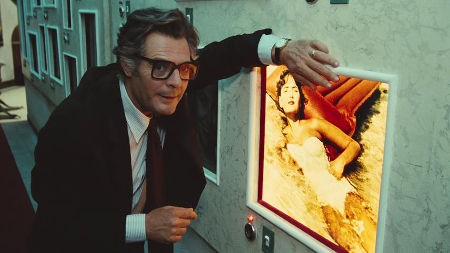
INDELIBLE IMAGE: After the brief introduction of the train ride turning into a romp across a field, virtually everything that follows in Fellini’s City of Women starts globbing on to the memory. From a long list of choices (addled Feminists fomenting in an hotel, drugged-out [?] minors driving the middle-aged protagonist to a haunting techno-pop tune, and an aged Lothario blowing out 10,000 candles among them), perhaps the best choice is the joy-filled sequence in the museum of women at Katzone’s villa. Snàporaz darts back and forth with an innocently lecherous glee as he flicks on the photographs’ illumination and hears a snippet from that woman’s sexual history. The visual and sonic overload goes up to eleven when Snàporaz’s ex-wife appears at the end of the corridor and turns on all of the displays. Women, women everywhere—in sound and vision.

THREE WEIRD THINGS: The hall of sexual conquests; memory lane slide; ideal woman escape balloon

WHAT MAKES IT WEIRD: Traipsing along for two and one-half hours, City of Women somehow combines the sugary charm of a light-weight musical with the non-stop adventure of an epic film. Beginning with a tone bordering on the mundane (the tediousness of travel), Fellini quickly pushes things from believable, to somewhat believable (the feminist convention), then onwards and upwards to a literal and metaphorical peak of disbelief as our hero escapes an arena full of spectators by clinging to a hot-air balloon. Between the jostling in the train car and the flight into the unknown, it would be faster to answer the question, what isn’t weird about it?


Original Italian trailer for City of Women

COMMENTS: Obsession can be a dangerous thing, but it can also be Continue reading 272. CITY OF WOMEN (1980) →