Tag Archives: Romance

203. WILD AT HEART (1990)

“This whole world’s wild at heart and weird on top.”–Lula Fortune, Wild at Heart

DIRECTED BY:

FEATURING: , , Diane Ladd, , , J.E. Freeman

PLOT: After being released from prison for manslaughter, Sailor Ripley and love-of-his-life Lula Fortune head west to California, but are waylaid by Lula’s psychotically protective mother and various colorful agents under the employ of the effete and mysterious Mr. Reindeer. Their travels take them to New Orleans, where Johnny Farragut, a hired detective, tracks them down. As the noose tightens, the West-bound lovers make a detour to the town of Big Tuna, where, unbeknownst to Sailor, hit man Bobby Peru awaits his arrival.

Still from Wild at Heart (1990)
BACKGROUND:

  • Wild at Heart was adapted from Barry Gifford’s pulpy 1989 novel “Wild at Heart” (which gave birth to multiple sequels). While the movie ending’s differed greatly from the book’s, Gifford was pleased and praised David Lynch’s choice.
  • Winner of the 1990 Palme D’Or prize at Cannes, the year before fellow Certified Weird movie Barton Fink. Film critic Roger Ebert headed a large group of those dissatisfied with the jury’s choice, and was among many American reviewers who were much less impressed than the Cannes crowd.
  • Wild at Heart was released just before “NC-17” became a ratings option with the MPAA later in 1990. It scraped by with an “R” rating by obscuring the effects of a nasty shotgun head wound. (It was subsequently re-rated NC-17 for the home video release).
  • Actors from Lynch’s then-current hit series “Twin Peaks” who have cameo roles in Wild at Heart: Sherilyn Fenn, , , David Patrick Kelly, and (appearing in his fourth Lynch feature).

INDELIBLE IMAGE: Like so many offerings from David Lynch, Wild at Heart is riddled with great shots—but an early image of Sailor Ripley pointing defiantly at the woman who just tried to have him killed captures his character’s sheer force-of-nature that drives the film’s unrestrained progression.

THREE WEIRD THINGS: Lipstick face; cockroach underpants; the Good Witch

WHAT MAKES IT WEIRD: While in the middle of working on his hit soap-opera “Twin Peaks,” David Lynch took a break to make something that allowed him to explore his weirder side. Throughout Wild at Heart, the viewer is exposed to such a smorgasbord of road-movie madness—highway hallucinations, small town weirdos, classic-cool criminals, a mountain of lipstick, and dozens of lit matches—that by the end of the movie, Lynch has already accomplished most of what and would spend the subsequent decade retreading.

Original trailer for Wild at Heart

COMMENTS: Before he got lost on a highway and before he went to Continue reading 203. WILD AT HEART (1990) →

202. BEAUTY AND THE BEAST (1946)

La Belle et la Bête

“Children believe what we tell them. They have complete faith in us. They believe that a rose plucked from a garden can plunge a family into conflict. They believe that the hands of a human beast will smoke when he slays a victim, and that this will cause him shame when a young maiden takes up residence in his home. They believe a thousand other simple things.
I ask of you a little of this childlike sympathy…”–Jean Cocteau, prologue to Beauty and the Beast

Must See

DIRECTED BY:

FEATURING: Jean Marais, Josette Day

PLOT: A merchant who has fallen on hard times wanders onto a mysterious estate and plucks a single rose to take back to his daughter, Belle. He is suddenly faced with a bipedal Beast, dressed as a nobleman, who says that the penalty for the theft is death, but who offers to spare the old man’s life if he will send his daughter in his place. Against her father’s wishes, Belle volunteers to be kept as the Beast’s prisoner, but the longer she stays in his magical castle the more she sees the noble heart beating underneath the bestial hide.

Still from Beauty and the Beast (1946)
BACKGROUND:

  • Jean Cocteau considered himself a poet who dabbled in filmmaking, although today he is best remembered for his contributions to cinema rather than literature. La Belle et la Bête was his first narrative feature film after making the 55-minute Surrealist film Blood of a Poet [Le sang d’un poète] in 1932.
  • This version of the story is based on 1756 fairy tale by Jeanne-Marie Leprince de Beaumont; it was a faithful adaptation, except that Cocteau invented the role of Avenant.
  • Cocteau suffered from a painful skin disease during shooting, and even had to be hospitalized once while filming continued (technical adviser Rene Clement directed in his absence). At times he wore a mask while directing to hide his inflamed countenance.
  • Jean Marais, who played Avenant, the Beast, and the Prince, was Cocteau’s lover. It is rumored that he convinced Cocteau to take on the project, thinking the role would launch his career as a French matinee idol (it did).
  • Minimalist composer and frequent film scorer Philip Glass composed an alternate soundtrack for the film (conceived of as an opera).

INDELIBLE IMAGE: Although it’s difficult to disregard the Beast’s magnificent makeup, it’s the candelabras made of living human arms lining the castle’s corridors that have made the strangest and most lasting impression over the years.

THREE WEIRD THINGS: Handelabras; statues that watch you; the steaming Beast

WHAT MAKES IT WEIRD: There is no movie before or since that manages to strike the same tone of dreamy believability as Beauty and the Beast. It’s a spectacle picture wrapped in the trappings of high art, mixing conventional storytelling with a smattering of Surrealist visuals. Too dry to entertain the very young, Cocteau nonetheless begs us to look at the film as if we were children; to surrender to the Beast’s enchantments and enter his mysterious halls lined with arms and statues that calmly watch us as we watch them.

Trailer for La Belle et la Bête

COMMENTS: Jean Cocteau argued with his cinematographer, the Continue reading 202. BEAUTY AND THE BEAST (1946) →

CAPSULE: THE DUKE OF BURGUNDY (2014)

DIRECTED BY: Peter Strickland

FEATURING: Sidse Babett Knudsen, Chiara D’Anna, , Eugenia Caruso

PLOT: An entomology professor and her student are very much in love, but their romance is threatened by the latter’s preference for BDSM practices in the bedroom.

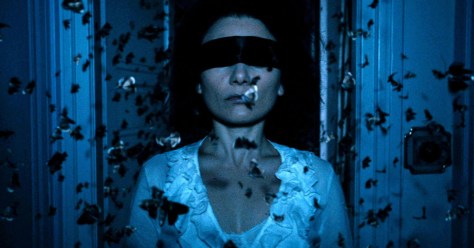
18BURGUNDY2-facebookJumbo

WHY IT WON’T MAKE THE LIST: Though the subject matter might seem strange or unusual to some viewers, the film itself is simply an examination of two women who are going through a trial in their relationship. There is some bizarre dream imagery and a choppy narrative style, but nothing truly Weird.

COMMENTS: The Duke of Burgundy opens with a drawn-out sexual role play as the wide-eyed Evelyn (Chiara D’Anna) enters the house of domineering mistress Cynthia (Sidse Babett Knudsen) to act as housekeeper. Evelyn scrubs and shines and soaks as Cynthia thinks of more demeaning tasks for her to do, ending the day with punishment for unsatisfactory work in the form of urination into Evelyn’s mouth. This scene returns in multiple forms later, as we see different perspectives and points in time, serving as an anchor for our understanding of their relationship. The film unfolds over a semester at the isolated women’s school where Cynthia lectures and Evelyn studies, but most of the focus is on their private moments at home. As the persistent Evelyn comes up with new ways to be dominated, she believes she’s found the perfect partner in Cynthia, who is willing to act the dominatrix if it makes her lover happy. However, it soon becomes clear that the older woman is uncomfortable with the parts Evelyn creates for her, struggling to emotionally and physically abuse her lover even in the context of role playing, and then growing to resent her for her increasing demands.

Strickland made waves two years ago with his stunning, unnerving ode to giallo, Berberian Sound Studio, in which a British sound technician sinks into a paranoid fever dream while shooting a gory horror in Italy. Here, the director again treats the eyes to a sultry palette, ornate settings, and thoughtful camerawork, matched by an effective soundtrack that pairs fuzzy synths with the hum of insects. The opening credits use freeze-frame and oversaturation to reference vintage softcore film, but thanks to the soundtrack and visceral color choices, other moments are more reminiscent of a slasher. The retro vibe is heightened by the somewhat ambiguous setting and time period. Fashions and hairstyles suggest the 1950s or 60s, the aesthetic is more 70s, the landscape and architecture is classical, evoking rural Italy (though filmed in Hungary), and everyone speaks English with different European accents. He clearly devotes much of his time to mixing and matching different film references, from art house to grindhouse, but ultimately the focus is on the characters. Even the weirder touches, including frequent close-ups of insects and stark shots of architecture, are meant to communicate the sense of dread that is hanging over Cynthia and Evelyn’s relationship as they move into darker sexual territory. There is a palpable feeling of intimacy in Strickland’s approach, utilizing close-ups and lingering shots to effect a kind of quietude over most of the proceedings. It is easily to believe in this relationship, though the world around them is often hazy.

On paper The Duke of Burgundy sounds like it should be a sleazy straight male fantasy about lesbian kink, and yet Strickland forgoes all sensationalism—there isn’t that much (explicit) sex or even nudity shown. Evelyn’s mental stimulation is highlighted, as she derives pleasure from being locked in a chest, verbally berated, and sat on by Cynthia. The BDSM scenes are often treated with humor, not to make fun of those practices but to reveal the kind of goofy accidents or strange conversations that might come with it, and to break the tension for an unfamiliar audience. At other times they are presented in a cold, almost sterile manner, with Cynthia eventually injecting a form of revenge into their role play. What is both wonderful and striking about this film is its undertone of normalcy, its relatable and honestly touching portrayal of a romantic struggle, despite its apparently sexploitative premise. The basic story could easily be rewritten with different conflicts, with different genders, with different settings; the BDSM elements are both central to the narrative and secondary to the overarching theme. The film asks if sexual preferences can damage an otherwise strong relationship, and if personal contentment can exist without complete sexual fulfillment. It allows us to peek into something extremely personal, but universal, intermingling with our own insights and experiences, with a dreamlike style so lush and distinctive we still walk away feeling like we’ve left behind a world of fantasy. It might not be List-worthy, but it is certainly worth seeing.

WHAT THE CRITICS SAY:

“…the question of who’s really in charge of these scenarios is complicated. Exactly the same deceptive quality can be found in the dreamlike artifice of Strickland’s film itself, set in a lush and aristocratic European fantasyland that’s entirely nonspecific as to geography and chronology… But while Strickland’s films already aren’t like anyone else’s, his real secret is that even in this strange constructed world, his characters feel like real people struggling with issues that aren’t exotic at all.”–Andrew O’Hehir, “Salon” (contemporaneous)