Tag Archives: Racism

ROGER CORMAN’S THE INTRUDER (1962)

The Intruder (1962) is a film that , star William Shatner, writer Charles Beaumont (who penned numerous Twilight Zone episodes) and a cast of relative unknowns can put atop their resumes. Predictably, Corman’s most progressive endeavor was his only commercial flop. The Intruder can also lay a considerable claim to being Corman’s best film. Shot in 1961, during the very early stages of the civil rights movement, The Intruder was extraordinarily risky, so much so,  that AIP, Corman’s studio, would not touch it. Corman and his brother Gene produced by refinancing his home. A few gutsy critics lavished admiration and praise, and, after Cannes banned it, a few smaller overseas festivals gave it awards. Alas, awards do not count as a return on investment, and a desperate Corman and his initial distributor Pathé made the drive-in rounds with four different titles in a vain effort to recoup costs. Whether under the moniker Shame, The Stranger, or I Hate Your Guts, it was a hopeless cause. Pathé eventually backed out and Corman distributed the film itself, securing the loss of his own investment.

The filming was no less tumultuous. Corman could have shot the film on back lot, but wanted Southern realism. While the leads were Hollywood actors, the crowds were made-up of townspeople, many of whom were as bigoted as the characters they played. Corman produced a watered down, alternative script for locals to read. Even with the script’s subdued version, the production was filled with tensions.

For the part of the sociopathic bigot, Corman picked the unknown newcomer William Shatner. Shanter later said he would have paid Corman for the part and despite being a Canadian Jew, Shatner embodies Cramer like an evangelical snake oil salesman.

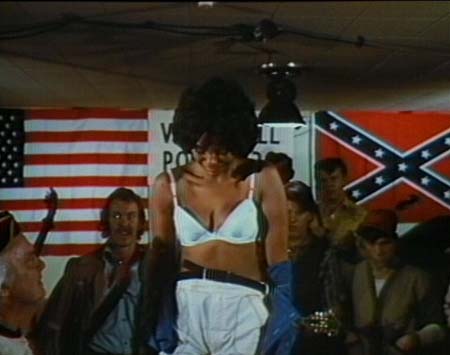
For the incitement-to-hatred crowd scenes, Corman shot all of the long shots with Shatner silently delivering his fascistic speech (adding dialogue in post-production) so the crowd had no idea what he was saying. The closeups, shot after much of the crowd had dispersed, were filmed with Shatner actually delivering his lines. Corman saved the cross burning scene until last, after which director, cast, and production crew immediately drove North, getting out of Dodge.

Still from The Intruder (1962)The Intruder has a refreshingly complex script. Two familiar character actors here have surprisingly three dimensional roles: Frank Maxwell as Tom McDaniel sides with integration, but only in loyalty to the law, not from moral conviction. Leo Gordon was typically known as a stock western heavy. Here, he plays the rowdy and uncouth Sam Griffin,driving his wife straight into the arms of  extrovert charmer Cramer. When the infidelity is discovered, Griffin does not retaliate, or seek revenge. Rather he advises Cramer to leave town. We do not expect this out of Griffin. Nor do we expect this crass vulgarian (or so he seems at first) to be the only local intuitive enough to see Cramer for what he is. Additionally, Griffin shoulders some of the blame for is wife’s unfaithfulness. This is Gordon’s best role and one of the few times he was given a part worthy of his skills.

Other character roles are fleshed out well by actors such as Robert Emhardt and Joey Greene. The writing is complex enough to invite comparisons to the /Burt Kennedy collaborations.

Shatner turns in a great, commanding star performance (no, I am not kidding). Like the script itself, Shatner’s Cramer is fast-paced and smart. He utterly convinces, making one wish he had more roles like this. Beaumont adapted the script from his own novel and actually surpasses his source material.

It is easy to look back and point accusatory fingers long after mores have changed, but Corman and company had the guts to go face-to-face with racial issues in their contemporary climate. It took him 40 years to break even with this film. That he was that far ahead of his peers is true horror.

SEVEN CHANCES (1925)

‘s Seven Chances (1925) features the greatest chase scene in silent cinema. It is a typically no-holds barred, Keatonesque climax. The film also highlights Keaton’s major flaw: his inability to rise above the racism of his society. This is a flaw that cannot be ignored; it factors into our moral and aesthetic assessment of the artist. The transgressions are brief here, but blatant and repeated.

Surprisingly, the frequent debates pitting Chaplin against Keaton rarely consider this factor. Or perhaps it is not so surprising. On just about every list imaginable, D.W. Griffith ranks near the top of all-time great directors, despite the fact that his epic landmark, Birth of a Nation, is one of the most monstrously racist films produced in cinematic history. Griffith’s onetime assistant, , might earn a footnote in such sophomoric lists. Browning, of course, went onto his own directorial career, which included Freaks (1932). There is no serious argument that Browning, with static camera and discomfort with sound, could  compete with Griffith aesthetically. However, Browning was ahead of his time socially. In his art, Browning bravely empathized with outcasts. Yet, Browning’s standing usually excludes the advanced social ideologies in his art. His skill with a camera, or lack thereof, is considered primary. In artistic evaluation we still rank technical skill highest.

While Keaton is not guilty of promoting racist epithets, he absolutely endorsed period racial stereotypes, repeatedly. Perhaps most so in Seven Chances, which he directed alone. To be fair, no Chaplin film went so far as Browning’s liberating manifestos. However, Chaplin certainly came close to the Browning ideal in his tramp characterization and his features Modern Times (1936) and The Great Dictator (1940). Amusingly, both films are still seen, by right-wing extremists, as something akin to communist propaganda.

Keaton ranks lower than Chaplin in my assessment primarily for this reason. Certainly, Keaton was more skilled in narrative, originality, innovative camerawork, and set design. However, Chaplin was light years ahead of Keaton in social sensitivities. On this issue, Keaton was a product of his time. Chaplin was that rarity of rarities; an authentic religious figure who rose above his time, which ultimately counts more than his saccharine heart and aesthetic deficiencies.

Still from Seven Chances (1925)Despite the brilliance to be admired and enjoyment to be had out of Seven Chances, there are moments to make you cringe: Keaton, searching for a bride, sits down on a bench near a pretty girl. He starts to flirt, but realizes she is reading a Hebrew newspaper and quickly springs up, running in the other direction (oddly, the film had a Jewish producer). Similarly, Keaton comes upon one of many brides to be, discovers her to be African-American and, again, does an exit stage left. The cherry on top of the icing on top of the cake is an excruciatingly embarrassing blackface vignette. We can, with effort, move past these and acknowledge the film’s artistry. Simultaneously, however, we cannot evaluate the work fully without factoring in the stinging racial stereotypes.

A simple plot evolves into an epic, surreal finale: cinema at its most animated. Keaton stands to inherit seven millions dollars if he is married by 7 pm on his twenty-seventh birthday. Unfortunately, he receives this news on the afternoon of his twenty-seventh birthday. Keaton’s girlfriend would be the natural choice for a mate, except that our hero is a tad awkward at expressing his love. The local gals cruelly mock Keaton’s marital efforts—that is, until they learn he is a potential heir. News of our shy protagonist’s inheritance leads to an epic deluge of wannabe brides pursuing him in a chase of mind-boggling comic inventiveness. With this climax, and the film’s timelessly shrewd satire of western avarice, it is no wonder Seven Chances was an audience favorite in revivals. Keaton literally seems to be a live action, stone-faced Speedy Gonzalez, fleeing foolish virgins and an avalanche of boulders (a justifiably famous scene that was improvised). Naturally, a wise maiden is waiting in the wings, even if she is devoid of personality or development.

The 2011 Kino edition beautifully restores a color tinted sequence.

Note: This was one of Keaton’s least favorites among his films. The script, based off a famous play by David Belasco, was purchased by Keaton’s producer and adapted by four writers. Actresses Jean Arthur and Constance Talmadge have brief, uncredited roles.

* Next week: The Cameraman (1928) and Film (1965)

SHANTY TRAMP (1967)

Elmer Gantry (1960) with a dose of The Intruder (1962) on a 75 cent budget.”

There is the one-sentence synopsis for Shanty Tramp (1967), written and directed by Joseph P. Mawra. Mawra was a lesser-known director of numerous grindhouse films (such as 1964-1965’s Olga trilogy, produced by Glen or Glenda‘s George Weiss). Movies from this sadosexual school of filmmaking were often referred to as “roughies,” and here the lighting alone justifies that moniker.

After watching Shanty Tramp, you’ll never think of the song “When the Saints Go Marching In” quite the same way. The film opens with a worm’s eye-view of the Shanty Tramp herself (Lee Holland, in her only film role), barely squeezed into a tight white dress and pumps from hell as she shakes, jiggles, and marches her tramp way into a tent revival, choreographed to a gospel tune.

The little incubus-Eve is bound and determined to distract Preacher Man and every other male with red blood, which includes Daniel, a young African American male whose Ma warns him about the wiles of evil Shanty Tramps.

There’s a gleam in Shanty Tramp’s eyes when she spies the tithing basket. There’s a gleam in Preacher Man’s eyes when he spies Shanty Tramp’s popping cleavage. They promise to rendezvous later for a “spiritual lesson,” but Shanty Tramps get easily distracted.

The local rock-n-roll bar is man meat magnet for our heroine. Shanty Tramp grinds. Shanty Tramp flirts. Shanty Tramp gets fought over and the winner is… Savage, the leader of a biker gang! “Come on big man! You promised me a fin! I wanna see it!” She tells Savage. “Shut up and put out, babe!” Put out she does, and darn it, Savage actually lives up to his name and frolics rough.

Meanwhile Daniel’s Ma is still warning her son: “Tain’t good for black folk to be out at night! You get that Shanty Tramp outta your mind! ” “Oh come on Ma!” “Them whites in this town, they’re the same ones who strung up your Pa!”

Still from Shanty Tramp (1967)Daniel’s not listening. He’s hearing the call of that succubus Shanty Tramp. The wise words of Ma can only fall on deaf ears when Shanty Tramp does her mating call. Daniel’s just in time to hear Savage yodel, “You teasing’ little bitch!” Poor Shanty Tramp has lost her top. It’s the exploitation version of Frankenstein Meets the Wolfman (1943) with Daniel and Savage substituting for  and , They crash into a case of Pabst Blue Ribbon. Daniel proves the better man and our heroine rewards him with some interracial action. Unfortunately, Shanty’s drunken Pa stumbles in to see Shanty and Daniel sharing a sweaty cigarette.

The redneck villagers, torch in hands, are in full pursuit of the black monster while his Ma has to pay the ultimate sacrifice for her little Cain. Shanty’s Pa gets sober enough to realize his little girl was engaging in consensual interracial sex. Pa grabs the old testament whip and … off with her top again!

Thrown in patricide, exploding cars, racial revenge, and bed-hopping that goes full circle back to Preacher Man, who don’t mind sloppy seconds so long as he gets to save a soul from the Devil’s lair. The sacrifices poor Preacher Man has to make doin’ the Lawd’s work!

Enjoy it with friends, but after shuffling your guests out the door, a tub full of Calgon is strongly advised to take you away from all that Shanty Tramp residue.

CAPSULE: SUBLIME (2007)

366 Weird Movies may earn commissions from purchases made through product links.

Sublime is currently available for VOD rental.

DIRECTED BY: Tony Krantz

FEATURING: Tom Cavanagh, Kathleen York, Lawrence-Hilton Jacobs

PLOT: The day after his 40th birthday, George Grieves enters Mt. Abaddon Hospital for a routine colonoscopy.  Waking after the procedure it rapidly becomes apparent that something has gone seriously wrong.  George and his only ally, a nurse called Zoe, attempt to discover the truth in an increasingly nightmarish hospital of horrors.

Still from Sublime (2007)

WHY IT WON’T MAKE THE LIST:  It really isn’t weird enough.  Certainly there are periods of scary oddness, but none that haven’t been depicted before in other, better films.  I hesitate to call the plot twist a “twist” as any regular weird film fan will see it coming over the hill a mile away, waving its hands to attract your attention (Zoe the stripper-gram nurse, I’m looking at you love!)  It has some serious and troubling points to make about fear, prejudice, white middle class guilt and health care systems in general, but it makes them in a long-winded, repetitive way.

COMMENTS: I practically leapt at the chance to review this film, having heard nothing about it, and being fond of “weird hospital” movies. About half way in I began to regret my decision, and this was the first film that I nearly pulled out of reviewing.  This is not because it’s a bad movie—though it is long-winded and really could have used the editor’s hand clipping away twenty minutes or so—but because the uncomfortable issues the movie raises hit close to home.

I’ve grown up in the occasionally stony but generally reliable bosom of the British National Health Service and felt I should perhaps have watched this with my wife who, as an American, has now experienced heath care on both sides of the Atlantic.  Procedures occurred in Sublime which seemed odd to me, even taking into account the national differences.  I mean, that was an awful lot of laxative!  Are American colons so different?

Protagonist George is an upper middle class, able-bodied (at least initially), straight, white male and his attitudes, prejudices and fears were in many respects different from mine.  But even if the specifics are different, fear, prejudice and guilt are common to everyone.  When Continue reading CAPSULE: SUBLIME (2007)

CAPSULE: POOR PRETTY EDDIE (1975)

366 Weird Movies may earn commissions from purchases made through product links.

DIRECTED BY: Richard Robinson

FEATURING: Leslie Uggams, Michael Christian, , Ted Cassidy, Slim Pickens, Dub Taylor

PLOT: Traveling alone in the Deep South, a black singer’s car breaks down and she finds herself the “guest” of an obsessive wannabe country singer and a town full of redneck oddballs.

Still from Poor Pretty Eddie (1975)

WHY IT WON’T MAKE THE LIST: This drive-in “hicksploitation” movie features eccentric characters, one or two moments of deliberate surrealism, and a few other scenes that may be unintentionally surreal, but ultimately it doesn’t rate as much more than a curiosity.  Those who like their 1970s exploitation movies on the sleazy and offbeat side will want to take a flyer on Poor Pretty Eddie, but it’s not quite the lost cult classic it’s being advertised as.

COMMENTS: In its opinion of Southern hospitality, Poor Pretty Eddie falls somewhere between Deliverance and 2000 Maniacs. The flick plays on urban prejudices about backwards bumpkins, and on fears of being a stranger in a strange land with inscrutable customs where tribal loyalties are more important than justice. An interesting, colorful cast adds flavor to the sordid (but not graphic) scenario, which revolves around rape and racism.

As Liz Weatherly, future TV actress Leslie Uggams is, unfortunately, about as appealing as her last name. In the beginning she projects the persona of an urban snob rather than a harried celebrity seeking privacy; by looking down her nose at the hicks, she threatens to move our sympathies towards her future tormentors. When she turns victim she becomes unforgivably passive, becoming a symbol of oppression rather than someone we identify with. Michael Christian, who also found steady work as a TV character actor, does a fine job as the deluded Eddie, dressing like Elvis in a powder-blue leisure suit with rhinestone spangles for an awkward “audition” for an unappreciative Uggams. Acting as a foil to Eddie is hulking handyman and dog breeder Ted Cassidy (“Lurch” from the Addams Family); he’s smarter than he appears and, since he fights back, he becomes more Continue reading CAPSULE: POOR PRETTY EDDIE (1975)