Tag Archives: Musical

LIST CANDIDATE: PEPPERMINTA [2009]

DIRECTED BY: Pipilotti Rist

FEATURING: Ewelina Guzik, Sven Pippig, Sabine Timoteo, Elisabeth Orth
Still from Pepperminta (2009)

PLOT: A whimsical young woman brimming with optimism moves breezily through her hometown in Switzerland, picking up new friends Werwen (Sven Pippig)—a sickly momma’s boy—and Edna (Sabine Timoteo)—a cross-dressing gardener—along the way.  The trio’s mission is to teach others to live without fear through experimental color hypnosis.

WHY IT MIGHT MAKE THE LIST: Pepperminta is a creative, experimental, singular film that defies standard classification.  It is at once funny, thought-provoking, insightful, fanciful, sexual, and wistful; it contains memorable visuals, bizarre characters, impromptu musical numbers, and flashes of complete fantasy.  It’s wonderfully weird, to be sure, but its sentimentality and naive perspective can be cloying and alienating for some audiences.

COMMENTS: Swiss video artist Pipilotti Rist is known for saturated colors and themes of harmony and sensuality in her short works.  Pepperminta marks her first foray into feature-length narrative film, allowing her to expand upon these concepts in a more accessible manner.  Inspired by Pippi Longstocking, the story is a fantastical urban adventure set in a magical realist universe that’s open to Utopian ideas, and the central character is unflappable in her quest to bring joy, beauty, and strength to everyone she meets.  Pepperminta transforms the souls of those she chooses to be a part of her mission, healing them with flowers, touch, music, and contagious confidence.  She believes that through certain combinations of color a person’s outlook can be altered, and demonstrates this in several wacky encounters.

Pepperminta is primarily driven by its mysterious but likable characters.  The title character is quick-to-smile, red-haired, freckled, and feels completely at ease in her own body.  She wins others over to her side with unshakable kindness, even if her weirdness confuses most people at first.  Werwen is shy,  middle-aged, and allergic to everything; he easily falls in love with Pepperminta, most likely because she’s the first girl with whom he’s interacted.  With her help he conquers his fear of the outside world bred by his overprotective mother.  Edna is taciturn and serious-minded, slowly released from her hard outer shell as she opens herself up to her new friends, even tapping into the magical aspects of Pepperminta’s personality. Continue reading LIST CANDIDATE: PEPPERMINTA [2009]

BORDERLINE WEIRD: THE NIGHTMARE BEFORE CHRISTMAS (1993)

AKA Tim Burton’s The Nightmare Before Christmas

Recommended

DIRECTED BY: Henry Selick

FEATURING: Voices of Chris Sarandon, Danny Elfman, , Ken Page

PLOT: Jack Skellington, the Pumpkin King of Halloweentown, discovers Christmas and tries to recreate it, with ghoulish results.

Still from The Nightmare Before Christmas (1993)

WHY IT’S ON THE BORDERLINE: As a children’s film, The Nightmare Before Christmas has a high hurdle to overcome. Since it’s aimed at kids, the movie is permitted to indulge in imagination and fantasy, so long as it uses a conventional story framework and takes a stab at conveying a useful moral lesson. Nightmare has a great, morbid motivating idea and is a triumph of macabre art design, but at heart it doesn’t stray very far from the childrens’ film format. If it’s eventually to be counted amongst the weird, it will be solely for its incidentals and visuals.

COMMENTS: The opening song introduces us to the ghastly denizens of Halloweentown, including the expected assortment of witches, vampires and ghosts, but also a creature with black and white striped snakes for fingers, the “clown with the tearaway face,” and a two-faced mayor with a spinning top for a head and a freakishly phallic stovepipe hat. This legion of scary weirdos are ruled over by Jack Skellington, an elegant but spindly skeleton in a pinstripe suit. A grim gray pallor hangs over the town, which features an Expressionist pumpkin patch/boneyard with slanted tombstones and a curlicue hill permanently posed before a giant yellow moon. Bored with the repetitive routine of  Halloween, Skellington seeks new vistas and finds one when he stumbles onto Christmastown, an eye-popping festival of lights and toys set among blinding white snowbanks ruled over by a jolly fat man; the town provides the perfect visual and spiritual contrast to gloomy Halloweentown. A holiday architect looking for a new challenge, Jack decides to “take over” Christmas (incidentally kidnapping Santa Claus). After futile attempts to ferret out the meaning of Christmas by dissecting teddy bears and placing crushed ornaments in boiling beakers, Skellington hatches a plan to pose as Kris Kringle and deliver toys himself, which leads to the film’s keystone sequence: a horrific Christmas Eve sleigh ride through a doomed village, where the Santa-suited skeleton leaves ghoulishly inappropriate gifts for Christmastown’s tots, including a severed head and a tannenbaum-swallowing snake. It all ends in disaster, as Jack, who began with the best of intentions, realizes that his amateur staging of Christmas was a Nightmare and that he has to set things right and reaffirm his devotion to the Satanic rites of All Hallow’s Eve. The moral seems to be, attempts to understand other cultures are doomed to failure; stick to your own kind.

The character designs and intricate, almost hidden gruesome details (like the skeletal Halloween cock that crows the dawn) are the triumph of Nightmare. With a couple of exceptions—the bubbly, Broadwayesque “What’s This?” when bemused Jack first discovers Christmastown (“There’s children throwing snowballs instead of throwing heads/They’re busy building toys and absolutely no one’s dead!”) and a deviant number sung by three mischievous trick or treaters who plan to kidnap “Sandy Claws” (“Kidnap the Sandy Claws, throw him in a box/Bury him for ninety years, then see if he talks”)—Danny Elfman’s songs are flat and unmemorable, advancing the plot but not thrilling the ear. The story is also exceedingly thin, even at its trim running time of under 80 minutes. The original concept came from a Burton parody of Clement Moore’s “Twas the Night Before Christmas;” to pad out the running time, a romantic subplot and an antagonist were added. The love interest is Sally, a stitched-together female Frankenstein forever losing her limbs.  She’s constantly scheming to escape her creator, a duck-billed mad scientist with a detachable brainpan who wants to keep her locked in his castle, and she acts as a cautionary voice for Jack, trying to warn him off his insane Yuletide scheme. There’s no spark to their relationship, though, and though their romantic ending is pretty, it’s also pretty meaningless in story terms. The villain, Oogie Boogie the Boogeyman, is another wonderful character in search of a plot function. A burlap sack stuffed with creepy crawlies, gruff Ken Page gives him a 1920s boogie-woogie singer’s voice, and he makes a hell of a hellish impression. But he’s introduced late and has no real motivation: it’s unclear why he thinks that bumping off Santa Claus will help him unseat Skellington as king of Halloweentown. He pads the film, but his main purposes are to set up an unnecessary, anticlimactic action sequence for the finale, and (more importantly) to provide Selick the opportunity to build another magical set. And Oogie’s lair is it’s own freaky, fun world: his hideout is casino themed, with living gunfighter slot machines and worms crawling through the pips of dice, and it’s bathed UV lights to give the puppets an eerie glow. Though the script could have done much more to make him a meaningful antagonist, the awesome visuals this boogeyman inspires are reason enough for him to take up space in Nightmare‘s world. The entire story takes a back seat to the cute, Gothic animation, so why should Sally and Oogie Boogie be any different?

The idea for Nightmare was originally sketched out by Tim Burton at Disney Studios, before they fired him for “wasting company resources” by making Frankenweenie. After the director found success outside the Magic Kingdom, Disney was willing to work with him again, and he served as Nightmare‘s producer and even got his name in the title. In a case of history repeating itself, the studio again found the finished work too morbid and were afraid it would frighten young children, so they released it under their Touchstone subsidiary. Despite rave reviews, Nightmare was not an immediate success, but it has found a cult audience on video. Disney has since fully re-embraced the movie, removing all traces of the old Touchstone logos and prominently slapping the Disney name back on the prints, just as if they had been 100% behind it before it became a hit.

Related: Alfred Eaker’s A Few Odd Yuletide Favs.

WHAT THE CRITICS SAY:

“[Burton] pulls adult minds down to the surreal darkness of childish imagination — where the real nightmares are. But through Burton’s eyes, these dark dreamscapes aren’t bad places at all. In fact, they’re quite wonderful.”–Desson Howe, The Washington Post (contemporaneous)

BORDERLINE WEIRD: STINGRAY SAM (2009)

DIRECTED BY: Cory McAbee

FEATURING: Cory McAbee, Crugie, David Hyde Pierce

PLOT: Ex-con/lounge singer Stingray Sam grudgingly joins his former partner the Quasar Kid

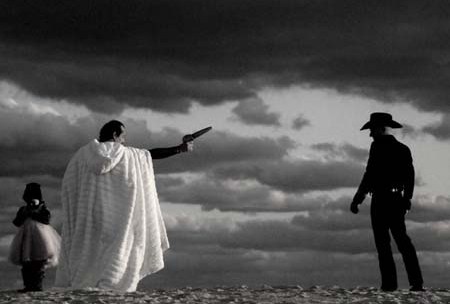
Still from Stingray Sam (2009)

in a quest to save a little girl, with frequent musical breaks featuring songs by The Billy Nayer Show. David Hyde Pierce narrates intermittent segments of animated collage that explain their futuristic society.

WHY IT’S ON THE BORDERLINE: It’s a wacky, memorable space musical with western flair, crisp black and white visuals, and imaginative, nonsensical notions of the future, but all that can be found in slightly more intriguing form in McAbee’s earlier work The American Astronaut, which better serves The List by being a feature-length movie (Stingray Sam is an hour-long serial).  But it certainly contains enough of its own charm and inventiveness to stand alongside its predecessor, and it shouldn’t be wholly dismissed just yet.

COMMENTS: Conspicuously sponsored by the fictional “Liberty Chew Chewing Tobacco” and excitedly asking what our heroes will be up to next at the end of every episode, Stingray Sam is a fitting tribute to old-fashioned serials, keeping many of the western and sci-fi elements of such shows while incorporating a wealth of inspired new ideas. There are several weird inventions and convenient technologies to place it in the futuristic space setting, but the sets are wonderfully low-key and familiar. McAbee’s incredible charm seeps through the screen in everything from his performance to the silly dialogue, aided along by the excellent musical numbers and gorgeous animated collage sequences.

By the time the second episode’s explanatory animated piece details the upper class invention of gender-determining drugs, male-on-male baby-making, and a delightful portmanteau naming system, what started out as a fairly straightforward quest to rescue a maiden quickly evolves into a madcap journey through McAbee’s unpredictable imagination.  The layers of references, backstory, character, and pseudo-science wrapped up in a musical comedy-adventure are impressively nuanced.  David Hyde Pierce’s articulate and tongue-in-cheek narration (which delights particularly in the word “Durango”) offers a range of ideas, inventions, and happenings that don’t always make sense but never fail to spark interest.  The first time around some of this information goes by too quickly, as viewers are hit with so many novelties and humorous animation at once, but subsequent watches prove McAbee’s involved story and unique futuristic vision to be unavoidably successful, if preposterous.

With catchy tunes that probably sit somewhere in the rock and roll spectrum yet manage to remain without a definable genre classification, The Billy Nayer Show (who also comprise several main cast members) craft a fun soundtrack that usually leads to manic dancing and wide smiles.  Each episode contains one song, which never encroaches on the action or comedy (and often increases the latter), along with a curt opening theme that reminds us “Stingray Sam is not a hero, but he does do the things that folks don’t do that need to be done.”  They serve to make the strange story even more memorable, describing stingray babies, entertainment on Mars, and peg-legged fathers, and add an extra element of goofy joy to the work.

Looking past the wonky sci-fi premise and western trappings (complete with cowboy hats and “yes ma’ams”), the heart of Stingray Sam lies in the unbridled glee the entire project exudes. As Sam, McAbee swings his way into everyone’s hearts with his jerky dance moves, easy smile, and affable demeanor, while Crugie keeps his cool as the Quasar Kid, offers some gruffer tunes, and frequently betrays a weakness for olives.  Their intricate secret handshake is just icing on this lovable, quirky cake of a partnership.  The beleaguered faces of many supporting cast members seem somehow twisted and plasticine, suiting the off-kilter atmosphere perfectly as they help or hinder our heroes’ proceedings.  There’s not much else like Stingray Sam.

Stingray Sam is currently only available directly from director Cory McAbee at his personal site (click here to purchase).  If the film follows the marketing plan of The American Astronaut, it will eventually be released via normal distribution channels as well.

WHAT THE CRITICS SAY:

“Sounds weird? You bet your ass… Cory McAbee manages to cram enough story and song in to each episode, each more ridiculous than the other and still come out with a coherent story and structure.”–Swarez, Twitchfilm

BORDERLINE WEIRD: SIX-STRING SAMURAI (1998)

DIRECTED BY: Lance Mungia

FEATURING: Jeffrey Falcon

PLOT: In an alternate post-apocalyptic past, Elvis has died, and samurai musician Buddy races to Lost Vegas to make his claim the King’s throne—along with every other rock-and-roll outlaw prowling the wasteland.

Still from Six-String Samurai (1998)
WHY IT’S ON THE BORDERLINE: From the plot synopsis alone it should be clear that Six-String Samurai‘s weirdness isn’t in doubt.  Although it has an excellent chance to make the List down the line, something in me resists putting it on after the first ballot.  The mix of action and absurdity in Six-String Samurai is tempting, like a dish at a fancy restaurant that sounds mouth-watering on the menu; but when you order it you discover that, although the individual ingredients are of the highest quality, the flavors don’t quite blend properly. It’s satisfying and too good to send back, but you had hoped for much more.

COMMENTS: This is my second review of Six-String Samurai; a younger me reviewed the film when it first came out, in 1998.  With time, wisdom, and more weird movies under my belt, has my assessment of changed since then?  I reprint that review below, with my contemporary observations to follow.

“The mainstream Las Vegas Review-Journal gives it one star.  The alternative free weekly City Life gives it four stars (out of five).  My interest is piqued; the kid in me wants City Life to win out, but my internal cynic is betting heavily on the Review-Journal.  Reading the plot synopsis—after nuclear war in 1957, Elvis, King of the City of Lost Vegas, has just died, and every guitar-picking, sword-wielding outlaw of the Wastelands, including Buddy Holly and Death himself, is heading to Vegas to claim the throne—it’s easy to guess that this will be a polarizing film.  But, once you get past the “I’m just hip enough to get this/I’m so hip that I’m way past this” dichotomy, it turns out that Six-String Samurai is a fairly engaging, sporadically irritating piece of entertainment.  Although it plays like an assignment from a class in postmodern film making—write a script which will serve to distance the author from charges of Continue reading BORDERLINE WEIRD: SIX-STRING SAMURAI (1998)

CAPSULE: ACROSS THE UNIVERSE (2007)

Recommended

DIRECTED BY:

FEATURING: Jim Sturgess, Evan Rachel Wood

PLOT: More than thirty Beatles songs illustrate a romance between a working-class Liverpudlian and a New England WASP during the tumultuous 1960s.

Still from Across the Universe (2007)

WHY IT WON’T MAKE THE LIST: Set in a sentimentalized Sixties, it’s inevitable that Across the Universe heaves to that decades psychedelic squalls. Spectacular director Julie Taymor relishes slathering lysergic pigment on her CGI canvas for five or six of the thirty plus songs, but the ultimately the story is more about how all you need is love than it is about girls with kaleidoscope eyes.

COMMENTS: In a career of a mere eight years, the Beatles probably cranked out more memorable melodies than Mozart. It was a minor stroke of genius to adapt that songbook into a musical.  he script of Across the Universe, which tells the story of a pair of young lovers and their friends with the Vietnam War protests and the Summer of Love as a backdrop, can be viewed in two ways. It could be seen a complete failure, built out of equal parts of romantic cliché and self-congratulatory Baby Boomer nostalgia. Or, it could be looked at as a masterpiece of craftsmanship, considering the fact that the scriptwriters had to weave a coherent epic tale from a relatively small catalog of three-minute song-stories containing no recurring characters.

Like most musicals, however, the story is almost beside the point; it only needs to be good enough to set up the next production number. Fortunately for weirdophiles, the numbers Universe‘s story sets up are frequently cosmic, though you will have to wade through an hour of character setup before it starts coming on. This being an archetypal 1960’s tale, there’s a nod to acid culture: more than a nod, it’s a magical mystery tour through an extended three song medley. It starts with the principals sipping LSD-spiked drinks at a party while a Ken Kesey type (played by Bono) lectures on mind expansion using “I Am the Walrus” as the holy text; whirling cameras and and tie-dye colored solarization gives their trip to the countryside via magic bus the requisite grooviness. This sequence segues into “For the Benefit of Mr. Kite,” where another acid-guru (Eddie Izzard) takes the crew inside his magic tent for a twisted computer-generated carnival complete with a roller skating pony, a dancing team of Blue Meanies, and contortionists in spooky wooden tribal masks. The scene’s an impressive visual spectacle whose impact fizzles thanks to Izzard massacring the lyrics through an off-the-beat, spoken-word delivery with some unfortunate improvisations. The dreamy comedown features the flower children staring up at the sky, imagining themselves tastefully nude and making love underwater.

Psychedelia intrudes into other numbers, as well: the carefully layered images of “Strawberry Fields Forever” feature bleeding strawberries that morph into fruit bombs splattering on the jungles of Vietnam. “Happiness Is a Warm Gun” includes a cameo by Salma Hayek as five sexy dancing nurses, and a bliss-giving syringe filled with a nude dancing girl. The best and weirdest segment may be “I Want You/She’s So Heavy,” which addresses the draft board and stars a talking poster of Uncle Sam, dancing sergeants with square plastic chins, and a platoon of soldiers lugging the Statue of Liberty. Standout non-weird numbers include a gospel version of “Let It Be” set during the Detroit riots and a funky “Come Together” performed by Joe Cocker, who sings as three different characters, including a natty pimp backed by a chorus of hookers. Hardcore Beatles fans will rate Universe a must see (and they’ve probably already seen it); unless you’re some sicko who absolutely can’t stand Lennon-McCartney compositions, you’ll want to check it out just for the visuals. It can get pretty far out.

Despite its weird parts, Across the Universe was able to secure a mainstream release. Audiences were willing to accept the unreal scenes because they were presented in the lone format where the average person expects and accepts surrealism—the music video. Unfortunately, however, even the Beatles fan base couldn’t make Taymor’s experiment profitable at the box office.

WHAT THE CRITICS SAY:

“A cameo by Bono as a sort of godfather among hippies (delivering a forceful cover of ‘I Am the Walrus’) shifts the movie into a hallucinatory realm, with a tie-dye color scheme that suggests scenes were shot during an acid trip with Baz Luhrmann. Viewers who like movies to reflect their out-of-body experiences will gladly inhale, but for others, the excess may seem off-putting.”–Justin Chang, Variety (contemporaneous)