Tag Archives: Mindbender

LIST CANDIDATE: RESOLUTION (2012)

DIRECTED BY: Justin Benson, Aaron Moorhead

FEATURING: Peter Cilella, Vinny Curran, Zahn McClarnon, Bill Oberst Jr., Kurt David Anderson, Emily Montague

PLOT: A man ties up his methamphetamine-addicted friend in a cabin in hopes he will kick his drug habit, but strange things start to happen.

Still from Resolution (2012)

WHY IT SHOULD MAKE THE LIST: In this tense micro-budget thriller, a young man tries to bring his friend back to reality, only to find that “reality” is not just open to interpretation, but malleable and ever-changing. In fact, the pair’s reality might not even be their own. A genre bender and a puzzler all in one film, this indie thriller combines horror, mystery, drama, and psychological suspense elements with a novel premise and twist and turns to deliver a uniquely weird viewing experience.

COMMENTS: In spite of some worn clichés—mysterious found footage, missing researchers, and a mystic medicine cabin obligatorily set on an Indian reservation—with Resolution, independent writer/director Justin Benson brings us a breath of fresh air. The film is technically adept on its small budget, and presents a real genre-bender of a plot. Resolution builds slowly as a crime drama, becomes psychological suspense, then morphs into a puzzler riddled with paradoxes. It releases in a brief climax of occult horror.

In the story, yuppie Michael (Peter Cilella) travels to a remote squatters’ shack, where his addict friend Chris (Vinny Curran), bristling with firearms and contraband, has holed up, resolved to kill himself with drugs. Michael restrains Chris, and forces him to withdraw “cold-turkey” over the course of a week.

A progression of weirdos make the scene. Chris’s low-life cohorts (Kurt David Anderson and Kyler Meacham) drop in, demanding drugs. A tightly-wired Native American property owner (Zahn McClarnon) and his menacing gang show up to evict the occupants. A scheming real estate developer (Josh Higgins) creeps in, mistaking Michael and Chris for the deed-holders, and a doomsday religious cult is engaging in shenanigans a little too nearby for comfort.

Michael strives to maintain control over the situation to buy enough time to get Chris straightened out, and back to civilization and rehab. Despite the threat posed by oddball interlopers, the real tension is yet to come.

Someone…or some THING is watching and recording everything Michael and Chris do. But how? The surveillance indicates a presence that looms closer and closer, yet Michael can’t detect the observer.

Looking for clues, Micheal discovers strange footage shot by a missing anthropology team, then locates a laconic neighbor, Bryon (Bill Oberst Jr.), with an uncomfortably unorthodox existential philosophy. From here the story plunges into perplexing paradoxes. Chris’s sleazy drug buddies and the landowner converge for a showdown. Mind-bending events knock Mike and Chris away from objective reality and any sense of control over their destinies.

Resolution is talky, but intriguing. The long-winded plot is better suited for an hour short. Aside from establishing an initial setting and circumstances, the first half of the film doesn’t bear vital relation to the engaging concepts of the second. It’s still pretty good. Unsettling developments keep us watching. Plot twists reveal a honeycomb of passages down which to venture. Rather than choose one of them and proceed, the filmmakers offer a twisted experience based on the fact that these alternate routes exist.

Part of the fun of Resolution is thinking about the various possibilities and what they mean. In our minds, we pursue them, trying to predict the outcome, but just when we think we know what’s going to happen, Resolution throws us a new twist. Throughout it all ripples a nerve-jarring undercurrent of menace, indeterminate and incipient. Mike and Chris’s safe return to the outside world is increasingly unfeasible.

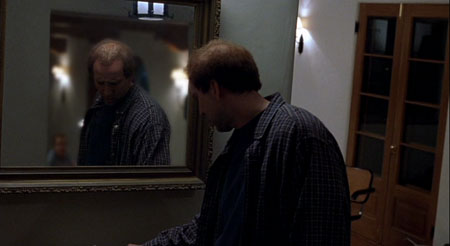
Subtle cinematic artistry reinforces the exposition. In the scene in which Michael is conversing with Byron, Byron discusses his views about narrative and story. As he explains his views, he holds a mirror. At first, the mirror is angled so that Micheal’s reflection blends with Byron’s face. The effect is to project Byron and Micheal as melded together, depicting a dual entity. But Michael cannot see it. Only we can see it.

Byron angles the mirror so that we see another mirror on the wall behind Michael, producing the illusion of endless repetition. It illustrates the concept of how a painter records a scene. There is the scene, and a painter painting it. But there is a larger scene. For us to see the painter painting the scene, there must be another painter, painting the painter painting the scene… and so on to infinity. This is a pivotal moment in the film. Resolution carries distinct, though not fully developed sub-themes about the evolution and structure of folklore, myth and story, and these are tied into paradoxes.

Resolution was filmed in a half-completed lodge under construction, illuminated by hook lamps, and without background music. Intimate camerawork increases a sense of realism, almost like seeing a documentary. The technique is effective because Resolution turns out to be all about deconstruction and the plastic nature of reality. By the time we realize this, we’ve accepted the actuality of what’s transpired, only to have the drop sheet yanked out from under our feet.

WHAT THE CRITICS SAY:

“…a strangely tense and humorous meta-narrative about two friends experiencing weird goings-on at a remote cabin.”–Robert Abele, The Los Angeles Times (contemporaneous)


Resolution trailer

CAPSULE: IN THE MOUTH OF MADNESS (1994)

DIRECTED BY: John Carpenter

FEATURING: , Julie Carmen, ,

PLOT: An insurance investigator investigates the disappearance of a bestselling horror novelist whose books have the power to drive men mad.

Still from n the Mouth of Madness (1994)

WHY IT WON’T MAKE THE LIST: In the Mouth of Madness has an ahead-of-its-time, and slightly weird, premise, but the movie’s execution doesn’t live up to the promise of the insane scenario.

COMMENTS: A throng of maddening ideas writhe within In the Mouth of Madness. A horror writer whose books turn susceptible readers into psychopaths. A New England town, not marked on the map, inhabited by characters and places from the writer’s fictional stories. A world where the insane gradually come to outnumber the sane, and mental asylums become a refuge from the madness of the world outside. These elements conspire to make Madness an intriguing proposition, but unfortunately the movie sports an equal number of gaffes that keep it from reaching its potential. Madness‘s initial budget of 15 million was cut by more than two-thirds, which perhaps explains some of the unevenness on display. Some of the special effects, especially the ones devised by Industrial Light and Magic such as the sequence where Prochnow peels his face apart and it turns into the ripped pages of a novel, are up to 1990’s snuff. But some of the non-scary rubber makeup effects belong in a movie from a decade earlier; for example, a scene where a circus contortionist wears a mask meant to convince us she’s another character is more likely to elicit chuckles than shudders. The acting, too, is all over the map in terms of quality. The first speaking part goes to a bow-tied asylum administrator whose campy, overly-precise delivery doesn’t inspire much confidence going in. Sam Neill is fine here as the somewhat bland hero, Prochnow has the proper face for the otherworldly novelist, and it’s nice to see Charlton Heston in a small role as a publisher (he probably enjoyed working with Carpenter for a couple of afternoons in the kind of a low-stress cameo accomplished actors can afford to indulge in the twilight of their careers). Julie Carmen is wooden as the female lead, however, and shares little chemistry with Neill; her character serves little purpose and the movie may have benefited if she’d been cut out. Despite having an original premise, the script leans on horror cliches too often, with jump scares, a “fake wake” dream sequence, and an expository wraparound that doesn’t make a lot of story sense (who does the doctor who’s interviewing Neill’s character work for, why is he interested in this patient, and what exactly is he trying to learn?) Given those drawbacks, which are the kinds of flaws that usually sink mid-budget horror attempts, it’s a testament to the strength of the ideas here and to Carpenter’s direction that the movie does manage to keep our interest–and has even become a cult item in some people’s minds. Although the name of the novelist—Sutter Cane—is a blatant sound-alike for Stephen King, the style of horror here (both in this story and in Cane’s fictional universes) is more reminiscent of H.P. Lovecraft, with its emphasis on insanity brought about by forbidden knowledge and on unseen, indescribable monsters from other worlds who seek to invade ours. (The movie’s title even suggests Lovecraft’s novella “At the Mountains of Madness”). Those addicted to Lovecraft’s influential style of occult horror—a universe where the Old Gods slumber uneasily, waiting to be awakened by foolish mortals so they can assume their rightful dominion over our world—will appreciate this occasionally clever tribute to the perverse imagination of “the gentleman from Providence.”

In the Mouth of Madness is a pioneering example of meta-horror, by which I mean not just a horror movie that is “self-aware” (as in a parody) but in which the nature and craft of diabolical literature itself plays an essential part in the story. Another example from the very same year of 1994 was Wes Craven’s New Nightmare, in which actors from the Nightmare on Elm Street series find that the fictional creation Freddy Kruger is clawing his way into the real world. The best recent iteration of this interesting mini-genre is last year’s The Cabin in the Woods.

WHAT THE CRITICS SAY:

“…confusing, weird, and not very involving.”–James Berardinelli, Reel Views (contemporaneous)

(This movie was nominated for review by Kevin, who argued that Madness is “the best of John Carpenter’s 90s films, and the weirdest in his catalogue.” Suggest a weird movie of your own here.)

RECOMMENDED AS WEIRD: MINDFLESH (2008)

DIRECTED BY: Robert Pratten

FEATURING: Peter Bramhill, Carole Derrien, Christopher Fairbank, Roy Borrett, Steven Burrell, Isabella Jade Fane, Lucy Liemann, Clare Routh

PLOT: A troubled man with a dark secret unwittingly summons an alien nymphomaniac from another dimension; she just may represent a race of gods who are none too happy about her latest tryst.

MINDFLESH22 450 A

WHY IT SHOULD MAKE THE LIST: Mindflesh features a plethora of the foreign and the grotesque. From its lurid, bizarre story about sex with aliens to its colorful visual effects, Mindflesh is sure to please fans of the weird.

COMMENTS: Wow! Mindflesh threw me for a loop and really knocked me back in my seat! Discovering a prize like this in a media slurry of mainstream mediocrity is like running across the fabled Star of India in a trash heap.

Slick and fresh, Mindflesh is a bizarre horror yarn about sexual obsession, body disassociation, and morbid metamorphoses. Independent writer/director Robert Patten outdoes himself, making an extreme departure from his first feature length effort, London Voodoo. Mindflesh is a surreal shocker. It’s sexy, grotesque, and provocative. It’s a crazy, jarring ride through alternative consciousness, through the chilling, the macabre, the uncanny, and the wantonly perverse. Patten has accomplished the nearly impossible task of visually translating William Scheinman’s quirky, metaphysical novel “White Light” to the screen in a sensible manner, replete with all of its dreamlike nuances, foreboding atmosphere, and otherworldly Ick! factor.

What transpires in Mindflesh isn’t presented via corny, over-simplified exposition, yet we achieve an intuitive grasp of the phenomena that unfolds. The result is a movie that challenges us with its imaginative concepts, yet is not hard to understand.

Chris (Peter Bramhill) lives after dark: quiet, solitary, driving a mini-cab through the swirling night fog along the damp asphalt traverses of nighttime London. Dimmed neon signs, empty boulevards, abandoned parking lots; the lonely, sleeping city is his domain. The distracted soundtrack to his nocturnal patrols issues from his cab: a mottled, perpetual backdrop of scratchy dispatch messages, police reports, weather bulletins, and static. It’s a world alien to that which most of us are accustomed.

Chris finds out just how alien it can be.

He may have some special sensitivity. Chris is haunted by murky half-memories of something awful from years ago. Increasingly, he suffers from terrifying dreams and hallucinations. He learns from a book, that trauma warps our plane of existence, creating holes in the fabric of space time through which various phenomena cross between parallel worlds.

Suppressed angst, wistfulness, and loneliness radiate from Chris like an aura. By chance, it catches the notice of an enigmatic stranger with a similar perceptive gift.

During his travels through the urban twilight, in shadows, out of the corner of his eye, in his rear-view mirrors—is it a trick of the light?—Chris gets mysterious glimpses of an apparition, a woman (Carole Derrien), solitary, resolute, watching him.

Her appearance is accompanied by electromagnetic disturbances. His automobile compass spins wildly. Radio transmissions warp and undulate, becoming unintelligible. When Chris approaches the mystery woman, she vanishes into a smoke trail, shimmering out of sight in a spiral of mist.

Chris desires her absolutely. An inter-planar transcendence takes place. The woman achieves a physical manifestation, acquiring form out of thin air. Has Chris willed her into this world, or has she willed herself here, entwining with our plane of existence in order to entwine with Chris?

She flickers in and out of earthly reality, until, in an example of Pygmalionism gone utterly awry, she materializes from the skeleton up. Organs fill in the gaps, skin follows. Slick with lymph and blood, basking in the presence of Chris’s humanity, she finalizes like a caterpillar transforming in the chrysalis.

She is a quantum Goddess: sex incarnate, saturated, oozing, seething with desire. She and Chris engage in a ghastly, slimy, ethereal coupling, an obscene union of heaving, illicit, inter-species sex. In her amorous frenzy, the Goddess trashes Chris’s apartment, seducing him tirelessly, repeatedly, transforming him into a quivering lump of catatonia. She pulls him into her alien universe and he undergoes a bodily transformation into her peculiar native anatomy.

Problematically, some very frightful aliens make the scene. They have heavy grievances about Goddess leaving her plane for the earthly realm. They’re willing to do some very nasty things to get her back!

Chris is burdened with the job of returning her, and sheer hell awaits him if he falters. To achieve his salvation, Chris must discover how the Goddess is linked to a sinister episode in his deliberately obfuscated past.

But how?

Mindflesh is colorful and wonderfully twisted. Arban Ornelas’s score reinforces its vivid imagery and seamlessly blends the film’s segues. Patten’s striking cinematic technique is captivating and compelling. His transitions between scenes, the way he melds flashbacks, dreams, and hallucinatory experiences artfully conveys their meaning in a manner that’s concise and logically accessible to the audience.

Mindflesh is almost a perfect horror film. It just misses the bullseye. Chris’s Achilles heel is right out of a famous Greek tragedy. The effect is melodramatic. More surprisingly, in the otherwise sound screenplay, there are a couple of easily avoidable logical flaws which occur later in the story. We try to overlook these incongruities because they pale in comparison to the movie’s sensationally striking visual and imaginative elements. For a horror movie, Mindflesh is in the top tier, sporting visual effects and horror styling reminiscent of Altered States, Videodrome, Hellraiser, Possession (1981), Species, and Splice.

WHAT THE CRITICS SAY:

“…this movie is one of those rare breeds: a unique creation.”–Zev Toledano, The Worldwide Celluloid Massacre

CAPSULE: TRANCE (2013)

DIRECTED BY: Danny Boyle

FEATURING: , ,

PLOT: After torture fails, gangsters hire a hypnotherapist to help their amnesiac comrade remember where he hid a stolen painting, but can they trust her not to play with the subject’s mind?

Still from Trance (2013)
WHY IT WON’T MAKE THE LIST: It’s watchable and a little weird (once the hallucinations finally start), but not as entrancing as it would need to be to make the List.

COMMENTS: Trance features a lot of twists and turns as it explores the corridors of memory, but ultimately this trippy guided imagery only leads to off-topic revelations, an action movie finale that could have fit in a Vin Diesel vehicle, and a smugly ambiguous postscript. If you’re highly suggestible, though, you may be able to relax and enjoy the trip through Simon’s tortured mind as he struggles to recall where he hid the stolen painting before petty gangster Franck loses patience and lets his thugs take a turn at more than his fingernails. The rough patches Trance encounters come solely from the script, not from the game cast, who do their best to sell the peculiar material. As another of Danny Boyle’s beleaguered, boyish (Boyle-ish?), in-over-his-head heroes, James McAvoy serves as an effective anchor. (Fifteen years ago this role would have gone to fellow baby-faced Scot ). Vincent Cassel, as always, embodies suave Continental decadence. But it’s Rosario Dawson as Elizabeth Lamb, the bored but sexy hypnotherapist, who steals the show, gradually overshadowing Simon to emerge as the movie’s central character. Brought in by Franck in a desperate attempt to recover Simon’s strangely repressed memory, she quickly, if subtly, asserts psychological control over the criminals. Tired of dealing with over-eaters and premature ejaculators, the doctor relishes her dangerous new assignment, and it’s not quite clear whether she’s in it more for the money or the thrills. Seizing control of the mission, she leads Simon (and occasionally the others) on a series of increasingly complicated guided hypnotherapy sessions; her subject always balks just before remembering the fatal hiding place, subconsciously terrified that if he gives up the information, he’ll be killed. As he is led deeper and deeper into the labyrinths of his mind, it becomes unclear where his trance state ends and reality resumes. Are sparks really flying between him and Dr. Lamb, or is it just transference? If he appears to get the upper hand on his captors, is it just a mental trick to get him to reveal the location? It’s a good, if somewhat hard to swallow, start for a psychothriller, and the film does keep you guessing through the early reels. But the plot ultimately doesn’t make much sense; it’s too contrived, and not just in the obvious sense that hypnotherapy has nowhere near this kind of mystical power. The story is also too concerned with misdirection, forgetting to find an emotional center; we have no real rooting interest among the characters. The trance sequences, which are for the most part meant to be indistinguishable from real life, seldom deliver the surreal payoffs that weirdophiles crave (although there is one excellent, startling image involving Vincent Cassel’s head that I unfortunately can’t describe it without ruining the surprise). Once the missing painting is finally found, there’s an empty feeling. Emerging from Trance, you feel like you’ve been to see a middle-of-the-road Vegas magician; you were entertained while the show was on, sure, but you’re already forgetting the tricks on the ride home.

If anything about the movie is hypnotic, it’s Dawson’s full-lipped sexuality. Fans of the actress’ vulva will definitely want to check Trance out; her pubic hair is a minor plot point.

WHAT THE CRITICS SAY:

“Anything goes, which may make all this great fun for the hallucinogenically inclined, but since nothing in these sequences has any lasting consequences, suspense is difficult to amplify… the film is under the mistaken impression that its unmoored trance sequences are compelling enough to justify their implausibility.”–Zachary Wigon, The Village Voice (contemporaneous)

LIST CANDIDATE: 1 (2009)

Recommended

DIRECTED BY: Pater Sparrow

FEATURING: Zoltán Mucsi, László Sinkó, Vica Kerekes, Pál Mácsai

PLOT: When all the rare books in a bookstore are mysteriously replaced by an anonymous book titled “1,” the “Reality Defense Council” steps in to investigate.

Still from 1 (2009)

WHY IT MIGHT MAKE THE LIST: 1 aggressively aligns itself with the irrational by making a fascistic institution dedicated to the defense of reality into its chief villain. It’s a professionally made little sleeper of a movie with some outrageously bold and inventive ideas; it would fit comfortably alongside other candidates on the List. Better visibility would help its case.

COMMENTS: 1 is a partial adaptation of the short story “One Human Minute” by the Polish science fiction author Stanislaw Lem (who also wrote the novel on which Solaris was based). The story was a fictional review of a fictional book that purported to describe, in voluminous statistical tables, all of human activity that occurs on Earth during one minute’s time (including, for example, the suicide totals, subdivided into the number of hangings, gunshots, and so forth, reports on gallons of blood spilled and sperm ejaculated, etc.). The original story may seem like an insanely ambitious project, but, although 1 quotes extensively from “One Human Minute” and illustrates Lem’s sardonic prose with extensive stock footage montages, the film takes the idea merely as its launching pad. 1, the movie, posits that “1,” the book described by Lem, has been published by some godlike force, and that it has a mystical power to drive men mad. The book appears in a rare bookstore one day, replacing every other volume on the shelf. The store is locked down by a detective and the four people who were present during the event—the wealthy owner, the beautiful clerk, a mute janitor, and an elderly customer who is a “citizen of the Vatican”—are sequestered for questioning. Eventually a copy of “1” finds its way into the streets and is uploaded to the Internet. Those who read the book riot. Meanwhile, the quartet of suspects is whisked away to a government installation/dolphin habitat run by the Reality Defense Institute, where they are drugged and interrogated. Then pears start showing up everywhere. Then things get a little weird. 1 covers a lot of ground: formally, it’s a dark and dystopian parody of a police procedural with surrealist touches, and the original novella’s warning about humanity being swallowed up by statistics is still there. But more than anything 1 seems to be about the notion that reality is subjective, taking the idea that we can do whatever we can imagine to literal extremes. To me, that’s not that inspiring or original of a philosophical concept; then again, so few movies have any ideas at all that it hardly seems fair to criticize 1 for having a weak one. What really matters isn’t the novelty of the idea but of the execution, and here 1 is a winner: it’s constantly fresh, surprising and amusing. It’s clever to see reality grilling imagination in an interrogation room. It’s bizarre when a government agent tears down a poster of a pear, but doesn’t notice that by doing so he has just revealed a real pear hidden in a recess of the wall. The entire notion of a government-sponsored “Reality Defense Institute” dedicated to investigating and prosecuting offenses against reality is a beautiful mockery. 1 is baffling, but its surprises are almost always rewarding. It’s 1, weird movie.

Perhaps ironically, 1 is not available on DVD (or any other format) in Region 1. There is a Spanish Region 2 DVD out there somewhere. According to director Sparrow, “…the main production house, Honeymood Films, for reasons unfamiliar to me stayed aloof from the dvd release… since the distributional rights belong to them, the only thing that I can do is to accept the fact that my first feature will not be officially released on dvd.” This being the digital age, 1 can still be seen by those with rudimentary Google skills (with the director’s blessing). Sparrow has moved on and is currently working on a second feature, Heartsnatcher, an adaptation of a Boris Vian novel.

WHAT THE CRITICS SAY:

“Reminiscent of the works of Peter Greenaway (especially 1980’s The Falls) in its vast referential breadth, its mannered blurring of fact and fiction, and the beauty of its tableau-like images, this fever dream of a film conjures up the ineffable presence of God alongside the whiff of dog turd, and defies viewers to determine for themselves both what’s what and what it’s all about.”–Anton Bitel, Eye for Film (contemporaneous)

(This movie was nominated for review by “tranqilo.” Suggest a weird movie of your own here.)

RECOMMENDED AS WEIRD: THE DOUBLE HOUR (2009)

DIRECTED BY: Giuseppe Capotondi

FEATURING: Ksenia Rappoport, Filippo Timi, Antonia Truppo, Gaetano Bruno, Fausto Russo Alesi

PLOT: After surviving a gunshot wound to the head, a woman is haunted by apparitions of the dead and visions from what seem to be an alternate, but parallel version of her life.


WHY IT SHOULD MAKE THE LIST: The Double Hour keeps us guessing as to whether we are watching a supernatural chiller or a psychological thriller as it shifts from reality to fantasy and back again. The technique is disorienting, but effective for presenting the story in a creative, unconventional way, and produces a viewing experience that is at times slightly surreal, and definitely perplexing and weird.

COMMENTS: Wow! Guiseppe Capotondi’s stylish, haunting mystery, wrought with paradoxes and disturbing plot twists, really kept me guessing and thinking. The heroine’s perplexing afflictions are in some way personally relevant to her, but instead of clarifying what has happened, they further darken the murky conundrum into which she inexorably spirals in this smoldering, claustrophobic thriller. Capotondi cleverly wields suspense and uncertainty so as to merge the lead character’s unfolding impressions with our viewing experience so that I found myself drawn into her to nightmare as if it were my own.

Strong performances glue The Double Hour‘s convoluted, anomalous elements together into a cohesive, atmospheric mystery. Stars Filippo Timi and Ksenia Rappoport won 2009 Venice Film Festival awards for their roles. Armchair sleuths will find themselves put to the test to try to untangle a twisty path of clues in The Double Hour. With a finale similar to The Butterfly Effect II, everything comes together in the end with no red herrings, but even the most intrepid brainteaser trailblazer will have to lift the double bill of his deerstalker cap to scratch his brow in consternation after the 20 minute mark.

The Double Hour takes it’s name from those times during the day when the numerals designating hour and minutes match. Such as 10:10, or on a 24 hour clock, 22:22. In The Double Hour, these instances hold a special significance: it’s rumored one can wish on them and the wish will come true. They seem to figure prominently in Sonia’s (Rappoport) life, coinciding with strategic events.

Sonia is a chambermaid working in an upscale hotel. She is hounded by bizarre occurrences. After a hotel guest in a room assigned to Sonia leaps off her balcony, the maid takes up a romance with Guido (Timi), a guard at a wealthy absentee land owner’s estate. While visiting her boyfriend, professional criminals raid the manor, holding Guido and Sonia hostage while they loot the mansion of art treasures. Events run awry when Guido tries to protect Sonia. A shot is fired, and everything goes black. It’s unclear what happened.

This is where The Double Hour, already a romance and now a crime caper, completely departs from what the viewer is expecting and plunges into the realm of the eerie and bizarre. The film takes up with Sonia back at work at the hotel as if nothing has happened, but clearly her world is sliding off its axis. Sonia’s life shifts back and forth between light and dark, with a maddeningly indiscernible, sickeningly deliberate design. Phantasmal apparitions and unnerving coincidences begin to gaslight the moments of her day, appearing at those times marked by double digits on the clock.

Disquieted again and again by contact from the other side, Sonia questions her interpretation of reality. How far can we trust our senses to tell us what is real? At what point does subjective experience part from objective truth? Like a Gordian tangle of thread unraveling from some bedeviled funeral shroud, Sonia’s effort to decipher her burgeoning enigma is predicated by a series of uncanny twists and turns, each successive development hurtling all that has preceded it into uncertainty.

As Sonia drifts through a limbo, The Double Hour deftly, seamlessly crosses multiple genre boundaries, from mystery, to horror, to thriller, keeping us off balance and agitated. Just as we begin to draw conclusions, the storyline bends and splits yet again down another unexpected course.

Do our lives co-exist on parallel planes, where mere chance causes outcomes to diverge into differing pathways? If we could wish to reverse tragedies, could things ever really be the way they were knowing what we know now? Be careful what you wish for. We can only watch powerlessly as Sonia discovers whether or not destiny compels those alternate pathways to converge with an eerily vexing prearrangement upon the manifestation of The Double Hour.

WHAT THE CRITICS SAY:

“A love story wrapped in a way-twisty thriller, this Italian film was made to mess with our heads.”–Kenneth Turan, The Los Angeles Times (contemporaneous)


CAPSULE: KING OF THORN (2009)

DIRECTED BY: Kazuyoshi Katayama

FEATURING: Brina Palencia, Patrick Seitz (English dub)

PLOT:  A group of randomly chosen global volunteers are cryogenically frozen to escape a petrification virus, but wake up to a world overrun by monsters.

Still from King of Thorn (2009)

WHY IT WON’T MAKE THE LIST: King of Thorn falls afoul of the anime conundrum: because we expect every Japanese sci-fi cartoon to look like a nightmare we had after eating expired sushi and make as much sense as a script where William Gibson and David Cronenberg alternate lines of dialogue, “weird” is actually “normal” for this subgenre. We could technically fill up all of our 366 slots with these efforts, but we reserve spots on the List for animes that are either highly influential, are that go above and beyond in the craft of WTF-ery. King of Thorn is a weird movie by anyone’s standards, but it lacks that extra level of brilliant insanity necessary to stand out from the pack in its crazy genre.

COMMENTS: “What you’re saying doesn’t make any sense!” one character tells another near the climax of King of Thorn. “I don’t want you to understand,” responds the accused. “It’s better that way.”

By this point in the story, the first time viewer might assume that response is the screenwriter’s personal confession. For nearly two hours the script has been juggling multiple plot hot potatoes like a worldwide virus, an apocalyptic doomsday cult, an advanced bioweaponry corporation, intrusive dreams and flashbacks, super-powerful artificial intelligences, correspondences to the fairy tale “Sleeping Beauty,” and complex, psychologically rich backstories for the main characters, but as we reach the dramatic showdown it appears that all of these balls have been dropped in favor of a psychedelic explosion of mumbo-jumbo mysticism. Anyone who saw the movie in theaters without the benefit of the rewind button would be totally flummoxed by the plot; rest assured, however, that this complicated story does ultimately make sense, although it may take you two passes through the story to parse it all out.

Things start out simply enough: the world is threatened by a fatal virus, christened “Medusa” because its victims turn to stone. One hundred sixty infectees from around the world are randomly chosen to be frozen in a cryogenic chamber housed in a Scottish castle, to be awakened only once there is a medical cure for Medusa. The first big twist comes when the one hundred sixty awake; the cryonic chamber is overgrown with huge, thorny vines, the facility is abandoned, and the skies are full of mutant bats that make quick work of most of the crew. Seven manage to escape down a side tunnel, only to encounter larger and more bloodthirsty beasties prowling the interiors of the castle. The survivors are a heavily tattooed convict, a black American cop, an architect, an Italian senator, a Japanese teenager who left her identical twin behind, an orphan boy who’s convinced that the castle’s monsters come from his video game, and a nurse who quickly assumes a role as the boy’s surrogate mother. As the plot thickens, it turns out that almost everyone has a secret identity or a deep dark secret; whenever one of the characters turns out to be exactly who they seem to be, it’s a huge shock. One by one, the survivors die off during a midsection of the film that plays  as an almost nonstop chase/battle scene, interrupted by clues that only deepen the mystery. Where did the monsters come from? Why does the little boy instinctively know where to go? How long have they been asleep, and why did they wake up? What happened to A.L.I.C.E., the supercomputer that was supposed to be taking care of them as they slumbered?

Rather than answering these questions, King of Thorn keeps piling on more and more as its body count mounts. Reality melts away as the survivors penetrate the castle’s inner sanctum and the director breaks out the lysergic eye candy with fantastic vistas of floating castles, thorny vines entwining like Jack and the Beanstalk with a bondage fetish, and hallucinatory sequences with characters doubled and tripled and giant faces peering down from the ceiling. The visuals are impressive throughout, from the opening scene of a doll-like petrified woman plummeting from a skyscraper and shattering on the streets of New York to picture postcard shots of the Scottish countryside, but the finale pulls out all the stops. No matter how confused you get, King of Thorn satisfies the eye; after a second viewing, or at least a review of some key scenes, you should find it satisfies the mind as well.

King of Thorn has everything a sci-fi anime fan could want: psychedelic visuals, non-stop action, a convoluted, mindbending sci-fi plot, and Japanese schoolgirls in ridiculously short skirts. And yet, the movie has so far failed to gain a huge cult following among the otaku. Unimpressed anime fans raise two objections to Thorn. The first—“the manga was better”—is predictable and inevitable. The second complaint is unexpected, coming from a class that generally worships at the altar of Katsuhiro Otomo’s Akira: Thorn is just too confusing. Of course, that criticism has no effect on us at 366 Weird Movies; to us, “confusing” isn’t a bug, it’s a feature.

WHAT THE CRITICS SAY:

 “With a little tighter writing and a clearer exposition of the film’s central conceit, not to mention its somewhat bizarre climax, this piece could easily be ported over into a live action feature with someone like Guillermo del Toro, James Cameron or even Gore Verbinski at the helm… As it stands, you may be occasionally (or even more than occasionally) a little confused by King of Thorn, but it’s virtually guaranteed you won’t be bored.”–Jefferey Kaufman, Blu-ray.com (Blu-ray)