Tag Archives: Martin Donovan

CAPSULE: NADJA (1994)

366 Weird Movies may earn commissions from purchases made through product links.

DIRECTED BY:

FEATURING: , , , , Jared Harris

PLOT: Dracula’s estranged son and daughter reunite after his final death.


COMMENTS: A remix of Bram Stoker’s original text haunted by the influences of prior adaptations, Nadja is an atmospheric homage to the Universal monster flicks of the 1930s filtered through the East Village art scene with deadpan Brechtian cool. Bela Lugosi portrays Dracula through clips of old footage. For half the film, the image appears distorted by an aura of supernaturalism, thanks to a pixelating camera. The rest of the cinematography is crisp black and white, interiors cloaked in Expressionist shadows, exteriors swathed in shrouds of fog.

When André Breton met the woman who called herself “Nadja,” she had left behind one life and arrived in Paris seeking another. We meet Almereyda’s Nadja in a similar scene, on a date with a random guy who asks her the usual questions. “Do you work?” “No.” Her father provides for her. What does he do? He has money, family money – old money that goes back all the way to Romania. But she left Europe because it’s like a small village, whereas New York City is the world. She talks of how she wants to change her life. She can sense the potential for change but, as Renfield will remind her, changing your life is easier said than done, even when you’re undead.

The guy asks if she wants another drink. A dangerous question to ask a vampire but apparently the old Romanian money didn’t tip him off. He takes Nadja back to his place and she has that second drink, disappearing before he even knows what happened.

But then she feels it: her father is dead. Van Helsing has staked him, and Nadja knows immediately that Dracula is gone for good. She experiences a sense of relief, the impetus for change she’s been looking for. But first, she has to risk a reconciliation with her estranged brother, Edgar, who for unknown reasons, wants to kill her.

Nadja was one of a slew of existential vampire films released in the early to mid-1990s. It makes a perfect double feature with ‘s The Addiction (1995), which features a similarly impressive cast, set in New York City just before it drowned beneath a tide of Starbucks lattes. But while Ferrara focuses on gritty street reality, Almereyda’s style is more Pictorialist, providing impressions of a city that never seems quite real. It’s all about the atmosphere, the vampire as symbol, as philosopher, though these musings are delivered with tongue-in-cheek humor, preventing the tone from ever becoming too ponderous or heavy. The story follows the basic outline of Stoker’s plot, but Almereyda introduces additional entanglements and family secrets to a pared down cast of characters. Peter Fonda’s Van Helsing is the embarrassing drunk uncle of Jim (Donovan), a Harker-esque character whose marriage to Lucy is on the rocks. When Lucy catches Nadja’s eye in a bar, she unwittingly sets Van Helsing on the trail of Dracula’s children.

The ending sees the characters, somewhat improbably, whisked away to Transylvania, after some of them inexplicably survive an explosion, but don’t expect an action-packed, blood-soaked finale. The always lovely Suzy Amis delivers a moving monologue on humanity’s bereftness in the modern world, and Nadja finds the change she was looking for.

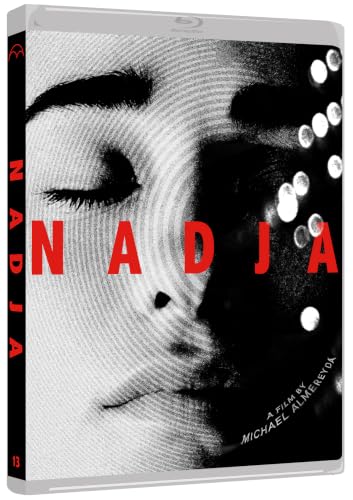
Nadja largely succeeds as arthouse horror through its unusual visual style and subtle surrealism, enhanced by the strengths of its cast. Löwensohn captivates as Nadja, and plentiful shots focus on her unique face framed by the dark folds of a hooded cloak. She and Martin Donovan were regulars in Hal Hartley’s early ’90s films, where both perfected the technique of delivering emotionally resonant lines with minimal modulation of voice and facial expression. Fonda provides much needed energy as a zany and eccentric Van Helsing. For fans of , his brief cameo as a morgue security guard is a nice little bonus.

Arbelos Films recently completed a 4K restoration of a director’s cut approved by Michael Almereyda, which has just finished its run in select theaters and will see by a physical media release in mid-October.

WHAT THE CRITICS SAY:
“Stylish, eccentric and occasionally deliciously weird, it is a film for audiences who like their horror served with humour and their vampires with personality. With a runtime of under 90 minutes, for those willing to embrace its peculiar rhythms, Nadja reveals that even creatures of the night can have a sense of humour.”–Romney Norton, Dirty Movies (re-release)

I think this movie is weirder than average
I think this movie is better than average

Nadja

  • Director Michael Almereyda and Executive Producer David Lynch conjure a rare vampire film.

New starting from: 34.99 $

Go to Amazon

APOCRYPHA CANDIDATE: COME TO DADDY (2019)

DIRECTED BY: Ant Timpson

FEATURING: Elijah Wood, , Michael Smiley,

PLOT: Norval receives a letter from his long-estranged father, begging him to come to his remote home to reconnect; daddy is not who he seems, but he does have a lot of deadly associates holding long-simmering grudges.

WHY IT SHOULD MAKE THE LIST: The word “quirky” lurked around the back of my mind throughout the first half, until a plot spasm of strange violence brought the weird levels up to floodgate-breaking point.

COMMENTS: Appropriately for a plot that hinges on a theft, there is a whole lot of stealing in the movie: stealing of scenes (not to mention chewing of scenery). That’s to be expected from a film featuring some of the best characters actors in the business, each one-upping the other as the craziness volcano erupts. The heavy lifting (and grand larceny) is done most by Elijah Wood, who surprised me equally with his capacity to normalize the narrative while drawing attention to himself with perhaps the most nerd/hipster/pratt/ mama’s boy character I have ever seen. (While rocking one of the worst haircuts ever to grace the big screen.)

Wide-eyed, apprehensive Norval (Wood) steps off a bus close to the middle of nowhere, California, and walks on foot while rolling a massive suitcase along with him. When he arrives at “a UFO that crashed in the ’60s”-style cabin, he meets his father (Stephen McHattie), whom he has not seen for three decades. They bond, or try to, but mostly Norval endures of varying degrees of abuse. Norval is a recovering alcoholic who describes himself as a combination DJ, pianist, beat-layer, and event organizer; what his father describes him as I cannot type, but the description is apt. At one point mid-rant, his father’s dander rises so high that he has a fatal heart attack while threatening his boy with a butcher knife. Then what’s actually going on starts coming to light.

Watching it with a packed house on a Friday night, I noticed two related things: the audience was far too eager to laugh at things that probably warranted silence, and Come To Daddy‘s sheer oddness (and intensity) was insidious. Rabid fans of Stephen McHattie burst out laughing at the drop of a pin; I sat quietly wondering what, if anything, was going to make a payoff that warranted my attention. The arrival of Michael Smiley’s character (a kind of a twisted, drunken, deadbeat heir to A Field in England‘s effete and sinister O’Neal) turned out to be the harbinger of the film’s madness, and once this madness set in, it did not relent.

As I mentioned above, it doesn’t feel like a slow build up so much as a massive explosion. I came close to writing this off as a wasted outing, as I had with a previous Fantasia buzz-puffed disappointment, 68 Kill. Rarely have I been happier to have been proven wrong, as the investment of my time and focus handsomely paid off. I was left, though, with the burning question, how in Heaven’s name did they get Elijah “Frodo Baggins” Wood to go through this suffering on-screen? But good for him. I look forward to him embracing the role of character actor—albeit on a quite different pay scale than his confrères.

WHAT THE CRITICS SAY:

“‘Come to Daddy’ struggles to maintain its zany energy through the final act, and a concluding hotel room showdown unfolds like a quirky, half-hearted sketch comedy in the shadow of the more alluring weirdness leading up to it. Even so, it’s punctuated by a violent act so cartoonish and bizarre it brings the story back to its strengths… the movie finds its way to a bizarre form of closure that illustrate Timpson’s confidence in this strange genre brew. By the end, it all suddenly clicks.”–Reic Kohn, Indiewire (festival screening)

CAPSULE: THE QUIET (2005)

DIRECTED BY:  Jamie Babbit

FEATURING:  Elisha Cuthbert, Camilla Belle, Edie Falco, , Katy Mixon

PLOT: A deaf girl becomes ensnared in her adoptive family’s amoral dysfunctions.

Still from The Quiet (2005)WHY IT WON’T MAKE THE LIST: The Quiet is an artfully produced, comparatively non-formulaic independent film, but it’s not a dramatic enough departure from the thriller genre to constitute a truly weird viewing experience.

COMMENTS:  Strong sexual themes ground this strange tale of a family slowly going insane.  After her father’s untimely death, deaf-mute teenager Dot (Belle) is taken in by her godparents (Donovan, Falco) who from outward appearances have a conventional, affluently idyllic suburban life along with their cheerleader daughter Nina (Cuthbert).  Dot’s transition is derailed by increasingly disturbing conflicts and revelations. Her new family has dark secrets.

A sick, twisted dysfunctionality plagues the household.  Trapped between an opiate addict mother, licentious father, homicidal sister, and perverted new beau, Dot struggles to keep her perspective.  Unable to readily communicate, and with no outside party to turn to, Dot is at a disadvantage when her demented new family draws her into a sordid web of immorality and charade.  The line between spider and fly becomes blurred, however, when it turns out that Dot harbors her own eerie enigma.

The Quiet rips the facade from blissful, suburban tranquility in the tradition of movies such as American Beauty and The Safety Of Objects.  Less satirical than the former and not as convoluted as the later, The Quiet is a suspenseful drama with an hypnotic narrative tone reminiscent of One Day Like Rain and Make-Out with Violence.

The Quiet is a well produced film with a perverse story.  It does not set out to be a black comedy, or a sophisticated social indictment of suburbia, although it contains some elements of both.  Neither is it a movie with a message or mere exploitation.  The Quiet is a simple, racy, psychological thriller.  With some hauntingly memorable dialogue, it is arty yet lucid, brooding and visually dark.  While more twists and turns would have provided greater depth, it is structurally complete enough to be worthwhile for patrons seeking a departure from blockbusters, crowd-pleasers, and annoying Lifetime Network potboilers.

Feminist director Jamie Babbit’s other films include But I’m A Cheerleader and Itty Bitty Titty Comittee.  Viewers will recognize Cuthbert from the sensational The Girl Next Door.

WHAT THE CRITICS SAY:

“…flirts with the trappings of exploitation cinema without going all the way. The director… suggestively crowds her two talented leads together, but can’t push them or the film into the fairy-tale surrealism to which she seems to aspire.”–Manohla Dargis, The New York Times (contemporaneous)


The Quiet trailer