Tag Archives: Magical Realism

132. BEASTS OF THE SOUTHERN WILD (2012)

“…unique perspectives and self-sufficient lifestyles are sacred things that should be fought for and preserved. So-called ‘eccentrics’ were my earliest heroes, and one of my biggest influences.”–Benh Zeitlin

Recommended

DIRECTED BY: Benh Zeitlin

FEATURING: , Dwight Henry

PLOT: Six-year old Hushpuppy lives with her ailing father Wink in “the Bathtub,” a community that turns into an island isolated from society when floodwaters cut it off from the mainland. After a second flood nearly destroys the Bathtub, Wink decides that he must destroy the levee so that the water will recede. This plan brings the attention of the authorities, however, who forcibly evacuate the defiant pair from their ramshackle home, all while Wink’s health is getting worse…

Still from Beasts of the Southern Wild (2012)
BACKGROUND:

  • Beasts of the Southern Wild was adapted from the play “Juicy and Delicious” by Lucy Alibar (who also collaborated on the movie screenplay). The action was moved from Georgia to Louisiana, and Hushpuppy’s character was altered to fit the personality of actress Quvenzhané Wallis.
  • Hushpuppy was originally conceived of as 9-12 years old, but Quvenzhané Wallis was so perfect for the role that the character’s age was changed. Wallis beat out a reported 4,000 other kids for the role. She was only five when she first auditioned and, since the minimum age to be considered was six, her mother lied about her age.
  • Dwight Henry (Wink) is a New Orleans baker; this was his first acting role. He originally turned down the role in order to focus on opening a new bakery.
  • The aurochs in the movie are actually pot-bellied pigs with horns glued on.
  • Won the Caméra d’Or prize at Cannes (given to the best first film screened at the festival).

INDELIBLE IMAGE: Hushpuppy coming face to face with the apocalyptic aurochs of her imagination.

WHAT MAKES IT WEIRD: Quvenzhané Wallis’ childish explanation, “once there was a Hushpuppy and she lived with her daddy in the Bathtub” turns out to be a literal description of the plot in this ridiculously original fairy tale that resembles The Tree of Life set in a post-apocalyptic bayou.


Original trailer for Beasts of the Southern Wild

COMMENTS: Although many movies purport to view reality from a child’s perspective (including Curse of the Cat People, My Life as a Dog, and Pan’s Continue reading 132. BEASTS OF THE SOUTHERN WILD (2012)

100. UNCLE BOONMEE WHO CAN RECALL HIS PAST LIVES [LOONG BOONMEE RALEUK CHAT] (2011)

AKA Uncle Boonmee

“Facing the jungle, the hills and vales, my past lives as an animal and other beings rise up before  me.”—Title card at the beginning of Uncle Boonmee Who Can Recall His Past Lives

Recommended

DIRECTED BY: Apichatpong Weerasethakul

FEATURING: Thanapat Saisaymar, , Sakda Kaewbuadee, Kanokporn Tongaram

PLOT: On his plantation in rural Thailand, the dying Boonmee is visited by living relatives and the ghosts of his past. As they ease him into death, the story is interrupted through vignettes that may represent his memories of past lives.

BACKGROUND:

  • Apichatpong Weerasethakul considerately refers to himself as “Joe” when speaking to Western audiences.
  • Uncle Boonmee is loosely based on a 1983 book by Phra Sripariyattiweti, a monk from Apichatpong’s hometown of Khon Kaen, Thailand.
  • The film is a feature-length component of Primitive, Apichatpong’s ongoing multimedia project, which also encompasses a number of video installations and the short films A Letter to Uncle Boonmee and Phantoms of Nabua.
  • Received the Palme d’Or at the 2010 Cannes Film Festival. Jury president Tim Burton described it as “a beautiful, strange dream.”
  • Sakda, who plays Boonmee’s nephew Tong, and Kanokporn, who plays his nurse Roong, played characters of the same names in Apichatpong’s earlier films Tropical Malady and Blissfully Yours, respectively. In both cases, it’s unclear if they’re meant to be the same characters.

INDELIBLE IMAGE: Though it’s chock-full of beguiling, whimsical imagery, the single most memorable sight in Uncle Boonmee is that of a princess in a lagoon, undulating with pleasure as she receives oral sex from a catfish. (Unsurprisingly, the words “catfish sex” became synonymous with Uncle Boonmee‘s brand of weirdness immediately following its Cannes premiere.)

WHAT MAKES IT WEIRD: Critics sometimes identify Apichatpong’s style as a mix of


Apichatpong Weerasethakul on Uncle Boonmee Who Can Recall His Past Lives

surrealism and neorealism, and this is a handy skeleton key for getting at Uncle Boonmee‘s weird nature. The film contains plenty of enigmatic images and seeming non sequiturs, but they’re framed as natural, even welcome steps in the cycle of life and death. The characters accept them nonchalantly, going along with the film’s dream logic and implicitly entreating viewers to do the same. No clear border separates the mystical from the mundane. And two hours in, when it feels like you should be totally inured to Uncle Boonmee‘s disorienting twists, along comes a denouement that renders everything else normal by comparison.

COMMENTS: An ox, having escaped its tether, strolls through the forest at twilight.  Eventually, Continue reading 100. UNCLE BOONMEE WHO CAN RECALL HIS PAST LIVES [LOONG BOONMEE RALEUK CHAT] (2011)

CAPSULE: PASSION PLAY (2010)

Beware

DIRECTED BY: Mitch Glazer

FEATURING: , ,

PLOT: A trumpet player discovers a woman with wings at a freak show while hiding out from a

Still from Passion Play (2010)

gangster who wants him dead.

WHY IT WON’T MAKE THE LIST:  Because it’s the most predictable and obvious movie about a jazz trumpeter saving an angel from a gangster it would be possible to make.

COMMENTS:  There’s almost nothing that Passion Play gets right, starting with its pretentious, inappropriate title: if Mickey Rourke is a Christ figure, then I’m a sex symbol.  The scenario starts out promisingly enough, positioning itself in a twilight netherworld somewhere between film noir and fairy tale.  Junkie jazz musician Nate, who gets by providing bump ‘n grind accompaniment for strippers in pasties at the Dream Lounge, is seized by persons unknown and taken to the desert for summary execution.  After an incredible escape from certain death, he stumbles upon an equally improbable carnival that has pitched its tents in the middle of nowhere and where yokels pay a dollar to peep at a beautiful “angel” with eagle wings.  So far, your suspension of disbelief is strained but not broken, but then the movie goes too far: 59-year old Mickey Rourke, with his stringy unwashed hair falling in clumps around a face that looks like the beaten-up mug of an ex-boxer experimenting with Botox injections, knocks on Megan Fox’s trailer door, and she asks him in for a drink.  From there the movie just gets worse and worse, as the mobster who ordered Nate’s execution also becomes obsessed with Fox and the pic turns into a conventional, obvious and boring love-triangle that begs us to care whether angelic Megan Fox will choose old, sleazy, poor Mickey Rourke or old, sleazy, rich Bill Murray.  Rourke, whose look and backstory are modeled on Chet Baker in his heroin-ravaged final days, is acceptably gruff, and you’ll believe he shoots junk and sells out those dearest to him.  The fact that there’s nothing sympathetic or likable about his character is a serious problem, though.  Watching the sex scene between Rourke and Fox is guaranteed to make your skin crawl; wondering where she’s going to position her wings as they roll around on the hotel room bed isn’t the only thing that’s awkward about it.  “Happy” Shannon’s laid back, almost emotionless mien may have been a deliberate acting choice by Bill Murray to make his character seem cold and calculating, but in the context of a film this bad, it makes it look like he’s acting under protest.  You feel more sympathy for Fox as an actress than you do for her character; after starring in one awful movie after another, she tries to expand her horizons with an ambitious art film, but winds up in yet another bungled disaster (and this time, it’s not even her fault).  Passion Play‘s target audience seems to be creepy old guys who like to daydream that they’d have a shot at Megan Fox if only she had some sort of easily overlooked physical deformity.  So when I, as a creepy older guy who wouldn’t kick Ms. Fox out of bed if she sprouted wings, tell you that this movie sucks, it should carry extra weight.

Mickey Rourke made waves for openly criticizing Passion Play after its release, publicly calling it “terrible.”  I can’t say I disagree with him, but openly and proactively trashing your own film seems like the kind of classless move Passion Play‘s crummy trumpeter might make.

WHAT THE CRITICS SAY:

“…though the movie is both too strange to take seriously and not weird enough to live up to [David] Lynch’s macabre surrealism, you have to credit writer-director Mitch Glazer (co-author of ‘Scrooged’) for being daring.”–Kyle Smith, New York Post (contemporaneous)

CAPSULE: THE FUTURE (2011)

DIRECTED BY: Miranda July

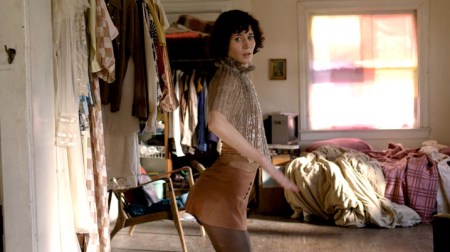
FEATURING: Miranda July, Hamish Linklater, David Warshofsky, Isabella Acres

PLOT: A thirtysomething couple decides to adopt a sick cat in one month, during which time they quit their jobs and try to find ways to make their lives more satisfying. The cat (named Paw-Paw) narrates part of the story from her veterinary hospital cage.


WHY IT WON’T MAKE THE LIST: Populated with just enough flights of fancy to warrant “eccentric” and offering a surprisingly bleak and realistic look at two people on the brink of nervous breakdown while in a crumbling relationship, The Future just isn’t strange enough for a spot on the List.

COMMENTS: Though it opens with the creepy, nasally voice-over of Paw-Paw the cat detailing its rescue by a kind couple, The Future spends most of its time with Sophie (July) and Jason (Linklater).  She is an “overqualified” dance teacher for young girls, he works from home accepting tech support calls.  When they decide to adopt a sick cat, their future spreads before them as nothing but caring for it and then reaching old age after it dies.  Sophie tries to motivate herself to make online dance videos but instead finds solace in an affair with a friendly sign-maker.  Jason becomes “open to everything,” accepting a volunteer position with an environmental group and befriending an elderly pack rat.  As Paw-Paw waits patiently, her soon-to-be owners flounder in the face of self-fulfillment with anxiety-ridden freakouts.

Known in the film world for her quirk-filled debut Me and You and Everyone We Know, writer and performance artist Miranda July is developing definite trademarks.  She once again employs experimental voice-over and somewhat stilted scripting for a portrait of white middle-class romance, but this time her characters are more realized and the emotions more focused.  As Sophie and Jason claw their way through individual bouts of near-insanity, a surprisingly touching story unfolds.  For the most part we are looking at this relationship from the outside in, seeing these characters more often apart than together.  Sophie’s uncertain relationship with sign-maker Marshall and Jason’s curious friendship with elderly chatterbox Joe offer insights unseen in their actual interactions with one another.

This is uncharacteristic for me but I actually found most of the “weirder” parts detrimental to the film overall.  The creepy cat narration and puppet paws feel irrelevant and clashing—it doesn’t move the story forward and it doesn’t increase my sympathy for the cat or the couple.  Sophie’s suddenly animated t-shirt also feels out of the blue.  The best offbeat technique is employed towards the end, when Jason literally stops time so he can sort out his feelings about Sophie’s infidelity, and ends up in a sad conversation with the moon.  It’s a neat trick and sets forth an interesting structure for that segment of the film, and serves to highlight Hamish Linklater—an actor often set in supporting roles—as a performer.

There’s a good amount of twee baggage weighing down The Future.  Some of July’s little touches of style and wry humor are fun, but many drag the focus away from the central story unnecessarily.  The writing and characterization just aren’t tight enough.  It is at times a beautiful and heartbreaking film, and even quite funny at others, but viewers need to wade through a lot of excess in order to hit upon the most effective points.

WHAT THE CRITICS SAY:

“‘The Future,’ July’s coy and precious new film, is just oddball enough to be interesting, if not good.” –Peter Rainer, Christian Science Monitor (contemporaneous)

CAPSULE: PERFUME: THE STORY OF A MURDERER (2006)

366 Weird Movies may earn commissions from purchases made through product links.

DIRECTED BY:

FEATURING: , Dustin Hoffman, Alan Rickman, Rachel Hurd-Wood

PLOT: An apprentice perfumer in pre-Revolutionary France sets out to make the perfect scent, a task that requires him to murder thirteen beautiful virgins.

WHY IT WON’T MAKE THE LIST: Although its choice of protagonist—an orphaned serial killer with a superhuman sense of smell—certainly proves that Perfume is out of the ordinary, it’s mostly just a period drama punctuated by bursts of black humor, with most of its weirdness concentrated in the orgiastic finale.

COMMENTS: Adapted from Patrick Süskind’s novel of the same name, Perfume: The Story of a Murderer feels like a lavish epic as it traverses 18th century France, stopping to sniff out every scent (good or bad) along the way. German director Tykwer (of Run Lola Run fame) shows us the urban squalor of Paris, the expansive majesty of the countryside, and the perfume mecca of Grasse through the eyes and nose of Jean-Baptiste Grenouille (Whishaw), our amoral and barely verbal anti-hero.

With his unsurpassed olfactory prowess, Grenouille wonders at all the scents in the world, yet is perpetually enraged: he can’t capture them all, and he lacks a personal scent. As far as his nose is concerned, he’s a cipher, a nonentity. His response to these inner crises is to study the secret art of perfuming under the tutelage of the self-absorbed Baldini (Hoffman), then migrate to Grasse, where he hatches his elaborate, murderous master plan.

This plan forms the centerpiece of the film, as Grenouille kidnaps and kills Grasse’s young maidens one after another, distilling their scents through the technique of enfleurage. Perfume spares little sentiment for the victims, focusing instead on how their deaths contribute to Grenouille’s angelic-smelling magnum opus. The film even juxtaposes Grenouille’s reign of terror with the authorities’ botched investigation in a blackly comic montage, all the better to highlight its anti-hero’s messianic, above-the-law status.

Like any rogue with a rise-and-fall character arc, Grenouille eventually gets arrested and tortured.  But after his solemn march to the town square for crucifixion, Perfume loses all resemblance to other crime thrillers past or present and begins to look like an excerpt from Ken Russell‘s richest, most elegant fantasies. I won’t give away the climactic twist, except to say that it indulges all of the film’s wildest, most spectacular urges.  By the time a drop of perfume falls on a Paris street in the last shot, there’s little for the viewer to do but gape at Tykwer’s mad bravado.

The rest of Perfume isn’t quite so magnificently over-the-top, but Tykwer complements Grenouille’s obsessions by zeroing in on one sensuous piece of period detail after another, all in a futile but nonetheless impressive attempt to visually capture scent. And although Whishaw dominates much of the film, the supporting cast occasionally steals the show: Hoffman provides tragicomic relief as a desperate has-been; Rickman brings his laconic grace to the role of a Grasse nobleman and overprotective father; and John Hurt’s mordant narration frames the whole endeavor as a bleak fairy tale.

Perhaps the greatest irony about Perfume is that although it was a massive, expensive undertaking, it still feels cultish and off the beaten path. It’s so morbid, thorny, and perversely funny that it’s hard to believe it could ever have much mainstream appeal. But imagine sniffing the fumes that would rise if you blended a picaresque costume drama with a slasher movie, then heaped on a thick broth of style.  That, more or less, is Perfume.

WHAT THE CRITICS SAY:

“… a tale whose off-the-charts screwiness obscures virtually all shortcomings.”–Nick Schager, Lessons of Darkness