Tag Archives: Japanese

285. DEAD LEAVES (2003)

“A guy with a TV for a head and a girl with a panda-like mark on her face find themselves naked on Earth with no recollection of how they got there. After attempting to violently acquire food and clothes, they get arrested and sent to the Lunar prison Dead Leaves… and things get weirder from there.”–Dead Leaves synopsis from the listicle “15 Bizarre Anime That Make You Wonder ‘Wtf Did I Just Watch?’

DIRECTED BY: Hiroyuki Imaishi

FEATURING: Voices of Takako Honda, Kappei Yamaguchi; , Jason Lee (English dub)

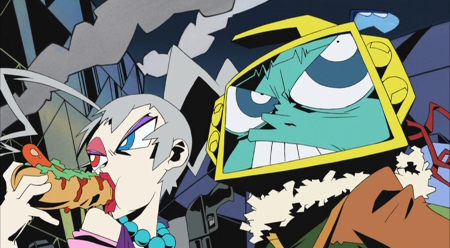
PLOT: Pandy, a woman with mismatched eyes, and Retro, a man with a television for a head, awaken naked with no memories and immediately go on a crime spree. Quickly arrested, they are sent to Dead Leaves, a prison housed on what remained of the crumbling moon, where they have sex and then arrange a prison break. Pandy grows pregnant and comes to term in a day, and faces a giant caterpillar monster with the help of her precocious newborn son.

Still from Dead Leaves (2003)

BACKGROUND:

  • The directorial debut of Hiroyuki Imaishi, who had worked as an artist on many animes, including the TV version of “Neon Genesis Evangelion” and it’s bizarre theatrical incarnation.
  • Released as an OVA (original video animation, a common direct-to-video release strategy in Japan).
  • Dead Leaves was made with the American and European secondary markets in mind. The English dub was made contemporaneously with the Japanese version.

INDELIBLE IMAGE: Dead Leaves‘ images, while carefully painted, streak by almost too fast for the eye to register, leaving an impression of havoc rather than focusing on particular images. Since the main characters—especially monitor-faced Retro—appear most often, it’s their faces that stick most in the memory.

THREE WEIRD THINGS: TV-headed Retro-reprobate; penis drill; inexplicable psychedelic caterpillar

WHAT MAKES IT WEIRD: Dead Leaves moves so fast and makes so little sense that it’s the equivalent of putting an ultraviolent manga in a high-speed blender and trying to read it while the pieces swirl around. The plot is nearly incomprehensible, but somehow involves mutant clones and a psychedelic caterpillar. Weird? Hell yes. Recommended? Well, definitely not to epileptics. Even for older folks with a healthy neurobiology, the breakneck pacing is as likely to induce a headache as an adrenaline rush. It’s definitely one-of-a-kind, though, and as an experiment in compressing as much berserk and illogical anime flavor as possible into as short a running time as possible, it’s worth a look.


Short clip from Dead Leaves

COMMENTS: Although the director advised the audience at Dead Continue reading 285. DEAD LEAVES (2003) →

LIST CANDIDATE: TAMPOPO (1985)

Recommended

DIRECTED BY: Jûzô Itami

FEATURING: Tsutomu Yamazaki, Nobuko Miyamoto, , Fukumi Kuroda

PLOT: A stranger rides into town and helps a struggling widow to master the art of noodle preparation, while peripheral characters enact food-related comic sketches.

Still from Tampopo (1985)

WHY IT MIGHT MAKE THE LIST: Tampopo‘s parodic tale of noodle shop warfare is almost straightforward, if offbeat. Fortunately, there are enough surreal diversions—a fourth-wall breaking introduction where a gangster lectures the audience about eating too loudly during the movie and scenes exploring the erotic possibilities of live shrimp and egg yolks—to make this one worth a weird watch.

COMMENTS: Few movies can make you as hungry as Tampopo, the savory “noodle Western” (or “Eastern”) about an itinerant truck driver/gourmet who trains a mediocre cook to prepare the world’s greatest bowl of ramen. The main plot lightly parodies Westerns, with the stranger wandering into town to help (and woo) the local attractive widow, complete with showdowns with the local gang—although they battle not with guns, but with cutlery. In between advancing that storyline, the film takes time out for unrelated absurdist sketches revolving around food. (In the first of these, we visit a five star restaurant for a business meal where sycophantic salarymen order the same bland meal as the boss, while in another room a matronly etiquette maven tries in vain to teach young ladies to eat their spaghetti without slurping). The most of memorable of these excursions involves a mysterious yakuza in a white suit, who has kinky gourmet sex in a hotel room with his mistress. Come to think of it, the movie may make you as horny as it does hungry, although the sex is (almost) all done in good taste.

Not that it’s all fluffy, marshmallowy cinema. There are moments here that seem better fitted to a mondo film, such as the killing of a turtle (with one quick slice from a knife inserted under the shell), and the thematically meaningful yet taboo footage that plays while the credits roll. Many people find the egg yolk foreplay more yucky than erotic, while there’s another scene where the yakuza flirts with–and even French kisses—a dangerously underage oyster fisherwoman. These scenes are mildly shocking, although they’re neither mean-spirited nor deployed simply for the sake of shock. They add pungent, R-rated spice to a movie that might otherwise be too sweet and mild; with a few judicious cuts, it’s appropriate for a school-age crowd.

I first saw Tampopo (on VHS) when it came out thirty years ago, and although I had a generally good impression of it, I didn’t remember much beyond the basic premise. I’m surprised that I didn’t recall it as being especially strange or surreal. I found it a more interesting film this time around, which suggests that this may be a movie that takes some life seasoning to appreciate. It’s essentially a silly work, but as a paean to the pleasures of food and sex (and movies), it’s an easy one to champion.

The Criterion Collection released Tampopo on DVD in 2010, then finally upgraded it to Blu-ray this year (2017).

WHAT THE CRITICS SAY:

“…one of those utterly original movies that seems to exist in no known category…. the movie is so consumed and detailed, so completely submerged in noodleology, it takes on a kind of weird logic of its own.”–Roger Ebert, Chicago Sun-Times (contemporaneous)

(This movie was nominated for review by “upgrayedd,” who simply said “Tampopo is a weirdo.” Suggest a weird movie of your own here.)

LIST CANDIDATE: TWILIGHT OF THE COCKROACHES (1989)

Gokiburi-tachi no Tasogare

366 Weird Movies may earn commissions from purchases made through product links.

DIRECTED BY: Hiroaki Yoshida

FEATURING:  Kaoru Kobayashi, Setsuko Karasuma, Kanako Fujiwara

PLOT: A colony of cockroaches lives in happy comfort in the apartment of a lonely slob, but that all changes the day a girlfriend moves in and takes over cleaning the place and eradicating the pests.

Still from Twilight of the Cockroaches (1989)

WHY IT SHOULD MAKE THE LIST: As noted elsewhere on this site, the bar for weirdness in Japanese anime is set pretty high, because the genre itself is such a wild frontier. Twilight of the Cockroaches sets itself apart by being half-animated and half-live-action, and by being about the politics of cockroach tribes. If that in itself isn’t compelling enough, any film whose IMDB page’s plot keywords list includes the phrase “talking turd” pretty much demands our consideration.

COMMENTS: The present author is aware of exactly two commercial films in which cockroaches make up the majority of the cast. One of them is Joe’s Apartment, and I’m reveiwing other one now. Of the two, Twilight of the Cockroaches wins easily for “weirdest cockroach movie.” The comparison has to stop there, because the two movies are entirely opposite in tone. A critter’s eye view of a society of anthropomorphic non-humans, Cockroaches has more in common with Watership Down or The Secret of Nimh than an MTV-sponsored slacker comedy. It pounds in a heavy political message, possibly related to Hiroshima or Auschwitz, though the director declared it to be about Japan; fan bases debate it to this day. Fill in your own country and political philosophy here.

But for those of you without too much book-learnin’, this is a movie about cockroaches. Naomi is a cockroach waif—“19 in cockroach years”—who serves as our narrator and has “never experienced terror.” She and the rest of her vermin society reside in the apartment of Saito, a human bachelor whose deadly sins include sloth and gluttony, allowing the cockroaches to live in fat contentment. The roaches worship Saito as a god, giving thanks for his sloppy leftovers as they mistake his neglect for benevolence. Sage, the “great leader” of this society, is a reassuring father to his people, ringing with praise for their benevolent human. Naomi is engaged to the stable suitor Ichiro, but she pines for Hans, a warrior cockroach from another tribe. Hans brings grim stories of other apartments where cockroaches fight for survival against humans determined to annihilate them, which is shocking news to Naomi in her peaceful utopia.

Hans returns to his side of the apartment complex, while Naomi contracts wanderlust, exploring the outside world in her quest for the truth. She sets across the vacant lot next to the apartment to find Hans, braving all kinds of hazards—and meeting a helpful turd—along the way. The elders of Naomi’s tribe lament how entitled and shiftless the modern generation is, as the young ones scoff at the warnings that the good times could abruptly end. That foreshadowing comes to pass when Saito, somehow, gets a girlfriend, who moves in with him and brings with her a holocaust of housecleaning and bug-killing. This forces the roaches to confront the error of their complacency. It will be up to Hans’ militarized comrades to show the way forward for roachkind.

The slow, lethargic pace of this film, scored to soulful, lonely piano solos, makes it a chore to sit through. And yet, just when you’re ready to take the film on the serious terms it so obviously desires, it throws talking poop at you. Scenes like a pie-eating party that turns into a pie-throwing party are slapstick; while when Naomi is trapped in a roach motel with other bugs, themselves dying, working together to lift her out, are creepy. The tone is all over the place, and on top of that the visuals flash from blaring daylight reality to shadowy animation. Moments of drama are punctuated by the realization that you’re being compelled to sympathize with a bunch of cockroaches. At the very least, it’s a unique effort in all kinds of ways, with some imaginative technical shots, but it’s also a shoestring budget with blockbuster ambitions. Furthermore, the lack of a DVD release means you’re stuck watching VHS tapes with very phoned-in English dubbing. The choppy result is a hard film to know how to take, but one thing is certain: a bug’s life ain’t always easy.

WHAT THE CRITICS SAY:

“Somebody please get that rolled-up newspaper and smack Japanese writer-director Hiroaki Yoshida in the head with it. COCKROACHES doesn’t even qualify as a camp classic. Besides being thoroughly deranged, it’s also slow, dull, and numbingly mediocre.”–TV Guide

CAPSULE: TESTUO II: BODY HAMMER (1992)

DIRECTED BY:

FEATURING: , Shinya Tsukamoto

PLOT: After receiving a mysterious injection and having his son killed by members of a cult, a man’s body starts to slowly transform into a weapon of flesh and steel as he tracks down the cultists and their leader, the “Metal Fetishist.”

Still from Tetsuo II: Body Hammer (1992)

WHY IT WON’T MAKE THE LIST: Body Hammer is a larger-budgeted, more conventional reinterpretation of the original Tetsuo that partially attempts to rationalize its world. By common standards, however, it’s still very much a weird movie, packed with bizarre images and occasional outbursts of the nightmarish industrial madness that defined the first. With the List’s increasingly limited slots and Body Hammer‘s more surreal predecessor already certified, there isn’t a lot of pressure to add this one.

COMMENTS: Shinya Tsukamoto’s first Tetsuo, whose status as a landmark of weird cinema and one of the most defining representatives of the Japanese Cyberpunk film movement is contested by few, was a truly unique, aggressively hyperactive, feverish industrial nightmare set in its own immersive realm. To the dismay of some fans, the sequel is clearly a very distinct effort to craft a more accessible movie, with a structured narrative and a focus on its dramatic plot, and more nuanced and realistic characters along with their emotions and motivations (the protagonist even gets a name). The most obvious departure from the first film’s style is the cold, sterilized color palette (with an emphasis on blue and white) that sets up a robustly clinical and artificial world. Before the transformations kick in, it seems like the humans we see are already machine-like and dehumanized, moving lifelessly through an imposing urban environment that dwarfs and assimilates them. Inevitably, the main character’s metamorphosis into a man-machine hybrid mechanism later on may look like a natural evolution in such surroundings.

The first scenes after the opening credits show Tomoo, Body Hammer’s version of the “salaryman”, waking up and having breakfast with his wife and child while discussing a dream from the previous night. These initial moments would be almost casual if it wasn’t for Tsukamoto’s insistence on unconventional angles and a fluid camera that freely hovers and rotates. After the family is assaulted in a mall by a group of mysterious skinheads who kidnap the son and trigger Tomoo’s transformation with an injection, setting the main plot course in motion, we get the first glimpses of the original story. It’s easy to say that the more expository approach of the sequel robs it of the magic and low-budget charm that made the first so memorable and unique, but the sensibility behind it is the same. To describe it simply, Body Hammer feels like an intersection between our familiar world and the alternative, hallucinatory logic that governs the first Tetsuo universe. As such, it’s more accessible, but there are never any signs of the auteur’s vision being hampered by the imperatives of telling a coherent story.

In fact, Tsukamoto’s directorial tics shine through the film. Sometimes, he interrupts the narrative’s course with bizarre montages mirroring Tomoo’s grotesque mutation. It helps that the film grows progressively stranger and closer to its predecessor’s insanely energetic pace, with furious imagery of sprawling wires, cables, pipes and random metallic parts that overpower and merge with fragile flesh, with the difference being that here they are lightly mediated by a contextual plot. As the movie approaches the climatic confrontation between Tomoo and the fetishist, it even presents us an explanatory flashback that clarifies the antagonist’s motivations and introduces a final twist related to his relationship with the main character. This sudden device comes completely unexpected, mainly because we would never guess that Tsukamoto would show such a preoccupation with the narrative’s background. Even this passage, however, is infused with his surrealistic style, and it may actually contain the film’s ultimate surreal set piece, culminating in a murder scene that manages to be simultaneously gory, dreamlike and touching.

The additions to the Tetsuo mythology, possible through the bigger budget, are also welcome. It is, for example, nice to see a whole cult of metal worshipers operating, instead of a sole maniac like the original, as well as further inventive variants of the bloody and biomechanical mutations of flesh, steel and rust.

The consensus on Body Hammer is positive, but a number of fans show discontent with what they see as an ill-fated attempt at making sense out of the perfectly irrational fable that was the original. To a certain extent, they are correct. But the decision to flesh out the character dynamics and lend emotional weight to the chaotic events on screen, works because it passively accepts and coexists with the absurdity of the film’s plot. In the end, Body Hammer is immersed in its mix of alien atmosphere and cold, fantastical reality, making it both a satisfyingly strange movie and a distinct enough one from the original.

WHAT THE CRITICS SAY:

“Tsukamoto’s preoccupations with meta(l)morphosis, body horror and unchecked masculinity remain firmly in place, as does the writer/director’s way with outrageous images and ideas.”–Anton Bitel, Eye for Film

260. AKIRA KUROSAWA’S DREAMS (1990)

Yume; Dreams

“I dream my paintings, then I paint my dreams.”–Vincent Van Gogh

Recommended

DIRECTED BY: Akira Kurosawa

FEATURING:

PLOT: Legendary filmmaker Akira Kurosawa lenses eight short films inspired by his own dreams. The main character, played by two child actors and one adult, is simply credited as “I.” The dreams involve a fox wedding, living doll spirits, a snow witch, a platoon of dead soldiers, Vincent van Gogh, the explosion of Mt. Fuji, a weeping demon, and a happy funeral.

Still from Akira Kurosawa's Dreams (1990)

BACKGROUND:

  • One of the most awarded filmmakers in cinema history, Akira Kurosawa made Dreams at the age of 80. He had not made a movie since 1985’s Ran. He completed two features after Dreams before finally retiring in 1993 and dying in 1998.
  • Late in his life, Kurosawa had difficulty raising money in Japan because, despite winning awards overseas, his movies did not make a lot of money in his home country. After reading the script for Dreams, Stephen Spielberg and George Lucas convinced Warner Brothers to fund the film. Spielberg served as executive producer and Lucas’ Industrial Light and Magic provided the visual effects.
  • Ishiro Honda (Godzilla) served as “creative consultant” and is said to have directed some sequences uncredited, as well as supplying the inspiration for “The Tunnel” segment (which was similar to a story Honda had written but never filmed),
  • Kurosawa personally chose to play Vincent Van Gogh because the director’s energy matched his conception of Van Gogh’s passionate nature.
  • A final ninth dream, which would have involved an outbreak of world peace, was scrapped because Kurosawa envisioned legions of extras and it would have been too expensive to film.

INDELIBLE IMAGE: “I” wandering through a series of Van Gogh paintings, crossing over painted bridges and stepping around painted trees.

THREE WEIRD THINGS: Dancing dolls; Martin Van Gogh; demon under a dandelion

WHAT MAKES IT WEIRD: When one of the world’s greatest filmmakers deigns to tell us of his dreams, we should sit quietly and listen. If we do, we will be privileged to witness ghostly spirit pageants, movie screens transformed into impressionist canvases splotched by gobs of paint, giant dandelions, and horned demons weeping beside pools of blood.  We have much to learn.


Original trailer for Dreams

COMMENTS: The title is a lie. The visions here are not literal recreations of Akira Kurosawa’s dreams. Although each segment grows Continue reading 260. AKIRA KUROSAWA’S DREAMS (1990) →