Tag Archives: Horror

BILL MORRISON’S SPARK OF BEING (2010)

Spark of Being can be watched in its entirety for free on IMDB.

Spark of Being (2010) is an example of an artist resisting an aesthetic anchor. ‘s films are often categorized as non-narrative and experimental, so the idea of this artist tackling such a perennial chestnut such as “Frankenstein; or, the Modern Prometheus” leads us to wonder exactly how he is going to deconstruct such a familiar narrative. Throwing out all preconceived assumptions, Morrison pays homage to Mary Shelly and makes her Gothic creation fresh again with a startlingly literal interpretation. Indeed, Spark of Being may be one of the most faithful cinematic adaptations of the book to date.

Using found footage, Morrison teams with jazz trumpeter Dave Douglas and his electric sextet, Keystone, to illustrate Shelly’s tale. Douglas is an eclectic trumpeter who once worked as a sideman with the John Zorn ensemble Masada. With an original score that is simultaneously mercurial and animated, it is hard to imagine a more perfect composer for Spark of Being. 

Still from Spark of Being (2010)A frequent (and sometimes justifiable) criticism in films this textured is that the style becomes so all-important the end result is a viewer deprived of a heart to identify with. In short, often, a human element is missing. Morrison has referred to this film itself as “the Creature,” and given the agonized condition of footage chosen, Morrison’s creature may be the most pathos-laden performance of the character since . One can only imagine the painstaking process it took in assembling Morrison’s creation into a cogent psyche, imbued with personality as predominant “presence.” A popular comparison might be the collaboration between  and Claude Rains in producing a personality-driven Invisible Man (1933), but Morrison’s approach is more innovative, while still being true to the author’s tenets. Douglas’ music provides an informative touch of flesh stretched over the cranium supplied by archival footage from Ernest Shackleton’s film of an Antarctic expedition. As in the novel, the film opens here in the segment titled “The Captain’s Story.” The viewer steps with the Captain in his interaction with creator and created and the unfolding tragic drama.

Through laboratory footage we meet “A Promising Student” and adopt his sense of ambition and wonder. Educational footage and decayed nitrate, which looks hauntingly like an intensely animated closeup of an Emilio Vedova canvas, bring “The Doctor’s Creation” to violent life.

In “The Creature Watches” antiquarian city crowds, desolate landscapes and achingly lonely images of a child endow the creature with a Chaplinesque essence. The psychedelic beauty of “The Creature’s Education” is extended and sublime. The heartbreaking “Observations Of Romantic Love” segues into the bitter sting of ‘The Doctor’s Wedding” and the inevitable dejection of “The Creature in Society.” In “The Creature Confronts His Creator,” the new Adam dares to accuse a negligent father, and in “The Creature’s Pursuit” it is God who is tried and condemned. A justifiable patricide is, perhaps, the greatest burden of all. It is the stuff of horror, even nearly 200 year old horror served up in our own mythological consciousness.

154. VIDEODROME (1983)

“My early drafts tend to get extreme in all kinds of ways: sexually, violently, and just in terms of weirdness. But I have to balance this weirdness against what an audience will accept as reality. Even in the sound mix, when we’re talking about what sort of sound effects we want for the hand moving around inside the stomach slit, for example; we could get really weird and use really loud, slurpy, gurgly effects, but I’m playing it realistically. That is to say, I’m giving it the sound it would really have, which is not much. I’m presenting something that is outrageous and impossible, but I’m trying to convey it realistically.”–David Cronenberg on Videodrome

Recommended

DIRECTED BY:

FEATURING: , , Jack Creley, Sonja Smits

PLOT: Searching for the next level of violent and pornographic entertainment, CIVIC-TV president Max Renn discovers a pirate broadcast called “Videodrome” that depicts the torture and killing of nude men and women in an undisclosed location. Renn is thrilled by what he sees as the future of television, a savage show with no plot, characters, or budget, but his interest in in the program becomes more personal than professional as he watches it with radio personality Nikki Brand and develops his own taste for sadomasochism. Meanwhile, Renn explores the origins of “Videodrome” and its connection to media prophet Professor Brian O’Blivion, whose lectures about the relationship between the human mind and televisual media suggest “Videodrome”’s influence over Renn goes much deeper than he realizes.

Still from Videodrome (1983)

BACKGROUND:

  • David Cronenberg’s inspiration for Videodrome came from his childhood experiences of watching televisions pick up distant, distorted signals after the local stations had gone off the air. He imagined what it would be like to see something obscene or illegal on the screen, and he wondered whether he would turn away from the sight or keep watching.
  • CityTV, a Toronto-based independent television station that controversially broadcast softcore porn movies late at night in the 1970s, was the inspiration for Videodrome‘s “Civic TV.”
  • Special makeup effects designer Rick Baker began work on Videodrome shortly after winning the Academy Award for Outstanding Achievement in Makeup, the first award ever given in that category. He was awarded for his work on the film An American Werewolf in London.
  • The character of Professor Brian O’Blivion was loosely based on Marshall McLuhan, a Canadian philosopher of communication theory. McLuhan is famous for coining the phrase “the medium is the message,” echoes of which can be seen in Videodrome. Cronenberg may have been a student of McLuhan’s at the University of Toronto.
  • Videodrome was a box office bomb, earning only $2 million at theaters (it cost $6 million to make). It has since become a cult film.
  • At the time of this writing Universal Pictures lists a Videodrome remake as “in development.”

INDELIBLE IMAGE: Videodrome is full of unforgettable scenes, from Max Renn inserting a gun into his stomach to Barry Convex’s death by cancer-inducing bullets, but it is Renn’s sexual encounter with his television that best captures the hallucinatory, philosophical, and disturbingly erotic aspects of the film. After watching footage of Nicki Brand strangling Prof. O’Blivion, Renn is drawn to his television by Brand’s playful but insistent voice, as her lips grow to fill the screen. Soon, Renn is close enough to reach out and touch the device, which throbs and grows veins under his fingers like an engorged organ. Between rasps and sighs, the television says, “I want you, Max,” as Renn caresses its frame, becoming more aggressive and aroused. The screen begins to bulge under Renn’s groping hands as he leans forward, his face disappearing into the screen’s disembodied lips while they slurp and moan in ecstasy. Though Brand initially seduces Renn, by the end the television has become the willing object of his lust. Renn is not a passive observer of the screen, nor is his television a lifeless machine. Rather, Renn’s craving for the television enters the device and animates it, infusing it with so much desire that it is able to desire Renn in return. This giving of life to the mechanical captures Videodrome’s most salient theme, the idea that technology is not separate from humanity but instead represents an expansion upon the human form, a “new flesh” that may either subjugate or liberate us all.

WHAT MAKES IT WEIRD: Videodrome ((Videodrome is used in three senses in this essay. When italicized (Videodrome), the word means the movie directed by David Cronenberg. “Videodrome” is placed in quotes to signify the pirate broadcast Renn watches. When not in quotes or italics, Videodrome refers to the abstract entity or idea of the Videodrome.)) is weird from the moment it introduces its titular snuff program, not just because of the violence it depicts but also because of the characters’ casual acceptance of that violence. Renn and Brand’s unreserved fascination with the “Videodrome” broadcast places them in an alternate moral universe, one where murder is simply the next step for television; the viewer is displaced from his or her own ethical reality.

That disorientation only increases as Videodrome takes hold of Renn, inducing horrible visions that further loosen his and the viewer’s grasp of what is real. In those hallucinations, Renn is subjected to brainwashing and disfigurement that warp him on a mental and physical level, shaking the sense of himself that is his most basic link to the real world. In one scene Barry Convex forces a videocassette into the vaginal slit that Renn has grown on his stomach, adding overtones of surrealism and rape to the story. It is an assault on not just the body and the mind but also on reality, an experience that shatters the protagonist and the viewer in a way few other films can match.


Original trailer for Videodrome

COMMENTS: Near the beginning of Videodrome, a talk show host asks, “Don’t you feel [violent and sexual] shows contribute to a social climate of Continue reading 154. VIDEODROME (1983) →

CAPSULE: MAGIC MAGIC (2013)

DIRECTED BY: Sebastián Silva

FEATURING: , , Agustín Silva, Catalina Sandino Moreno,

PLOT: An emotionally fragile American girl is trapped with four strangers in a vacation home in Chile when her friend ditches her to deal with personal issues.

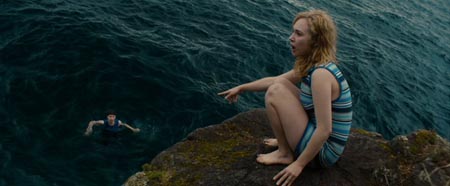
Still from Magic Magic (2013)

WHY IT WON’T MAKE THE LIST: The movie is good at creating a subtly unnerving atmosphere, but it doesn’t quite push far enough into eldritch realms earn a single Magic in its title, much less two.

COMMENTS: Magic Magic‘s scenario is a little like Repulsion-lite. Juno Temple plays the repressed girl with the disintegrating mind, with the major difference being that it is other people, not solitude, that makes her crack up. It’s also not clear that Temple’s Alicia fears men in general, although she certainly shudders at the touch of Michael Cera’s Brink (which is actually pretty rational behavior, given Brink’s awkwardly sleazy passes at her). Abandoned among strangers in a foreign country, Alicia comes off as merely shy, at first; but, she seems to be having difficulty sleeping, as well as relating to her fellows. She loves animals, but they don’t reciprocate, unless it’s to hump her leg. As the vacation goes on her paranoid behavior gets worse. She begins recalling conversations others don’t remember. The camera sometimes inhabits her subjectivity; when out of focus, her companions’ faces seem to be staring at her, studying her, but a more objective view shows them to be minding their own business. Most of the movie consists of a string of scenes that are very good at creating a subtle, unsettling atmosphere of social and sexual anxiety. The individual pieces are carefully detailed and observed, but the movie as a whole lacks the narrative hooks to draw you into the story, either emotionally, or as a psychological mystery play. The roots of Alicia’s problems, even her basic backstory, are barely hinted at, leaving this unsatisfying as a character study. The movie’s climax invokes Chilean voodoo, a left-field gambit that’s fairly intense and spooky on its own; but, like a potentially interesting and emotionally resonant subplot involving Browning’s character, it doesn’t seem to belong to the main narrative in a meaningful way. The overall result is a slightly unsatisfying movie with parts that are better than the whole. On the plus side, the performances by Temple and Cera are very good. Cera’s character is the socially inept inversion of Temple; overcompensating for his inadequacies with obnoxiousness, he talks a big game, but he may be even more repressed than Alicia.

Michael Cera made two movies back-to-back with director Silva while on a visit to Chile. In Crystal Fairy and the Magical Cactus, the somewhat better of the two films, he plays a neurotic American drug tourist foiled by a free-spirited hippie girl.

WHAT THE CRITICS SAY:

“To be sure, the movie isn’t much more than its atmosphere of clammy discomfort and a gonzo performance from Juno Temple, but those open to the experience will enjoy its gleeful strangeness.”–Tim Grierson, Screen Daily (contemporaneous)

CAPSUE: NIGHTMARES COME AT NIGHT (1970)

Les Cauchemars Naissent la Nuit

DIRECTED BY: Jess Franco

FEATURING: , Colette Giacobine, ,

PLOT: An exotic dancer in a psychologically abusive lesbian relationship thinks she’s going insane when she has vivid recurring nightmares in which she kills people.

Still from ghtmares Come at Night (1970)

WHY IT WON’T MAKE THE LIST: The simmering erotic atmosphere of Nightmares is either tedious, or hypnotic, depending on your outlook; but either way, although there are some dreamy moments, it’s not good enough to make the List of the 366 Weirdest Movies on its merits, nor weird enough to warrant inclusion despite its flaws.

COMMENTS: It is bad enough to be constantly plagued by nightmares, but imagine—horrors!—if those nightmares were also directed by Jess Franco. They’d be poorly lit, out-of-focus, and go absolutely nowhere. This is the position poor Anna (voluptuous Diana Lorys) finds herself in. Not that her regular existence is vastly superior: even in her waking hours, she’s still trapped in a Jess Franco movie. Anna is in an unhealthy relationship with her Lady Svengali lesbian lover, Cynthia, who promises to make her a star but spends more time sleeping around and slapping her around than getting her gigs. Anna has nightmares where she kills men while birds fly around inside the house, then wakes up with actual blood on her hands. She thinks she’s going insane. She reveals her story to her psychiatrist in a long flashback that itself dissolves into more dream sequences. Whether its from intentional disorientation or merely sloppy scripting, the loopy storytelling of Nightmares does effectively create a situation where at times you aren’t sure whether the protagonist is dreaming, or whether what’s happening is supposed to be occurring in the present or in a flashback. Like a good bit of Franco’s oeuvre, Nightmares was made in a rush, and the movie frequently seems improvised. The short parts featuring cult actress Soledad Miranda were probably originally intended for a different film entirely (she watches the action from a window near Anna and Cynthia’s manor home and is never appears in the same frame as any of the principals). Franco’s directorial choices are frequently bizarre, and it’s often hard to locate the line between incompetence and experimentalism. For example, when Cynthia meets Anna for the first time, she proposes to make the stripper into a model: they carry on the conversation, but, because it is a flashback, Anna is simultaneously narrating the meeting in voiceover, recapping the conversation in real time as we listen to it. Later, while Anna and Cynthia are making love for the first time, Franco zooms in and out of focus seemingly at random, choosing to spend a lot of time on blurry closeups of the top of his actresses’ heads—it’s as if he’s suddenly handed the camera to a small child, or a monkey. At other times, his arty photography is more purposeful. When Anna and her psychiatrist talk in their car, he shoots the doctor from the side so his features appear normally, but films Anna head-on through a sunny windshield, so her visage is diffuse and otherworldly, as if she’s trapped in a separate reality. Nightmare‘s strangest sequence is, without a doubt, Anna’s narcotized, eight-minute striptease routine. She lies on a divan before a red backdrop next to a marble statue draped with white furs and very, very slowly removes her clothes while a tenor saxophonist plays Ornette Coleman licks over slightly out-of-tune piano chords (you know—strip club music). The strangely depraved atmosphere of this scene could believably have inspired ‘s “red room” sequences in “Twin Peaks,” although Lynch, of course, took that extra step of actually having things happen in his dream sequence. For an extra dollop of oddness, Franco announces this scene by having Anna explain that the cabaret owner had instructed her to “keep the audience’s attention for as long as possible with a strip that seemed to last forever.” In other words, not only is Franco padding his film, he’s brazenly rubbing his viewers’ noses in the fact that he’s padding the film. This slow-as-molasses, narratively confusing movie can be strangely hypnotic, if you’re in the right mood or very drunk, and there are nude women onscreen at almost all times, if that’s your thing. It seems obvious that Franco assumed that nudity would carry the movie and he could do pretty much whatever he wanted with the rest of it; the results are so peculiar that it’s unclear whether he was utterly indifferent about the effect he was creating, or completely enraptured by his own creativity.

Jess Franco directed nearly two hundred movies in his forty-five year career, most of them sleazy exploitation pieces, so it’s no surprise that almost all of them feel rushed. In 1970 alone he directed three other features besides this one, plus a forty-minute short. It may be hard to believe but, as bad as Nightmares is by any measure of conventional filmmaking, this movie is arguably Franco working at near the peak of his abilities.

WHAT THE CRITICS SAY:

“It all comes together in Franco’s characteristically dream-logic-beholden way, the plot holes and pacing bumps smoothed over by the film’s low-key eroticism and semi-surreal atmosphere.”–Casey Broadwater, Blu-ray.com