Tag Archives: Fantasy

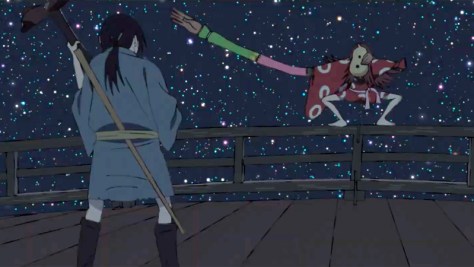
APOCRYPHA CANDIDATE: INU-OH (2021)

366 Weird Movies may earn commissions from purchases made through product links.

犬王

Recommended

DIRECTED BY: Masaaki Yuasa

FEATURING: Voices of Avu-chan,

PLOT: A blind itinerant priest crosses paths with “the King of Dogs”, a vivacious and deformed creature with a talent for dancing; through the priest’s music and the dancer’s storytelling, they attempt to lay the lost souls of the Heike clan to rest.

WHY IT SHOULD MAKE THE LIST: I have come to the conclusion that perhaps everything in Masaaki Yuasa’s œuvre should get canonized, particularly as we now have the elbow room to do so. (Night is Short, Walk on Girl was shortchanged due to numeric constraints.) Inu-oh brings an unlikely legend to bombastic life, fusing rock opera, ballet, pyrotechnics, spirits, curses, gender self-discovery, physical transformation; it’s a 21st-century story about a 14th-century performance troupe unearthing the secrets of an 12th-century war.

COMMENTS: It tickles me that Inu-Oh is Masaaki going “commercial.” This stems to a great extent, of course, from the fact that here in the United States, film norms are sickeningly normal: we are reigning kings of the lowest white bread denominator (so much so that it was controversial when Disney took a belated and modest stand against overtly bigoted legislation in its home state). Among the many themes explored in Inu-Oh, gender identity is near the fore, along with the nuances of parental acceptance of someone’s true self.

But let me stop that vein of thought for the moment. This is film for, and about, entertainment. It’s about musical revolution, and the delineation of the esteemed Noh tradition, which harkens back to the middle of last millennium. Inu-Oh follows Noh’s traditional story arc, lacing it with modern rock sensibilities. (Well, maybe not “modern” rock, but certainly strains of Buddy Holly through Jimmie Hendrix and Freddie Mercury.) The titular character is a born performer, despite—or because of—the fact he is a born monstrosity: an unnamed son of a proto-Noh performer, a boy of ambiguous shape, deformed face, and a long, strong arm. He embraces his outcast status, at one point referring to himself as “the Horrible Gourd” in honor of his misshapen mask. But as the son of a dance troupe leader, it comes as no surprise that Inu-Oh was born to jump and jive.

Tomona, the biwa priest, has a comparatively subtler trajectory. The son of a salvage diver, he is blinded at a young age when he and his father retrieved cursed regalia. Masaaki’s visual treatment of this unseeing musician is a treat, as total darkness gains rough outline of form with each sound Tomona hears. Being unable to see, the priest-musician (a biwa is never without his four-string shamisen and bachi) does not fear Inu-Oh, and is so able to help the mutant through his journey. Tomona’s personal journey is also about transformation as he evolves into an increasingly feminine entity, adopting the name Tomaori by the film’s end. The morphing of their name allows them to grow into their true form, but plays havoc with the spirit world, and with their ancestors—as one’s given, or accepted, name is what allows Tomona/Tomaori’s father to maintain contact from the afterlife.

While the first half of Inu-Oh is “merely” steeped in music, song, and dance, the second half is one long string of hand-clapping, foot-stomping musical numbers showcasing the monumental talents Tomona and Inu-Oh share as natural performers. They give the forgotten fate of the Heike spirits full-throated treatment, with Inu-Oh performing transgressively non-traditional storytelling through song and dance, while Tomona positively shreds it on their shamisen. Contemporary shogunate politics play a role in the story as well, as does the concurrent, tragic tale of Inu-Oh’s fame-obsessed father. Masaaki Yuasa never settles for half measures, and every theme—friendship, salvation, transformation, politics, and music—ties together in an animated vortex of vivacity and sonic rollercoaster of rocking melody.

WHAT THE CRITICS SAY:

“This anachronistic rock musical promises a return to the playful, literary surrealism of ‘The Tatami Galaxy’ (2010) and its 2017 spin-off, ‘Night Is Short, Walk On Girl,’ but comes up short… There are individual sequences that reach the psychedelic heights of Yuasa’s best work. But too often, this tale of the liberating power of art is about as mind-expanding as an early-afternoon set at Fuji Rock Festival.”–James Hadfield, Japan Times (contemporaneous)

CAPSULE: NEPTUNE FROST (2021)

366 Weird Movies may earn commissions from purchases made through product links.

Neptune Frost is currently available for VOD rental or purchase.

DIRECTED BY: Anisia Uzeyman, Saul Williams

FEATURING: Cheryl Isheja, Bertrand Ninteretse (AKA Kaya Free), Elvis Ngabo

PLOT: In an alternate-reality African nation, an escaped coltan miner teams up with an intersexed refugee to hack global information systems through their dreams.

Still from Neptune Frost (2021)
COMMENTS: Neptune Frost‘s scenario involves an authoritarian crackdown in an imaginary African country; a resistance movement composed of university students, refugees, and escaped coltan miners; and global hacking accomplished in dreams. With a first act that indiscriminately flips back and forth between two different on-the-run protagonists, one of whom is played by two actors, and dialogue spoken and sung in five different languages, Neptune Frost loses viewers in its thickets early on. And that’s before the first big musical number—in which a dream spirit transports the dreamer into a black-lit, monitor-lined room festooned with spinning rainbow bicycle wheels and advises him (later her) to “hack” into abstract systems like land rights, labor, and greed—even occurs. The film is aware of its own difficulty: a third of the way through, a character addresses the viewer directly: “Maybe you’re asking yourself WTF is this? A poet’s idea of a dream?”

Persevere through the confusion, or at least get yourself into a headspace where you’re not invested in everything adding up in a rational way, and you’ll find much to appreciate in Neptune Frost. Foremost is the music, which ranges from work songs (which carry over into protest songs) to dreamy electronica-based trance chants, and eventually full-bore hip-hop bashes. The African setting—landscapes, dress, flora and fauna—fosters a unique language of images. The costuming tends to the bizarre: background characters have keyboard parts and diodes glued to their clothes and faces, a spirit has a head enclosed in a semicircular wicker cage, the state’s brutal police favor pink uniforms, and Neptune herself sometimes has a bird’s nest on her shoulder. As it progresses, the movie throws datastreams of glitchy cybernetic psychedelia at the screen to represent its mystical hack of the global order. The narrative remains hard-to-follow all the way to the end, but themes of technology, gender, colonialism, and DIY revolutionary politics (local, global, and imaginary) float in and out of the mix. The film’s aesthetic may be Afrofuturist, but its style is Afrosurrealist.

Truthfully, there is almost too much to process in Neptune Frost: both the characters and the events can be a chore to sort out. The film’s concepts are half-hidden in a haze of impressionistic poetry and song (with phrases such as “binary crime,” “martyr loser king,” and “unanimous goldmine” carrying obscure significance); although at other times, messages are delivered bluntly (one song bears the refrain, “fuck Mr. Google”). It’s no surprise to learn that writer Saul Williams is a poet and musician. If Neptune Frost sometimes feels like a concept album brought to life, that may be because there is one: Williams’ 2016 left-field rap album Martyrloserking (and two sequels), plus a graphic novel. This world is much wider than the slice we see in the film, and further exploration may yield more answers than are given here. Neptune Frost comes achingly close to a general “” rating, and also to a “” rating. But ultimately, while impressive, I think the project’s appeal is decidedly niche: fans of Afrofuturism, proponents pf progressive (verging on radical) politics, and advocates of African film in general (of which we have far too few examples). If you’re not in one of those groups, but have adventurous tastes in cinema and are up for a challenge, then Neptune Frost is also a worthwhile visit: there is truly nothing quite like it out there.

Neptune Frost opens June 3 in New York City and Dallas, expanding to additional art-house theaters through June. We’ll let you know when streaming options get sorted out.

WHAT THE CRITICS SAY:

“…a bold, bizarre, and unflinchingly confident debut that prompts its audience to interrogate the very real human costs of the information age through the speculative lens of a future both vastly different and uncannily similar to our own.”–Toussaint Egan, Polygon (festival screening)

CAPSULE: THE HOUSE (2022)

366 Weird Movies may earn commissions from purchases made through product links.

Recommended

DIRECTED BY: Emma De Swaef and Marc James Roels (Part One), Niki Lindroth von Bahr (Part Two), Paloma Baeza (Part Three)

FEATURING: Voices of , , Jarvis Cocker, Susan Wakoma, Helena Bonham Carter

PLOT: Designed by an eccentric 19th-century architect, a magnificent house traps and torments a series of owners over the centuries.

COMMENTS: This unusual house has three stories. The first is classically unsettling, the second is downright creepy, and the third is charmingly hokey. Each story’s physical structure is ever-changing, as the house is built, re-built, and re-built, then is infested and decays, finally embracing its ephemeral nature. From its loftily sinister beginnings as a macro-doll’s house up through its final untethering from its foundations, the titular mansion houses three separate visions: one man’s cruel infliction of nightmarish doom; one man’s mental disintegration as he attempts to tame the decaying edifice; and one woman’s spiritual liberation. Each director provides a unique touch, but each tale fits together, creating a narrative arc that morphs into an arc of redemption.

The chronicle begins with a house within a home. A doll’s house, that is. Mabel’s immediate family has fallen from grace, and a troupe of off-putting relatives chastise them. That night, her father gets drunk and wanders angrily through the woods, only to stumble across an illuminated sedan chair, the luxurious transport housing the altogether-too-creepy architect, Van Schoonbeek (“clean stream”, one of the most subtle bits of foreshadowing I’ve seen), who promises Mabel’s family a beautiful new place to live. But as is so often the case, midnight rendezvous with giggling fatcats lead to terror and lamentation.

The House dodges the bullet typical of anthology films in that, unlike the physical structure, none of the sections are weak. Their tenor differs, as well as their style. The first features unnerving felt-made people, the latter two anthropomorphic animals. The dark shadows of Mabel’s section become marvelously lit, and tackily modern, in the second segment. An unnamed “Developer” (perfectly voiced by Pulp’s Jarvis Cocker as an at-his-wits’-end handy-rat; he also provides the closing credit’s song) begins falling part as he repairs the now-dilapidated house in the hopes of selling it off. Fate is as unkind to him as it was to the first owners—albeit with a modern twist. Part two climaxes with an intricately choreographed club-jazz dance of fabric beetles and a run-in with the law after the Developer’s dentist, sick of being telephoned at all hours and called “sweet-heart” and “dear,” sends the police around to the hapless rat realtor.

The House breaks no new ground, and much of the spook-or-creep factor relies on old fashioned methods: light-play, musical cues, background laughter, scuttles, wriggles, and poofs of poison. But it all works more than well enough. I was not unpleasantly transported in mind to that special place I can end up when emerging from a well-crafted film experience. It is worth noting the third segment, which differs sharply from the first two. It’s the story of the final owner, and of her desire for her home clashing with a subconscious itch for freedom. Helena Bonham Carter’s hippy cat performance is relief-through-whimsy (she pays rent with potent crystals), and she is the perfect guide for the frazzled young owner. The House‘s first two acts scrabble in the darker corners of the mind, but when the sun breaks through the finale’s mists, I could feel the haunting memories begin to recede.

The House is exclusive to Netflix.

WHAT THE CRITICS SAY:

“…a consistent anthology, in that it’s always just about the same level of surreal, playful, sadistic, and entertaining. Across its different styles and species, The House never holds the audience’s hand when it comes to the poetic flourishes from its mighty gradual pacing; it prefers to be odd…” -Nick Allen, RogerEbert.com (contemporaneous)

APOCRYPHA CANDIDATE: IN SEARCH OF THE TITANIC (2004)

366 Weird Movies may earn commissions from purchases made through product links.

Tentacolino

DIRECTED BY: Kim Jun-Ok

FEATURING THE VOICES OF: Jane Alexander (not that one), Anna Mazzotti, Francis Pardeilham, Gregory Snegoff

PLOT: Attacked while on an undersea exploration to find the wreckage of the Titanic (which evidently suffered no casualties following its run-in with an iceberg thanks to the intervention of an enormous doe-eyed squid), survivors Elizabeth and Don Juan, talking dog Smile and incorrigible talking rats Ronnie and Top Connors are rescued by the denizens of Atlantis, who ally with them in a battle against an army of rebellious rats, a group of shark inmates, and the evil human Lord Vandertilt, who wants the valuable shipwreck all to himself.

Still from In Search of the Titanic (2004)

WHY IT MIGHT MAKE THE LIST: What ought to be a simple quick-buck exploitation to lure in dumb kids and their undiscerning parents by ripping off such entertainments as The Little Mermaid, Atlantis: The Lost Empire, and ’s Titanic swims proudly into its own realm of insanity. Impossible to dismiss as merely incompetent, the unfolding story contains enough deliberate intentions to force its consideration as art. The choices are almost painfully strange, forcing you to question the very fabric of reality. It’s like if a Penrose triangle were a movie.

COMMENTS: If you decided to turn off In Search of the Titanic after two minutes (a reasonable desire)—having only watched the opening credits consisting of scene snips from this film’s predecessor in which a man dances with a dog, an enormous octopus forces the two broken halves of the Titanic back together, and a blue whale catches a couple after they have fallen from the mighty ship’s deck—you could still make a solid case for it as one of the weirdest movies ever made. Having taken this hiatus from the film, you might then take a moment to dig into the history of its animation studio, which is based in North Korea and which has handled outsourced work for The Simpsons Movie and Avatar: The Last Airbender, at which point you might feel as though you were losing your grip and start doing that thing where you try to read a book because supposedly you can’t read in your dreams. But at this critical juncture, let me encourage you to head back to the film. Stick around. Ride this out. Watch the whole movie. Because believe me, your descent into madness is just getting started. Go with it. Let the insanity rain down upon you like mighty waters.

Because even after you meet the talking dog and the sharks who work on an underwater chain gang and the CGI that came from a 1990s DVD menu, it still hasn’t gotten amazing yet. You see, you haven’t met the leader of the sharks. You haven’t seen him wearing the dress-whites of the Titanic’s captain. You definitely haven’t heard him start to rap. And you certainly haven’t heard his backup chorus of clams who also double as a telegraph machine. Only when you’ve gotten this far can you even begin to imagine the scale of the Continue reading APOCRYPHA CANDIDATE: IN SEARCH OF THE TITANIC (2004)

CHANNEL 366: “RUSSIAN DOLL,” SEASON 2

366 Weird Movies may earn commissions from purchases made through product links.

Recommended

DIRECTED BY:

FEATURING: Natasha Lyonne, , , ,

PLOT: Having escaped the time loop that imprisoned her in Season 1, Nadia now finds that she can visit her own past via the New York City subway system, and uses this power to try to salvage her family legacy of stolen Krugerrands—with troublesome and paradoxical results.

Still from Russian Doll, Season 2

COMMENTS: Just a few years after resolving the time loop that saw her killed nightly, Nadia steps onto the 6 train and finds herself transported back in time to 1982. Her smartphone is gone; in its place is a matchbook cover with a note scrawled telling her to meet one “Chaz” at the Black Gumball at 8. The Gumball turns out to be a go-go bar with a topless dancer gyrating on the counter, and when Nadia orders a bourbon, the bartender asks her if she’s sure. Launching into one of her typical raspy monologues, she responds, “It’s arguably the only thing I’m sure of. Basic concepts like time and space are suddenly eluding me. Last night this place was mayhem because the wi-fi went out, but in the new here and now, apparently gratuitous nudity is back in play. My past, your future. Begs the question: am I haunting you, or are you haunting me?”

Circumstances have changed, but Lyonne’s unflappable (or at least, very rarely flapped) Nadia—streaming’s quirky, acerbic breakout character of 2019—is a constant. She’s the kind of middle-aged arrested adolescent who grabs a cocktail first thing in the morning (after lighting a cigarette, of course), chooses both when offered a choice of uppers and downers, and impulsively sleeps with creeps from other eras she barely knows and likes even less. She acts drunk even when sober, but she’s grown into her identity: she’s permanently tipsy and supremely confident, with a mouth like Dorothy Parker if she been raised by a company of Jewish longshoremen. She’s a treasure, and the sole justification for reviving a series that successfully closed its loop back in 2019.

Lyonne puts her mark on the series, directing three of seven episodes this season (as opposed to only the finale of Season 1). She also becomes the only person credited with writing on every episode in the series: while the team of Lyonne and co-creators Leslye Headland and SNL-alum Amy Poehler wrote all of Season 1 together, Season 2 features a wider variety of scripters, with Lyonne the only constant. We suspect that her main contribution is Nadia’s dialogue, which remains as sharp as ever (“every time you compliment me, a cockroach gets its wings.”) Perhaps as a result of the larger writing staff, Season 2 is looser, almost reckless compared to the relatively tight focus of the debut season. The setting is no longer confined to modern day New York City, but ranges through time and space, from the crime-ridden city of 1982 (patrolled by red-bereted Guardian Angels) to Nazi-era Hungary and Cold War Berlin to an allegorical subway labyrinth of memory and regret.

Despite being as acerbic as ever, Nadia has become even more blasé about her dislocated realities, barely batting an eye (and definitely not dropping her cigarette) when she finds herself thrown backwards in time. This matter-of-factness reflects a thematic decision to never even hint why Nadia, and the similarly-situated but far more neurotic Alan, are the subjects of such wrenching temporal anomalies. This approach allows the story to focus purely on its symbolic meaning, which, in Nadia’s case, is coming to terms with her family’s dysfunctional past: she believes that if she can rescue the family Krugerrands, she can redeem her family’s legacy. Of course, things are never that simple, and in the series’ final two episodes the weirdness blooms as Nadia has created a series of paradoxes that throw her carefully laid plans into complete chaos.

It’s inevitable that Netflix’s “Russian Doll” will be compared to Amazon Prime’s “Undone“: two slightly trippy time-travel stories starring strong and sarcastic female leads, centered around the investigation of family histories. The main difference is cosmetic, if significant:”Undone”‘s uncanny valley rotoscoping versus “Doll”‘s traditional live action setting. “Doll” has more comedy (Nadia’s comebacks are a lot spikier than Alma’s); “Undone” takes its science fictional conceit more seriously, delving into time travel mechanics and hinting at some possible causes for the family’s gifts. I’ve tried, and I can’t pick a favorite between them. Stream them both, if you can.

The series’ nesting title is more apt this season (you’ll see why soon enough). Both seasons of “Russian Doll” stream exclusively on Netflix for the foreseeable future.

WHAT THE CRITICS SAY:

“…manages to pack in big laughs, real emotional moments, and an effective time-traveling plot that fits right in with what happened during the show’s trippy first season.”–Joel Keller, Decider (contemporaneous)