Tag Archives: Fantasy

LIST CANDIDATE: LOST RIVER (2014)

Recommended

DIRECTED BY:

FEATURING: Christina Hendricks, Iain De Caestecker, Saiorse Ronan, Matt Smith, Ben Mendlesohn, , Reda Kateb,

PLOT: An urban fantasy/fairy tale set in an unspecified city in decline (which looks a lot like Detroit) where single mom Billy and her sons Frankie and Bones attempt to keep their home despite all obstacles and enemies: for Billy, a bank manager/underground club impresario, and for Bones, the neighborhood gang kingpin, Bully.

Lost River (2014)

WHY IT MIGHT MAKE THE LIST: Gosling calls Lost River (originally titled How to Catch a Monster) a dark fairy tale, inspired by both the 80’s fantasy films he watched growing up and by a stay in Detroit while acting in The Ides of March. It’s a very unorthodox melding, like lo-fi magic realism set against a documentary background. Some might feel it exploitative, which could account for the polarized reaction the film received.

COMMENTS I guess it’s a gauge of where we’re at in film culture when something like Lost River can arise from sunken depths to befuddle everyone. People were expecting a disaster of epic proportion, judging from its reception at the 2014 Cannes Film Festival and the outright hostile reviews during its very brief theatrical run/VOD in the U.S. From that reaction, one would think that Lost River would be better paired with other recent cult “darlings” like The Room or Birdemic.

lost-river-film-ryan-gosling-700x425Happily, Lost River is nowhere near those icons of ineptitude, which makes the reaction to it even more of a curiosity.  Critics seemed to take it personally that a Hollywood Star would actually choose to make his directorial debut an artistic endeavor rather than some flashy franchise production. It is evident that Gosling isn’t at all shy about his influences—he was paying close attention while he was working with and —but I would think that would be something to be encouraged by, rather than excoriated.

Apparently surrealism and dream imagery are only to be attempted when the director is a less well-known name. Either that, or most reviewers felt very uncomfortable with the approach in conjunction with the Detroit setting. There are several scenes with non-actors which briefly push the tone into docudrama, which is completely jarring with the “urban fairy tale” atmosphere Gosling is attempting to create.

lost river artGosling’s direction is very assured, aided by the lensing of Benoit Debie (Enter the Void) and the music of Johnny Jewel, which provide the proper atmosphere. Performances are pretty good all around: Hendricks, DeCaestecker and Ronan are fine, though it’s mainly the supporting characters that make an impression, such as Mendes, Mendlesohn and especially Matt Smith’s villainous turn, which is as far away from his Doctor Who as possible. One caveat: it seems a waste to get Barbara Steele and give her nothing to do. She’s more of a presence than a full character.

Whatever you might think of Lost River, I highly encourage you to search it out and make up your own mind.

Available on Blu-Ray and DVD with no additional features.

WHAT THE CRITICS SAY:

“Indulgent and movie-like, Lost River is Gosling’s weird, let’s-do-this-thing folly.”–Brad Wheeler, The Globe and Mail (contemporaneous)

222. SPIRITED AWAY (2001)

Sen to Chihiro no Kamikakushi

“It was just too bizarre.

“Honestly, when I watched Spirited Away for the first time back in 2008, I didn’t like it for the same reason as you. I just found it too weird.”

–IMDB message board dissenters on Spirited Away

Must See

DIRECTED BY:

FEATURING: Voices of Rumi Hiiragi, Miyu Irino, Mari Natsuki; , Jason Marsden, (English dub)

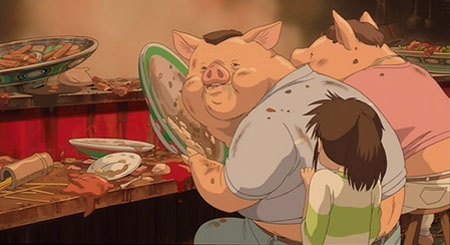
PLOT: While moving to a new town, ten-year-old Chihiro and her parents take a detour to a seemingly abandoned amusement park in rural Japan. Once the sun sets, the park transforms into an otherworldly resort for spirits and gods overseen by the cruel witch Yubaba. Now separated from her parents, Chihiro must learn to survive among an array of weird creatures as she attempts to reunite her family and return home.

Still from Spirited Away (2001)

BACKGROUND:

  • Hayao Miyazaki had announced his retirement from feature filmmaking in 1998, after completing Princess Mononoke. He came out of retirement in 2001 to make Spirited Away.
  • Disney Studios had distributed Studio Ghibli’s previous film, Princess Mononoke, in the United States, with disappointing results. They put little money into marketing the film, but strong reviews and word of mouth turned it into a hit, and Disney’s partnership with Ghibli was cemented from that point on.
  • Spirited Away won the Academy Award for Best Animated Feature (along with 52 wins granted by other organizations).
  • Spirited Away is the highest-grossing film of all time in Japan.
  • Hayao Miyazaki had announced his retirement from feature filmmaking in 2001, after completing Spirited Away. He came out of retirement in 2004 to make Howl’s Moving Castle.

INDELIBLE IMAGE: Lured into the park by a delicious scent, Chihiro’s parents come upon a vacant restaurant filled with sumptuous, exotic dishes. The two immediately begin to fill their plates, ignoring their daughter’s worries that they’ll be punished for taking the food. After the park begins its transformation, Chihiro returns to find her parents bloated and hunched over piles of scraps. She tries to warn her father about what is happening, but when he looks at her she sees only the sweating, engorged face of a pig. The grunting pig ignores Chihiro and climbs over the restaurant’s counter, only to be swatted away by an unseen figure’s reptilian arm. The pig then crashes to the ground with a primal squeal, frightening Chihiro as she cries out for her parents and runs into a street filled with tall, anonymous ghosts.

THREE WEIRD THINGS: Pig parents; “No Face” eats; three heads and a giant baby

WHAT MAKES IT WEIRD: In Spirited Away, Hayao Miyazaki plays on the normal fears of lost children as the basis for an outlandish, frightening fantasy about a young girl being thrust into the incomprehensible life of an adult. The imagination of the setting is so immense that it seems to dwarf the film itself, suggesting a fully realized universe of magic and monsters with borders that extend far beyond the frame of the story.


Disney Trailer for Spirited Away

COMMENTS: Spirited Away begins with the main character, Chihiro, Continue reading 222. SPIRITED AWAY (2001)

214. DER SAMURAI (2014)

“…there seems to be some sort of secret anarchic urge within me to see the monsters set loose and rampantly reclaim what’s theirs, to witness them bringing back some wonder and excitement into a world so controlled by order and reason that it at times threatens to suffocate all sense of joy and opportunity.”–Till Kleinert

DIRECTED BY: Till Kleinert

FEATURING: Michel Diercks

PLOT: Young policeman Jakob deals with a wolf menacing his rural east German village by placing bags of butcher scraps in the woods, hoping to lure the predator away from inhabited areas. One night he receives a mysterious package which he is instructed to deliver to an abandoned house; inside the home is a man in a dress who unwraps the package to reveal a samurai’s katana. The transvestite then runs into the night, where he embarks on a campaign of murder and mayhem which Jakob must put to an end.

Still from Der Samurai (2014)

BACKGROUND:

  • Der Samurai is Till Kleinert’s directorial debut, and his graduation project for the German Film and Television Academy.
  • The film was denied a government funding grant because it was deemed “incompatible with the taste guidelines of German public television.” Much of the budget was instead raised through a crowdfunding campaign.

INDELIBLE IMAGE: When your movie stars a blond-haired samurai in a floor length backless white party dress, you have a good idea what the indelible image is going to be.

THREE WEIRD THINGS: Transvestite samurai; flamingo punch; explosive decapitation

WHAT MAKES IT WEIRD: Exploring the weirdness in queerness, Der Samurai is a primal confrontation with the Other, embodied in the person of a wolf man come to life as a dress-wearing, sword-wielding maniac who taunts a repressed country policeman into a confrontation with his own desires.


Original trailer for Der Samurai

COMMENTS: Jakob’s long duel with a mysterious cross-dressing Continue reading 214. DER SAMURAI (2014)

CAPSULE: THE FALL (2006)

Recommended

DIRECTED BY: (as “Tarsem”)

FEATURING: Catinca Untaru, Lee Pace, Justine Waddell

PLOT: In a Los Angeles hospital, a young girl with a broken arm befriends Roy, a stunt-man paralyzed by a recent accident. Through her eyes, a beautiful vision of his epic yarn unfolds; and, as a quintet of wronged men hunt for the hated Governor Odious in his story, the crippled Roy slips further into suicidal depression.

the_fall

WHY IT WON’T MAKE THE LIST: Fans of the movie will likely kneecap me for this, but by placing the free-spirited story within the framing of the realistic (and touching) “actual” narrative, Tarsem has made a movie that, though beautiful and full of the fantastic, is not wholly weird.

COMMENTS: Set all around the globe, but primarily in a turn-of-the-century hospital, the Fall is both a grand, epic adventure and the intense emotional drama of a sick, suicidal man bonding with an impressionable young girl. Roy Walker (Lee Pace) is an ironically named stunt-man who has worked in countless “flickers”. In his latest, his jump from a train bridge on to a moving horse goes awry. Perhaps he intended to kill himself—the movie is noncommittal—but the result is he becomes paralyzed from the waist down. Now crippled, he is also sick at heart, pining for a starlet who cast him aside. Through a chance encounter involving a secret note and a crate of oranges, he meets the young Alexandria (Catinka Untaru, an amazing find on the director’s part), a 5-year-old Romanian fruit-picker, who is in the hospital because of a fall of her own. She has taken to wandering the corridors of the hospital, carrying a “box of things [she] likes” in her hand.

Moods ranging from wonderment to tragedy and back to joy bubble up and dissipate over the course of the film. As Roy’s situation goes from bad to worse, the heroes of the story he tells, originally poised for a quick triumph, get waylaid and thwarted. Alexandria sees the five heroes of the tale largely as described by Roy, but also through her own subjective lens. For instance, Roy mentions one of the heroes being a brave Indian warrior. Alexandria has no knowledge of the Native Americans he is referring to, so she sees in her mind’s eye a glorious Sikh. The main hero of the group, the Masked Bandit, changes too; first he is her father, then a Frenchman, and then finally Roy himself. The epic’s various characters are all based on the hospital’s denizens and visitors (à la the Wizard of Oz). Alexandria even makes herself appear in the story; when Roy is giving up on life, both in the hospital and in the story, a small masked bandit saves the five heroes. And all the while, dozens of fantastical (and, apparently, real-world) locales are explored as the adventurers pursue their sworn enemy. The movie’s unbelievable locales—a blue city, an endless maze of stairs, a glorious wedding temple, among many others—merit research. Apparently little to no CGI was used (somehow).

While the story-within-the-story is a good one, the truly compelling drama unfolds as we see Roy and Alexandria together. He tries to trick her into bringing him enough morphine to end his life, but she misinterprets his handwriting. As he spirals downward, her entreaties for him to keep telling the story—to keep living—become the film’s driving force. Naturally, I cared about the vengeance of the Bandit and his crew, but even more, I wanted to see the stuntman and the little girl. Their story was so charming and moving that every bit of the mundane hospital world still had magic. All told, this movie is both boisterous and heart wrenching — and has an ending for which we can only be grateful.

WHAT THE CRITICS SAY:

“These rambling scenes then inform the way the fable unfolds, which at best is impressionistic and dreamlike, but for the most part is just haphazard… The end result is like listening to a little kid tell a story: sometimes intriguingly bizarre and surprisingly clever, but mostly just futile and frustrating.”–Josh Bell, Las Vegas Weekly (midnight screening)

CAPSULE: THE ILLUSTRATED MAN (1969)

366 Weird Movies may earn commissions from purchases made through product links.

DIRECTED BY: Jack Smight

FEATURING: , Claire Bloom, Robert Drivas

PLOT: A young hobo meets a man covered from head-to-toe in tattoos; each illustration tells a story of the future if you gaze it at long enough.

Still from The Illustrated Man (1969)

WHY IT WON’T MAKE THE LIST: It has a few odd moments, but overall this collection of speculative fiction isn’t that strange. Maybe people were easier to wierd-out in 1969; after all, this movie comes from a time when the tattoos that cover from Steiger’s character from head to toe made him a freak only suitable for a job as a sideshow attraction at a carnival. Today, the Illustrated Man could just be any old barista at Starbucks.

COMMENTS: Structurally, The Illustrated Man‘s concept is simple. Rod Steiger is Carl, the title character, whose body is a canvas of tattoos (“illustrations!,” he insists) that move and tell stories if the viewer stares at them long enough. Neophyte hobo Willie (Drivas) does so, which is the excuse for the movie to launch into three mildly ironic science fiction short stories. Meanwhile, a lot of time is devoted the interplay between Carl, whose harsh experiences are etched on his very flesh, and the wide-eyed younger wanderer who can’t resist peeking at the bitter future promised by the illustrations. Carl also relates, in flashback, the story of how he met the “witch from the future” (Claire Bloom), who seduces him into becoming her canvas.

The three tattoo-inspired stories involve a virtual reality nursery and some very spoiled children, a group of soldiers trapped on a planet where it never stops raining, and the tale of the last night on Earth. The major roles in these insets are also played by Steiger, Bloom and Drivas, but the framing story (and its flashbacks) outshines each of them. Steiger digs into the role like a famished hobo digs into a steak, and he’s a lot of fun to watch. He is grizzled and dominant as the tattooed tramp wandering the Earth looking to take vengeance on his witch, but fresh-faced and easily led as the younger man who stumbles into her lair. A couple of fantastical, surreal elements also exist in the framing story: Carl’s highly portable dog, and his ability to silence crickets. These moments give the film a strange altered reality and a creepy texture that goes beyond the chills elicited by mere campfire tales. The Illustrated Man received generally poor reviews at the time of its release. It’s not quite as bad as its contemporary critics thought, but neither is it a lost cult classic. It’s a perfectly serviceable science fiction anthology that will probably satisfy the average “Twilight Zone” enthusiast, but it also leaves a lot on the table, since Steiger’s meaty Carl seems like he could carry a feature-length film.

Ray Bradbury’s short story collection “The Illustrated Man” was first published in 1951. The framing story there only consists of a few paragraphs, so the adaptation necessarily expands greatly on the Illustrated Man’s character. Bradbury later wrote a short story also titled “The Illustrated Man,” which shows up in print editions of the book starting in 1997; it’s a dark fairy tale that is thematically similar, but very different, plotwise, than the story that appears in the film. There are rumors of a remake (which would adapt some of the other 18 stories in the original collection), with to direct.

WHAT THE CRITICS SAY:

“…[the] screenplay is unsharp, without focus, working into and out of the hallucinations with great awkwardness. It also is so thinly structured that it simply cannot contain Mr. Steiger’s baroque performance as the man whose very skin is haunted.“–Vincent Canby, The New York Times (contemporaneous)

(This movie was nominated for review by Caleb Moss. Suggest a weird movie of your own here.)