
Your faithful correspondent has returned from the field with reports on two offbeat festival films…
 Alex de la Iglesia bolsters his already fine cult film résumé (Acción Mutante, The Day of the Beast) with this b-movie styled action/melodrama that’s also an allegory for the Spanish Civil War. The movie’s best sequence is the prologue, where the Republican army conscripts a circus troupe into emergency action (“a clown with a machete—you’ll scare the s**t out of them”!) Flash forward to 1973, when the embittered son of one of the Shanghaied carnies embarks upon a career as a “Sad Clown,” but is immediately smitten by a beautiful trapeze artist. Unfortunately for him, the acrobat Natalia is the personal property of the “Happy Clown,” a psychotic, drunken woman-beater who just happens to be great with kids. The two mountebanks’ working relationship quickly turns sour as they take turns beating the greasepaint off each other in a brutal rivalry that eventually leaves both of them mutilated and insane. Which mad harlequin will Natalia choose? The Spanish Civil War angle is simplistic and neither adds nor subtracts from the narrative, which starts as a tawdry carnival melodrama and morphs into an action movie with a high-flying, clown-mauling showdown atop a giant cross. A few Sad Clown dream sequences–he keeps seeing his dead father and archival footage of Spanish pop singer Raphael singing a vintage ballad in clownface—add nominal weirdness, but these touches aren’t pervasive enough to raise the film above the level of aggressively offbeat. Still, there are those who are going to want to check out any film where an insane jester uses lye, an iron, and some clerical vestments to improvise his own clown costume, then steals a cache of automatic weapons and walks the streets of Madrid armed to the teeth with homicidal gleam in his eye. One final note: my movie-going companion was disappointed in the lack of variety in the clown-on-clown violence; he had been hoping to see a wide variety of Bozos brutalizing each other in an all-out melee. So be forewarned—if you consider two killer clowns too few, this Circus is not for you.
THE LAST CIRCUS [Balada Triste de Trompeta] (2010). Dir. Álex de la Iglesia, Featuring Carlos Areces, Antonio de la Torre, Carolina Bang.
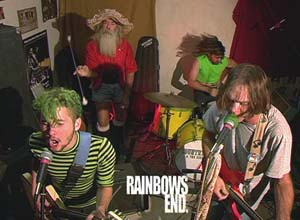 If The Last Circus is edgy, Rainbows End occupies the opposite end of the offbeat spectrum—it’s whimsical. Ostensibly a documentary about six east Texas eccentrics on a road trip to California to pursue a motley assortment of dreams, it’s also one of the funniest movies yours truly has had the privilege of checking out in 2011. It’s the characters who drive the bus in this episodic feature—and in this case that bus needs a push start, leaks radiator fluid, and at times is literally held together with duct tape. Continue reading FILM FESTIVAL DOUBLE FEATURE: THE LAST CIRCUS [BALADA TRISTE DE TROMPETA] (2010)/RAINBOWS END (2010)


 Wrathell considers himself a Warhol-inspired dadaist who is obsessed with the planet Pluto. He recollects that when he met president George W. Bush, he asked Bush to support a mission to Pluto. Bush replied “I’m going to send you to Pluto!” Wrathell (in 2004) predicts the mission to Pluto will be a reality by 2006.
 He takes us to Burger King where he describes the perfect Whopper as having two tomatoes, or three, if you order extra tomato, which is what he orders. Wrathell sits down with his Whopper and explains that it should have three tomatoes. When he unwraps his sandwich, he discovers it to be a Chicken Whopper. He returns the sandwich and hums, masking his displeasure, as they make him a new Whopper. They do it right this time and the world is good again.
 Thomas Pynchon: A Journey into the Mind of P, directed and produced by the brothers Fosco and Donatello Dubini, is not so much a documentary as it is a homage to that legendary recluse of post modern literature, who wrote books such as “V” and “Gravity’s Rainbow.”