Tag Archives: Action

301. FANTASY MISSION FORCE (1983)

Recommended

Mi ni te gong dui; AKA Dragon Attack

“If it sounds ridiculous, that’s only because it was.”– Jackie Chan on Fantasy Mission Force (quoted in Keith Bailey, “The Unknown Movies”)

DIRECTED BY: Yen-Ping Chu

FEATURING: , , Yu Wang (), Yueh Sun, David Tao, Jin Fang, Shiu Bu Lia, Ling Chang

PLOT: Four Allied generals have been captured by the Japanese. Mercenary Don Wen is hired to liberate them, and recruits a team which includes “Old Sun,” escape artist “Greased Lightning,” two kilt-wearing soldiers, con man Billy, and Lilly, Billy’s bazooka-toting on-and-off girlfriend who tags along when she hears about the cash reward. Tailed by rogues Sammy and Emily, the team encounters Amazons and a haunted house on their way to a surprisingly bloody showdown with the kidnappers.

Still from Fantasy Mission Force (1983)

BACKGROUND:

  • Director Yen-Ping Chu (sometimes credited as “Lawrence Full” or “Kevin Chu”) is the director of sixty-five (mostly kung fu and comedy) films; this is his only effort which is marginally well-known in the West.
  • According to persistent but unconfirmed rumors, a Triad-connected movie mogul ordered a hit on Jackie Chan when he decided to change studios. Jimmy Wang Yu intervened to settle the dispute, and as part of the deal Chan agreed to lend his growing star power to two of Wang’s movies (this being one).

INDELIBLE IMAGE: An ambush by ribbon-shooting ninjas? Bloody ghost hands waving wads of toilet paper? Assault of the Road Warrior-Japanese-punk Nazis? Your opinion on this one is as good as ours, and it’s likely to change many times during the movie as some new amazement pops up. We’ll just go with any shot of the assembled team: Old Sun in his top hat, Brigitte Lin in black leather with a bazooka, Billy in his white suit and Elvis sideburns, the kilt-wearing pair of misfits… as weird a group ever formed to fight an anachronistic battle against fascist kidnappers somewhere in Canada, Luxembourg, or Taiwan.

THREE WEIRD THINGS: Scottish/Chinese mercenaries; toilet paper ghosts; Japanese Nazis in Chevys

WHAT MAKES IT WEIRD: Packed with kung fu, shootouts, flying ninjas, hopping vampires, and slapstick comedy reminiscent of Benny Hill, Fantasy Mission Force is one of the only commercial entertainments ever released where you can honestly say you have no idea what will happen next. It’s a pulp surrealism masterpiece, set in a previously undiscovered movie universe at the conjunction of the Shaw Brothers, , and the Three Stooges.


Original Cantonese trailer for Fantasy Mission Force

COMMENTS: Although some reviewers are reluctant to discuss the Continue reading 301. FANTASY MISSION FORCE (1983) →

CAPSULE: TOKYO DRIFTER (1966)

Recommended

DIRECTED BY:

FEATURING: Tetsuya Watari, Tamio Kawaji, Ryuji Kita, Chieko Matsubara, Hideaki Nitani

PLOT: Tetsu tries to quit the yakuza life after his boss goes straight, but a rival gang leader wants the building they own—and Tetsu’s life.

Still from Tokyo Drifter (1966)

WHY IT WON’T MAKE THE LIST: This is a rare case of a movie being screened out by competition from its own maker. Had Seijun Suzuki never made Branded to Kill, Tokyo Drifter just might stand as the most unusual yakuza picture ever made (at least, until arrived on the scene). But Suzuki took his deconstruction of the genre so much farther the very next year that Tokyo Drifter, while a stunning visual achievement, seems conventional in Branded‘s wake. Unfair to Drifter, which should stand alone on its own strange merits? Perhaps, but these two films, made (almost) back-to-back and leading to Suzuki being blackballed from the Japanese film industry for genre rebellion, will always be linked together in film history—and Branded to Kill will always be remembered as “the weird one.” You are still advised to watch them both.

COMMENTS: A movie so cool they ripped off its title for a Fast and Furious installment, Tokyo Drifter is an exercise in pure style. Seijun Suzuki, bored with the generic gangster scripts Nikkatsu Studios kept giving him as a B-director, amuses himself with outlandish set pieces while deconstructing the genre before our very eyes. The plot is a standard tale of loyalty and betrayal, merely an outline for Suzuki to hang his experiments on. Scenes are clipped—for example, how does Tetsu appear in the driver’s seat of the kidnappers car, other than by magic? How is his showdown on the train tracks resolved? We never see him actually escape. How does he evade certain death time and time again, with Viper showing up each time to drive him to his next drifting destination? It all makes sense, but only mythologically. Tetsu is a heroic archetype, a chosen one, undefeatable but cursed to wander forever without satisfaction. Suzuki simply chooses to cut out a lot of inessential exposition and get right to the cool stuff. He gives us the elements of the myth without bothering with the logistics.

Whereas the followup film, Branded to Kill, is a record of haunted  characters and obsessive themes, Tokyo Drifter is a thrill ride of stylish moments. The film is suffused with comic book colors and Pop Art sensibilities, and magnificent sets inspired equally by German Expressionism and Surrealism. The prologue mixes black and white with color sequences (and one shot incorporating both color and monochrome). Tetsu is seldom caught without his stylish powder-blue suit, which remains unrumpled no matter how many tussles he gets into. His gun blazes with a bright pink muzzle flash. The soundtrack is cool, Bond-ish spy-jazz, with a “drifter” theme song for Tetsu (performed as a torch song by his chanteuse moll, and whistled by Tetsu to announce his presence). Tetsu’s is a world of alleyways of full of jazz bars advertising their disreputable wares with garish neon signs. In an Old West-themed saloon in a U.S. Navy town, he gets caught up in a brawl that turns into havoc-laced slapstick straight out of a Mel Brooks movie. What you’ll probably remember best are the sets: Kurata’s office, which has Roman frescoes on one wall, and an abstract red and white light sculpture on the opposite wall. Even more impressive is the Club Aires cabaret, where the wild finale happens. It features an Expressionist door mounted atop a staircase and a sculpture of a slender, Dali-esque figure hoisting a giant doughnut above his head. At night it’s a complete black void, except for a spotlight, a glowing white piano, and a glowing red torus. Drifter may not have made bank, but Tokyo Drift wishes it could be a fraction as groovy as its swinging forebear.

The Criterion Collection disc (DVD or Blu-ray) includes two Suzuki interviews and the original Japanese trailer.

WHAT THE CRITICS SAY:

“…kitted out with plot ellipses, bizarre sets and colour effects, inappropriate songs, absurd irrelevancies (nice hair-drier gags!), action scenes that verge on the abstract, and some visual jokes tottering precariously between slapstick and surrealism.”–Geoff Andrews, Time Out London

CAPSULE: TAKASHI MIIKE’S “DEAD OR ALIVE” SERIES (1999, 2000, 2002)

DIRECTED BY:

FEATURING: ,

PLOT: The original Dead or Alive, is a crime/yakuza adventure with a bizarre ending; Dead or Alive 2: Birds involves two hitmen who eventually join forces to kill for charity; and Dead or Alive 3 is set in a post-apocalyptic world.

Still from Dead or Alive 2 (2000)

WHY THEY WON’T MAKE THE LIST: The three films in this trilogy are unrelated except that they each star Riki Takeuchi and Shô Aikawa. The best, the original, is the least weird, while the sequels grow increasingly strange, but drop off in quality. They are necessary entries for Miike fans, and worthwhile ones for followers of Japanese extremity and pop-surrealism, but none of the three manage to nail the right combination of weirdness and distinction to earn spots on the List of the Best Weird Movies Ever Made.

COMMENTS: It’s only natural that the first entry in Takashi Miike’s Dead or Alive trilogy would be the best: otherwise, why try to recapture the magic twice more? Not only is it the pick of the three entries, it also starts with the series’ most memorable sequence: a scorching five-minute heavy metal montage of strippers, cocaine, noodles, blood, gunfire, sodomy, and more blood (and more noodles). This virtuoso sequence is equally thrilling and confusing; but, as it turns out, all of a piece, telling a tale of yakuza warfare between rival gangs. What follows is a relatively straightforward, though densely plotted, crime story, with a Chinese gang facing off against a Japanese gang facing off against the cops. Of course, Miike the provocateur can’t resist throwing in a gag-inducing, scatological prostitute drowning. That’s unnerving, but he ends the tale with a bewildering curve ball that abandons the shaky realism of the previous story altogether in favor of a Looney Tunes apocalypticism. There are no survivors, and the audience may feel scorched, too.

The second installment, subtitled Birds, again moves in an unexpected direction. Rather than rivals on opposite sides of the law, Takeuchi and Aikawa are now hit men who, through incredible coincidence, grew up as childhood friends before independently finding their way into the assassination biz and being assigned to take out the same target. Unexpectedly, Birds almost plays like an art-house drama for the first two acts, striking a nostalgic tone as the two killers return to the island orphanage where they were raised and reconnect with each other and the community. Miike always zigs when expected to zag, so it’ s almost natural that he would follow the adrenaline rush of Dead or Alive with the reflectiveness of Birds. The second film morphs, too, with an impressionistic third act that sees the assassins sprout wings and go on a proceeds-to-charity killing spree that includes a Mexican standoff with a dwarf.

Dead or Alive 3: Final is in many ways the weirdest of the series, but unfortunately suffers from lower production values. On Arrow’s DVD, a note appear before the movie explaining that there are no HD masters of the film in existence and they used the best materials available (which include burnt-in Japanese subtitles for scenes in which characters speak untranslated Chinese and English). Most of the video has a jaundiced yellow-green cast to it, which may have been intentional, but does not make for an attractive visual milieu. The plot is inspired by (to the point where you’re tempted to say “rips off”) Blade Runner, but with Miike twists. In this dystopia, an evil mayor with a skinny sax-playing boytoy enforces homosexuality by the use of medication, and procreation is a crime punishable by death. Aikiwa uses his replicant superpowers smoke cigarettes to the filter in a single inhale and to snatch bullets in midair or redirect them with u-shaped tubing that’s lying around post-apocalyptic Japan. The final battle between Takeuchi and Aikawa is a wire-fu spectacle in an abandoned warehouse which ends in a typically nonsensical, out-of-nowhere fashion with the two molded together into a penile mecha.

“What is this?,” Takeuchi asks of the characters’ predicament at the end of Final. “I don’t know,” Aikiwa responds. “It’s this.” That’s probably as good a description of Miike’s whacked-out movies as you’re going to get. In the supplemental material, the director says, “the films I want to make are ones where I can say, ‘I don’t know how I feel about it as a film, but I like it anyway.'” There’s a punkish “take it or leave it” attitude in the Dead or Alive films, which experiment with logic and narrative from within the most formulaic genres, making Miike something of a grindhouse . The series spans the director’s most fertile and febrile period, from 1999-2002, when he was making up to eight films a year. It’s the period that also brought us such singular atrocities as Audition, Visitor Q, The Happiness of the Katakuris, and Ichi the Killer. I wouldn’t count any of the Dead or Alive films as top-rank masterpieces in the Miike universe, although the first comes close. But they are all expressions of the director’s vision: uncompromising unexpectedness, with one brow held high and the other low.

WHAT THE CRITICS SAY:

“… for someone on Miike’s wild and amazingly dexterous wavelength, these films represent nirvana: a hit of pure aesthetic cocaine.”–Chuck Bowen, Slant (DVD series release)

ALFRED EAKER VS. THE SUMMER BLOCKBUSTERS: WONDER WOMAN (2017)

366 Weird Movies may earn commissions from purchases made through product links.

Patty Jenkins’ Wonder Woman (2017) is reaping critical praise, and opened with an astounding one hundred million dollar weekend box office. It’s being hailed as the best movie in the DCEU—i.e., D.C. comics extended universe—although I’m not sure how exactly that’s different than the DC movies that preexisted that label.

Still from Wonder Woman (2017)Regardless, this is the first big screen standalone treatment of the character, which originally debuted during the Second World War, created by William Moulton Marston and Harry G. Peter. Wonder Woman was always a kind of female variation on Superman. Paradoxically, she was both a symbol of female empowerment and a pinup bondage fantasy. Initially, under the original artists, she was more feminist than titillating. Predictably, it was the pinup quality that drove the bulk of her fan base and informed most of her subsequent incarnations, the notable exception being the series helmed by George Perez’ silvery pencils. Even then, “Wonder Woman” comics never equaled the sales of her male counterparts. When it was announced that Israeli actress was being cast as the big screen Wonder Woman, a lot of fanboys harped, comparing her unfavorably to 1970s TV Wonder Woman Lynda Carter—because, frankly, Carter has more robust cleavage. In 2011, an updated TV movie was planned, but once publicity stills were released of actress Adrianne Palicki wearing a long pants version of the red, yellow, and blue suit, the DC fundamentalists were up in arms. They wanted legs, dammit, and went the politically correct route of whining about political correctness. The movie, which apparently was a pilot for a series, was purportedly wretched anyway, and seems to have vanished from memory. Five years later, when Gadot’s cameo proved the only bright spot in the execrable Batman vs. Superman, the fanatics were finally appeased, and thankfully silenced.
Wonder Woman is well-crafted, entertaining, and has a charismatic lead, which says a hell of a lot more than the recent crap fests Man of Steel, the aforementioned BvS, and Suicide Squad. It gets right what all those films missed—it remembers that simplicity, primary colors, and ethical nostalgia, all wrapped up in a lasso of fun, are the attraction of the DC characters, who are really more appealing than their angst-ridden Marvel competitors. With a few exceptions, the multiple DC based TV series (live action and animated) get that right (i.e., “The Flash,” “Supergirl,” and the recent “Batman: Return of the Caped Crusaders,” which could as easily have been dubbed “The Return of Adam West, Burt Ward, and Julie Newmar”).

One of the main positives here is the direction of Jenkins, who is far better suited to the material than the dullard boys have proven to be. Predictably, right-wing fan boys, while giving faint praise and Continue reading ALFRED EAKER VS. THE SUMMER BLOCKBUSTERS: WONDER WOMAN (2017) →

285. DEAD LEAVES (2003)

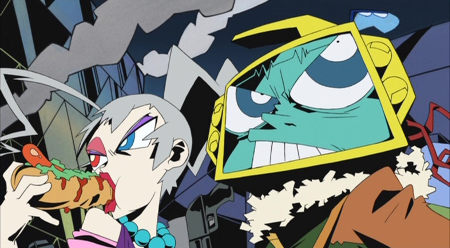
“A guy with a TV for a head and a girl with a panda-like mark on her face find themselves naked on Earth with no recollection of how they got there. After attempting to violently acquire food and clothes, they get arrested and sent to the Lunar prison Dead Leaves… and things get weirder from there.”–Dead Leaves synopsis from the listicle “15 Bizarre Anime That Make You Wonder ‘Wtf Did I Just Watch?’

DIRECTED BY: Hiroyuki Imaishi

FEATURING: Voices of Takako Honda, Kappei Yamaguchi; , Jason Lee (English dub)

PLOT: Pandy, a woman with mismatched eyes, and Retro, a man with a television for a head, awaken naked with no memories and immediately go on a crime spree. Quickly arrested, they are sent to Dead Leaves, a prison housed on what remained of the crumbling moon, where they have sex and then arrange a prison break. Pandy grows pregnant and comes to term in a day, and faces a giant caterpillar monster with the help of her precocious newborn son.

Still from Dead Leaves (2003)

BACKGROUND:

  • The directorial debut of Hiroyuki Imaishi, who had worked as an artist on many animes, including the TV version of “Neon Genesis Evangelion” and it’s bizarre theatrical incarnation.
  • Released as an OVA (original video animation, a common direct-to-video release strategy in Japan).
  • Dead Leaves was made with the American and European secondary markets in mind. The English dub was made contemporaneously with the Japanese version.

INDELIBLE IMAGE: Dead Leaves‘ images, while carefully painted, streak by almost too fast for the eye to register, leaving an impression of havoc rather than focusing on particular images. Since the main characters—especially monitor-faced Retro—appear most often, it’s their faces that stick most in the memory.

THREE WEIRD THINGS: TV-headed Retro-reprobate; penis drill; inexplicable psychedelic caterpillar

WHAT MAKES IT WEIRD: Dead Leaves moves so fast and makes so little sense that it’s the equivalent of putting an ultraviolent manga in a high-speed blender and trying to read it while the pieces swirl around. The plot is nearly incomprehensible, but somehow involves mutant clones and a psychedelic caterpillar. Weird? Hell yes. Recommended? Well, definitely not to epileptics. Even for older folks with a healthy neurobiology, the breakneck pacing is as likely to induce a headache as an adrenaline rush. It’s definitely one-of-a-kind, though, and as an experiment in compressing as much berserk and illogical anime flavor as possible into as short a running time as possible, it’s worth a look.


Short clip from Dead Leaves

COMMENTS: Although the director advised the audience at Dead Continue reading 285. DEAD LEAVES (2003) →