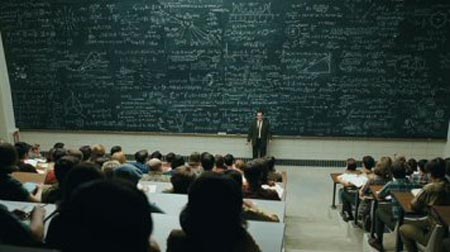
The music video is the one form where directors can be weird and experimental without fear of being shunned by the world at large. Made for the band N.A.S.A.’s album “The Spirit of Apollo,” where the concept was to pair unlikely musicians, “Spacious Thoughts” mixes the smooth rap of Kool Keith with the grumblings of ever-weird Tom Waits. Director Fluorescent Hill animates Keith as a black sphere wearing cowboy boots who breathes out Tom as an angry cloud.
Tag Archives: 2009
CAPSULE: THIRST [BAKJWI] (2009)
DIRECTED BY: Chan-wook Park
FEATURING: Kang-ho Song, Ok-vin Kim, Hae-sook Kim
PLOT: A priest becomes a vampire after he receives a blood transfusion during an experimental treatment to find a cure for a deadly virus; after his transformation he becomes erotically obsessed with a young woman who lives as a virtual slave to the family that adopted her.
![Thirst [Bakwjwi] (2009) Still from Thirst [Bakwjwi] (2009)](https://i0.wp.com/366weirdmovies.com/wp-content/uploads/2009/12/thirst.jpg?resize=450%2C193)
WHY IT WON’T MAKE THE LIST: All of Park’s films at least flirt with weirdness, and Thirst is no exception. In a way, however, this vampire drama is the Korean fantasist’s most conventional effort. Aside from a disorienting dream sequence intercut into a bout of lovemaking, Park adds only a few short surrealistic bursts here and there, instead sticking surprisingly close to the vampire formula.
COMMENTS: Like all Chan-wook Park films, Thirst is technically excellent: the cinematography, musical accents, and nuanced performances are all top-notch. The plot, while rambling and overlong, ties up loose ends neatly by the end. Many of the individual scenes are nearly perfect, too; the long and violent sequence where a furious Sang-hyeon forcibly converts Tae-joo into a vampire in front of her paralyzed adoptive mother is intense and beyond criticism. Hae-sook Kim’s Lady Ra has a particularly excellent turn that catches fire once her character becomes nearly comatose, and Song and Kim’s love scenes sizzle with guilt-ridden eroticism. Park even scales back the distracting, heavily stylized directorial flourishes (such as the dotted line coming off the hammer in Oldboy) that seem to pop up in his every effort just because the director thinks they look cool; the imagery in Thrist flows naturally, like uncoagulated blood.
With all of the above going for it, what I found most shocking about Thirst is how little spark or originality it emanates. We’ve seen the tragic reluctant vampire since 1936’s Dracula’s Daughter, and thirst for blood has always been a metaphor for lust (in the 1970s exploitation filmmakers became quite explicit with the theme in flicks like Lust for a Vampire and Vampyres). There’s no real spin on the vampire legend to be found here. A few traditional nemeses—garlic and crucifixes—have been jettisoned, but the vampire’s psychological essence—predation and isolation—remains intact. Making the bloodsucking protagonist a priest, while adding the superficial appearance of depth, doesn’t pay off in any profound poetic or philosophical way. If there’s a spiritual dilemma to be found here, it’s of the mostobvious sort, as the fallen Father struggles to reconcile his vow to serve his suffering flock with his need to drink their blood and avoid sunlight.
The film’s supposed organizing principle, the vampiric curse, gives way to a noirish supernatural love triangle; as it turns out, it’s that old snake in the garden, sex, that’s the root of all evil, not nocturnal bloodsucking. The shift from the struggle to create a personal system of ethical vampirism to a story about falling for a femme fatale means film looses its thematic focus, if not its drama, about halfway through. Thirst is well worth the watch, but frankly, it left me thirsty for more.
WHAT THE CRITICS SAY:
BORDERLINE WEIRD: A SERIOUS MAN (2009)
NOTE: A Serious Man has been promoted from the “Borderline” category onto the List of the Weirdest movies of all time! This page is left up for archival purposes. Please view the full review for comments and expanded coverage!

DIRECTED BY: Ethan Coen, Joel Coen
FEATURING: Michael Stubargh, Richard Kind, Fred Melamed, Fyvush Finkel
PLOT: A putzy Jewish physics professor suffers from an escalating series of problems

including a failing marriage, bratty kids, students willing to do anything for a passing grade, financial troubles, and a ne’er-do-well, mildly insane brother.
WHY IT’S ON THE BORDERLINE: While the early leader for Weirdest Movie of 2009, A Serious Man won’t be eligible to be officially added to the List of the 366 Best Weird Movies of All Time until it receives its DVD release and the film can be pored over meticulously by our team of critics. Okay, to be honest, the home video release requirement is a way to buy time, while I let the Coens’ latest ferment in the back cellar of my consciousness. The conundrum is that, superficially, this movie is not that weird; there are a few dream sequences and nonsense parables, but unlike the Coens definitely weird Barton Fink, this story of a suburban Jewish man beset by an improbably mounting set of real life woes contains no surrealistic fireworks (although there is a conspicuous surrealistic pillow). On the other hand, this movie has a skeletal undercurrent of ambiguity and disturbance running through it like a bone cancer; it feels weird at its core. Also, the way it’s currently unsettling and outraging square moviegoers points to a powerfully different movie.
COMMENTS: A Serious Man is a retelling of that most fascinating parable in the Old Testament, the Book of Job, as a postmodern absurdist comedy. The ancient Job was a good and prosperous man; God allowed Satan to test his faith by wiping out his flocks, killing his children, and smiting him with boils. The beleaguered Job, bothered by visits from three unhelpful friends who try to console him with off-base theological speculations, eventually despairs, but never doubts God’s existence or goodness. His only plea is to understand his misfortune, to be able to ask God directly, “Why me?” God, appearing in a whirlwind, bitchslaps Job for his audacity: “who are you to question me, the Author of the Universe? It’s your job to obey and suffer in silence.” (I’m paraphrasing here). After this reproof, God restores Job’s riches and lets him have new Continue reading BORDERLINE WEIRD: A SERIOUS MAN (2009)
CAPSULE: COLD SOULS (2009)
DIRECTED BY: Sophie Barthes
FEATURING: Paul Giamatti, Dina Korzun, David Strathairn
PLOT: Paul Giamatti (playing himself) feels burdened by his soul, so he utilizes the services of a company that specializes in soul removal and storage; when he decides to reclaim it from its safe deposit box, he finds there’s a problem…

WHY IT WON’T MAKE THE LIST: Cold Souls is an excellent little movie, but it pitches its tent a few yards outside the boundaries of Weird City. It posits its impossible philosophic premise as a scientific fact, and develops a strangely believable set of consequences from it. It’s magical realism that’s heavy on the realism but light on the magic; a perfectly reasonable artistic choice, and one that works well here, but a choice that should prevent it from making the List. A brief peek inside the (rather blurry) corridors of Giamatti’s soul isn’t enough to smuggle it across the weird border.
COMMENTS: Cold Souls has three things going for it: an intriguing concept, a great sense of humor, and Paul Giamatti. Writer/director Barthes doesn’t have anything new or profound to say about the human soul—her theme is limited to the idea that it has something to do with suffering, and the fact that we’re less human if we lose it—but what new or profound is likely to be said about the nebulous, millennia old concept of soul? Instead, she wisely focuses on creating an elaborate medical mythology of the soulectomy, and builds a fascinating plot by exploring those soul mechanics. We get such concepts as soul residues, the black market soul trade (dominated by those masters of soul, the Russians, natch), and soul mules, people who implant the souls of others inside themselves to smuggle them across international borders. The jokes arise naturally from the set of rules Barthes devises: human essences manifest themselves physically in a variety of shapes, including jellybeans and chickpeas, sometimes to their owners’ dismay. It’s gratifying to find laugh-out-loud funny lines in this film, since the intellectual concept could easily have limited the humor to being merely sly, witty, and clever.
Deadpan David Strathairn, as a satirically practical plastic surgeon of the psyche, sets up some of the best gags, such as the idea that removed souls can be warehoused in New Jersey to save on state sales tax. But most of the humor and pathos come from the performance of Giamatti, who plays both a soulful and a soulless role; he’s funny when troubled, and troubling once his cares are removed. Giamatti puts his own twist on the smart, neurotic Woody Allen type, but conveys plenty of genuine existential melancholy as well. As an actor playing an actor (his painful emotional over-involvement in playing the title role in Chekhov’s “Uncle Vanya” sets the plot in motion), he truly tests his range. It’s quite a challenge for a polished actor to portray a bad thespian, and Giamatti gets to showcase two failed Vanyas: one that’s subtly off because he’s too depressed, and one that is a complete, farcical burlesque. With the range he shows here, Giamatti merits Oscar notice. On the negative side, one could criticize the flat ending, which is not ambiguous so much as inconclusive, and the fact that the obvious similarities to Being John Malkovich tempt unflattering comparisons. Cold Souls is still a rewarding watch, a smart movie that avoids pretension and delivers solid chuckles.
Eric Young‘s alternate take: it should be borderline weird, at least: Cold Souls is a weird movie in the same way that Southland Tales is weird, except that it’s not horrible. It has that paranoid misgiving about the future that begs to be analyzed like a cinematic psychological disorder. There’s something definitely weird about the world that surrounds Paul Giamatti here: it’s foreign, it’s vaguely (and at times obviously) threatening, and it fuels a very strong, underlying neurosis in Paul. Sophie Barthes’ odd cinematic landscape was not the best place for him to go and get something as emotionally and philosophically ponderous as a soul removal, I believe.
Cold Souls is one of the weirder films I’ve seen in 2009, a year soundly devoid of anything resembling true weirdness a la David Lynch (or Crispin Glover, if you’re feeling frisky). It seems the indie circuit has taken the ideas brought forth by the cinematic pioneers of oddities from yesteryear and used them to fit their own kitschy agenda. This new breed write bizarre movies without really bringing much attention to the deformed elephant they’ve written into the room: see Growing Out, as well as flicks like Nicole Kidman‘s Fur and, to a lesser extent, Wristcutters. Their efforts have been of dubious quality, for the most part, as most indie directors are a little too insistent on navel gazing to examine the strangeness in their midst, but Cold Souls has something different about it. It’s a well-made movie with a star in his prime that has its priorities lined up, and while existential ponderings by resident schlub Giamatti are priority numero uno, introducing us to the fascinatingly bizarre world of illegal Russian soul trafficking and all the unusual characters involved is pretty high on the list, much to the delight of anyone who’s willing to try something different and new.
WHAT THE CRITICS SAY:
CAPSULE: GROWING OUT (2009)
DIRECTED BY: Graham Ratliff
FEATURING: Devon Lott, Ryan Sterling, Michael Hampton
PLOT: An aimless musician gets a job cleaning up an old William Castle-style spooky mansion. In the basement he finds a hand emerging out of the floor, and the longer he works there, the more he watches the mysterious person appear from below…

WHY IT WON’T MAKE THE LIST: Normally, I’d be hard-pressed to tell you why a man slowly rising out of the sandy floor of a scary old basement isn’t weird, but if we’re going to count down the WEIRDEST movies of all time, this really doesn’t scratch the surface. It’s a guy-meets-girl movie with a few Lynchian twists thrown in, and that’s really not enough to hang with the big boys, now is it?
COMMENTS: Perhaps a penetrating metaphor for the encroaching distance that separates our true selves from our public personas, or perhaps a cheap, quick flick about freaky shenanigans in a creaky old house, Growing Out is a movie that tries to reach out and grab a very particular audience, specifically the indie horror crowd, and it does this with a gusto that is atypical of independent features like this. And, for what it is, it’s indeed enjoyable. It’s quite thrilling to see a young director and cast just go for it—even though the results aren’t all that spectacular, their enthusiasm is in itself kind of spectacular. The film looks good, the actors—in particular, the peripheral characters—are a lot of fun to keep track of, and the scenario is rife with possibilities. The problem it faces as a weird movie, though, is that it places a lot of limiters on itself. It wants to be a relationship movie so badly, with the usual current-jerk-boyfriend-in-the-way-of-the-aspiring-sensitive-boyfriend scenario, that it forgets the oddities it sets up in favor of meet-cutes and lonesome emotional guitar playing scenes. It’s not conducive to what they seemingly wanted to do with this kitschy film full of hipper-than-thou hopefuls. What about the guy growing out of the ground? What about the freaky house? And how about the strange man that lives in a trailer in the back yard? These factors seem unimportant compared to how our troubled troubadour is going to wind up with the girl of his dreams, and while I for one was interested to a point, it left me at the end feeling slightly disappointed and expecting a slightly more charming, slightly smarter, slightly weirder movie that just didn’t come. If you want well-paced and well-shot on a shoestring budget, this is a good bet, but this isn’t what you’re thinking of when you’re thinking of a bizarre film.
WHAT THE CRITICS SAY: