Tag Archives: 2009

CAPSULE: DRAG ME TO HELL (2009)

366 Weird Movies may earn commissions from purchases made through product links.

Recommended

DIRECTED BY:  Sam Raimi

FEATURING: , Lorna Raver

PLOT: Seeking a promotion, a cute and kind-hearted loan officer decides to get tough with the wrong customer, denying a mortgage extension to an elderly gypsy woman who curses her with a demon that will torment her for three days before dragging her to hell.

Drag Me to Hell (2009) still

WHY IT WON’T MAKE THE LIST:  Because too much weirdness would have jeopardized Sam’s chance to direct the next Spiderman installment.

COMMENTS: On the surface, Drag Me to Hell‘s blend of spurting body fluids, horror, and absurd slapstick bring to mind director Sam Raimi’s celebrated The Evil Dead 2. Drag Me, however, isn’t nearly as anarchic or over-the-top with its carnage; and more importantly, it lacks the cabin-fever dream feel of Raimi’s weird wonderwork, substituting a standard ticking-clock suspense trope. Rather than being comically unhinged, Drag Me to Hell instead feels tightly controlled, at times even micromanaged: a PG-13 Evil Dead for the cineplexes. Not that that’s entirely a bad thing: the movie is exactly what it’s intended to be, a spook-house carnival ride with abundant jump scares and grossout scenes to thrill the teenyboppers, along with plenty of black humor homages offered as a sop to fans of 1980s drive-in horror/comedy classics (such as the eyeball-related callback to Evil Dead II, and the gleefully excessive catfight between a hottie and grannie using office supplies as weapons).  The diabolic plot is reminiscent of ‘s 1957 classic Night of the Demon, retooled to focus on action and effects instead of oppressive ambiance. Simultaneously satisfying the longing for classic Gothic atmosphere, the high spectacle quota demanded of blockbusters, and the nostalgia of longtime Raimi fans for those abandoned hip horror trips, Drag Me to Hell is a well-constructed, well-placed and welcome addition to Hollywood’s summer lineup.

Although it’s an entertaining movie, the enormously positive critical and audience reaction probably relates more to the relative crapiness of Hollywood’s recent efforts in the horror genre than to the inherent quality of this film. After reviewing a seemingly endless parade of gory slaughterfest “reboots” of Halloween, Dawn of the Dead, Friday the 13th, ad nauseum, critics are eager to encourage an original supernatural script that doesn’t cynically depend on a massive bloody body count for effect. Audiences whose taste in old-fashioned spooky stories have been ignored in recent years are just thrilled to see anything arcane on the big screen.

WHAT THE CRITICS SAY:

“…Raimi temporarily shrugs off the A-list status the Spider-Man movies earned him and returns to his disrespectable Evil Dead ways. The blood and guts may have been tamped way, way down, but the manic intensity and delirious mayhem of those earlier zombie romps remain intact.”–Rene Rodriguez, Miami Herald

OSCAR WON’T, AND IF CANNES CAN’T, MAYBE MEXICO?

We almost never pay attention to the Academy Awards around these parts. When the weirdest film to get a “Best Picture” nomination in 2008 is The Curious Case of Benjamin Button, you know you’re dealing with one weird-hating Academy. The last film “Best Picture” winner with even smatterings of weird was Midnight Cowboy (1969). Just a pinch of weirdness, or even a mild, sub-weird flirtation with the experimental, is usually the kiss of death to Oscar.

The international and less commercial-minded Cannes Film Festival, on the other hand, has been much kinder to innovation in film. In 2000 Lars von Trier’s Dancer in the Dark managed to win the highest prize, the Palme d’Or, despite containing musical dream sequences.  Acknowledged weird classics like Wild at Heart (1990) and Barton Fink (1991) have also managed to break realism’s stranglehold on the top awards.

On May 24, 2009, Cannes announced the recipients of its jury prizes.  Let’s see how Cannes did in recognizing cinematic weirdness this year:

PALME D’OR:  The White Ribbon [Das weiße Band].  Black and white film set in Germany on the eve of World War I.  The synopsis says, “Strange accidents occur and gradually take on the character of a punishment ritual.  Who is behind it all?”  Although it appears to have a weird element in the form of an unsolvable mystery, at heart it looks like a standard allegorical art film.

GRAND PRIX (I.E., PALME D’OR RUNNER UP):  The Prophet [Un Prophete]:  An illiterate young Arab man is thrown into a French prison and becomes a gang kingpin.  Sounds about a weird as a plastic couple on a wedding cake.

JURY PRIZE (I.E., THIRD PLACE):  This year was a tie.  The first film recognized was Fish Tank, an unweird drama about a British teenager, her promiscuous mom, and her mom’s lout of a boyfriend.  The second awardee shows a little more promise: Thirst [Bakjwi], Chan-wook Park‘s take on the vampire legend, although reviews suggest the oft-weird director takes a conventional approach to the subject this time out.

OTHER FILMS IN COMPETITION:  A few interesting, potentially weird films were screened Continue reading OSCAR WON’T, AND IF CANNES CAN’T, MAYBE MEXICO? →

CAPSULE: WATCHMEN (2009)

Recommended

DIRECTED BY: Zach Snyder

FEATURING:, Jackie Earle Haley, Jeffery Dean Morgan

PLOT: As the film opens in an alternate past in 1985, Richard Nixon has been re-elected to a fifth presidential term as the Cold War rages on, costumed superheroes are integrated into the national security defense framework, the nuclear Doomsday Clock has ticked forward to five minutes to midnight, and ex-Watchman “the Comedian” has just been thrown through the window of his Manhattan high rise.

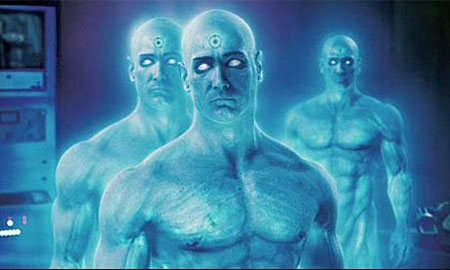
watchmen

WHY IT WON’T MAKE THE LIST:  Not weird enough.  Watchmen is about as weird as big-budget major studio releases will ever be allowed to get, which weirdness explains why Watchmen was released as a Spring rather than a Summer blockbuster.  All the oddness, however, resides in the scenario.  Once the rules of this alternate universe are laid out—superheroes are real, they have tawdry affairs and abuse their power in bursts of sociopathic violence—Watchmen goes about its business with strict action-movie realism.

COMMENTS: The brilliant montage over the opening credits is a distillation of “all-too-human” vignettes in which we see four decades of masked avengers interact on a fictionalized American history stage, to the strains of Bob Dylan’s “The Times They Are a Changin’.” A costumed moth-man is dragged off to an insane asylum, and a glowing blue man in a three piece suit shakes hands with a grateful JFK, and Andy Warhol paints pop portraits of caped crusaders. The opening captures what is good about Watchmen: the setting is so original that the film relocates you into its own peculiar universe, which is what escapist entertainment is supposed to do.  And this one has just enough of a veneer of philosophical and political depth (“who watches the Watchmen?”) to give adults an intellectual justification to sit back and enjoy a comic book on film.  The flawed superheroes are briefly sketched, but their slightly twisted archetypes capture our interest.  The noirish Rorschach has an inflexible vigilante code of justice and ever-shifting inkblot mask; atomic superman Dr. Manhattan deploys his colossal blue CGI penis as unashamedly as he does his godlike power to create special effects, all the while suffering existential detachment as his contemplation of quantum realities alienates him from human ones. The script weights the amount of time devoted to each of the intertwining stories and backstories well, supplying a rich context without becoming confusing.  The film’s nihilism ultimately appears as little more than a tonal choice, much like a decision to film in black and white instead of Technicolor. The setting is absorbing enough to make most overlook the films more than occasional gaffes, from the excessively visceral, bone-cracking and blood-spurting violence meant to deglamorize the heroes to a laughably glamorous moonlight lovemaking scene in a hovering owlcraft.

From the standpoint of someone who hasn’t read the beloved comic book graphic novel from which the movie was adapted, it’s amusing to observe Internet kvetching over the movie’s supposedly superhuman power to drain the source work of it’s magic.  Even reviews by professional critics often devolve into column-length comparisons of the literate merits of the original to the relatively pedestrian film version.   But, coming to the film not expecting it to have the intellectual depth and characterization of a novel, I found the movie Watchmen to be an excellent advertisement for the source material.

WHAT THE CRITICS SAY:

“‘Watchmen’ is… going to be the ultimate tough sell: there will be those who view the film as a bewildering mishmash of underexplored themes, thinly sketched characters and noisy, excessive violence… And yet, there’s something admirable about the entire enterprise: its ungainly size, its unrelenting weirdness, its willful, challenging intensity.”–Tom Huddleston, Time Out London (contemporaneous)

CAPSULE: CORALINE (2009)

366 Weird Movies may earn commissions from purchases made through product links.

Recommended

DIRECTED BY: Henry Selick

FEATURING: Dakota Fanning (voice), Teri Hatcher (voice)

PLOT:  A petulant little girl finds a parallel universe behind a hidden door in an old house, a world where her parents are more attentive, her neighbors more fascinating, and the entire universe seems set up to pamper and delight her; she can stay there forever, but of course there’s a catch.

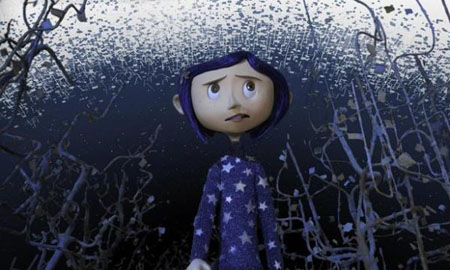
Still from Coraline (2009)

WHY IT WON’T MAKE THE LIST:  I attended a screening with a ten-year old and asked him if he thought the movie was “weird.”  His answer: “Nah, not unless you think every fantasy movie is weird.”  Smart lad.

COMMENTS:  Coraline is a welcome dark fantasy for children, although its themes of evil Doppelgänger moms, frightening buttons, and implied eye-gouging are too scary for very little ones.  Since it’s from Hanry Selick, the director of the borderline weird Nightmare Before Christmas, we suspect going in that the art direction and stop-motion animation will be the real stars.   Selick does not disappoint, shuffling the viewer through three distinct visual styles: the dingy earth tones of real life, a brightly colored, eye-popping fantasy world, and a sinister, disintegrating universe with an insect trapped in a spiderweb theme.  The storyline, and the unexpected scares once the movie shifts from childhood fantasy to childhood horror in the third act, make Coraline more than just eye candy for the kiddies.

Presented in theaters in 3-D, but the novelty doesn’t add anything significant to experience: I would have been just as happy to watch the same moving pictures tell the same story on an unabashedly flat screen.  Though there’s nothing really weird to be found here, Coraline, in the best children’s’ movie tradition, is worth a trip even for adult fans of fantasy and pure escapism.

WHAT THE CRITICS SAY:

“Coraline discovers a Wonderland filled with surreal characters and dark implications that make a kid grow up quick… those who tough it out with this twisted, trippy adventure in impure imagination will only be the better for it.”–Peter Travers, Rolling Stone