Tag Archives: 2003

CAPSULE: 11:14 (2003)

DIRECTED BY: Greg Marcks

FEATURING: , Hilary Swank, , Ben Foster, Colin Hanks, Henry Thomas

PLOT: A ragtag assortment of small-town misfits shuffle through an eventful night: we follow the small cast through their stories, which all intertwine at the fateful minute of 11:14PM. Someone will die, someone will get arrested, someone will get in a fight, several people will have vehicular damage, and absolutely everybody will panic.

Promotional image from 11:14 (2003)

WHY IT WON’T MAKE THE LIST: It’s a great, dark comedy thriller that quaffs a heroic shot of with a chaser of ’ comedy. But it’s not even remotely weird. As a Public Service Announcement, PLEASE stop cramming the reader suggestion box with every random movie you can name just because you like it. This is the WEIRD (Adj.: “very strange, bizarre”) movie site.

COMMENTS: The movie opens with bouncy alternative rock and an animation of the credits driving around on a grid of streets. Yes, you guessed correctly, this is an Indie Flick. Eighty-six minutes later, it proves to be one of those gems that are the whole reason you hang out at film festivals. 11:14 is so clever, it’s almost a fault, like the one kid too smart for his own good that can’t resist showing off, so much that the rest of the class strains for a chance to knock him down a notch. The story intertwines five mini-stories in a small town in Anywhere, America, all of which intersect at 11:14 P.M. on what would have been an uneventful night if everybody had stayed home. It also does that Tarantino thing where it shows the events out of order so we can see how all the parts of the evening fit together. Ready? No you’re not.

In this busy town full of busy people, we meet #1: Jack (Henry Thomas) is a drunk driver who sails under an overpass and gets into an accident; #2: Tim (Stark Sands), Mark (Colin Hanks) and Eddie (Ben Foster), teenage waste-aways who are driving around bored when Eddie injures himself during a completely different accident; #3: Frank (Patrick Swayze), walking his dog and finding car keys belonging to his daughter, Cheri (Rachael Leigh Cook), implicating her in a crime he wants to clear her for; #4: Duffy (Shawn Hatosy) who thinks he has gotten Sheri pregnant and needs money for an abortion, so he goes to his friend Buzzy (Hilary Swank), who works at a convenience store, for help; and #5: Cheri, who is in the cemetery having sex with her boyfriend Aaron when yet another freak accident happens. “Middleton: A happy place to live!” Most of all, this is a movie about people under pressure making hasty decisions.

As you can see, this movie is set up to make life hell for movie re-cappers. How does all this come off? Everybody has a Wile E. Coyote scheme that backfires, and furthermore random events by coincidence steer all of their fates no matter how they try to wriggle out of them. Nobody in this movie is particularly stupid, it’s just that they’re C-average ordinary people who find themselves at crisis points. The dialog is funny, the characters are well-cast, the soundtrack rocks, the plot construction is dizzying, and of course the movie has to keep starting over again to show time from different characters’ points of view as all their drama intersects in an untidy heap at the fateful minute. It’s dark, funny, thrilling, and tickling. It demands multiple viewings so you can retrace the plot intersections and try to spot the exact minute writer-director Greg Marcks is stuffing all the rabbits and doves into his hat. The show-off.

WHAT THE CRITICS SAY:

“…Marcks does a number of things quite well. He establishes a difficult tone — part dramatic, part comic, part absurdist — and he maintains it throughout.”–Mick La Salle, San Francisco Chronicle (contemporaneous)

(This  movie was nominated for review by “Nick,” who described it as “definitely untypical.” Suggest a weird movie of your own here).
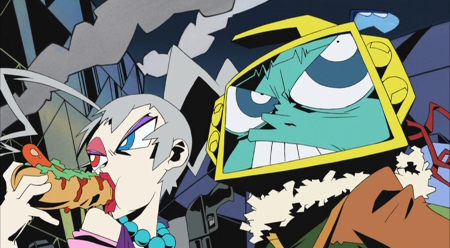
285. DEAD LEAVES (2003)

“A guy with a TV for a head and a girl with a panda-like mark on her face find themselves naked on Earth with no recollection of how they got there. After attempting to violently acquire food and clothes, they get arrested and sent to the Lunar prison Dead Leaves… and things get weirder from there.”–Dead Leaves synopsis from the listicle “15 Bizarre Anime That Make You Wonder ‘Wtf Did I Just Watch?’

DIRECTED BY: Hiroyuki Imaishi

FEATURING: Voices of Takako Honda, Kappei Yamaguchi; , Jason Lee (English dub)

PLOT: Pandy, a woman with mismatched eyes, and Retro, a man with a television for a head, awaken naked with no memories and immediately go on a crime spree. Quickly arrested, they are sent to Dead Leaves, a prison housed on what remained of the crumbling moon, where they have sex and then arrange a prison break. Pandy grows pregnant and comes to term in a day, and faces a giant caterpillar monster with the help of her precocious newborn son.

Still from Dead Leaves (2003)

BACKGROUND:

  • The directorial debut of Hiroyuki Imaishi, who had worked as an artist on many animes, including the TV version of “Neon Genesis Evangelion” and it’s bizarre theatrical incarnation.
  • Released as an OVA (original video animation, a common direct-to-video release strategy in Japan).
  • Dead Leaves was made with the American and European secondary markets in mind. The English dub was made contemporaneously with the Japanese version.

INDELIBLE IMAGE: Dead Leaves‘ images, while carefully painted, streak by almost too fast for the eye to register, leaving an impression of havoc rather than focusing on particular images. Since the main characters—especially monitor-faced Retro—appear most often, it’s their faces that stick most in the memory.

THREE WEIRD THINGS: TV-headed Retro-reprobate; penis drill; inexplicable psychedelic caterpillar

WHAT MAKES IT WEIRD: Dead Leaves moves so fast and makes so little sense that it’s the equivalent of putting an ultraviolent manga in a high-speed blender and trying to read it while the pieces swirl around. The plot is nearly incomprehensible, but somehow involves mutant clones and a psychedelic caterpillar. Weird? Hell yes. Recommended? Well, definitely not to epileptics. Even for older folks with a healthy neurobiology, the breakneck pacing is as likely to induce a headache as an adrenaline rush. It’s definitely one-of-a-kind, though, and as an experiment in compressing as much berserk and illogical anime flavor as possible into as short a running time as possible, it’s worth a look.


Short clip from Dead Leaves

COMMENTS: Although the director advised the audience at Dead Continue reading 285. DEAD LEAVES (2003)

CAPSULE: THE SHAPE OF THINGS (2003)

366 Weird Movies may earn commissions from purchases made through product links.

DIRECTED BY: Neil LaBute

FEATURING: , , , Frederick Weller

PLOT: A nerdy security guard falls for an anarchic art student; she encourages him to change his appearance and dress, increasing his self-confidence—but is she really good for him?

Still from The Shape of Things (2003)

WHY IT WON’T MAKE THE LIST: Neil LaBute’s pitch black adaptation of his own play falls into the category of “outside-the-box indie drama” rather than “weird.”

COMMENTS: On the surface, The Shape of Things appears to be about the lengths someone will go to change themselves to gain someone else’s approval. Evelyn transforms Adam from schlub to stud, but the changes to his body inevitably effect his mentality. But although the erotically-motivated malleability of the less confident romantic partner is one of the work’s themes, Shape reveals a different, more controversial, focus in the third act. The ending twist is easy to guess, particularly to anyone who has seen LaBute’s debut film (the venomous dissection of masculine manipulation In the Company of Men). But I was willing to forgive the obviousness, because I think that LaBute’s fundamental point—an attack on attitudes and platitudes prevalent in the postmodern art scene (Evelyn, the film’s antagonist, is the kind of artist who believes in spray painting classical sculptures as a “statement”)—needed to be said.

The Shape of Things‘s origins as a stage play are obvious—each transition might as well be preceded by intertitles of the format “Act 2, Scene 3”—but that’s not necessarily a bad thing. What it really means that this is an actor’s and writer’s movie; everything is built around dialogue, which is often very sharp, with only a couple of set changes. Each of the four characters gets at least one big scene with the other three: Adam and Evelyn, obviously, spend the most time together, but the male lead must also defend himself from a “you’ve changed, man” speech from bro Phillip and navigate a moment of awkwardness with his best friend’s girl, while Evelyn gets to argue with douchey Phillip about the nature of art and to confront Jenny about her supposed attraction to the new and improved Adam. The fact that each of the actors had played these characters on stage for a year beforehand inevitably helps their chemistry—the characters are a artificial, written as types to support a thesis, but the young foursome does everything possible to make them feel like real people.

LaBute is often accused of being misanthropic (or even misogynistic), but, like all satirists, he’s actually humanistic. It shocks me that so many critics and viewers come to the exact opposite conclusion—I guess they conclude that no writer could pen scenes of emotional sadism so convincingly without being a psychopath themselves. It seems obvious to me that LaBute shows us extreme cruelty not to titillate us, but to arouse our disgust—to encourage us to try to be better people. And, to encourage his peers to become better, more morally focused artists.

WHAT THE CRITICS SAY:

“This version of Neil LaBute’s ongoing project is crisp and aggressive, occasionally alienating or annoying, that is, effectively unlike other movies.”–Cynthia Fuchs, Pop Matters (contemporaneous)

(This movie was nominated for review by “noa.” Suggest a weird movie of your own here.)

CAPSULE: LAST LIFE IN THE UNIVERSE (2003)

Ruang rak noi nid mahasan

Recommended

DIRECTED BY: Pen-Ek Ratanaruang

FEATURING: , Sinitta Boonyasak, Laila Boonyasak

PLOT: Suicidal expatriate librarian Kenji witnesses a fatal automobile accident while contemplating jumping off a Bangkok bridge, and falls for Noi, the victim’s sister.

Still from Last Life in the Universe (2003)\

WHY IT WON’T MAKE THE LIST: Last Life in the Universe is a quality romantic drama with a strong “indie” flavor to it, but the few liberties it takes with reality aren’t quite enough to tip it into the “weirdest of all time” category.

COMMENTS: Suicide attempts, pot-smoking hallucinations, abusive boyfriends, yakuiza revenge killings: Pen-Ek Ratanaurang slips a surprising amount of plot into a languid movie that’s essentially about two mismatched people lying around talking and occasionally cleaning the house. It also has enough fantasy sequences (which are sometimes difficult to distinguish from reality) that you may become confused once or twice as to whether events really occurred (I confess that I thought one of the major plot twists was a dream up until the end of the movie). Asano and Boonyasak make for an appealingly melancholy couple, each of them mired in their own particular tragedy. The Japanese librarian is an obsessive neatnik, while the Thai local is a pothead slob, but the movie makes the barrier to these two consummating their attraction feel like it runs deeper than superficial traits; their private sadnesses seem unbridgeable.

As a whole, Last Life‘s story is denser than the minimalist individual scenes might suggest; it’s a movie with good replay value. Try to catch things that you missed on a first pass. Look for lizards everywhere, and a nod to That Obscure Object of Desire. You’ll also learn about Bangkok bars where the hostesses dress like schoolgirls wearing bunny ears, and how to get bloodstains out of your Escher print. And you can make up your own mind about the ambiguous ending. If nothing else, Ratanaruang goes down easier than fellow sleepyThai ‘s work: it’s not as weird, but a lot more happens.

Last Life was lensed by cinematographer nonpareil ; according to an interview with Ratanaruang included on the DVD, the chance to work with Doyle was one of the main inspirations for the movie, and the DP seems to have had an unusually large role in the finished project. Last Life is also notable for a rare acting cameo by director , who does well as a yakuza boss. Miike, of course, directed Last Life star Asano in Ichi the Killer. If you’re looking for a truly international film production, you can’t get much more cosmopolitan than this: a Thai setting and director, a Japanese star, an Australian cinematographer known for his work in Hong Kong, and the whole thing was partially funded with French and American money. They even speak three languages in the movie: Thai, Japanese, and English (although Asano and Boonyasak’s English accents sometimes made me anxious to return to the subtitles).

WHAT THE CRITICS SAY:

“The closest thing to entering a dream state at the movies right now is watching ‘Last Life in the Universe’…”–Charles Taylor, Salon (contemporaneous)

(This movie was nominated for review by “CoinLocker.” Suggest a weird movie of your own here.)