225. ADAPTATION. (2002)

CHARLIE KAUFMAN: I’ve written myself into my screenplay.

DONALD KAUFMAN: That’s kind of weird, huh?

—Adaptation.

Must See

DIRECTED BY:

FEATURING: , , Chris Cooper, Brian Cox

PLOT: Screenwriter , fresh off the hit Being John Malkovich, is contractually and mentally trapped as he is forced to plow his way through an impossible project: “writing a movie about flowers.” Things go from bleak to bizarre as he finds himself competing with his endearingly oblivious twin brother, Donald, who also aspires to be a screenwriter. Charlie slips further and further past the deadline, until things come to a head in the film’s swampy denouement where he comes face-to-face with both the writer of and titular character from “The Orchid Thief,” the book he is adapting for the screen.

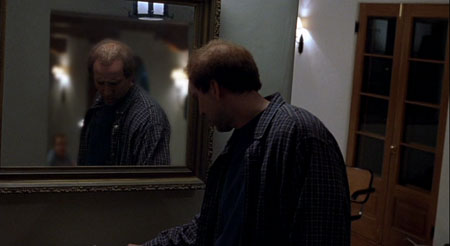
Still from Adaptation. (2002)

BACKGROUND:

  • The screenplay for Adaptation. was on Charlie Kaufman’s to-do list since the late ’90s. Tasked with adapting Susan Orlean’s novel-length essay “The Orchid Thief” and suffering the same problems as his doppelganger, he kept his progress secret from everyone other than Spike Jonze until 2000, when the movie was green-lit for production.
  • Screenwriting guru Robert McKee and his seminars are real. He personally suggested Brian Cox play him in the movie.
  • Adaptation. handily recouped the producers’ investment, with a return of $32.8 million worldwide on a $19 million outlay.
  • Nominated for four Oscars: best actor for Cage, supporting actor for Cooper, supporting actress for Streep, and adapted screenplay for Charlie and Donald Kaufman. Cooper was the only winner.
  • Though “Donald” Kaufman’s serial killer script The 3 was never shot, the idea may have inspired two subsequent movies, 2003’s Identity and 2006’s Thr3e.

INDELIBLE IMAGE: Returning from a misfired date, Charlie finds his twin brother already back home from a writer’s seminar, brimming over with newly adopted wisdom. As Charlie stands in front of his hallway mirror, Donald’s face is captured in the reflection as he expounds upon his own screenplay’s “image system” involving broken mirrors. Charlie’s expression goes from dour to disbelieving at this inanity, and the viewer sees the movie mock both itself and screenplay tricks. A further twist is added by the fact that the blurry reflection in the mirror is the face of the actual Charlie Kaufman talking to Nicolas Cage.

THREE WEIRD THINGS: Film-within-a-film-within-a-screenplay-within-a-screenplay ; Ouroboros; orchid-snorting

WHAT MAKES IT WEIRD: For all its unconventionality, Adaptation is amazingly self-deprecating. Spoilers unravel in opening scenes and are tossed aside, coastal city elites are presented as real people with the petty little problems real people have, and Nicolas Cage gains a bit of weight and loses a bit of hair to provide the compelling double performance as the Kaufman brothers. Events seem scattershot, only to have their purposes later clarified as the tightly structured flow keeps the viewer jumping from moment to moment, always questioning which parts of this convoluted tale are actually true.

COMMENTS: Between its thorough description of the protagonist Continue reading 225. ADAPTATION. (2002) →

CAPSULE: LOVE ME IF YOU DARE (2003)

Recommended

DIRECTED BY: Yann Samuell

FEATURING:  Guillaume Canet, , Thibault Verhaeghe, Joséphine Lebas-Joly

PLOT: A boy and girl carry on their childhood contest of dares into adulthood, when the game escalates into life-wrecking catastrophes.

Still from Love Me If You Dare (2003)

WHY IT WON’T MAKE THE LIST: It’s not weird enough to make the List, although it is offbeat enough to earn a mild recommendation—especially as non-treacly alt-Valentine’s Day viewing.

COMMENTS: When Love Me If You Dare came out in 2003, most critics pegged it as a flawed and unpleasant attempt to cash in on Le Fabuleux Destin d’Amélie Poulain‘s international success. With distance, Love Me If You Dare doesn’t seem derivative so much as part of an ongoing tradition of whimsical French romantic fantasies. Writer/director Yann Samuell’s twist on the formula is to cut the sweetness, not with the usual melancholy bitter, but with sharper flavors of black comedy that many found too pungent. While is indeed the main stylistic touchstone here—both the French and American distributors were clearly hoping Marion Cotillard would melt international hearts the way had two years earlier—Dare both recalls and anticipates other Gallic romances, while forging its own path. The mix of brightly colored childhood nostalgia and salty adult sensibilities is indebted to , the unsung père of modern French whimsy. Some fantasy sequences play out on cutified versions of Georges Méliès sets—as  when young Julien goes sailing through a sky of cardboard cutout clouds, or the children find themselves as Adam and Eve with a prop apple serving as their lapsiarian music box—while anticipating the crafty handmade worlds of .

The Amélie comparisons were more of a marketing ploy than an accurate aesthetic description, but many reviewers took them to heart. Samuell’s movie got hit from both sides, simultaneously criticized for being too derivative of the hit fantasy, and for failing to warm hearts the way the previous film had. Critics who hated the film because the two main characters were too cruel failed to give credence to the underlying metaphor—that passion often involves an undercurrent of childish competition—but there is psychological merit in the notion. The increasing stakes of the dares—which move from mere humiliations (like wearing your underwear outside your clothes) to acute psychological cruelty to actual physical peril—take the movie into War of the Roses territory. They provide danger and give us a reason to keep watching, rather than the limp “will they or won’t they?” formalities of typical romantic comedies. Yet, for all the sadism inherent in their bantering, there is no doubt Julien and Sophie share a real bond, a hybrid of all-consuming love and hate that is, in a way, admirable for its purity and fidelity. They may not be a likable couple, but they are strangely believable one. Samuell’s script and direction are very impressive for a debut, and the acting by the four principals (young Julien and Sophie are portrayed by cute and expressive couple of kids) is above standard. Marion Cotillard may have been no Audrey Tautou when it came to launching a million crushes, but she ultimately proved the more versatile actress.

One negative note, though: sad to say, you will be sick to death of “La Vie en Rose” before the final credits roll.

WHAT THE CRITICS SAY:

“The dreamlike amber washes and comic visual asides stress the otherness of the pair’s reality, but seem to offer a limp excuse for their deluded exemption from empathy.”–Gianni Truzzi, Seattle Post-Intelligencer (contemporaneous)

[This movie was nominated for review by “tsross13,” who confessed “I realize this movie might not be weird enough (but the greatness of it, in my humble opinion, cancels that factor out)….” Suggest a weird movie of your own here.]

LIST CANDIDATE: STREET OF CROCODILES (1986)

DIRECTED BY: ,

FEATURING: Feliks Stawinsky

PLOT: After being brought to life by a spit-and-blood activated machine, a gaunt puppet explores a dreary landscape of smeared windowpanes, cryptic machines, and wraith-like tailors, simultaneously observing and observed by a young boy.

Still from Street of Crocodiles (1986)

WHY IT MIGHT MAKE THE LIST: Not content simply to be staggeringly creepy, the Quay brothers imbue this masterpiece of decayed memory with a great deal of pathos and philosophy. From any given screen-capture, it’s easy to see why this movie would be considered weird—watching this cloud of nightmare in motion is simultaneously unnerving, moving, and awe-inspiring.

COMMENTS: This stop-motion film opens with the unlikely use of a lecture hall and an actor counting ceiling lights before activating an apparatus. Drawing up a globule of spit, he lets the liquid drop inside the machine, setting off the first of the unsettling devices found throughout Street of Crocodiles. The film’s protagonist, a shabbily well-dressed man, begins bound by the wrist to a cord attached to a bell before the actor uses a pair of scissors installed in the converted kinetoscope. Once loosed from the ties that bind him, the suited puppet begins navigating his dark surroundings.

Like a reticent explorer, he warily observes machines, gated pathways, and windows to bizarre figures. Behind one is a barely humanoid figure that emits one of the few bright lights in the movie. Judged by his design and actions, this automaton seems to be an inventor of some sort, and he labors away. As the man continues to explore, his environment slowly starts dismantling itself. Screws come undone from the paneling and begin moving across the floor. A young boy, perhaps representing the man’s childhood, merrily travels around the dank cityscape, harnessing the inventor’s light with a pocket mirror, bringing objects to life with its beam. Things come to a muted crescendo when the man comes across a tailor’s shop along the dim street below a crocodile skeleton.

The Quay brothers capture so much in this tiny but unlimited world. The viewer sees things in frame, only to find a moment later that what he is seeing is a reflection (in some cases, a reflection of a reflection). The micro-cosmos created here is both stifling and vast, as if no matter how far the man may explore, he is still trapped, unable to break free and get a larger picture of the mystery around him. Eventually he discovers where his life went sideways after a literally transformative encounter with the tailors, the only entities who seem at home in this murky subconscious. Through them, we see the allure of a commercial world and the high price paid for succumbing to it.

Stephen and Timothy Quay interpret Bruno Schulz’s gritty memoir “Street of Crocodiles” with a combination of smeared perspective and macro-lensed attention to detail. Schulz’s source material is filtered through the Quay’s vision of pervasive but fungible memory. Much is explored during the scant 21-minute run-time, but its brevity is wholly counter-balanced by its depth, both literally and metaphorically. As the man’s world in the movie is folded uncomfortably on itself, Street of Crocodiles explores its subject matter with a compact precision that belies its length. After watching this, I felt that the twenty minutes may well have been hours. So goes time in the dream world. This film must be seen to be believed: my words are almost utterly incapable of parlaying the direct line the Quay brothers have with the subconscious world.

WHAT THE CRITICS SAY:

“… an ambient horror film in the vein of Eraserhead.”–Jake Cole, Movie Mezzanine

WEIRD HORIZON FOR THE WEEK OF 1/8/2016

Our weekly look at what’s weird in theaters, on hot-off-the-presses DVDs, and on more distant horizons…

Trailers of new release movies are generally available at the official site links.

NEW ON DVD:

Condemned (2015): A slumming rich girl squats with her boyfriend in a condemned building where a virus is turning the disreputable residents into hallucinating homicidal maniacs. Critics didn’t like it (it earned a pathetic 14 on the Metacritic meter) but the “w” word did pop up a couple of times in reader reviews. Buy Condemned.

“Man Seeking Woman: The Complete Season 1”: Critics repeatedly refer to this Jay Baruchel sitcom about a single man’s dating life as “surreal”: he goes on a date with an actual troll, attends a wedding in Hell, accidentally misplaces his penis, and so forth. The series survived a first season on deep cable’s FXX network and been renewed for a second. Buy “Man Seeking Woman: The Complete Season 1”.

Over Your Dead Body (2014): The prolific returns to straight horror for the first time in years for this tale of the production of a classic kabuki revenge drama, the adulterous backstage shenanigans of the cast, and the supernatural collision between the two. Released via Shout! Factory with no special features. Buy Over Your Dead Body. Buy Over Your Dead Body [Blu-ray].

NEW ON BLU-RAY:

Over Your Dead Body (2014): See description in DVD above. At this writing the Blu-ray is actually listed at $2 cheaper than the DVD (a trend we’ve been seeing more of as Blu works its way towards being the standard physical format). Buy Over Your Dead Body [Blu-ray].

Valentino (1977): A fantastical biopic covering the life of silent screen sex symbol Rudolph Valentino (played by dancer Rudolf Nuryev). One of ‘s least appreciated movies because, as Ken Hanke points out, “Russell fans greeted it somewhat tepidly, because it was much less experimental than his last three films... The rest of the world found it too experimental and over-the-top…” Buy Valentino (1977) [Blu-ray].

FREE (LEGITIMATE RELEASE) MOVIES ON SNAGFILMS:

The American Astronaut (2001): Read the Certified Weird entry! The first absurdist musical comedy space western, about the title character trying to hook up the Boy Who Actually Saw a Woman’s Breast with the Girl with a Vagina Made of Glass. I paid good money for a DVD of this film; a Mr. Stephenson later informed me it was available for free online, then was heard to say “hertz doughnut.”  Watch The American Astronaut free on SnagFilms.

What are you looking forward to? If you have any weird movie leads that I have overlooked, feel free to leave them in the COMMENTS section.

Celebrating the cinematically surreal, bizarre, cult, oddball, fantastique, strange, psychedelic, and the just plain WEIRD!