2022 FANTASIA FILM FESTIVAL: “BACK AGAIN”, PART THREE

366 Weird Movies may earn commissions from purchases made through product links.

Montréal 2022

All you had to do was give Giles a chance—

And now I’m gonna do my dance.

7/28: Freaks Out

Come one, come all, to the Half-Penny Circus. Witness the aerial insect artistry of Cencio the albino! Giggle at the pratfalls of Mario the magnetic clown! Behold the raw strength—and ample fur—of Man-Beast Fulvio! And delight in the electrifying acrobatic artistry of Matilde, who powers light bulbs with the touch of her fingers!

This assembly of war-time freaks must work together to save Israel, their fatherly emcee, and thwart Franz, a six-fingered seer who has foreseen the downfall of Hitler and so wishes to harness the powers of four super-powered performers he has seen in his dreams. Gabriele Mainetti has made an action-packed comedy about the nature of family and challenges of being an outside. Franz Rogowski’s performance as “the 3rd Reich’s Cassandra” is alternately menacing, heart-wrenching, and comedic: he liquidates any “freaks” who do not live up to his standards, cowers in the withering judgment of his brother, and can toddle through danger as ably as Charlie Chaplin, replete with a loooooong-barreled luger as cane stand-in (this also doubles as a charmingly oblique reference to Tim Burton’s Batman). In his character, Franz as Franz has created perhaps the most sympathy-eliciting Nazi I’ve ever seen, a tragi-comic figure who strives for acceptance from the blustering half-wits he’s been surrounded by his entire life. Let me slide in a Recommended icon here…

Recommended

That will do nicely. Check out Freaks Out as soon as you can.

7/29: Huesera

The latest addition to the increasingly explored “pregnancy-related-psychological-horror” genre, Michelle Garca Cervera’s feature debut (!) uses a classic (actual) horror narrative to illustrate that no, motherhood is not for everyone—certainly not for Valeria, the pregnant protagonist—and no, mothers, as a whole, are no better than other women just for having given birth. Huesera‘s heroes are the childless women: the “spinster” aunt who recognizes the dangers Continue reading 2022 FANTASIA FILM FESTIVAL: “BACK AGAIN”, PART THREE →

CAPSULE: BLOODY ORANGES (2021)

Oranges Sanguines

366 Weird Movies may earn commissions from purchases made through product links.

Bloody Oranges is currently available for VOD rental or purchase.

DIRECTED BY: Jean-Christophe Meurisse

FEATURING: Alexandre Steiger, Christophe Paou, Lillith Grasmug, Olivier Saladin, Fred Blin

PLOT: An elderly French couple enters a dance contest hoping to ease their debts, while a scandal-ridden politician schemes to rehabilitate his image, and a 16-year old girl hopes to lose her virginity.

Still from Bloody Oranges (2021)

COMMENTS: If you like movies about French pension reform with a side of torture porn, you’ll dig Bloody Oranges. There are lots of discussions of the French pension system (which, we learn, constitutes 13.5% of the annual budget) and the younger generation’s resentment towards funding it. Pension complaints are pillow talk, getting rid of pension fraud among the elderly is the centerpiece of a fiscal cabinet meeting, and pension reform is the subjet de tous les jours on ambient TV news broadcasts. Olivier and Laurence are deep in debt and their combined monthly checks can’t cover their expenses, so they’re hoping to win a rock n’ roll dance contest that would net them an SUV which they could resell and possibly cut their debts in half.

But perhaps the modern French have deeper problems than the pension system. In almost the dead middle of the film we get an epigram from Marxist philosopher Antonio Gramsci that ends with the line: “Now is the time of monsters.” And this is when the movie, which had been an ensemble comedy dry as a glass of Merlot, suddenly takes a turn for the bloody. The change in tone is jarring and won’t work for many, but you do have to say one thing: le patriarcat gets (by which I mean loses) theirs at the end.

Writer/director Jean-Christophe Meurisse has fashioned a well-written, if not necessarily pleasant or tonally coherent, third feature. Although the situations get a bit bizarre, the characters are generally believable. Much of the dialogue is delivered through complicated discussions full of counterpoint: the dance jury argues spiritedly about the role of diversity in the selection process, a family birthday party is full of subtle recriminations and resentments. Individual scenes are well-crafted: a lover takes little post-coital digs at her partner’s slight build, microagressive but delivered with such sweetness that taking offense would appear as a gauche overreaction; in another amusing incident, a gynecologist gives advice to a virgin (I like to believe all French gynecologists flippantly explain hand job techniques to their inexperienced teenage patients).

But the movie’s central shock scene, while perhaps cathartic, reveals none of the careful control or wit Meurisse displays throughout the rest of the movie. It makes narrative sense, sure, but its brutal over-explicitness makes it a mood-killer. Instead of sweet orange flesh, with are left with bitter pith.

WHAT THE CRITICS SAY:

“…a film with bizarre events strung up together with not real interest and barely any joy at all is what is presented here and unless one wants to watch something that is just blandly negative, this is not a film many will like watching.”–Emillee Black, Cinema Crazed (festival screening)

APOCRYPHA CANDIDATE: INCREDIBLE BUT TRUE (2022)

366 Weird Movies may earn commissions from purchases made through product links.

Incroyable mais vrai

Recommended

DIRECTED BY: Quentin Dupieux

FEATURING: , , Benoît Magimel,

PLOT: Unlike his wife, Alain isn’t impressed by the dazzling feature hidden away in the basement of their new home, and his boss Gérard can’t believe that neither of them are impressed by his new penis.

WHY IT SHOULD MAKE THE LIST: Dupieux takes on two absurd premises and runs with both in tandem, and in so doing explores some lofty themes by way of a time-travel plot device and a “steerable” iPenis.

COMMENTS: Please believe me when I say there was a legitimate reason why I began earnestly checking my watch two-thirds into this (*gasp*), and for hoofing it out of the auditorium before the end credits had finished (double-*gasp*). Incredible But True filled me with such enthusiasm that I felt it imperative to return to my hotel room as quickly as possible to write this review. So, here I am. I made good time—and that is a perfect segue.

Dupieux’s latest film is predominately about time, and its passing. About aging, and aging’s ramifications. Alain (Alain Chabat, in full-on mellow) is an insurance functionary, and he and his wife purchase a new home featuring an odd basement amenity that, as the realtor explains after much breathless “You won’t be believe this…”, defies the laws of space and time. The upshot of it is a slooooow path to youth. This prospect leaves Alain amused, but fairly indifferent; his wife Marie becomes obsessed. Before the domestic feature takes over her life, the two have dinner with Alain’s boss Gérard, and his girlfriend Jeanne. These dinner guests explain, after much delay in the reveal, that Gérard got an upgrade.

The deadpan comedy trundles along to a plucky score, with the surrounding absurdity perfectly bouncing off Alain Chabat’s unflappable demeanor. His character is older, and content with it; has his limitations, and is at peace with those. Marie becomes obsessed with youth, Gérard is obsessed with being perceived as masculine—exemplified most obviously by his implant, but also by his penchant for fast cars and firing ranges, where a nasty recoil incident triggers his first run-in with technological fallibility. In many ways, Alain is more like Jeanne, an avidly sexual being who lives for the now and neither makes nor demands apologies from others living their lives.

Having set this plot in motion, Dupieux lets it roll nicely until…

Until…

Until… it just kind of ends. I like to think that I understand, as much as one might hope to, what Dupieux is about. I love that no idea is too crazy, and that someone out there is making comedies that are clever and outlandish. But too often, his movies just seem to stop. He’s got the middles nailed, and is good enough setting his various gears in motion (maybe he’d do well to talk with Steven Penny), but though I don’t necessarily demand a punchline, or, Heaven forbid, a nicely wrapped-up narrative complete with expository ribbon, Rubber, Keep an Eye Out, and now Incredible But True all feel like they cop-out on the finale. That said, I can still full-throatedly recommend this movie—as could the hundreds of fellow viewers who laughed along with me through the feature. Indeed, watching a Dupieux film in a theater full of avid enthusiasts was almost as surreal as the film itself.

WHAT THE CRITICS SAY:

“Throughout the film’s lean 74 minutes, Dupieux coaxes four strong core performances, while the jaunty bounce of Jon Santo’s synth-led score mirrors the film’s cheerful weirdness.” -Lou Thomas, Sight & Sound (festival screening)

APOCRYPHA CANDIDATE: INU-OH (2021)

366 Weird Movies may earn commissions from purchases made through product links.

犬王

Recommended

DIRECTED BY: Masaaki Yuasa

FEATURING: Voices of Avu-chan,

PLOT: A blind itinerant priest crosses paths with “the King of Dogs”, a vivacious and deformed creature with a talent for dancing; through the priest’s music and the dancer’s storytelling, they attempt to lay the lost souls of the Heike clan to rest.
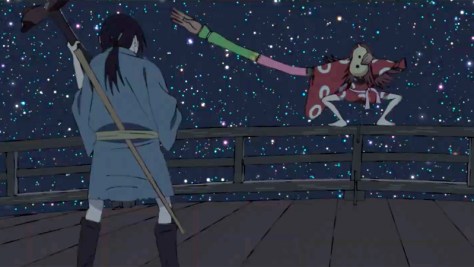
WHY IT SHOULD MAKE THE LIST: I have come to the conclusion that perhaps everything in Masaaki Yuasa’s œuvre should get canonized, particularly as we now have the elbow room to do so. (Night is Short, Walk on Girl was shortchanged due to numeric constraints.) Inu-oh brings an unlikely legend to bombastic life, fusing rock opera, ballet, pyrotechnics, spirits, curses, gender self-discovery, physical transformation; it’s a 21st-century story about a 14th-century performance troupe unearthing the secrets of an 12th-century war.

COMMENTS: It tickles me that Inu-Oh is Masaaki going “commercial.” This stems to a great extent, of course, from the fact that here in the United States, film norms are sickeningly normal: we are reigning kings of the lowest white bread denominator (so much so that it was controversial when Disney took a belated and modest stand against overtly bigoted legislation in its home state). Among the many themes explored in Inu-Oh, gender identity is near the fore, along with the nuances of parental acceptance of someone’s true self.

But let me stop that vein of thought for the moment. This is film for, and about, entertainment. It’s about musical revolution, and the delineation of the esteemed Noh tradition, which harkens back to the middle of last millennium. Inu-Oh follows Noh’s traditional story arc, lacing it with modern rock sensibilities. (Well, maybe not “modern” rock, but certainly strains of Buddy Holly through Jimmie Hendrix and Freddie Mercury.) The titular character is a born performer, despite—or because of—the fact he is a born monstrosity: an unnamed son of a proto-Noh performer, a boy of ambiguous shape, deformed face, and a long, strong arm. He embraces his outcast status, at one point referring to himself as “the Horrible Gourd” in honor of his misshapen mask. But as the son of a dance troupe leader, it comes as no surprise that Inu-Oh was born to jump and jive.

Tomona, the biwa priest, has a comparatively subtler trajectory. The son of a salvage diver, he is blinded at a young age when he and his father retrieved cursed regalia. Masaaki’s visual treatment of this unseeing musician is a treat, as total darkness gains rough outline of form with each sound Tomona hears. Being unable to see, the priest-musician (a biwa is never without his four-string shamisen and bachi) does not fear Inu-Oh, and is so able to help the mutant through his journey. Tomona’s personal journey is also about transformation as he evolves into an increasingly feminine entity, adopting the name Tomaori by the film’s end. The morphing of their name allows them to grow into their true form, but plays havoc with the spirit world, and with their ancestors—as one’s given, or accepted, name is what allows Tomona/Tomaori’s father to maintain contact from the afterlife.

While the first half of Inu-Oh is “merely” steeped in music, song, and dance, the second half is one long string of hand-clapping, foot-stomping musical numbers showcasing the monumental talents Tomona and Inu-Oh share as natural performers. They give the forgotten fate of the Heike spirits full-throated treatment, with Inu-Oh performing transgressively non-traditional storytelling through song and dance, while Tomona positively shreds it on their shamisen. Contemporary shogunate politics play a role in the story as well, as does the concurrent, tragic tale of Inu-Oh’s fame-obsessed father. Masaaki Yuasa never settles for half measures, and every theme—friendship, salvation, transformation, politics, and music—ties together in an animated vortex of vivacity and sonic rollercoaster of rocking melody.

WHAT THE CRITICS SAY:

“This anachronistic rock musical promises a return to the playful, literary surrealism of ‘The Tatami Galaxy’ (2010) and its 2017 spin-off, ‘Night Is Short, Walk On Girl,’ but comes up short… There are individual sequences that reach the psychedelic heights of Yuasa’s best work. But too often, this tale of the liberating power of art is about as mind-expanding as an early-afternoon set at Fuji Rock Festival.”–James Hadfield, Japan Times (contemporaneous)

Celebrating the cinematically surreal, bizarre, cult, oddball, fantastique, strange, psychedelic, and the just plain WEIRD!