CHANNEL 366: I’M A VIRGO (2023)

366 Weird Movies may earn commissions from purchases made through product links.

Recommended

“I’m a Virgo” streams exclusively on Amazon Prime (subscription required)

DIRECTED BY:

FEATURING: Jharrel Jerome, Olivia Washington, Walton Goggins, Kara Young, Carmen Ejogo, Mike Epps, Brett Gray

PLOT: Cootie, a 13-foot tall black man, tries to find a purpose in Oakland, while idolizing a real-life superhero/media sensation known as “the Hero.”

Still from I'm a Virgo (2023)
Jharrel Jerome (as ‘Cootie’), Olivia Washington (as ‘Flora’). Copyright Amazon Studios, Courtesy of Prime Video

COMMENTS: How do you find shoes for a 13-foot tall teenager? And how do you support him without him eating you out of house and home? If you care about the answers to these stupid questions, then “I’m a Virgo” is not for you. If, on the other hand, you’re curious as to how giant Cootie is going to carry on a romantic affair with the normal-sized Flora—who experiences time at about ten times the speed of other people—then have I got a series for you!

“I’m a Virgo” is, on the one hand, a charming story of a sweet, naive man-child coming-of-age in a world that’s not always kind to the differently-heighted. Since this is a Boots Riley joint, it’s also a left-wing political allegory, with a citizen-led rent strike occupying a major subplot. The series is, unexpectedly, also a satire of superhero culture; in Riley’s eyes, these icons of law-and-order are nothing more than propagandist for the status quo . Cootie, meanwhile, is the ultimate image of the Other; he’s a minority of one even within his own minority group. And there are ample, literal lectures about the evils of capitalism. Most of the time, these are far too on-the-nose, as compared to the subtler satire seen in Riley’s debut feature Sorry to Bother You, where such critiques arose naturally as an organic part of the plot. But I can at least say that these lessons are far livelier (and more hallucinatory) than the similarly didactic Marxist monologues that occasionally pop up in ‘s Dziga Vertov movies of the late 60s and early 70s.

And, since this is, again, a Boots Riley joint, it’s also a work that explores these weighty issues by diving into a deep well of absurdist satire. If you thought the premise of a 13-foot man roaming the hood was enough madness for one series, Riley disagrees. We also get the story of the Hero, a homegrown Oakland version of Batman, who runs a comics empire during the day and fights crime at night from his headquarters, and whose elevator moves the building up and down instead of shuttling people between floors. He and Cootie aren’t the only remarkable humans on the block: about half the cast has hidden superpowers which are gradually revealed. The series also features a group of tiny people about as big as your finger, as well as a religious cult devoted to Cootie (who is indifferent to them). Remarkably, Riley ladles out the insanity with a steady hand, sprinkling his twisted creation with bold, surreal flavors, but never overwhelming the core story or making his characters seem anything less than psychologically real (regardless of height).

The extended length of the series format is both a blessing and a curse here. On the plus side, Riley has plenty of time to explore numerous oddball cul-de-sacs without taking time away from character development; for example, the smidgen of crazy grace that comes with a pirate broadcast of an animated series-within-the-series, a digression that would feel too far afield in a feature. Almost an entire episode is devoted to the Hero’s bizarre lifestyle; there’s so much richness here, in his fear of assassination by ninjas, his relationship to his subordinates, and his search for the perfect mate, that a spin-off series devoted to this complex character would be most welcome. On the other hand, it’s always troubling when the first season of a series like this wraps up awkwardly, tying up some loose ends but leaving others flapping in the breeze. Unfortunately, “I’m a Virgo” falls prey to this syndrome in the final episode; it’s particularly disappointing that the Hero ends his too-short arc in anticlimactic fashion. Overall, however, this is a small complaint for Riley’s extraordinary sophomore effort, and one that Amazon can easily make moot if they decide to pick up “I’m a Virgo” for round two. This bizarro Oakland neighborhood has too much craziness left to explore to leave after a mere seven episodes.

WHAT THE CRITICS SAY:

“…an epic and surreal story that is part fairy tale, part parable, and utterly unique. Evoking the same off-kilter filmmaking style as his feature film debut, Riley has delivered one of the weirdest streaming series in recent memory that pulls together statements on unemployment, racial bias, exploitation, and class warfare within the guise of a comic book-themed superhero adventure. I’m A Virgo is weird and weirdly wonderful.”–Alex Maidy, JoBlo (contemporaneous)

MIKE MCCARTHY/JMM – A (SOMEWHAT LENGTHY) PRIMER

Mike McCarthy – or JMM?

Twins?

Actually, both are one and the same. When John Michael McCarthy started in comics, he branded himself with the JMM logo. And if you’ve seen JMM’s work either in comics or movies, your impression is probably:

GIRLS! (Nudity!!)

GARAGE! (Rock and aesthetic)

GARISH! (look, plotting, dialog, attitude)

ELVISNESS!

Basically, what was/is considered to be the rudiments of American pop culture of the 20th Century. If you really want to get into subtopics, specifically Southern American Pop Culture, including the films of David Friedman, early , and lots of others I can’t begin to list…

JMM started in the late 80’s/early 90s, just ahead of the Nu Garage/Greaser/Glam Explosion* of the late 90s, which he and his work helped spread.

[* – NOT an official genre term]

McCarthy’s pinnacle (?) was possibly Superstarlet A.D., which was picked up for distribution by in 2000, making it the easiest of his films to find. After that… that Garage/Greaseball/Glam Boom slowed down and got overshadowed by Whatever New Thing was current. And although McCarthy got notice and acclaim overseas, back home he was just what was called a “cult figure”; an interesting but obscure branch of underground film. Meanwhile, others in the Memphis film scene broke through to studio interest, and money.

As McCarthy has stated himself, as a mantra: “My work is UNPOPULAR“.

I’ve long wondered why. Full disclosure: I was a crew-member on Superstarlet A.D. for the last half of shooting. But I was a fan of McCarthy’s before that, having seen The Sore Losers in Kansas City during the “Vice Parties” tour. My San Francisco roommate was a fan of Russ Meyer, which is how I started discovering that particular corner of film. So when an opportunity came to check out that type of filmmaking, I jumped right in—but that’s another story for another time…

Afterwards, I delved more into McCarthy’s work, and tried to keep an eye on what he was up to. If there’s a genre label for McCarthy/JMM, it’s “Redneck Art-house.” He remarks in the Blu-ray commentary for Damselvis, Daughter of Helvis that a reviewer once referred to him (and the film) as a “Pawnshop .” Both terms sound derisive, initially; but they’re both on-the-nose and correct, and not in a bad way.

McCarthy’s work follows two distinct paths:

JMM comix adaptations. McCarthy’s lo-fi versions of his own personal Cinematic Universe: Damselvis (1994), The Sore Losers (1997), and Superstarlet A.D. (2000) fit in here, along with his comix “Cadavera”, “SuperSexxx”, and “Bang Gang.”

Mike McCarthy graphic novel adaptations. These include features Continue reading MIKE MCCARTHY/JMM – A (SOMEWHAT LENGTHY) PRIMER →

APOCRYPHA CANDIDATE: TODD TARANTULA (2023)

366 Weird Movies may earn commissions from purchases made through product links.

DIRECTED BY: Ansel Faraj

FEATURING: Ethan Walker, Kelly Erin Decker, Nathan Wilson, David Selby

PLOT: Todd Tarantula’s prized motorcycle is stolen; more disconcertingly, he keeps slipping through time.

Still from Todd Tarantula (2023)

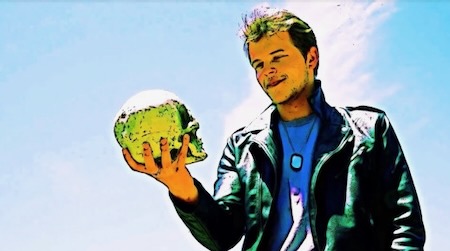
WHY IT MIGHT MAKE THE APOCRYPHA: Todd Tarantula renders L.A. in neon-sparked hues, a surreal effect heightened by the underlying grit of the smog-soaked city. The slippery narrative coursing beneath the death-candy visuals touches on ancient Pueblo lore, modern ennui, technological immortality, and a pleasing finish that is fairly rare in our corner of cinema. Also, there’s a skull-headlight time-travel motorbike.

COMMENTS:

I can’t tell if this is blood or snot! Can somebody help?

The scene is set with efficiency, because for Ansel Faraj, time is of the essence. This pressing speed is somewhat ironic when one considers that the protagonist, ne’er-do-well business scion Todd Tarantula, has time on his side. Well, more accurately, he has time at his disposal. This stubbled James Dean stand-in has his share of troubles—deceased mother, estranged father, dead-end life—but  at least hehas a bitchin’ bike: his treasured means of escape from the demons that pursue him. But over the course of an evening, he loses that, and considerably more.

Tell me one—just one dream—that’s all I ask.

Rotoscoping is a wondrous technique, creating what is possibly the uncanniest of valleys. Grafting animation on to filmed reality anchors us in form and flow, while allowing unfettered tinkering. Faraj’s peripheral tinkering is limited, for the most part, to a glorious color skew. Murky nights shift from green to black. Dazzling sun-lit cityscapes become a Technicolor kaleidoscope. Negative space morphs into clingy radiance. When Todd finally encounters his father, the wire-and-bandage-wrapped patriarch appears as a tethered angel amidst his array of hospital machines and plastic draping. During a car ride with Lucifer (a business rival of his father), the power of animation emphasizes Todd’s claustrophobia and draws the eye to the old gentleman’s skull-topped cane, hinting at the unspoken cost of the business deal playing at the tip of Lucifer’s tongue.

News of death travels fast; dare I say, ‘I’m sorry’?

Ansel Faraj’s film is not perfect. The performances are inconsistent, and the narrative thread sometimes veers too far from the main stitching. However, he has an interesting story to tell here, and it is told entertainingly, with many clever bursts. When he learns of his father’s demise, and the deceased’s disrupted attempt to achieve digital immortality, Todd is idling at the La Brea Tarpits—site of others who have failed to achieve a favorable form of perpetuity.

I don’t know what’s real any more, and I’m really fucking tired of it.

As events unfold (and, in some cases, re-fold), Todd Tarantula slows its pace, drawing everything together at the end for a finish that some will consider a touch too trite. I, on the other hand, was pleased, and relieved to see something pleasant and astounding befall this troubled bohemian nomad. Todd Tarantula sears the eyes, bends the mind, and has the good manners to elicit a satisfied grin.

Todd Tarantula is currently streaming free on Tubi.

WHAT THE CRITICS SAY:

“The search for his missing motorcycle takes Todd on a journey into the darkest and weirdest byways of Los Angeles… Todd Tarantula is like the lovechild of an unholy union between an urban dungeons and dragons quest and a ‘50s teen angst movie. To bless the union, Faraj and company digitally rotoscoped the footage in post production to make the colors, characters and scenery pop like a cross between a live-action graphic novel and an acid trip.”—Brian Schuck, Films From Beyond (contemporaneous)

IT CAME FROM THE READER-SUGGESTED QUEUE: BOXING HELENA (1993)

Beware

DIRECTED BY: (credited as Jennifer Chambers Lynch)

FEATURING: Julian Sands, , Bill Paxton, Kurtwood Smith, , Betsy Clark

PLOT: Unable to cope with his recent breakup with the temperamental Helena, surgeon Nick Cavanaugh finds himself caring for her at his house after a car accident.

Still from Boxing Helena (1993)

COMMENTS: I honestly don’t recall which was the bigger source of discussion when Boxing Helena hit theaters. Was it David Lynch’s daughter helming her first feature? Or was it the prospect of so much sexiness revolving around “Twin Peaks” bad girl Fenn? Some of it was probably the titillatingly taboo premise of a man so infatuated with a woman that he hacks off all her limbs and puts her in a box. (Spoiler: there is exactly one box in this movie, and it does not contain Helena.) But the bulk of the attention circled around the fact that Kim Basinger had to pony up nearly $4 million as recompense for breaking her contract to appear in the title role (and that was after Madonna had rejected it outright). Many of the negative contemporary reviews congratulated Basinger on getting the better end of the deal—and with 30 years distance, watching the film with clearer eyes, we discover that those critics were absolutely right.

We learn at the outset that Nick has been emotionally scarred from his youth, with a slutty mom who rejected him and left him hungry for love. So maybe it’s easy to understand what he sees in Helena: the apathy, the dismissiveness, the belittling condescension… who could turn that down? What’s not at all clear is what she ever saw in him. Within two minutes of arriving at Nick’s party, she’s stripped down to her negligee and cavorting in the fountain. It’s hard to argue that she leaves anything on the table.

One of our most iconic weird actors, Julian Sands, is either terribly miscast or horribly directed. This beautiful, suave man flounces about like an emasculated mockery of masculinity, whining and pining for a lost love that it’s not clear he ever had. But as pathetic as he makes Nick, Lynch goes to great pains to make him more so, with mournful closeups as he jogs and his puppy-dog fawning over her. Later, when Helena mocks his poor bedroom skills, his defensive retort is, “If you were a real woman, you’d lie to me about our sex.” It’s hard to know if Sands is in on the joke or just fully committed to Nick’s painful lack of self-awareness, but his despairing cry of “she’s leaving?” actually left me in hysterical laughter.

Fenn, meanwhile, has almost nothing to do. She begins the film peevish; the loss of her legs makes her angry, the loss of her arms moreso. Her shift to a needier, more empathetic character is motivated not by any change in her but rather as a means of bringing about a change in Nick, an especially odd choice given that a massive plot twist essentially undoes all of the “learning” we’ve witnessed. So this movie about handicapping and torturing a beautiful woman in order to satisfy a broken male ego can’t even commit to its own questionable choices.

Once you establish that the whole thing is an elaborate melodrama with no real point, you can start to embrace it as unintentional comedy, with ridiculous situations, thudding dialogue, and overheated acting. This is best exemplified by the amazingly entertaining Bill Paxton, who shows up as Helena’s occasional boytoy in a Nigel Tufnel hairdo, mesh T-shirt, and leather pants, as cocksure as a 12-year-old trying to buy liquor. The movie may believe in him (when he busts out a Benjamin in payment for information, it cracks on the soundtrack with a snap), but there’s no reason we should. Bragging about his manhood one moment, hiding in the bushes like a Peeping Tom the next, he’s always absurd. The moment late in the third act when he sees what has become of Helena is a masterful double-take, a magnificent piece of comic idiocy.

Boxing Helena could have used a lot more of that, because it is resolutely dumb but lacks the wisdom to recognize it. Young Ms. Lynch seems to think she’s created something bold and erotic and profound. That is an impulse that should be cut off.

WHAT THE CRITICS SAY:

“I am probably prevented by some unwritten law from divulging the end of Boxing Helena. I can only say that, instead of adding an extra twist to this bizarre tale, it deprives it of what little point it had.”–Quentin Crisp, Christopher Street (contemporaneous)

(This movie was nominated for review by Motyka. Suggest a weird movie of your own here.)

Celebrating the cinematically surreal, bizarre, cult, oddball, fantastique, strange, psychedelic, and the just plain WEIRD!