Becky’s first date is going well, until she finds she has an eyelash stuck in her eye—again.
CONTENT WARNING: Contains graphic cartoon violence.

Becky’s first date is going well, until she finds she has an eyelash stuck in her eye—again.
CONTENT WARNING: Contains graphic cartoon violence.
366 Weird Movies may earn commissions from purchases made through product links.
Audio only link (Soundcloud download)
Quick links/Discussed in this episode:
Dickshark (2016): Discussion begins. Read our anonymous reviewer’s review. We gave this nudie horror comedy low marks, but it has its fans, judging by the Kickstarter campaign that resulted in this 2-Blu Collector’s Edition that includes a reported 6+ hour cut of the movie, plus 2 hours of behind the scenes footage. So if you liked Satantango, but wished it was in color, almost entirely composed of full-frontal nudity, and full of penis monsters, Dickshark is calling your name. Buy Dickshark.
Divinity (2023): Discussion begins. Read Giles Edwards’ apocrypha candidate review. Black and white dystopian would-be cult film that’s been dividing critics down the middle, with some camps claiming its just pretentious, and others saying its pretentious but wild enough for a recommendation. You can find out if it will be playing at a theater near you at Divinity official site.
Identikit (1974): Discussion begins. Read El Rob Hubbard’s review (as part of the “House of Psychotic Women” box set). Elizabeth Taylor stars as a bonkers lady in a bonkers movie. Formerly available only in the “Psychotic Women” box set, now on a solo Blu-ray (or VOD). Buy Identikit.
Videodrome (1983): Discussion begins. Read the Canonically Weird entry! You know it, you (presumably) love it; it’s the latest weird movie in the Criterion collection canon to get an upgrade to 4K UHD. All hail the new disc format! Buy Videodrome.
WHAT’S IN THE PIPELINE:
No guest lined up for next week’s Pod 366 (although more guests are coming, we promise). In written reviews next week, we take out three items from the reader-suggested queue: Shane Wilson looks at Francis Ford Coppola‘s overlooked Youth Without Youth (2007), Giles Edwards visits Motel Hell (1980), and Gregory J. Smalley jumps on the newest reader suggestion, Emesis Blue (2023), a feature-length fan psychological horror film made with the Team Fortress 2 SFM Engine. Onward and weirdward!
366 Weird Movies may earn commissions from purchases made through product links.


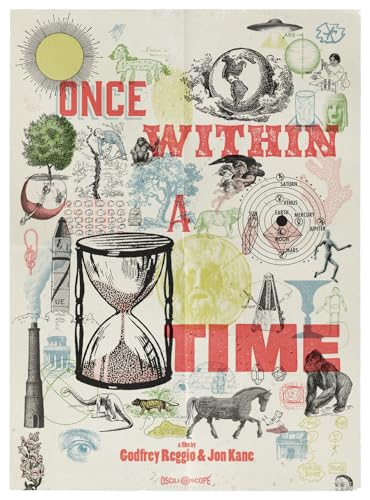
DIRECTED BY: Godfrey Reggio, Jon Kane
FEATURING: Sussan Deyhim, Tara Khozein, John Flax, Apollo Garcia Orellana, Brian Bellot, mystery celebrity guest
PLOT: Curtains open on a glowing, chanting golden tree woman, then children watch a couple with wicker cages around their heads wander through incidents of apocalypse, technology, and wonder.

WHY IT MIGHT JOIN THE APOCRYPHA: Simultaneously ancient and hyper-modern, Once Within a Time is as an apocalyptic dispatch from the far reaches of reality. A bold and foolish (in the complimentary sense) work of cinematic art, dense with imagery and symbolism, this is octogenarian Godfrey Reggio‘s first narritivesque film—his vision of what it means to be a human being in the 21st century, teetering on the brink of cataclysm, but balanced by wonder and creative possibility.
COMMENTS: Godfrey Reggio announces Once Within a Time as a “bardic fairy tale”; an imposing description, but one that the film lives up to. Set to a new score by Philip Glass—with snatches of other music floating through the mix—it’s a carnival of free-flowing imagery and ideas, a techno-gnostic hymn about cataclysms and the birth of new worlds. After the red curtains pull back, we are launched into scenes of an Earth goddess singing from her glowing heart, and innocent children spinning on a merry-go-round. Then, Adam and Eve appear, only to have their equanimity quickly destroyed by a digitized Apple. Cell phones recur as dire artifacts: as cages, as monoliths, as bricks on a road that leads to an audience of faceless puppets. We watch a dance of harlequin emojis. Entertainers and demagogues speak gibberish. UFOs zoom into dreamspaces and blast giant robots with their ray guns. Monkeys experiment with virtual reality goggles. There’s a reference to 2001 that will probably draw laughs, and maybe cheers, from savvy live audiences. There is even a special celebrity guest whose appearance I don’t want to spoil, who speaks in John Coltrane solos and acts as a pied piper. And throughout it all, reaction shots of children, bemused, delighted, taking in the helter-skelter as best they can, their little minds gathering fuel… hope for the future.
The visual aesthetic is faded yet bright, digital but evocative of finely aged film stock. The style and imagery brings to mind experimental films of the 1950s-1970s, specifically Kenneth Anger: the wicker baskets around the lead adult’s heads like the birdcages of the Pleasure Dome, the UFOs possibly on loan from Lucifer Rising, the whole thing seasoned with occult premonitions of a New Age Dawning. There are fleeting scenes of destruction, decay, despotism, mushroom clouds: but the imagery returns, unfailingly, to dwell on innocent children at play, and themes of creation and re-creation. It ends on a Botticelli tableau, with children as angels and Venus yet to emerge from her throbbing egg sac.
A new Philip Glass score is, of course, something to celebrate. The soundtrack here is more of a suite of short pieces than a large scale composition, moving through numerous flavors to illustrate the Reggio’s many different settings. Glass’ hypnotic minimalism may not get the chance to do its accumulation-by-repetition thing here, but he makes up for with a wider palette of colors: unfamiliar elements like chanting, accordions, and even African percussion offer the composer new settings for his ideas. The contributions of Iranian singer Susan Deyhim (who also plays the tree) are most welcome.
The runtime is listed as 51 minutes, but the credits take up the final 8, so the film itself is a manageable 45-minute experience. Watching this on a big screen with an appreciative audience would be magnificent; it makes perfect sense that it debuted at NYC’s Museum of Modern Art. It is uncommercial, personal, specialized, and fated to be underseen, but Once Within a Time is a major cinema event in 2023. Make it a point to track it down when you can.
Once Within a Time official site for trailer and screening calendar.
WHAT THE CRITICS SAY:
366 Weird Movies may earn commissions from purchases made through product links.
DIRECTED BY: Peter Greenaway
FEATURING: Anthony Higgins, Janet Suzman, Anne-Louise Lambert, Hugh Fraser
PLOT: At the finale of the 17th-century, the wife of a boorish aristocrat contracts with a draughtsman to contrive a series of drawings; unexpected pictographic clues appearing in the artist’s renderings suggest a deadly conspiracy.

WHY IT MIGHT JOIN THE APOCRYPHA: Greenaway tackles his first feature-length narrative with such structure, symmetry, and formalism that it might conceivably collapse into its own pretentious confinement. However, regular spikes of ornate bawdiness and cryptic banter, alongside Nyman’s jaunty film score, render the whole affair so baroquely flippant that the inclusion of a living garden statue is merely the ultimate, strange garnish on this eccentric appetizer to Greenaway’s impending career.
COMMENTS: “It has been fancifully imputed that Mr. Neville saw you as a deceived husband.” If that withering—and scandalous—insult vexes you, I strongly recommend against attempting to endure Peter Greenaway’s high-falutin’ whodunnit. On the other hand, if you wish to pry, peep, poke, and peek at the behind-closed-doors (and at times, on-the-lawn-somewhat-obscured-by-a-parasol) doings of the sickeningly wealthy and witty, the droll and devastating—veritably, the very cream of late-17th-century excess—Greenaway’s soufflé of mannerisms, ostentation, lines, lists, longitudes, and lasciviousness baked into this country-house mystery will not only fit the bill, but fit it perfectly with a stretch of laced linen that will leave you petrified to touch it with your coarse peasant hands.
Mr. Neville (Anthony Higgins), whose observations Mr. Noyes infers from prior insinuations and sketch-work, is a draughtsman by trade, and a haughty rake by inclination. On the eve of Mr. Herbert’s departure, Neville attends a soirée hosted by Mrs. Herbert, who wishes, she claims, to furnish her husband with a set of exterior drawings of their estate as a gift upon his return, in hopes of salvaging, at least, some civility in their marriage. Initially disinclined, Neville agrees only after much pursuit by Mrs. Herbert (and her daughter, Mrs. Talmann), and the inking of a curious contract which delineates recompense both financial and sexual. Mr. Herbert leaves for business, and Mr. Neville ensconces himself as he begins his work—and play.
I beg your indulgence for what is, even for me, an excess in flowery language; but such is the overwhelming effect of this strange matrix of conflicting impulses and shifting conspiracies. Greenaway kicks the door down for this one (doubtless because its vertical line displeased him) and comes swinging in full force with his painterly mise-en-scène and artful dialogue thronging the screen and speakers. Frames within frames, within frames; candlesticks joining and isolating conversers, sometimes positioned as an extension of a phallus-above-the-table (Neville’s, naturally); ordered chaos—there is nothing, it appears, left to ill-rendered whim nor faith in dreamscapes.
The “conflicting impulses” mentioned play out primarily between the pristine structure of the film (pacing, staging, scoring, framing, &c.) and the often-hilarious, invariably biting dialogue, which itself is masked with powder-splotched cosmetics and finery that could pass for a Ken Russell migraine. And Greenaway looooves sex on shameless display. As if imitating the outward prudish mien of its characters, The Draughtsman’s Contract conveys all manner of carnality, some of it extreme, while only ever exposing a single breast on screen. Anthony Higgins—witness to this breast, among other parts and places—is perfectly cast as the cocksure draughtsman, believing he is outwitting the conspiratorial axis of Mrs. Herbert and her daughter. Though doomed from the start, he careens toward his fate on a cloud of magniloquent artistry, wit, and lasciviousness.
As far as I could determine, the extras on Kino Lorber’s 40th anniversary, 4K release of The Draughtsman’s Contract were lifted straight from the preceding UK-only disc. Though they are scant, the included introduction from Peter Greenaway is a delightful and informative ten-minute essential, outlining the director’s intentions and providing a brief history of the film. The even briefer interview with Michael Nyman succinctly and charmingly relates how these two lovers of lists began their collaboration. Last, and by no means least, the video and sound are perfection in itself—and as Greenaway would observe, it is the deft combination of those elements that filmmaking is all about.
WHAT THE CRITICS SAY:
366 Weird Movies may earn commissions from purchases made through product links.
DIRECTED BY: Barry Levinson
FEATURING: Dustin Hoffman, Sharon Stone, Samuel L. Jackson, Liev Schreiber, Peter Coyote

PLOT: A team of scientists is dispatched to the middle of the Pacific to examine a mysterious spacecraft found on the ocean floor.
COMMENTS: An unexpected side effect of the success of Jurassic Park was the discovery by Hollywood studios that Michael Crichton had written other books. Several, in fact, and most of them characterized by (a) a deep interest in the intersection of advanced technology and human hubris and (b) shoddy writing and lazy characterization. (I devoured his books in my fresh-out-of-college years, so I readily acknowledge my role in the problem.) Their high-concept plots and sci-fi trappings were catnip for deep-pocketed producers, and soon the market was flooded with Crichton adaptations: Rising Sun, Disclosure, Congo, The 13th Warrior (from his novel Eaters of the Dead), his dino-sequel The Lost World, an old unproduced screenplay called Twister, and yes, Sphere went into production in short order.
Sphere has all the elements you need for a big box office smash: big stars, a big budget, and a Big Dumb Object to serve as the MacGuffin. It also had huge story problems, so big that Levinson and Hoffman were able to go off and shoot Wag the Dog during a break in the production, and so extensive that the final credits cite one writer as having “adapted” the book while another duo is listed as responsible for the actual screenplay. The result is why we’re here: it’s a classic mishmash of sci-fi tropes and action set pieces, but executed most oddly.
One reason that things feel so off with Sphere is that the basic story—an unexplained thing needs explaining—is free of suspense. Since research rarely makes for great blockbuster cinema, we start getting twists and turns thrown at us with a taste of every plot device imaginable. Time travel, temporal paradox, black holes, alien communication, mind control, the manifestation of dreams. Meanwhile, character is ladled out in small dollops of exposition in a belated effort to give the actors something to play. Hoffman hates snakes, Jackson hates squid. Hoffman and Stone were once lovers, and Stone once had suicidal tendencies. Jackson and Schreiber are fierce academic competitors, Schreiber is embarrassed by his glasses. Coyote is and always has been an officious, loudmouthed idiot. Everyone seems to be playing that improv game where you’re handed a piece of paper with a character trait mid-scene, and you have to backpedal furiously to justify the lay-on.
When there is drama, it’s incredibly silly. One naval officer (Queen Latifah, stunningly underused) is killed by an enormous swarm of jellyfish, which the film tells us should be no cause for alarm, so she has to flail about as though under attack from a flock of bats to gin up the excitement. Later, several of the crew are, oh, let’s just call it “attacked” by an onslaught of falling sea eggs, which frankly look like condoms being used to smuggle drugs, so you just have to take it on faith that this underwater ticker tape parade is, in fact, terrifying. Walls shake, coffee cups fall over, sirens wail, and Dustin Hoffman shrieks at the sight of an eel, but nothing actually happens.
Some of the most effective scares are derived from the notion that nothing happening is significantly more unsettling than flurries of activity. Jackson gets to play against type by not commanding the room with his stentorian delivery, and the film gets considerable mileage out of his eerie calm in the face of chaos. But sometimes that stillness is carried to such a degree that it feels like a glitch, especially when Elliot Goldenthal’s hyperactive score is working so hard to generate suspense.
Throughout, characters change on a dime, usually to generate tension, a late reveal about the identity of a character provides the requisite shocking twist without making a lick of sense, and Levinson deploys every kind of distraction he can think of (including a hilariously overwrought attempt to manufacture horror out of a cabinet full of books), probably because he knows that the moment anything gets explained, all the air will go out of the story. But there’s nothing he can do to cover up the truth of a script written by committee and pieced together from ideas either unfinished or shoehorned in to generate conflict. It’s a ridiculous mess, and not even a very fun one.
Sphere is actually the book that helped me give up my interest in Crichton, thanks in large part to its comically lame finale. I’m delighted to report that the book’s ridiculous ending is carried over to the film fully intact. There’s a logic to it, but it’s dramatically disastrous, as it all genuinely adds up to nothing. Naturally, the film sells it as a triumph (accompanied by a dramatically inexplicable special effect and another Goldenthal fanfare). Sphere ends as it begins: all wet.
WHAT THE CRITICS SAY:
(This movie was nominated for review by ry, who observes, “it has really strange dialogue, like their timing is off or something.” Suggest a weird movie of your own here.)