Category Archives: Capsules

CAPSULE: THE CASSANDRA CAT (1963)

Az prijde kocour, AKA When the Cat Comes

Recommended

DIRECTED BY: Vojtech Jasný

FEATURING: Jan Werich, Emília Vásáryová, Vlastimil Brodský

PLOT: A magical cat reveals people’s true natures leading to whimsy and chaos.

Still from The Cassandra Cat (1963)

COMMENTS: On the surface, the movies of the (1963-1968) seem vastly different from typical cinema, but they aren’t. Not really. See, starting in 1945, when the film industry in Czechoslovakia was nationalized, the country’s cinema became stultified. Even small children could predict the outcome of every story. But in the early sixties there was a de-Stalinization within the Czech Artistic Council, and that led to an explosion of creativity: the Czech New Wave.

Films as strikingly different from one another as Daisies (1966) and A Report on the Party and Guests (1966) share not only this sociopolitical background but also a similar sense of absurdity and surrealism.

Why this Film Studies 101 intro? Because The Cassandra Cat (1963) (aka When the Cat Comes, The Cat Who Wore Sunglasses, One Day a Cat, and That Cat) makes a lot more sense in context.

A magician and his troupe come to a small town. They bring with them a cat wearing sunglasses. During the magic show, we learn the direct and rather impassive glare of the cat reveals a person’s true colors: literally. People turn entirely yellow if they are guilty of infidelity, purple if they are “social climbers” (we might say “brown nosers”), gray if thieves, and of course red if when they’re in love. Much chaos and hilarity ensues.

The Cassandra Cat is witty and whimsical, never passing up an opportunity to take a jab at authority, which is shown as anti-art and, through hunting and taxidermy, as anti-life itself. Our hero, a third grade teacher, is pro-art, anti-death, and all red when the cat looks at him, as he is smitten with the magician’s assistant.

The cat gets lost and falls into the wrong hands. The children protest by going into hiding. The parents lose their cool each in their own way, and in one delightful scene stand on tree stumps in the forest calling out their children’s names under the direction of a conductor. In the end the teacher does not get to keep true love (which thwarts the predictable Artistic Council code), but he does get a class of happy and creative students.

The Cassandra Cat uses experimental special effects throughout. Some of these, such as the process used to color those who have been seen by the cat, made restoration of the film quite tricky.

The Cassandra Cat‘s story is thin. Many scenes seem to have no purpose except to have fun, which in itself could have been rebellion against previous (and future) restrictions. The Czech New Wave essentially ended when Soviet tanks rolled in and crushed the Prague Spring in 1968.

See, doesn’t a cat wearing sunglasses lest he expose people’s true natures make more sense when you have that Cold War background?

WHAT THE CRITICS SAY:

“Part family fable and part surreal acid trip… Usually surreal, hallucinogenic films are also dark and moody, but Cat is unusual in this regard. It is a bittersweet film that never loses its sense of innocence, despite the wild scenes from the town square.”–Joe Bendel, J.B. Spins

HOUSE OF PSYCHOTIC WOMEN: RARITIES COLLECTION

Recommended

Severin Films 5-disc set.

I’ve sung Kier-la Janisse’s praises earlier here about the “All the Haunts Be Ours” folk-horror boxset that she curated for Severin Films. I assume a good many of the people reading this are familiar with Janisse already from her book “House of Psychotic Women,” published in 2012. 2022, the book’s 10-year anniversary, saw the publication of an updated edition (new films appear in the book’s appendix) and this boxset of four movies. Though much smaller, this release is equal in quality to “Haunts,” if perhaps more niche-focused: all of the films featured could fall under the heading of “Eurocult.” This is the first American Blu-ray release of each.

Identikit (1974), directed by Giuseppe Patroni Griffi and based on Muriel Spark’s novel “The Driver’s Seat,” stars as Lise, a somewhat prickly woman on a trip from London to Rome on her way to meet up with a man. The film jumps around in time as Lise is apparently being pursued by the police, and we see the reactions of people who have encountered her and their interrogations. With incidents of terrorist activity in the background, it seems that Lise is on a mission that will end up in dire consequences—which indeed it does, but not all how one might expect.

Identikit comes at the end of what has been referred to as Taylor’s career decline, a period that included offbeat projects like Reflections in a Golden Eye (1967), Boom! (1968), Secret Ceremony (1968), and Night Watch (1973), all of which were thoroughly roasted by critics at the time and no more successful with audiences. Those films are being reevaluated and are now considered to be among some of Taylor’s best work. Identikit stands proudly amongst that body of work. Lise is abrasive and disagreeable to most she encounters: service people; airport security (note that the movie was shot one year after airport security measures were put into place, which look quaint and lax compared to current times); and toxic men like Bill (Ian Bannen), a buffoon who thinks he’s just her type, and Carlo (Guido Mannari), a mechanic who gives her a ride to a hotel and attempts to rape her. But Lise shows some wistful vulnerability with an older woman () with whom she goes shopping, a man she thinks might be the person she’s looking for ( in a cameo), and the man who is the one she’s searching for. As the movie skips around in time, Lise proves to be a totally enigmatic character, even as she achieves her goal.

The audio commentary by Millie De Chirico (late of TCM Continue reading HOUSE OF PSYCHOTIC WOMEN: RARITIES COLLECTION →

CAPSULE: THE BLISS OF MRS. BLOSSOM (1968)

DIRECTED BY: Joseph McGrath

FEATURING: Shirley MacLaine, Richard Attenborough, James Booth

PLOT: Mrs. Blossom, the bored wife of an eccentric and oblivious bra manufacturer, hides her lover in the attic.

Still from The Bliss of Mrs. Blossom (1968)

COMMENTS: Oh joy, a ‘60s European sex comedy! Wait, this can’t be right, where are the boobies? (Checks label.) Oh damn and blast, we brought home a British sex comedy by mistake! That means not even a peep of skin, only coy hints of sex, and a plot that’s rather stingy with the comedy too. Mrs. Blossom is an amusing and light-hearted romp, though, and a quaint period piece for die-hard mondo-60s collectors. Just be advised, even though Shirley MacLaine headlines, her performance here is far from Terms of Endearment caliber—she almost stifles a yawn between lines. As for Attenborough, he does his mutton-chopped best to liven things up a notch. Presumably the paychecks kept the cast in tea and crumpets until they could wend their way to loftier productions.

Meanwhile the sets do most of the acting. Beautifully shot at screwy camera angles in psychedelic Technicolor, the Blossoms’ mansion is decorated like it was intended as a water-colored playhouse for children’s  theater, while outside, London has never looked more swinging. McGrath partitions the pedestrian narrative between slices of abrupt, surreal chaos: gauzy garden-swing dream sequences, Three Musketeers homages, a St. George and dragon fantasy. And just when you’re about to give up on the movie, it pulls a cameo out of its hip pocket (Cleese was paid by the microsecond to portray an unhelpful postal clerk, and then was gone before he could outshine the rest of the production).

While Mr. Blossom (Attenborough) is a workaholic bra magnate, Mrs. Blossom (MacLaine) is a listless trophy wife and part-time portrait artist. When her sewing machine breaks down, the factory sends ‘round the blandly charming repairman Ambrose Tuttle (James Booth), whom Mrs. Blossom undertakes to seduce—but actually adopts, as one would a stray kitten—over an improbable game of pool. She later hides him in her home’s attic, which is spacious enough to furnish as a second home. There the situation stabilizes for years, while Mr. Blossom remains obliviously cuckolded. He is more fixated on his music fetish—not that he plays music, but he air-conducts on the balcony to prerecorded opera. Meanwhile, a sewing machine repairman’s disappearance is apparently noteworthy enough to attract detectives, investigating in a sputtering sidecar of a subplot.

So far this film doesn’t sound very invigorating, but its saving grace is an air of magical realism that feels like it might have been ad-libbed by the crew on the spot. Scotland Yard detective Dylan (UK acting legend ) turns in a campy performance of dogged investigation while remaining just inches shy of exposing the infidelity. But it’s when we meet Mr. Blossom’s shrink, Dr. Hieronimous Taylor (UK game show host Bob Monkhouse) that we get a real glimpse of weirdness. Dr. Taylor’s office interior set, equipped with piles of vaguely-threatening cyberpunk devices and animated neon pub signs twinkling and spinning in the background, would not look out of place in A Clockwork Orange. Mr. Blossom is seeing a shrink because, you see, he keeps hearing strange noises in his home—due to Ambrose, who is as stealthy as a brass band falling down stairs—and noticing that things keep disappearing, so of course he must be going daft.

While The Bliss of Mrs Blossom isn’t going to top anyone’s weird movie list, the surreal bits and whimsical plot threads accumulate to ultimately charm its way into quirky movie territory. Between the fantasy sequences with a romanticized theme and the gadget-filled psychiatrist’s office, you might be tempted to think Terry Gilliam saw this on his way to making Brazil. You can tell that somebody loved this movie and had ambitions for it that it could not deliver, but it’s so sweet and cheery, even to the end, that you can’t stay disappointed in it. Deep and meaningful cinema this isn’t, but it’s an interesting page in 1960s UK mod film history.

WHAT THE CRITICS SAY:

“Frankly, the whole film was a mess, a colourful mess but all over the place just the same.. The jokes were mild at best, but in the hope that we wouldn’t notice they were placed in a selection of near-psychedelic visuals… Joseph McGrath worked up a selection of visuals which truly took advantage of the Technicolor, and in opening up the play to downright oddness, this was quite something to behold, if not great at all.”–Graeme Clark, The Spinning Image


B’TWIXT NOW AND SUNRISE: THE AUTHENTIC CUT (2011/2022)

DIRECTED BY:

FEATURING: , , , Ben Chaplin, Joanne Whalley, Alden Ehrenreich, David Paymer, Don Novello, Anthony Fusco,

PLOT: A struggling writer’s book tour lands him in a mysterious small town, where the sheriff invites him to help investigate a serial killer and guides him through a dreamworld of ghosts, vampires, and murderers.

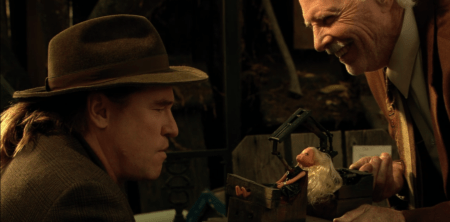
Still from B'Twixt Now and Sunrise (2011/2022)

COMMENTS: In 2011, Francis Ford Coppola released a movie called Twixt, a vampire/ghost story starring Val Kilmer as a low-rent horror writer, Elle Fanning as a pixie-esque dead girl, and Bruce Dern as the town sheriff/aspiring writer. Not many people remember it, which makes Coppola’s decision to re-release it, calling it B’Twixt Now and Sunrise: The Authentic Cut (2022), slightly baffling. Only slightly so, though, given both how much the man likes director’s cuts and the special significance this film has to him.

Its first time out, Twixt was roundly panned. The writing (by Coppola) is unfortunate, the look of the dreamworld—where Hall Baltimore (Val Kilmer) is guided through the story of a mass child murder by Edgar Allan Poe (Ben Chaplin)—is overly crisp, background characters are either wooden or overwrought, and so on. There are odd choices throughout, and the overall effect is that Twixt is a bad movie—a very entertaining bad movie.

For The Authentic Cut, Coppola removed eight minutes of runtime (four of them from the ending, which was already abrupt) and didn’t add any new footage. While the changes are understandable, such as patching scenes together, creating a twist ending, removing a homophobic joke, etc., the movie isn’t much better for them, and this is tragic.

B’Twixt is a movie close to Coppola’s heart. This is because of a subplot wherein Baltimore’s daughter has been killed in a boating accident, and he comes to accept culpability. Coppola’s 22-year-old son was also killed in a boating accident, in the same way as shown in the film. So of course he would want this semi-confessional movie to be its best and not an embarrassment. But all that works in Twixt/B’Twixt is the stuff makes it funny and cheesy and bad, like Bruce Dern’s screwball sheriff. His over-the-top energy would be par for the course in an out-and-out comedy, but because this is not one, the question of whether certain things are intentionally funny is that much more fascinating.

There are cool moments, especially in the dreamworld when everything is black and gray and red, sometimes looking like an expressionist version of  Sin City (which was released 6 years earlier). These scenes are dominated by the leader of the evil, possibly vampiric goth kids, who has the gothiest makeup ever and reads Baudelaire in French. His name is Flamingo, and he broods under the full moon. Again, genius bleeds into the ridiculous, leaving us both chuckling and wondering about intentionality.

Coppola’s original vision for this film included performing it live, taking advantage of the digital nature of editing, and having the score performed along with a fluid cut—a groundbreaking undertaking,  which occurred only once, at Comic-Con. One can easily assume from this intention that Twixt was never meant to be the final version.

For people interested in (one of) the auteur’s vision(s), B’Twixt is here for you now. But if you want a low budget horror-comedy that is both intentionally and unintentionally funny, Twixt is a hidden gem.

WHAT THE CRITICS SAY:

“The shot on digital low-budget indie film was inspired by dreams Coppola had and, well, that’s what it feels like. Although this trimmed down version is more focused and less clunky than the original (especially with Hall’s character arc), it still feels like a mish mash of ideas more than a fleshed out story… plays like a poor man’s ‘Twin Peaks.'”–DVD corner (Blu-ray)


IT CAME FROM THE READER-SUGGESTED QUEUE: MR. MAGORIUM’S WONDER EMPORIUM (2007)

DIRECTED BY: Zach Helm

FEATURING: Dustin Hoffman, Natalie Portman, Jason Bateman, Zach Mills

PLOT: Mr. Magorium, who has run his magical toy store for nearly three centuries, prepares for his imminent departure from the earthly realm, but his plans to hand the reins over to store clerk and aspiring composer Mahoney are endangered by her ambivalence, the suggestions of a straight-laced accountant, and the protests of the store itself.

Still from Mr. Magorium's Wonder Emporium (1993)

COMMENTS: From Dictionary.com:

whim·​sy [ˈ(h)wim-zee] n. 1: capricious humor or disposition; extravagant, fanciful, or excessively playful expression: “a play with lots of whimsy.” 2: an odd or fanciful notion. 3: anything odd or fanciful; a product of playful or capricious fancy: “a whimsy from an otherwise thoughtful writer.”

Zach Helm has an undisguised interest in finding joy amidst the frustrations of life. His screenplay for Stranger Than Fiction focused on a person who has spent his whole life in the grey and comes late to discovering the beauty of leading a more colorful existence. Here, making his directorial debut, he presents a world drenched in color and offers us a character who revels in it, until she doesn’t, and has to find her way back. The former film looked wistfully at the joyful world that was lost. This time around, we need to be right in the heart of that joy, and Helm’s weapon of choice is whimsy. Truckloads of it.

Our setting, identified in the title, is a sort of mad mashup of Willy Wonka’s chocolate factory and Weasley’s Wizard Wheezes. It’s a hyperactive place, perpetually bustling with children who have somehow pried themselves away from their PlayStations so that they can indulge in the unexpected surprises of the toyshop. The toys come to life. Any plaything you desire can be found in a great big book. Bouncy balls are always on the lookout for an escape opportunity. There is always something going on, so much so that the movie is its own Easter egg generator. It’s the kind of a place where dinosaur skeletons peek out the window, Playmobil figures do actual construction, and Kermit the Frog does his weekly shopping. (That’s Kermit himself, looking strangely embarrassed to be stared at, or maybe just to be in the movie.) It’s fun, and then it’s fun, and ultimately it’s FUN, DAMMIT. 

All this is overseen by an enormously affected Hoffman. With eyebrows to rival Thufir Hawat and an Ed Wynn-style lisp that would be mincing under any other circumstances, he’s carefully constructed to be eccentric. Sometimes that’s refreshing, best exemplified by his equanimous attitude toward the impending end of his life. He’s not at all cynical, but eager to indulge in pleasures large and small right to the very end. On the other hand, he’s liberally draped with quirks: wearing loud patterns, bantering with his zebra roommate, and obsessed with hot dog buns. This can have mixed results: I groaned Continue reading IT CAME FROM THE READER-SUGGESTED QUEUE: MR. MAGORIUM’S WONDER EMPORIUM (2007) →