Category Archives: Capsules

CAPSULE: WILD ZERO (2000)

DIRECTED BY: Tetsuro Takeuchi

FEATURING: Masashi Endô, Kwancharu Shitichai, Guitar Wolf, Makoto Inamiya

PLOT: Guitar Wolf (frontman of the pistol-packing punk outfit Guitar Wolf) makes Ace a blood brother when the would-be greaser is injured during a showdown between the band and an evil club owner; the rock star gives him a whistle he can use to summon the band in times of need, which comes in useful when Ace finds himself trapped in a town overrun by zombies.

Still from Wild Zero (2000)

WHY IT WON’T MAKE THE LIST: It’s more “wild” than “weird,” and more “awesome” than “great.”  The surrealism sometimes seems to result from carelessness—as if the director is thinking, “no one’s going to care if this character suddenly shoots lasers from his eyes, as long as something blows up and the soundtrack’s loud”—rather than an ideological dedication to absurdity. It’s a crazy, fluffy pop confection made from zombies, punk rock and flying saucers, fun but totally non-nutritious; the younger, or the drunker, you are, the more likely you are to fall in love with it.

COMMENTS:  When Wild Zero‘s advertising proclaims it a “super rock and roll jet movie!,” it reminds us that Westerners are as fascinated and amused by the way the Japanese absorb and alter American pop culture, chewing up and spitting our entertainment idioms back at us in twisted forms.  Wild Zero is a fairly obvious mashup of Rock and Roll High School and Night of the Living Dead, but when seasoned with casual Oriental surrealism, it turns into something that feels unique and unclassifiable: a “super rock and roll jet movie!”  The band Guitar Wolf, with their leather jackets, shades, shared surname (frontman Guitar Wolf shares the stage with sidekicks Bass Wolf and Drum Wolf), and fast and furious odes to teen rebellion, shamelessly crib from the Ramones.  However, they add their own flavor to the recipe.  The Ramones never had magical powers, arsenals of munitions, or flames shooting from their microphones, and to my knowledge they never went so far as to act as superheroes for their most dedicated fans, explode zombie heads with glowing guitar picks, or use samurai blades hidden in guitar necks to gut alien motherships.  Superhumanly cool and macho, like Clint Eastwood if he Continue reading CAPSULE: WILD ZERO (2000) →
CAPSULE: JESUS CHRIST VAMPIRE HUNTER (2001)

DIRECTED BY: Lee Demarbre

FEATURING: Phil Caracas, Maria Moulton, Murielle Varhelyi

PLOT: The Son of God recruits retired Mexican wrestler “Santos” to help him defeat the

Still from Jesus Christ Vampire Hunter (2001)

vampires who are preying on Ottawa’s lesbian population.

WHY IT WON’T MAKE THE LIST:  It’s defiantly odd, but not consistently funny or entertaining enough to rank among the all-time greats.  If you saw any two-minute stretch of JCVH selected at random, you might be convinced that this was a work of camp genius; but string 45 such segments together, and the comedy value runs a little thin.  It’s a hard movie to peg: in its own way, given its low budget, its a sort of masterpiece, and at the same time it’s sort of a disaster.  I think that if it had offered us one less overlong kung fu battle, and one more song and dance number, it might have had a shot at exalted weirdness. Ultimately, though, just as the tone is more irreverent than blasphemous, the style is more zany than weird, and that should keep it off this particular List.

COMMENTS:  Jesus Christ Vampire Hunter is a stew of pop-cinema leftovers, mixing kung fu with horror, Mexican wrestling and even scraps of blaxploitation, all seasoned with a hint of sacrilege.  Like all peasant cuisine, it will be comfort food for many, but offend some refined palates—it’s definitely an acquired taste.  The technical aspects effectively evoke the feel of late seventies/early eighties exploitation movies, with drab urban cinematography, sound obviously added in post-production, and even a cheesy “waka-waka” funk theme as the heroes cruise down the highway. The action scenes are a problem here: for one thing, there are too many, and they’re too long. They’re just competent enough to remind us that they’re not quite up to snuff; Phil Caracas’ Jesus shows reasonable high-kicking athleticism, but he’s no action hero, and it would have been funnier and more endearing if he’d been clumsier. At any rate, the movie can’t be accused of false advertising. The campy/sacrilegious title scares off the squares and the fundies (though it’s obvious the filmmakers are clearly fans of JC’s philosophy of love and tolerance, if not proponents of his divinity). More to the Continue reading CAPSULE: JESUS CHRIST VAMPIRE HUNTER (2001) →

CAPSULE: ESCANABA IN DA MOONLIGHT (2001)

DIRECTED BY: Jeff Daniels

FEATURING: Jeff Daniels, Harve Presnell, Joey Albright, Wayne David Parker, Randall Godwin, Kimberly Guerrero

PLOT: 42-year old Rueben must bag a buck during this year’s deer season or he’ll become

Escanaba in da Moonlight (2001)

the oldest male in the history of the Soady family never to have done so; with the help of a potion supplied by his Native American wife, he encounters strange supernatural forces that help him in his quest.

WHY IT WON’T MAKE THE LIST:  Escanaba is unique, at least: it’s got an interesting subject (the deer hunting subculture in Upper Michigan), lots of local color, and evil spirits (or UFOs, or God) haunting the woods.  Jeff Daniels has a lot of ideas here, but most of them fail: the crude quirk and sporadic weirdness never gels into something either meaningful or mirthful.  It ends up as a regional indie curiosity.  Escanaba does have its share of dedicated fans (mostly Michiganders)—must be a Yooper thing, eh?

COMMENTS:   The name Escanaba in da Moonlight sounds pretty cool, but doesn’t really fit the film—almost none of the action takes place in the town of Escanaba, and what little that does happens in the glare of the sun.  There’s plenty of moonlight, but it all falls well outside the town’s borders.  That’s pretty much the story of the movie, which puts things in just because they seemed cool at the time, without paying attention to whether they fit or not.  The movie knows where its soul is—holed up in the woods of the Upper Peninsula in a shack stocked with of maple whiskey and Leinenkugels, pronouncing its “th”‘s as “d”‘s, worried whether this will be the year middle-aged Rueben Soady finally shoots a deer.  It’s a recipe for a low-key male bonding comedy, but Escanaba loses its way when it expands beyond deer camp and goes cosmic.  Rueben is determined to break his curse before he becomes the record holder for oldest buckless Soady male, so he drinks a potion brewed by his mystically-attuned Indian wife and things get a bit weird.  Rueben and his camp pals—crusty but supportive dad, superstitious brother, and a family friend named “da Jimmer” who’s had a speech defect ever since he was abducted by an alien—chug down the brew and endure a night that’s half vision quest, half mushroom trip, with a touch of demonic possession and religious ecstasy thrown in for good measure.  They endure the flashing lights of UFOs, denatured whiskey, impossible euchre hands, a DNR ranger who’s just seen God, anxiety dreams, possession, epic flatulence, and a “bearwalk,” an evil spirit from Algonquin folklore.  The Soadys and their guests aren’t nearly as freaked out by these events as folks from under da Bridge would be; no matter how unsettling the paranormal events should be, the tone remains consistently stuck on coarse quirk, with jokes revolving around the supposed magical properties of jars of porcupine urine and the humiliation of accidentally drinking a moose testicle.  The movie’s message seems to be that in order to self-actualize and shoot a deer, it’s necessary to believe in something—anything—and it doesn’t really matter whether it’s aliens, ancient spirits, God, or the power of love.  That’s why all the supernatural occurrences that afflict the cabin are so damnably arbitrary; the trials Rueben goes through in that long night of the soul aren’t tightly tied to his psychological journey, and anyway, helpful spirits will show up at the end to solve his problem in about two minutes.  The unique Upper Peninsula flavor, deer-hunting rituals and likable rustic characters give Escanaba a lift, but the weirdness doesn’t work for the film, the comedy is gutshot and the spiritual triumph is lame.

Jeff Daniels, who grew up in Lower Michigan, not only starred, but also directed and scripted Escanaba, from his own play.  In the public mind, Daniels’ Golden Globe for The Purple Rose of Cairo (1985) has long been overshadowed by the scene where he suffers sudden and severe colonic distress in Dumb and Dumber (1994).

WHAT THE CRITICS SAY:

“…suggests Evil Dead II as directed by a lobotomized Garrison Keillor…”–Nathan Rabin, The Onion A.V. Club

(This movie was nominated for review by reader “Wycuff,” who called it “defiantly weird” but hedged with “It probably wont make the list but it’s at least worth a review and an honorable mention.”   Suggest a weird movie of your own here.)

CAPSULE: BATTLE ROYALE [BATORU ROWAIARU] (2000)


Recommended

DIRECTED BY:  Kinji Fukasaku

FEATURING:  Takeshi “Beat” Kitano, Tatsuya Fujiwara, Aki Maeda,

PLOT:  Intergenerational relations in Japan have broken down to such an extent that

Still from Battle Royale [Batoru Rotaiaru] (2000)

youngsters are rebelling by committing acts of violence and mass truancy.  The situation has deteriorated so badly that the government reacts by passing the “Battle Royale Act”: each year a randomly selected high school class is sent to an isolated, uninhabited island, fitted with remotely detonated explosive collars, given meager supplies and told to fight to the death.  One must emerge a victor or three days later everyone will die.

WHY IT WON’T MAKE THE LIST:  Although I consider Battle Royale to be a “must see” film, it really can’t go on the list.  It’s just not weird.  It’s funny, violent, overblown, disturbing, both operatic and banal, but not weird.

COMMENTS:  My first review of the film was a little flippant and then, quite randomly, I overheard a man say it was the “sickest” film he had ever seen.  He appeared to be quite sincere and I was driven to go back and watch it again, and again, to try and see what he had seen, what had disturbed him so much.

I don’t think that there’s anything in Battle Royale which will upset “366-ers.”  Yes, it is a film filled with images of youngsters killing each other and it would not be unnatural to find that disturbing.  The violence is so over the top, however, that it’s difficult not to be amused at times.  Who would have thought that a saucepan lid could prove to be such an effective weapon in the right hands?  It’s not even a very good saucepan lid.

The controversy surrounding Battle Royale on its release centered on the graphic violence and the age of the participants, but there is no connection between the violence in the film and real life violence involving teenagers.  The high school class that we follow are being forced against their will to participate in a life or death game, and they have been forced to do so by adults: adults who have stooped so far as to rig the game.  Despite having their backs against the wall, some of teenagers behave quite nobly; pleading for peace, setting up Continue reading CAPSULE: BATTLE ROYALE [BATORU ROWAIARU] (2000) →

CAPSULE: HORROR RISES FROM THE TOMB [EL ESPANTO SURGE DE LA TUMBA] (1973)

DIRECTED BY: Carlos Aured

FEATURING:

PLOT: The head of a medieval warlock possesses the bodies of young people staying at an isolated country estate, turning some into zombies and causing them to kill each other.

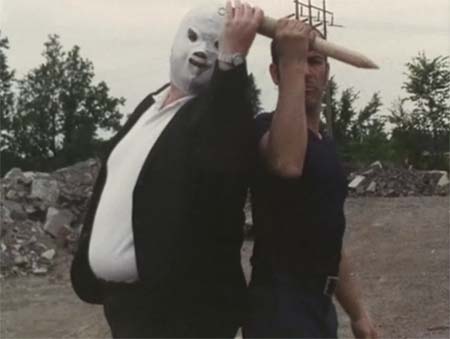
Still from Horror Rises from the Tomb (1973)

WHY IT WON’T MAKE THE LIST: Horror Rises is a worthwhile, but not quite exemplary, illustration of the tendency of 1970s Eurotrashy fantastique horror to elevate atmosphere and effect over sense and logic. Made out of equal parts camp, decadence, and incoherence, it’s a decent choice for a midnight viewing some evening when you don’t want to think too hard while getting some pre-bedtime chills.

COMMENTS: Most of the plot developments in Horror Rises from the Tomb need to be prefaced with the phrase, “for unclear reasons…”  When invited to a seance with a medium, swinging playboy Hugo suggests they contact an ancestor of his who was hanged for practicing witchcraft (and vampirisim and lycanthropy), then decapitated so his head and body could be laid in separate graves to prevent him from rising from the tomb.  The same warlock ghost has been haunting Hugo’s artist pal, dripping blood from his severed head on his canvases.  After successfully contacting the spirit, Hugo, the painter and their girlfriends travel to Hugo’s isolated country estate to go digging for the head but are waylaid by bandits, then rescued by vigilantes who execute the criminals on the spot.  Upon arriving the foursome hires village locals to dig up the head, or buried treasure, whichever they find first.  Halfway through the movie, after the cast is mostly dead or possessed, the caretaker’s daughter remembers that her father hid a magic talisman that would protect them from any evil spirits that would rise from the nearby tomb in a well.  Besides possession, the warlock also creates a mini-army of walking corpses, and when daylight comes Hugo goes to dredge up their corpses from the river (where he dumped them earlier—for unclear reasons) and burn the bodies, even though he already incinerated them the night before.  And so it goes. The storytelling is jumpy—characters are killed off before you even realize who they are—and awkward editing exacerbates the problem.  According to legend, star Naschy took anywhere between two days to a week to write the script, and it’s easy to believe.   You go into every story segment presuming it’s not going to make sense, and you’re surprised when, on reflection, there’s a hidden logic to some development.  Besides writing the script, Naschy is also credited as playing three roles (the warlock and Hugo are two of them, but somehow I missed the third one). Horror Rises gets by on atmosphere—beautiful, misty Spanish scenery; gorgeous doomed women in gauzy nightgowns; floating heads; zombies; Paul Naschy flinging his black cape about and keeping his bushy arched eyebrows flying at full mast.  There’s also a screechy organ score that is irritating but effective in keeping you on the edge.  The decadent exploitation, in combination with the disjointed storytelling and jittery editing, produces a comic-nightmarish effect typical of 1970s Eruohorrors; it’s a style that can become addictive if you give yourself over to it wholeheartedly.

The version of Horror Rises from the Tomb reviewed here is the edited, full frame version, likely compiled for television broadcasts, that’s commonly found in multiple-movie bargain packs.   This edition cuts out the abundant nudity and most of the gore (including, reportedly, heart-eating) and runs 10-15 minutes shorter than the uncut film.  The frequent edits to produce a TV-friendly, PG-rated product likely increase the incoherence factor, but given the movie’s edited in the purely expository scenes, I don’t believe the complete version makes significantly more sense.  The out of print but widely available BCI/Eclipse DVD contains both cuts of the film, along with a third “clothed” version intended for European distribution that substitutes alternate takes for some of the nude scenes but keeps the blood and guts intact.

WHAT THE CRITICS SAY:

“…there was no denying the strange, unsettling otherness of this film as I watched it in a dark room, illuminated only by my portable black-and-white TV set.”–Troy Guinn, Eccentric Cinema (remembering a 1970s TV broadcast)