Category Archives: Capsules

CAPSULE: THE FUTURE (2011)

DIRECTED BY: Miranda July

FEATURING: Miranda July, Hamish Linklater, David Warshofsky, Isabella Acres

PLOT: A thirtysomething couple decides to adopt a sick cat in one month, during which time they quit their jobs and try to find ways to make their lives more satisfying. The cat (named Paw-Paw) narrates part of the story from her veterinary hospital cage.
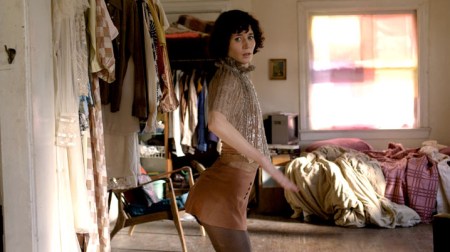

WHY IT WON’T MAKE THE LIST: Populated with just enough flights of fancy to warrant “eccentric” and offering a surprisingly bleak and realistic look at two people on the brink of nervous breakdown while in a crumbling relationship, The Future just isn’t strange enough for a spot on the List.

COMMENTS: Though it opens with the creepy, nasally voice-over of Paw-Paw the cat detailing its rescue by a kind couple, The Future spends most of its time with Sophie (July) and Jason (Linklater).  She is an “overqualified” dance teacher for young girls, he works from home accepting tech support calls.  When they decide to adopt a sick cat, their future spreads before them as nothing but caring for it and then reaching old age after it dies.  Sophie tries to motivate herself to make online dance videos but instead finds solace in an affair with a friendly sign-maker.  Jason becomes “open to everything,” accepting a volunteer position with an environmental group and befriending an elderly pack rat.  As Paw-Paw waits patiently, her soon-to-be owners flounder in the face of self-fulfillment with anxiety-ridden freakouts.

Known in the film world for her quirk-filled debut Me and You and Everyone We Know, writer and performance artist Miranda July is developing definite trademarks.  She once again employs experimental voice-over and somewhat stilted scripting for a portrait of white middle-class romance, but this time her characters are more realized and the emotions more focused.  As Sophie and Jason claw their way through individual bouts of near-insanity, a surprisingly touching story unfolds.  For the most part we are looking at this relationship from the outside in, seeing these characters more often apart than together.  Sophie’s uncertain relationship with sign-maker Marshall and Jason’s curious friendship with elderly chatterbox Joe offer insights unseen in their actual interactions with one another.

This is uncharacteristic for me but I actually found most of the “weirder” parts detrimental to the film overall.  The creepy cat narration and puppet paws feel irrelevant and clashing—it doesn’t move the story forward and it doesn’t increase my sympathy for the cat or the couple.  Sophie’s suddenly animated t-shirt also feels out of the blue.  The best offbeat technique is employed towards the end, when Jason literally stops time so he can sort out his feelings about Sophie’s infidelity, and ends up in a sad conversation with the moon.  It’s a neat trick and sets forth an interesting structure for that segment of the film, and serves to highlight Hamish Linklater—an actor often set in supporting roles—as a performer.

There’s a good amount of twee baggage weighing down The Future.  Some of July’s little touches of style and wry humor are fun, but many drag the focus away from the central story unnecessarily.  The writing and characterization just aren’t tight enough.  It is at times a beautiful and heartbreaking film, and even quite funny at others, but viewers need to wade through a lot of excess in order to hit upon the most effective points.

WHAT THE CRITICS SAY:

“‘The Future,’ July’s coy and precious new film, is just oddball enough to be interesting, if not good.” –Peter Rainer, Christian Science Monitor (contemporaneous)

CAPSULE: PERFUME: THE STORY OF A MURDERER (2006)

366 Weird Movies may earn commissions from purchases made through product links.

DIRECTED BY:

FEATURING: , Dustin Hoffman, Alan Rickman, Rachel Hurd-Wood

PLOT: An apprentice perfumer in pre-Revolutionary France sets out to make the perfect scent, a task that requires him to murder thirteen beautiful virgins.

WHY IT WON’T MAKE THE LIST: Although its choice of protagonist—an orphaned serial killer with a superhuman sense of smell—certainly proves that Perfume is out of the ordinary, it’s mostly just a period drama punctuated by bursts of black humor, with most of its weirdness concentrated in the orgiastic finale.

COMMENTS: Adapted from Patrick Süskind’s novel of the same name, Perfume: The Story of a Murderer feels like a lavish epic as it traverses 18th century France, stopping to sniff out every scent (good or bad) along the way. German director Tykwer (of Run Lola Run fame) shows us the urban squalor of Paris, the expansive majesty of the countryside, and the perfume mecca of Grasse through the eyes and nose of Jean-Baptiste Grenouille (Whishaw), our amoral and barely verbal anti-hero.

With his unsurpassed olfactory prowess, Grenouille wonders at all the scents in the world, yet is perpetually enraged: he can’t capture them all, and he lacks a personal scent. As far as his nose is concerned, he’s a cipher, a nonentity. His response to these inner crises is to study the secret art of perfuming under the tutelage of the self-absorbed Baldini (Hoffman), then migrate to Grasse, where he hatches his elaborate, murderous master plan.

This plan forms the centerpiece of the film, as Grenouille kidnaps and kills Grasse’s young maidens one after another, distilling their scents through the technique of enfleurage. Perfume spares little sentiment for the victims, focusing instead on how their deaths contribute to Grenouille’s angelic-smelling magnum opus. The film even juxtaposes Grenouille’s reign of terror with the authorities’ botched investigation in a blackly comic montage, all the better to highlight its anti-hero’s messianic, above-the-law status.

Like any rogue with a rise-and-fall character arc, Grenouille eventually gets arrested and tortured.  But after his solemn march to the town square for crucifixion, Perfume loses all resemblance to other crime thrillers past or present and begins to look like an excerpt from Ken Russell‘s richest, most elegant fantasies. I won’t give away the climactic twist, except to say that it indulges all of the film’s wildest, most spectacular urges.  By the time a drop of perfume falls on a Paris street in the last shot, there’s little for the viewer to do but gape at Tykwer’s mad bravado.

The rest of Perfume isn’t quite so magnificently over-the-top, but Tykwer complements Grenouille’s obsessions by zeroing in on one sensuous piece of period detail after another, all in a futile but nonetheless impressive attempt to visually capture scent. And although Whishaw dominates much of the film, the supporting cast occasionally steals the show: Hoffman provides tragicomic relief as a desperate has-been; Rickman brings his laconic grace to the role of a Grasse nobleman and overprotective father; and John Hurt’s mordant narration frames the whole endeavor as a bleak fairy tale.

Perhaps the greatest irony about Perfume is that although it was a massive, expensive undertaking, it still feels cultish and off the beaten path. It’s so morbid, thorny, and perversely funny that it’s hard to believe it could ever have much mainstream appeal. But imagine sniffing the fumes that would rise if you blended a picaresque costume drama with a slasher movie, then heaped on a thick broth of style.  That, more or less, is Perfume.

WHAT THE CRITICS SAY:

“… a tale whose off-the-charts screwiness obscures virtually all shortcomings.”–Nick Schager, Lessons of Darkness

CAPSULE: DEEP RED [PROFONDO ROSSO] (1975)

366 Weird Movies may earn commissions from purchases made through product links.

Recommended

DIRECTED BY: Dario Argento

FEATURING: ,

PLOT: A pianist witnesses the brutal murder of a psychic and becomes obsessed with tracking down the killer, even though everyone he associates with is being slaughtered.

 Still from Deep Red (1975)

WHY IT WON’T MAKE THE LIST:  Not quite weird enough.  Deep Red flirts with the irrational, but at this stage of his career director Argento hadn’t fully committed to the bizarre yet.

COMMENTS: Previous to Deep Red, Dario Argento had made three stylish, well-regarded gialli (for those unfamiliar with the Italian giallo genre, imagine a slasher movie with an actual whodunnit plot and a near-Gothic atmosphere, and add bad dubbing). With Deep Red, the director turned up the style meter several notches, and pushed further into his own esoteric brand of the fantastique: the Expressionist flowers that bloom in Suspiria grow from the blood spilled in Deep Red. Still pitched as a traditional mystery, Deep Red does not abandon the primacy of plot, but the story becomes so convoluted, and makes so many concessions to atmosphere, that it begins to bear hallmarks of weirdness. The film begins with a shadow-play prologue that reenacts a Yuletide murder, then segues into a parapsychology conference held inside a scarlet-cloaked opera house. A panel of experts discuss telepathy in zebras (!) and then introduce a psychic, who senses the presence of an evil soul in the audience. During her subsequent brutal murder, a pianist played David Hemmings witnesses the murderer leaving the scene of the crime and becomes obsessed with tracking down the killer (who strikes again several times). Although the tale is intricately constructed and the resolution itself “makes sense,” the movie takes fairly arbitrary steps in its quest for closure. Drive-in film critic Joe Bob Briggs used to have a saying, “this movie has so much plot it’s like it doesn’t have any plot at all,” an adage that fits Deep Red perfectly. The story takes leaps that aren’t always clear to the viewer. Barely introduced to each other at the scene of the crime, Hemmings and a female photographer (Nicolodi) suddenly begin working as a team to investigate the murder. Hemmings is constantly following up on obscure clues, Continue reading CAPSULE: DEEP RED [PROFONDO ROSSO] (1975) →

CAPSULE: BLOOD SABBATH (1972)

DIRECTED BY: Brianne Murphy

FEATURING: Anthony Geary, , Sam Gilman, Susan Damante

PLOT:  A Vietnam veteran falls in love with a water nymph, but she can’t love a man who has a soul; the local topless witches’ coven offers to get rid of his for him.

Still from Blood Sabbath (1972)

WHY IT WON’T MAKE THE LIST: Because, let’s face it, the movie’s terrible.

COMMENTS: Sometimes, exploitation movies are so rushed and cut so many corners that they become incoherent and unintentionally strange.  Cases where movies aimed at a six-pack swilling Friday night crowd dare to be intentionally bizarre are far less common.  Blood Sabbath is an ultra-rare example of a jiggle-fest that manages to be weird in both ways.  The story of a world-weary vet who walks to Mexico, falls in love with a water spirit, and sells his soul for love could have made for an odd enough little modern fairy tale, played straight.  But, instead, Blood Sabbath begins with a scene of a gang of longhaired peaceniks luring our hitchhiking hero to their flower power van so they can spray him with beer and taunt him with the dangling melons of a topless hippie chick as they zoom off into the sunset.  Then, a gang of picnicking naked women (including mammacious nudie fave Uschi Digart) try to pants the harried soldier and chase him until he rolls down a ravine and gently knocks himself unconscious.  The casually introduced fantasy elements—water sprites, the witches coven that demands an annual blood sacrifice from the local peasants—and the solemn tone make this an unusual enough drive-in horror movie, but the way the director seizes any opportunity to put a naked woman on screen, regardless of logic, is its weirdest, and its defining, feature.  In the course of the movie we discover that topless go-go dancing is a much bigger part of Satanism than anyone realized, and being sacrificed at a black mass turns out to be surprisingly similar to getting a lap dance.  The flick is amazing, and amusing, in its shamelessness.  The thespianship is abysmal all the way around; the quiet, tormented village priest who occasionally explodes into loud, dramatic bouts of anguished “acting!” is the worst offender.  Campy though her performance may be, future Ilsa, She-Wolf of the S.S. Dyanne Thorne (playing a witch-queen named “Alotta”), emerges as the best actor in the troupe (though the guy who plays the hermit who looks like Lloyd Bridges caught in the early stages of werewolf transformation isn’t half bad).  Of course, it would be hard for anyone to shine when reciting lines like “take my soul, damn you!” and “It’s David.  He came into the cave with blood all over him.  Sacrificial blood!”  Ensorcellment is indicated by the usual array of low-budget acid trip clichés: double images, solarization, colored filters, and zoom-lens abuse.  A random shot of David cradling a dying solider suggests it’s all an allegory for America’s experience in Vietnam, or something.  Though it’s pretty terrible, it’s seldom boring, and you already knew whether you were in this film’s target audience or not when you reached the lines “taunt him with the dangling melons of a topless hippie chick…”  With its eerie fairy tale + naked lady formula, I wouldn’t be shocked to learn that director Murphy had been inspired by the previous year’s (much better) Girl Slaves of Morgana le Fay.

Some jokes are just too easy.  I was going to quip “this movie should be called Boob Sabbath,” but when I went looking for a critical quote, I found that someone (probably many people) beat me to it.  Great minds think alike.

WHAT THE CRITICS SAY:

“…this bizarre cross between seventies witch movies, NIGHT TIDE, LOVE STORY and ORGY OF THE DEAD, with romantic meadow-romping, tepid gore effects, crass exploitation… and bad acting is, in a word, awful.”–Dave Sindelar, Fantastic Movie Musings and Ramblings (DVD)

CAPSULE: TROLLHUNTER [TROLLJEGEREN] (2010)

DIRECTED BY: André Øvredal

FEATURING: Otto Jespersen, Glenn Erland Tosterud, Johanna Mørck, Tomas Alf Larsen, Urmila Berg-Domaas

PLOT: Three journalism students traipse about the Norwegian countryside following a

mysterious poacher, only to discover he is a government-funded troll hunter trying to contain an outbreak of monsters in the mountains.

WHY IT WON’T MAKE THE LIST: Though a troll-themed found footage horror/comedy sounds like a novel concept, for the most part TrollHunter is a straightforward and predictable—and enjoyable—horror flick.

COMMENTS: Building slowly up to its fantastical pay-off and composed of edited footage purportedly sent anonymously to a news station, TrollHunter begins with Thomas (the reporter), Johanna (the sound woman), and Kalle (the rarely-seen camera operator) driving through the Norwegian mountains after suspected bear poacher Hans. There’s something fishy going on with this guy, as evidenced by his strange, solitary habits and tricked-out hunting truck, and they aim to find out exactly what’s up.  When they finally catch up with him, they learn firsthand that he’s an honest-to-goodness troll hunter, employed by the government to protect humans from troll attacks.  An entire troll subculture is explored and explained matter-of-factly; they’re like a typical woodland animal species, only ten times bigger and wholly improbable.  They’ve been breaking out of their contained areas and wreaking havoc lately, so it’s up to Hans and his new camera crew to determine the cause.

Hans’s gruff and fed-up line deliveries coupled with the students’—especially Thomas’s—befuddled reactions make for much of the film’s cheeky comedy, but they rarely elicit big laughs, keeping an understated atmosphere for most of the running time.  Of course, when the actual trolls come into play, action and thrills take precedence.  Director Øvredal makes good use of unseen monsters and intense sound effects, injecting the affair with fear of the unknown more than anything else.  The trolls are well CGI-ed, kept primarily in dark lighting; the effects showcase several different monster designs.  The shaky-cam vérité style can be taxing at points, but overall the first-person camerawork is incorporated effectively.

TrollHunter is the kind of genre mash-up that doesn’t lean to any one side.  Many will think it should be much funnier, or much scarier, or both. Personally, I appreciated its low-key approach.  The story and characters are interesting enough to keep the momentum going, and the gorgeous Scandinavian scenery and multiple gruesome troll bouts are entertaining to the eye.  Some of the specifically Norwegian references are likely lost on outside viewers, but this look into Norwegian folklore is never abstruse or alienating.  For the most part, it’s just fun!

WHAT THE CRITICS SAY:

“With impressive technical credits, stunning fjord and forest locations and a winking ownership of its own absurdity, ‘Trollhunter’ manages to be at once spooky, satirical and endearing.” –Colin Covert, Minneapolis Star Tribune (contemporaneous)