Category Archives: Capsules

IT CAME FROM THE READER-SUGGESTED QUEUE: WAVE TWISTERS (2001)

366 Weird Movies may earn commissions from purchases made through product links.

AKA DJ Qbert’s Wave Twisters

DIRECTED BY: , Eric Henry

FEATURING: DJ Qbert, Yoga Frog, D-Styles, Flare, Buckethead

PLOT: When the dastardly Lord Ook deprives Arrow Town of the Four Lost Arts of Hip Hop — rhyming, scratching, breaking, and graffiti — it’s up to an intergalactic crew of dentists to liberate the town through the power of sick beats.

Still from "Wave Twisters" (2001)

COMMENTS: Faced with a video album based on the musical stylings of a national and world champion DJ known as the Jimi Hendrix of the turntable, the last thing I would have expected was a coherent narrative. Yet that is what we get in Wave Twisters, a hip-hop sci-fi musical in which rapid-fire scratching and carefully chosen radio drama samples combine to tell a story that would have been at home in the days of Buck Rogers and Flash Gordon. From the outset, the movie’s strongest claim to weirdness is that it’s so unexpectedly linear and focused. 

Don’t mistake that for any pretensions of depth. The story would not be out of place alongside the cheap sci-fi serials shot in Bronson Canyon in the 40s and 50s; strange aliens attack, and a group of square-jawed heroes save the day, complete with cliff-hanging chapters that slowly advance the conflict. It remains first and foremost a platform for the real star, DJ Qbert’s scratching wizardry. Qbert’s album came first, and it was up to directors Garon and Henry and co-writer/art director Doug Cunningham to transform the soundscape into a visual tale, while leaving Qbert’s original work intact. Considering the challenge, the result is impressive, with a charming comic book feel that takes advantage of limited animation. The images lend a broader sense of humor to Qbert’s sardonic wit; the DJ may have enjoyed finding a snippet of a classic serial villain declaring, “I am the Red Worm!,” but it’s the filmmakers who add lascivious gloss by putting that dialogue in the mouth of a symbiotic parasite residing in the navel of a baby in a luchador mask.

Perversely, it’s the beats that inadvertently drag down the story. With all the tunes working at roughly the same BPM, there’s not much variety in the energy, and you can feel the story slowing down to keep pace with the score. For example, a side trip wherein graffiti expert Honey is captured by the enemy is intriguing, especially as she is transformed into an ostrich. It looks cool, but it’s a dead end for the plot, and overlong as an eye-catching visual. Similarly, set pieces like an assassin stalking the crew down a hallway are tense for the first few seconds, but in short order the repetition becomes tiring. The visuals are in sync with the soundscape, but they never quite harmonize.

If nothing else, Wave Twisters is worth the watch to see Qbert and his colleagues in action. Amusingly, they are deployed in live action as agents of the bad guys, using their rapid-fire scratches and sonic tweaks as weapons against enemies of the state, but it’s remarkable watching them do their thing at breakneck speed. If it takes a wacky tale from the Golden Age of Science Fiction to show off the awesome instrumental power of the turntable, then by all means, get those dentists to space on the double.

WHAT THE CRITICS SAY:

“‘Plot’ clarity ain’t a high priority here, as ‘Wave Twisters’ blitz-riffs on everything from hip-hop and sci-fi mythology to vidgames, toys, Japanese anime, manga tomes, Godzilla pix, Hanna Barbera-style toons, even retro dental-hygiene ads. The in-jokes and absurdist gags fly by so fast that many viewers will be eager to re-experience pic on DVD and other manipulation-friendly formats.”–Dennis Harvey, Variety (contemporaneous)

(This movie was nominated for review by Katie. Suggest a weird movie of your own here.)

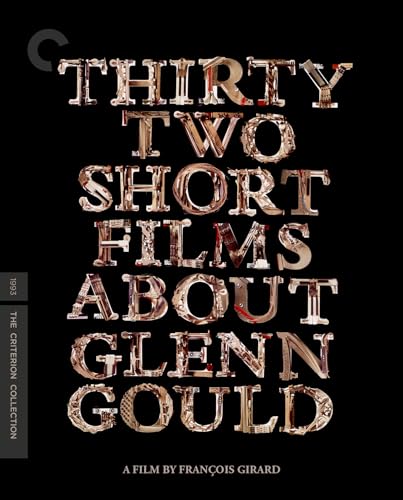
CAPSULE: THIRTY TWO SHORT FILMS ABOUT GLENN GOULD (1993)

366 Weird Movies may earn commissions from purchases made through product links.

DIRECTED BY: François Girard

FEATURING: Colm Feore

PLOT: A patchwork of short vignettes explores the allure of the eccentric piano virtuoso.

Still from thirty two short films about glenn gould (1993)

COMMENTS: I discovered my all-time favorite recording, Glenn Gould’s complete “The Well-Tempered Clavier,” and François Girard’s Thirty Two Short Films About Glenn Gould at about the same time. I can’t definitively remember which I encountered first: my guess would be Girard’s film, because it is such an effective advertisement for Gould’s genius that it seems likely to have inspired a purchase. On the other hand, it’s entirely possible that I saw there was a film out about this marvelous pianist who accompanied his nimble fingers with ecstatic spontaneous humming,  breathing humanity into Bach’s precise baroque miniatures, and knew I had to learn more about this man. I do know that Gould’s “Clavier” was reissued in on CD in 1993, likely to coincide with this film, and I love to imagine I actually picked up that set from Tower Records and rented a VHS of Thirty Two Films from my local mom and pop video store on the same weekend in 1993 or 1994.

The movie does what it says on the tin (although some might object to calling the closing credits a “short film.”) The sequences break down into four main categories: documentary-style interviews with friends and co-workers, dramatic reenactments of events in the pianist’s life, adaptations of Gould’s own works, and abstract experimental sketches. The interviews are illuminating, and give the film its hybrid documentary character. The dramatic scenes form the bulk of the movie. They follow in a roughly chronological format, but do not tell a continuing story: each is a standalone vignette. Memorable moments show Gould corralling his hotel chambermaid to listen to his hot-off-the-presses LP and the Gould mesmerized by contrapuntal conversations he hears in a diner. A performance of “String Quartet, Opus 1,” one of his few original compositions, an excerpt from the word collage “The Idea of North,” and a dramatization of a portion of his puckish essay “Glenn Gould Interviews Glenn Gould About Glenn Gould” ground us in the legend’s actual creative output. The experimental shorts constitute the most intriguing category, although there are only five or six of them (considering how you count). They include closeups of Gould’s own CD318 piano in action, hammers striking the soundboard, illustrating the physical geometry of the sonic construction; a scene of Gould playing the piano in x-ray vision; and “Gould Meets McLaren,” a 1969 animated short (originally entitled “Spheres”) that shows globes popping into existence, dancing symmetrically across the screen, and dividing like eggs undergoing musical mitosis as Gould plays a Bach fugue.

I once defined bopic as “a movie genre that’s not accurate enough to be documentary or interesting enough to be fiction.” One of the most formulaic and cliched film formats, the celebrity biography only really works when it is heavily fictionalized, as in Amadeus or Lisztomania (which, coincidentally, both involve classical musicians). Thirty Two Short Films shatters the mold of this generally insipid movie genre. There are enough talking head reminiscences to capture the spirit of the man, but not so many that it appears lazy. Girard solves the genre’s central problem—the fact that messy human lives rarely fit neatly into three act structures with unified themes—by ignoring narrative almost entirely. This collage portraiture method captures its subject more faithfully than a “realist” approach would. When we think back on people we know, we recall them as a collection of moments and characteristics; we don’t think of them as a contiguous life story. Glenn Gould was the piano prodigy and the hypochondriac and the man who went everywhere wrapped in a coat and gloves and scarf and the man who called up his friends late at night and talked their ears off and the virtuoso who developed a hatred for performing and the monster who put ketchup on his eggs and the genius and the possibly asexual hermit. He is at least thirty two separate stories, and this seemingly chaotic collection of vignettes creates a portrait of a real person far better than a tick-tock chronology or a forced storyline would. Plus, the music is, naturally, great, and what Gould himself likely would have wanted us to focus on; his passion shines through every segment, turning almost anyone into a classical music fan for at least 90 minutes. Glenn Gould is a strong contender for the greatest biopic ever made.

Thirty Two Short Films About Glenn Gould entered the Criterion Collection in June 2025 on 4K UHD and Blu-ray. Of course it is a new 4K director approved transfer. Of course it comes with a booklet (a nice fold out broadsheet with titles and scenes from the shorts on the other side) with an informative essay (from Michael Koresky.) Of course it has a director’s commentary (Girard is joined by co-writer Don McKellar). Other extras include a thirty minute conversation between Girard and fellow Canadian director Atom Egoyan, archival interviews with star Colm Feore and producer Niv Fichman, and a two part 1959 television portrait called “Glenn Gould: Off the Record” and “Glenn Gould: On the Record.”

WHAT THE CRITICS SAY:

“…because of the deadening uniformity of the genre, Girard’s film appears all the more miraculous in retrospect. From its rigorous and deliberately distancing structural gambit to its restless stylistic experimentations, Thirty Two Short Films proves that biopics needn’t color within the lines to effectively portray their subjects.”–Derek Smith, Slant (Blu-ray)

[(This movie was nominated for review, without further comment, by “Anonymous.” Suggest a weird movie of your own here.)

CAPSULE: SNORKELING (2025)

366 Weird Movies may earn commissions from purchases made through product links.

DIRECTED BY: Emil Nava

FEATURING: Daniel Zolghadri, , Tim Johnson Jr.

PLOT: Teenagers Michael and Jameson start a relationship while delving deeper and deeper into the trippy landscapes concocted in their minds by a trendy psychedelic inhalant.

Still from Snorkeling (2025)

COMMENTS: Disaffected teens have been fertile ground for cinematic drama for decades. Going back to Rebel Without a Cause, and probably well before, young people have sought out entertainment that gets them, and the movies have responded with tales of kids whom the squares refuse to get. Snorkeling is a proud inheritor of that tradition, and seems especially in tune with a moment where teenagers are too beaten down to rebel; they just want to escape.

Snorkeling finds America’s youth in an especially despondent mood, and it’s hard to blame them. We only catch glimpses of adults, but the world they’ve created for their kids is a selfish one; they’re dedicated to satisfying themselves, leaving nothing behind for the next generation. We hear from several teenagers in quasi-documentary segments where they explain their rootlessness and highlight the relief that snorkeling brings. Our guides through this defeated landscape are Michael, a half-Iranian pothead who affably goes through his days just trying to put it all behind him, and Jameson, an effervescent young woman with a home life she is so over. (One suspects that her father named her after a bottle of his favorite spirit.) She introduces Michael to a new kind of high, and they embark upon a curious push-pull relationship where he always tries to get closer, and she’s always anxious to get away.

Looking inside their drugged-out world doesn’t tell us much about its appeal. Scenes take on a pink hue, featureless bodies writhe in the sky, and everyone seems to be caught up in a blissed-out, laid-back hippie vibe. Every now and then, the disconnect is so intense that characters literally become animated, swirling around in a hand-drawn fantasia for a few seconds of true escape from the real world. (These are the moments that take the most advantage of Nava’s background as a go-to music video director for stars like Ed Sheeran, Calvin Harris, and Eminem.) We have to take it on faith that this is as satisfying as the characters tell us it is. But while these peeks inside the hallucinations are mildly interesting, the truly shocking images are what these cosmic travelers look like back in our world. They’re half-comatose bodies, staring blankly into the sky with oxygen masks strapped to their faces, as if some titan had picked up a hospital and shaken all the patients out onto the ground. We’re trading one empty room for another.

The big paradox at the heart of Snorkeling is that Michael and Jameson—and presumably all their contemporaries—desperately seek connection, but their solution is to engage in the most isolating activity imaginable. That’s the driving force behind the awkward finale, which feels like adults showed up at the very end and shoehorned in a climax from an ABC Afterschool Special. It’s a relief to see them recognizing the trap they’ve escaped, but it feels stagey in a way that the earlier surreal naturalism did not. Snorkeling has some interesting ideas about the reasons the kids are not alright these days and is very sympathetic about why they’re downright anxious to get away from it all. But the only way out it can think of is to harsh everyone’s mellow. That’s disappointing, but for a little while, it’s a nice mild buzz.

WHAT THE CRITICS SAY:

“…perfectly captures the disaffected mood of a generation through its stunning, hallucinatory visuals and immersive soundscape, creating a potent atmosphere of beautiful despair. However, this stylistic triumph comes at the cost of story and soul. The characters are hollow vessels, and the film’s sanitized portrayal of addiction feels like a profound failure of nerve.” – Naser Nahandian, Gazettely (contemporaneous)

CAPSULE: THE TOXIC AVENGER (2023)

366 Weird Movies may earn commissions from purchases made through product links.

DIRECTED BY: Macon Blair

FEATURING: , , , Jacob Tremblay,

PLOT: A mild-mannered janitor becomes an avenging superhero after being thrown into a vat of toxic waste.

Still from THE TOXIC AVENGER (2023)

COMMENTS: The idea of Hollywood types spiffing up an old script for a polished take on the underground exploitation studio’s punk sensibilities is inherently intriguing. And although some might miss the Jersey grime and DIY nihilism, there’s enough of a novelty factor to the whole enterprise to make the new Toxic Avenger worth a look.

Right away, you can tell that little things like editing, lighting, and cinematography far surpass ‘s capabilities. Not to mention, of course, the acting. (If you can even name an actor from another Toxic Avenger movie, you’re a real fan.) Who wouldn’t be curious to see Peter Dinklage, Kevin Bacon, and Elijah Wood ham it up in Tromaville? Even the supporting characters with less name recognition, Taylour Paige and Jacob Tremblay, blow away most Troma performers, who tend to be broad comic caricatures who come across more through costuming and outrageousness than through line deliveries. The stars don’t sleepwalk through the project, either. Dinklage gives it his all, putting real pathos into Winston Gooze, snuffling in terror and even donning a pink tutu at one point. Bacon has as much of a ball as you would expect as a soulless and unscrupulous corporate huckster with his own mad science dungeon in the basement of his mansion. Wood is nearly unrecognizable as a pasty-faced, Penguin-like chief of security with a bizarre hairdo (he’s balding, but with one exceptionally long wisp of hair growing from the front of his crown).

The major tonal change is that this new Avenger sports conspicuously more heart than Troma’s cynical output. The script goes out of its way to show us that Winston is a decent man, whose only flaw is that he’s overly meek. A widower, Winston takes his responsibility as sole provider for surly teen stepson Wade seriously. Maybe he lacks the courage to stand up to a slumlord who’s harassing his grandmotherly neighbor, but he will instinctively risk his life to save her cat from an oncoming car. When he’s diagnosed with an unspecified fatal illness from mopping up toxic waste all day to feed his family, and then denied lifesaving care by healthcare bureaucrats, he generates legitimate sympathy. And the Avenger’s ultimate targets—corporate scallywags poisoning the populace, not just teen bullies as in the original—make for a noble cause. Paige’s J.J. is an activist, a legitimate self-sacrificing idealist in the usually everyone-for-themself Tromaville. Whether these changes represent a welcome humanizing touch, or a sellout of Troma’s laugh-while-burning-society-to-the-ground ethos, is a matter of personal taste. I think it generally works.

What the remake keeps from Troma is the reliance on comic violence and gore, which is in fact amped up to even higher decibels. Yep, arms get yanked off and heads split open aplenty, and the finale sprays megagallons of blood. The makeup also hearkens back to Troma’s glory days; the Avenger has an inarticulate rubber mask, and the chief baddies (a “horrorcore” band called the Killer Nutz) feature characters like a giant chicken with a mohawk. The comedy, however, misses even more than a Troma production. I didn’t hear a single hearty laugh ringing out at a lightly-attended screening, only occasional muffled chuckles. The humor is not transgressive or politically incorrect in the slightest; targets are kept safe (who could be offended by making fun of health insurers or narcissistic CEOs?) The mostly PG-13 jokes are similar to, but not quite as funny as, those in Attack of the Killer Tomatoes. It would have been nice to see the script go a little harder; one of Troma’s few virtues is their willingness to be equal opportunity offenders.

In the end, the new Toxie is neither the disaster nor the success it might have been. At a minimum, it fulfills what the project promised: a look at what the 80s superhero spoof might have looked like with a reasonable budget. It corrects some of the original’s shortcomings, but abandons some of the outsider charm in the process. Next up: a big budget remake of Pink Flamingos with RuPaul as Divine, Pedro Pascal and as the Marbles, and Lizzo as the Egg Lady.

WHAT THE CRITICS SAY:

“…a weird, messy, heartfelt little beast that finds a surprising amount of soul beneath its buckets of blood…  Against all odds, The Toxic Avenger has grown up, just a little, without losing the sense of gonzo fun that made him a cult legend.”–Nicolas Delgadillo, Knotfest (contemporaneous)

CAPSULE: DREAM HACKER (2025)

366 Weird Movies may earn commissions from purchases made through product links.

Dream Hacker is currently available for purchase or rental on video-on-demand.

DIRECTED BY: Richard Colton

FEATURING: Molly Hanson, Luke J I Smith, Gary Webster, Hannaj Bang Bendz

PLOT: A brilliant scientist creates a machine which enables the user to hijack sleepers’ minds, and her dream to use the technology for psychotherapy is thwarted by sinister forces.

Still from dream hacker (2025)

COMMENTS: This felt very much like a middling science fiction show from thirty years ago—albeit a fairly charming one. An earnest psychiatrist (with more than a little savvy in the field of computing and cybernetics) wants to improve the world, one trauma-sufferer at a time, with an enhanced doo-dad allowing her access to their subconscious. Her machinations result not only in such a device, but also an artificial intelligence to guide her through both the dreamscape (a slightly purple-tinged forest clearing) and the concurrent possibilities of remote body control. A glowing headset, a charismatic avatar, obscure government meddling, a sinister tech-conspiracy—it’s all here, and it all ambles forward in a cutesy thriller  kind of way.

Doctor Jennifer Connelly (no, that not one, as clarified during an early scene with a woefully man-bunned blind date) is an unlikely heroine, which is apt considering her naïvety about mankind’s more sinister ambitions. She is awkwardly charming: an American plopped into a metro-collegiate British milieu. (I swear, it seems you couldn’t toss a Beefeater in this movie without hitting one of the hundreds of iconic structures that litter the greater London area.) Her mentor has a tragic history which flirts with the pathetic, and the primary villain is of unclear national extraction.

Jennifer finds herself testing the machine for the first time immediately following the regrettable blind date, waking in the body of a waitress/stripper in Florida. Adam, the artificial intelligence she discovers in her program, combines nigh-omnipotence and simple charm. He, too, can take over (sleeping) bodies, and can otherwise manifest a visible form to Jennifer using the unspecified powers of “science.” The baddies muddle along attempting to kidnap Jennifer, whilst Jennifer and Adam hatch their own plan involving help from the stripper. This and other relationship story-drops are tied in and around the overarching narrative arc towards a rom-com-ish finish.

So, this thing was cute: a big, big, big idea put in service by a plucky adventurer, her computerized friend, and a kooky stripper. I am left with no complaints , except an unlikely one. I kind of want more of this breezy nonsense. Dream Hacker unspools as perfectly as a feature-length pilot for mid-90s science fiction television show. Its goofiness, disregard for grand implications, and laser-focus on the affable leads would demand at least half of a season before the network cancels it.

WHAT THE CRITICS SAY:

“Its execution and thematic concerns feel spiritually aligned with ambitious, slightly strange cult films like David Cronenberg’s eXistenZ, which also explored the porous line between a simulated reality and the physical world… a compelling genre piece for a specific viewer: one who appreciates intelligent, idea-driven sci-fi and is willing to forgive a few rough edges in service of a greater creative vision.”–Ahi Ho, Gazettely (contemporaneous)