Category Archives: Capsules

CAPSULE: HARVEST (2024)

366 Weird Movies may earn commissions from purchases made through product links.

DIRECTED BY:

FEATURING: , , Arinzé Kene, Frank Dillane,  Rosy McEwen, Thalissa Teixeira, Neil Leiper

PLOT: Life in a Scottish farming village changes dramatically with the arrival of a new lord.

Still from Harvest (2024)

COMMENTS: In a nameless village in an uncertain time—sometime after the arrival of tobacco, but before the Industrial Revolution has reached rural Scotland—Walter (Caleb Landry Jones) eats bark and sticks his tongue into a knothole on an oak tree. You can’t get much more at one with the land than that.

The village Walter lives in has no name. That changes when a chart-maker comes to map out the area. The natives see cartography as a threat; naming things is the first step to owning them, and the village operates (although somewhat hypocritically) on the principle of communal ownership of the land. Not that these people are noble savages, exactly; they’re as cruel, superstitious, and racist as they are poor. Walter wasn’t born there, but married a native and is now a widower; he is a close confidant of the beneficent landowner Master Kent, also not native born. He is a semi-outsider, caught between worlds, not fully accepted by the villagers but lacking another place to call home. His liminal status turns him into an observer. He befriends the cartographer, but also scolds him for “flattening” the land by mapping it. Walter is also spineless, sensing danger but as unable to stop progress from marching into the literal one-horse town as is the weak-willed Mater Kent. A fire in the Master’s stable foretells evil to come. Then, three outsiders are pilloried—for the crime of being outsiders. Walter is the only one who sympathizes with the trio,  but he is unable to muster the strength or courage to challenge any decision of the powers that be.

Harvest is beautifully shot (sometimes reminiscent of the “harvest” subgenre of European painting) and impressively scored (one peasant threshing song is synced to the rhythm of swinging scythes). But the storytelling is confusing, the dialogue can be stiff, and the feckless protagonists supply little dramatic momentum as the story limps to its inevitable conclusion. The “hallucinatory” element suggested in Harvest‘s promotional materials is vastly oversold; in truth, the strangeness (mostly coming from the slightly alien behavior of the village’s peasants) never rises beyond the occasionally odd. Nor is the movie, as a few have claimed, folk horror (there’s plenty of folk, including some authentic-sounding bagpipe tunes, but no real horror). With this project, director/co-scripter distances herself from her association with the “Greek Weird Wave,” delivering an on-the-nose exploration of the ruthlessness with which capitalism replaced agrarian societies. Weirdophiles may safely skip this one; arthouse fans with a taste for historical, class-conscious narratives might find it worthwhile.

WHAT THE CRITICS SAY:

” Smatterings of the earthy, the occult, the hallucinatory and the neo-realist never coalesce into a pacy narrative…”–Carmen Paddock, The Skinny (contemporaneous)

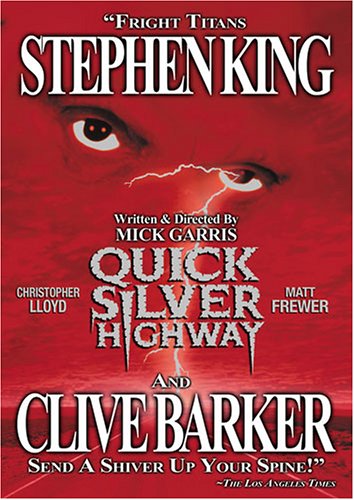
IT CAME FROM THE READER-SUGGESTED QUEUE: QUICKSILVER HIGHWAY (1997)

366 Weird Movies may earn commissions from purchases made through product links.

DIRECTED BY: Mick Garris

FEATURING: Christopher Lloyd, , Raphael Sbarge, Missy Crider

PLOT: The mysterious Aaron Quicksilver shares two tales of ill-fated individuals: a traveling salesman who encounters a suspicious set of novelty clattering teeth, and a plastic surgeon who finds that his hands have developed minds of their own.

Still from Quicksilver Highway (1997)

COMMENTS: Horror on television is a tricky proposition. The genre frequently relies upon visceral shock and gore, elements too unseemly for broadcast, which is why the most successful series either emphasize psychological terror or abscond to cable where the standards are looser. But Bless Mick Garris for continuing to try. He is responsible for five Stephen King TV adaptations, including takes on classics The Stand and The Shining. Plu,s he’s well-versed in the televised horror anthology, with credits in “Tales from the Crypt,” “Freddy’s Nightmares,” and “Masters of Horror.” If anyone is going to make Quicksilver Highway work, it’s Garris.

He doesn’t, though. That’s not necessarily his fault, of course. The film is a busted pilot, with two unrelated episodes inelegantly slammed together. They both traffic in body horror, a genre that is never going to get a fair hearing on network TV. The small-screen budget is also a limitation, with simplistic special effects (including some terrible CGI) and overly broad acting. The stories are also heavily padded to fill out 45 minutes apiece, with long diversions into pointless philosophical debates and weak character monologues arriving right at the moment when the story really needs to be gaining steam. Mostly, though, the finger needs to be pointed at the material, which is best described as “better on paper.” Neither of these are horror short story classics from genre masters King and Clive Barker, but one can see how they managed to create a sense of unease though their unlikely subjects. But visualizing them, without the reader’s imagination to hide behind, reveals them as low-stakes and low-impact. 

The King story, “Chattering Teeth,” relies upon a familiar trope from the author, an innocent-looking object that carries with it bad juju and sinister intent. A classic monkey’s-paw scenario. In this case, the object is an oversized set of windup walking choppers, which the protagonist somehow imagines is going to be the perfect gift to appease his disappointed son. When the novelty mandibles attack a nasty hitchhiker, it’s impossible to see it as anything other than an actor forced to pretend-wrestle with a goofy prop. The teeth need to have a “creepy doll” vibe in order to work, and they just don’t.

The second tale, Barker’s “The Body Politic,” finds greater success by indulging in sublime silliness. Here’s a villain we can get behind: human hands which have somehow become imbued with the spirit of Che Guevara, calling for liberation from the oppression of being attached to Matt Frewer. They are ridiculous little gremlins, speaking to each other with Smurf-like voices and hyperactively gesturing at each other while plotting their revolution. They’re risible, but they benefit from a couple solid jump-scares and the full commitment of Frewer, who actually does some pretty nifty acting with opportunities for his face and his hands to play conflicting emotions. Once again, though, what probably reads as spectacularly macabre on the page becomes ludicrous on screen, as when Frewer outwits a whole platoon of severed hands by leading them off the roof of a building, resulting in the jaw-dropping sight of dozens of hands flinging themselves into oblivion. I am sure you’re supposed to laugh in shock. The laughter you get is different.

The connective tissue is our good Mr. Quicksilver, a sort of wandering troubadour of the grotesque. He repeatedly insists that his tales have no moral, but contempt for his audience positively oozes out of him. Lloyd is a curious choice for a narrator. Already odd with his spiky red hair, black peasant’s blouse and knee-high leather boots, looking for all the world like Johnny Rotten in a witches’ coven, he’s an actor we often recognize for his manic interior that threatens to break into the open. This puts him at odds with the cool detachment he tries to project, the hint of judgment from on high that we associate with Rod Serling in “The Twilight Zone,” Vic Perrin in “The Outer Limits,” or even David Duchovny in “Red Shoe Diaries.” It’s telling that, the moment he gets someone to join him in his trailer for a pleasant meal, he immediately jumps into an indictment of America as a land of lies and darkness. (He’s not necessarily wrong, but it’s hardly an icebreaker.) It’s hard to understand why someone would sit through his spiel. Intriguingly, one can easily imagine Frewer in the role in a slightly lower-budget version.

Quicksilver Highway isn’t bad, just extremely inessential, an empty-calorie snack that’s not a career highlight for any of its participants. If you’re driving out west and happen to pass by a strange-looking man in a Rolls-Royce towing an Airstream trailer, don’t stop for one of his stories. Not because of the horrible fate that awaits you. But because there are so many better things to do.

WHAT THE CRITICS SAY:

“It’s odd, it meanders, it has unusual moralist tales, and it’s totally goofy. It’s not great, but it has a charm that’s hard to resist.” – Jolie Bergman, Horror Habit

(This movie was nominated for review by Dave Pistol. Suggest a weird movie of your own here.)     

CAPSULE: BEST WISHES TO ALL (2022)

Mina ni ko are

366 Weird Movies may earn commissions from purchases made through product links.

Best Wishes to All is currently available for purchase or rental on video-on-demand.

Recommended

DIRECTED BY: Yûta Shimotsu

FEATURING: Kotone Furukawa, Masashi Arifuku, Yoshiko Inuyama

PLOT: A nursing student returns from Tokyo to visit her grandparents remote village, where she finds they are acting oddly.

Still from best wishes to all (2022)

COMMENTS: We first meet the nameless young star of Best Wishes to All as a kindly nursing student who, based on sinister musical cues and subtle expressions, seems nervous to travel back to the village she grew up in to visit her aging grandparents. Part of her reluctance may be the family’s obsession with happiness. Since she was a young girl, they have been asking her “are you happy?”; her affirmative replies ring uncomfortably insincere. Dim, disturbing memories from childhood centered around bumps in the night and a perpetually locked door in the upper level of the house also give her pause. And perhaps she also foresees her outwardly pleasant grandparents’ odd behavior, such as their tendency to snort like pigs when eating pork.

In fact, their strange habits are accelerating, to the point where the heroine wonders if they might be experiencing dementia. But her own reactions become equally strange as the movie goes on. Relatively early on, the true horror of the situation is revealed; and while, at first, our heroine reacts as expected, then the movie shifts into a more dreamlike register. Beginning with an absurd automotive accident, the semi-logical horror story dissolves into a more impressionistic and nightmarish experience. It goes from ominously eccentric to full-on surreal, ending up in blood, betrayal, and, somehow, a middle aged man dancing in his underwear.

The village nonchalantly accepts the unnatural brutality of the movie’s premise, and the heroine is pressured into believing that this is just the way of the world. The happiness of the lion is the misery of the gazelle. Best Wishes to All posits the logically questionable but metaphorically sound proposition, “does the happiness of one person require the misery of another?” Although the thesis, taken literally, is absurd, the hypothetical is provocative. Who makes the smartphones, coffee, chocolate, diamonds, pornography, and food that you enjoy in your daily life? Wouldn’t you be happier if you didn’t know? Or, at least, if you could pretend that you don’t?

WHAT THE CRITICS SAY:

“…almost 90 minutes at the intersection of happiness and weirdness.”–Sharai Bohannon, Horror Movie Blog (festival screening)

IT CAME FROM THE READER-SUGGESTED QUEUE: EL CONDE (2023)

366 Weird Movies may earn commissions from purchases made through product links.

Recommended

DIRECTED BY: Pablo Larraín

FEATURING: Jaime Vadell, Gloria Munchmeyer,, Paula Luchsinger,

PLOT: Auguste Pinochet, former dictator of Chile and centuries-old vampire, contemplates whether it is time to finally die, and invites his family to his remote compound to discuss the dispersal of the fortune he looted from the country.

Still from El Conde (2023)

COMMENTS: In a world filled with so much death, it is one of the cruelest ironies that the people you want most to die never seem to oblige. Day after day, they go around fouling the very air they breathe and incurring your helpless wrath, a fact that honestly seems to fuel them and stave off their seemingly inevitable demise even longer. Sure, they may give off signs of ill health or mental decline, but they never actually take the crucial stuff of shuffling off, no matter how many Big Macs and Diet Cokes they clutch in their tiny hands. It’s exasperating.

Pablo Larraín feels your pain. Augusto Pinochet finally exited the Chilean presidential palace in 1990, but he continued to linger in the world for another 16 years, and in the public consciousness still after that, his crimes having had an immeasurable effect on the psyche of the nation. It probably explains why so much of Larraín’s career (when not profiling the notable unhappy women of the 20th century) has been devoted to examining Chile’s troubled soul. Still, El Conde marks the first time that he has confronted the man directly, and that appears to be because he has finally figured out who Pinochet really was: an undying, bloodsucking vampire.

Mapping the traits of a legendary monster onto the life of the man who disappeared thousands of dissidents turns out to be a fairly short walk. Pinochet’s hunger for power is attributed to his beginnings as a loyal soldier in the army of Louis XVI, where his distaste for revolution and anti-monarchal movements were born. From there, he goes from country to country helping to stamp out uprisings, until he finally arrives in Chile to lead the violent overthrow of the socialist government of Salvador Allende. Invoking the vampire legend is a canny choice, because it not only connects Chile to the broad historical arc of oppressive dictatorships, but provides a context to help understand the grotesque body count under Pinochet’s rule. It actually becomes more comprehensible to attribute it to a monster.

The luscious black-and-white cinematography (courtesy of Edward Lachman) lends an authenticity to the story of exclusively awful people. Vadell is suitably cadaverous as Pinochet, and his retinue — his duplicitous wife, his loyal majordomo, his venal children — all embrace their evil eagerly. The one character who never really clicks is Carmen, the undercover nun who Luchsinger infuses with a kind of wide-eyed wonder in almost every moment. This is intriguing when she openly encourages Pinochet and his family in their delusions of victimhood and entitlement, confusing when the narrator is telling us that she is an immensely powerful instrument of vengeance, and truly spectacular when she clumsily but eagerly takes on the capacity to fly. Compared with the vampire Pinochet’s austere, imperious flights over Santiago, Carmen’s tumbles in the sky are genuinely enchanting.

Ah, that narrator. She turns out to be the most important character in the piece, as her plummy upper-crust British tones point the way toward the film’s larger thesis. If you have an ear for voices and think she sounds awfully familiar, you’re probably right. It really is too delicious a secret to be spoiled (if you absolutely must know, let me just say that giving it away even by showing you a picture would be Crass), but it speaks to the larger metaphor that Larraín wants to convey. Pinochet, he tells us, did not arise out of the mists unbidden and commence a reign of terror. He was made, birthed by the same forces that always seek to enforce a rigid division of haves and have-nots and to reap the benefits. Ultimately, El Conde is not really concerned with the specifics of Pinochet or even Chile. It’s about the vampires who have sucked the lifeblood of humanity for centuries and (as the epilogue shows us) will continue to do so. We can take some comfort in the knowledge that death comes for everyone, but the evil that feasts on our ideals, our arts, our conception of what it means to be free… that evil is undying and elusive. The wish is not enough.

El Conde is a Netflix exclusive.

WHAT THE CRITICS SAY:

“…kinda funny, very weird… The quirkiness of the characters and their brutal honesty create dialogues brimming with acid humour and sarcasm. This form of communication, along with the surreal situations that take place, make a very original and entertaining piece…” – Lucía Muñoz, Cut to the Take (contemporaneous)

(This movie was nominated for review anonymously. Suggest a weird movie of your own here.)