Category Archives: Capsules

IT CAME FROM THE READER-SUGGESTED QUEUE: LAKKI… THE BOY WHO COULD FLY (1992)

Gutten som kunne fly; AKA Lakki, Lakki… The Boy Who Grew Wings

366 Weird Movies may earn commissions from purchases made through product links.

DIRECTED BY: Svend Wam

FEATURING: Anders Borchgrevink, Nina Gunke, Bjørn Skagestad, Jorunn Kjellsby

PLOT: A young man dreams of escape from his grim life; salvation may be coming in the form of the wings that seem to be sprouting from his back.

Still from LAKKI... THE BOY WHO COULD FLY (1992)

COMMENTS: Lakki comes by his pitifulness honestly. His father is intensely self-centered and will walk away from a relationship without a moment’s notice. His mother fosters a deep narcissism that expresses itself through wanton promiscuity. They’re both heavy drinkers. The boy’s grandfather was hauled away for insanity, and mom has a friend who comes over to the house and just sits around, day after day. Lakki’s school days are miserable, particularly thanks to his hyperaggressive gym teacher, who of course is now sleeping with his mom. None of these adults seems interested or capable of taking care of a child, and Lakki would happily remove their obligation if he weren’t only 14 years old. Growing wings and flying away is honestly the best idea he can think of.

Those wings are, one supposes, the most fantastical element in Lakki. Whenever he hits a particularly low point, he hustles to a mirror sneak a peek. Notably, we only see them when he does. While the film is cagey about how genuine we should find this, there’s no mystery about their metaphorical heft as a means of escape. But on another level, the characters are so outlandishly extreme and the situations are so cartoonish that the whole thing plays as unrealistic. Even Lakki’s ventures into the dark side of his situation play almost as parody. An attempt to offer himself as a rentboy results in a comically violent encounter in which he beats up the wishy-washy would-be John. Meanwhile, a walk down the path of drugs is met with overwrought hellfire and screaming. Far from being a cautionary tale,  even the most dire situation Lakki faces is laced with heightened ridiculousness. It plays like an ABC Afterschool Special, International Edition.

The dialogue is similarly purple, usually making Lakki feel ever more weighted down by the responsibility that the adults disown. His mother is especially dismissive, over-sharing, then dismissing her son’s frustration. (She’s pretentious, too. In a flashback, she tells Lakki, “We mustn’t shout. The night might punish us.”) In a pair of fascinating scenes, Lakki’s parents treat him not as their child but as the peer they yearn to confide in, right down to sharing their booze, and Lakki laps the attention up with needy urgency. Young Anders Borchgrevnik is in every scene trying hard to embody the emotional torment in Lakki’s soul, but some scenarios defy the talents of even the finest actors, and the multiple moments where the boy buries his face in his arm and sobs feel uncomfortably inauthentic.

Writer/director Wam and producing partner Petter Vennerød earned a reputation in Norwegian cinema for exploring social issues, but this, one of their last collaborations, doesn’t really pull back the curtain on the human condition. (After the initial release flopped, the film was recut and issued under new titles to give it another go.) Lakki’s situation is unique and odd, and his resolve to take on the responsibilities that are repeatedly abdicated to him feels more like a surrender than a culmination. Lakki doesn’t fly, and neither does Lakki. He never could.

WHAT THE CRITICS SAY:

“Lakki is a complete chaos, and the style suggests that Svend Wam for a moment thought he was David Lynch.” – Fredrik Gunerius Fevang, The Fresh Films

(This movie was nominated for review by Morgan. Suggest a weird movie of your own here.)

CAPSULE: ARCO (2025)

366 Weird Movies may earn commissions from purchases made through product links.

Recommended

DIRECTED BY: Ugo Bienvenu

FEATURING: Oscar Tresanini, Margot Ringard Oldra, Vincent Macaigne, Louis Garrel, William Lebghil (French); Juliano Krue Valdi, Romy Fay, , , Flea (English dub)

PLOT: A boy from the distant future accidentally time-travels to the “past” (2075), where a girl helps him find his way back to his own time.

Still from Arco (2025)

COMMENTS: Arco boasts two future visions for the price of one. In the title character’s utopian era, humans practice agrarian lives in verdant homesteads above the clouds, time traveling back to the Late Cretaceous period to pick up some exotic plants for supper. Time travel is achieved by activating a diamond while gliding through the sky at terminal velocity in a rainbow suit. The other future, set a mere 50 or so years from now, is more accessible: a world where people communicate via hologram, and robots do all the grunt work (including child-rearing) for busy humans, who somehow manage to remain workaholics despite outsourcing most jobs to automatons.

Worldbuilding—on a level that is recognizable to adults while still being comprehensible and engaging to kids—is Arco‘s superpower. The dual realities make for a refreshing twist on the “stranger in a strange land” plot. Arco has pleasant characters kids can relate to, achored by the touching friendship between Arco and Iris. The feature is well-paced, setting up the central characters and their relationship before notching up the tension in the second half, which features a series of thrilling seat-of-the-pants escapes. Once stuck in 2075, Arco finds himself tailed by three comic-relief buffoons with sharp rainbow shades, bowl haircuts, and uncertain intentions. A misplaced MacGuffin, imminent forest fire, and nurturing but inconsistently functioning nannybot Mikki fill out the plot. It plays out like E.T., minus the Christological baggage, but ending with an unexpected emotional gut-punch whose guiltier implications will hopefully sail over younger viewers’ heads. (It’s good for kids to realize actions have unintended consequences, sure, but this is a heavy trip to lay on a pre-teen).

The 2D animation is not particularly fluid most of the time (save for a bravura pseudo-psychedelic rainbow-flying sequence or two), but the Ghibli-inspired landscapes are impressively detailed. Children should respond well to the character designs, especially Arco’s coat of many colors (which one Letterboxd reviewer wittily described as “an LGBTQ+ allyship hijab.”)

was instrumental in bringing Ugo Bienvenu’s debut film to  a global audience. She served as a producer and took a small speaking role in the English dub, encouraging other Hollywood talents like and America Ferrara to make similar cameos (along with the more substantial roles for Ferrel and Samberg). Due to their neighborly release dates, Arco is paired in the critical consciousness with the recent French-Belgian animation Little Amélie or the Character of Rain. Both are unique and superior animations offering something more substantial than the usual Hollywood cartoon fare.  Arco is the more appealing of the pair for kids, while Amélie the more philosophical, artistically rendered, and adult-pleasing feature—and also, with its surreal renderings of childhood imagination, the slightly weirder one.

Proposed drinking game: every time a character says “Arco” you say “Polo.” If you’re not in first, take a drink.

WHAT THE CRITICS SAY:

“…will entrance kids and pre-teen viewers with its just-crude-enough animation style, providing the film with a taste of scrappy ’70s psychedelia and distinctly French character illustration.”–Coleman Spilde, Salon 

(This movie was nominated for review by “Anonymous.” Suggest a weird movie of your own here.)

CAPSULE: THE DEMON’S ROOK (2013)

366 Weird Movies may earn commissions from purchases made through product links.

DIRECTED BY: James Sizemore

FEATURING: James Sizemore, Ashleigh Jo Sizemore, John Chatham, Josh Gould

PLOT: After disappearing into the Earth as a young boy, Roscoe returns from the Dark Womb years later to thwart a demonic invasion.

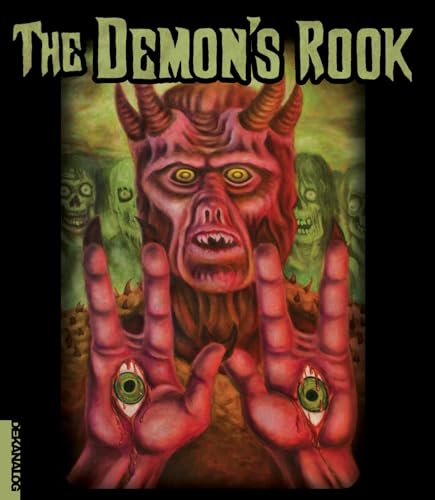
Still from The Demon's Rook (2013)

COMMENTS: Well, that was ridiculous.

Mind you, it is a glorious piece of ridiculousness—and a testament to the can-do attitude of filmmaker James Sizemore and his pals. The Demon’s Rook looks like a professional piece from a career special-effects artisan, though apparently all the costumes, violence, and prosthetics were whipped up by Sizemore after he watched some YouTube tutorials. The whole thing exhibits extreme enthusiasm, as supernatural set-pieces unspool (typically toward a gristly climax) while Roscoe and Eva do their darnedest to dodge death as a trio of dastardly demons reign havoc upon a rural corner of Georgia.

The story functions almost exclusively as a framework for the atmosphere and artistry (beyond the top-notch bloodwork, there’s a ubiquitous moody synth score whipped up—you guessed it—by Sizemore’s pals). The filmmakers provide just enough personality, pathos, and peril to give the viewer an emotional “in,” and a more enterprising reviewer might consider the symbolic ramifications of the title: in chess, the rook is a powerhouse enforcer, though one typically fated for doom.

I am not that enterprising. I am, however, someone who’s seen enough micro-budget DIY outings to recommend this movie to anyone who’s remotely hooked by the gory trailer, or has a yen for ’70s and ’80s splatter features—particularly if they like them spiked with mysticism. The Demon’s Rook is a joyous celebration of classic splatter, and proof positive that anyone with enough gumption (and tolerance for YouTube tutorials) can make an entertaining violence picture.

WHAT THE CRITICS SAY:

“Like a midnight movie from the 80s, its focus is on showing as much blood as possible, while acting, plotting and coherence all deliberately take a backseat… the nostalgic bunch of you out there, who remember staying up to watch cheap horror flicks on VHS or late-night cable, will probably find themselves entertained by THE DEMON’S ROOK’s cheesy, ridiculous charm.” — Eric Walkuski, JoBlo (contemporaneous)

CAPSULE: DANIELA FOREVER (2024)

366 Weird Movies may earn commissions from purchases made through product links.

DIRECTED BY:

FEATURING: Henry Golding, Beatrice Grannò, , Nathalie Poza

PLOT: A man enters a secret trial for a drug that exponentially enhances lucid dreaming, but instead of following instructions, he brings his dead girlfriend to life in a dream world.

Still from DANIELA FOREVER (2024)

COMMENTS: Modern mystic Alan Watts once delivered a lecture (which became the basis for an indie movie reviewed here) that suggested that if we could achieve our every desire through lucid dreaming, we would eventually become bored with omnipotence and return to the exact waking reality we once fled. Daniela Forever‘s Nicolás is determined to test that theory. After his girlfriend dies in a freak accident (for which he irrationally blames himself), all he wants is to live a simple life with Daniela alive and back in his apartment, forever. A lucid dreaming clinical trial gives him the opportunity to create that fantasy in a simulated world where he has almost total control over every aspect of reality, from the position of the sun to Daniela’s every mood, along with the ability to pause, rewind, and restart the flow of time. As he gains more and more facility with the process, he finds himself able to expand his dream-world from his cozy apartment to encompass most of Madrid (although he can’t create areas he’s never seen in waking reality, which show up in the dream as undulating grey walls). But he becomes surprised when Daniela suddenly appears to be developing free will and having thoughts of her own he didn’t place there. Meanwhile, the story moves forward in the waking world, where Nicolás deceives his clinical overseers about his real intentions, creating fake reports about assignments he is ignoring. How long can he keep it up?

While the dream-world is vibrant widescreen, Nicolás‘ everyday reality is shot in dingy, washed-out color (filmed in Betamax, to wit), and presented in a cramped, perfectly square aspect ratio. Distinguishing dreams from reality is thus not an issue for the viewer, at least not in the movie’s first two acts. While the film features some visual experimentation—mostly glitches like improper lighting schemes and stuttering, which are explicitly pointed out by the characters—there is no dream logic to the story. It all plays out instead with speculative realism. There is an interesting motif that shows up in Daniela’s artwork, however, where shadows skew in impossible directions: perhaps a nod to Last Year at Marienbad, that dreamlike smudge of a story in which a man and a woman’s memories of their relationship never match up. That suggestion may point towards the film’s weirder aspirations, and in the third act, Nicolás finds a way to boostrap the dream world, leading to unpredictable results, dreams bleeding into reality, and flirtation with meatier psychological thriller territory.

The creative scenario is rife with intellectual implications. Ethical questions proliferate in both the real and dream worlds. Nicolás‘ godlike abilities create one set of conflicts; his romantic fixation creates another. His dreambuilding also mirrors the evolution of a relationship, beginning in an infatuation stage where the lovers seem mystically simpatico in their mutual desires, but gradually revealing a frustrating separateness that undermines the utopian illusion.

What’s good about Daniela Forever is its thought-provoking premise. The execution, however, does not always match the conception. The pacing is a bit off; although it gets to the point quickly, it may spend a bit too much time locked in that apartment in repetitive scenarios of self-indulgent domestic bliss. I was surprised to read critical praise for Henry Golding’s performance; I found him almost unbearably bland and difficult to sympathize with—or to figure out what Daniela saw in him in the first place. The ending also feels emotionally forced, for reasons that unfortunately can’t be disclosed without spoilers. Of course, none of these small complaints kill Daniela Forever; they just hold it back from rising to the heights of such forebears as Open Your Eyes and Eternal Sunshine of the Spotless Mind, which would be lofty company indeed.

WHAT THE CRITICS SAY:

“Vigalondo never really taps into the full potential for whimsy or surrealism that the lucid dream scenario offers, while also keeping the film’s principal characters frustratingly one-dimensional.”–Josh Goller, Spectrum Culture (contemporaneous)

CAPSULE: FINALLY DAWN (2023)

Finalmente l’alba

366 Weird Movies may earn commissions from purchases made through product links.

Recommended

DIRECTED BY: Saverio Costanzo

FEATURING: Rebecca Antonaci, Lily James, Joe Keery, Willem Dafoe

PLOT: After losing track of her sister during a casting call in 1950s Rome, Mimosa ends up spending a long night with a Hollywood actress and her hangers-on.

Still from Finally Dawn (2023)

COMMENTS: Mimosa’s mother appreciated the actors’ performance in The Sacrifice—the black and white film which opens Finally Dawn—but is annoyed that all the movies these days obsess over war tragedies. Mimosa’s striking sister thought the film lovely; though perhaps not quite so lovely as a studio swain finds the sister. And Mimosa herself? She loves movies, and probably doesn’t love the quiet police official she’s engaged to. She joins her sister at Cinecittà the following day for an extras casting call for a new sword and sandal epic; though not selected (Mimosa’s modesty does her no favors with the film crew), she accidentally meets Josephine Esperanto, a star she greatly admires. When she’s hand-picked by the leading lady for a small cameo, so begins Mimosa’s long night of drinks, drugs, and rumors of a tiger escaped in the Eternal City.

Finally Dawn is slick, with the atmosphere of a period-period-epic. But the general malaise of the grand actors confounds Mimosa, and her lack of fluency in English does her no favors. (This is allayed when an affable bilingual American gallery owner played by a quietly charming Willem Dafoe smooths over the proceedings.) She’s brought to a fine restaurant, whisked to an opulent palazzo party, and otherwise has luxury and intrigue thrust upon her as her various hosts curry favor with this quiet Roman girl who has escaped the jadedness which weighs them down.

Saverio Costanzo’s film unwraps with an easy-awkward charm: easy on the eyes, as these are the beautiful people; awkwardness emerging from the unkindness found amongst those beautiful people, foisted upon an everywoman who is torn between wonderment, confusion, and a desire to just get home. Even with their flaws, the characters are all likable, to one degree or another—although Josephine Esperanto’s shenanigans with her human toy make for at least one uneasy scene—and Rebecca Antonaci’s turn as Mimosa evolves from endearing deer-in-headlights into compelling mistress of her fate. Finally Dawn concludes with a low growl, as Mimosa’s maturation arc lands with a soft, barefoot walk alongside a soft, toothful companion.

WHAT THE CRITICS SAY:

“…chronicles the dreamlike quality of a night that eventually descends into a nightmare… a surreal vision of coming-in-age via cinema, and James fully sells the movie star mayhem at its center. But it can’t overcome its meandering script and hollow depiction of the era.”–Maureen Lee Lenker, Entertainment Weekly (contemporaneous)