Category Archives: Capsules

CAPSULE: PERFUME OF THE LADY IN BLACK (1974)

DIRECTED BY: Francesco Barilli

FEATURING: Mimsy Farmer, Maurizio Bonuglia, Mario Scaccia, Jo Jenkins, Daniela Barnes, Orazio Orlando

PLOT: A wealthy, workaholic bachelorette chemist begins seeing visions of a lady in black, and a young blond girl; is she going mad or being tricked (or both)?
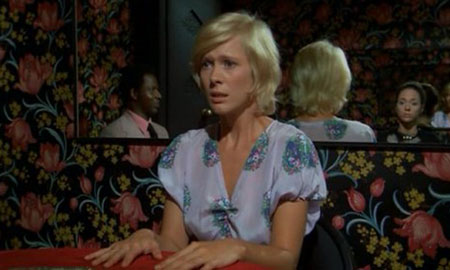
Still from The Perfume of the Lady in Black (1974)

WHY IT WON’T MAKE THE LIST: With its hysterical hallucinations and hints of witchcraft, plus a grisly surprise ending, a case could be made for certifying this quality offbeat occult giallo; but ultimately, it falls into the category of “you gotta draw the line somewhere.”

COMMENTS: In his interview comments accompanying the Raro Video release, writer/director Francesco Barilli acknowledges The Perfume of the Lady in Black’s debt to , but you’d probably sniff the lingering scent of Repulsion early on even without that admission (not to mention a whiff of Rosemary’s Baby, too). Perfume is part of a line of 60s and 70s horrors playing on the anxieties of young single working women. Thanks to sexual liberation, a class of working women living on their own without a live-in male protector was a relatively new phenomenon, and for all the necessary freedom, the fact is that it can be scary to be a woman in a man’s world. Lone females have more to fear than solo males: they fear all the same things men do, plus, they have to fear men. Silvia is competent enough to manage a chemistry lab, but she can’t trust her surroundings, her neighbors, strangers who stare at her on the street, or her even own senses in the dead of night. Whenever she’s alone, she’s endangered, and returns to sanity only when her boyfriend rushes to her side.

Perfume takes place in that lush giallo world, an existence full of tennis dates, elegant silk robes, and apartment courtyard’s with Roman fountains. The art direction is sumptuous, and at times a little outrageous, such as the jungle mural that hovers above Silvia’s friend’s bedpost. Surely such bourgeois elegance can only be there to cover up the stench of decadence. Mimsy Farmer, while not star material, is a treat in this role, constantly frightened and almost reluctantly sexy. The plot seems to be being made up as it goes along. It turns out that there are really two storylines, one of which involves oblique divulged secrets from Silvia’s childhood. The dual plots are mashed together, which produces extra confusion, but less satisfaction, since there’s not a single resolution, and nothing in particular to tie them together. Highlights include a ghostly little girl, “Alice in Wonderland” references, and a séance with a blind psychic (which may be the most giallo scenario ever). The ending is a genuine shock surprise, leaving a strong enough impression to make you forget the somewhat tedious early moments.

Raro Video upgraded Perfume to Blu-ray in 2016. The disc includes an interview with writer/director Barilli (which might be cut down from a longer one included on the DVD release) and a bonus short film, the 23-minute “The Knight Errant,” a shot-on-video variation on Death Takes a Holiday with a couple of surreal surprises that’s well worth a watch.

WHAT THE CRITICS SAY:

“The Perfume of the Lady in Black piles on the weird, somewhat to its detriment.”–Jamie S. Rich, DVD Talk (2011 DVD)

CAPSULE: THE LADY IN THE CAR WITH GLASSES AND A GUN (2015)

DIRECTED BY:

FEATURING: Freya Mavor, Benjamin Biolay, Elio Germano,

PLOT: When he’s away on business, a Parisian secretary who has never seen the ocean takes her boss’s Thunderbird on a road trip, but everywhere she goes people swear they’ve seen her before—is she going crazy?

Still from The Lady in the Car with Glasses and a Gun (2015)

WHY IT WON’T MAKE THE LIST: For a while, the Lady seems to be driving her borrowed car into French territory, but she ultimately crashes it into mere implausibility.

COMMENTS: Forget the car, glasses and gun: the Lady, portrayed by Freya Mavor, is something to see. Freya was the Norse goddess of love and sex, and with her red hair, willowy build and tempting freckles, Mavor could pass for Scandinavian love goddess (she’s actually Scottish). It’s the Lady (not the plot) that is Lady‘s chief asset, and the way he shoots Mavor, I think director Johann Sfar knows it. He begins the film with her dancing madly at the sea shore, flaming hair flying around her head and bare feet pattering on the sea-soaked concrete of the pier, then cuts to an earlier scene where the model/actress is shot in unflattering light to actually make her look kind of ugly (a remarkable feat of cinematography). But as her confidence increases throughout the story, her hemline rises. Mavor’s girlish looks and waifish figure lend her an air of forbidden innocence that makes her future behavior seem all the more shocking.

As the pseudo-doppelanger plot synopsis might suggest, mirrors will provide key imagery here, and an early scene where the Lady’s reflection disobeys her provides one of the first hints of an ever-increasing subjectivity that leads us to suspect that she’s headed for madness. The plot kicks into gear after the Lady has borrowed the car, and keeps running into people who insist they’ve seen her recently; for example, eating breakfast that morning in a country café when she was actually in Paris at the time. On her road trip, she’s also assaulted at random, and starts making poor decisions re: picking up sleazy drifters at roadside motels. Our attention is diverted by Sfar’s style (cool music, cool cars, sexy chicks, impossible occurrences); and the Lady seems to be turning schizophrenic, until fifteen minutes of closing exposition explain what’s really been going on all along. Many people criticized the climax as a clunky dénouement device, but I was more disappointed in the solution to the mystery, which relies too much on crazy coincidence for my satisfaction.

Johann Sfar has been hanging around on the fringes of weird films for a while now, starting with the mildly hallucinatory biopic Gainsbourg: A Heroic Life, and continuing with The Rabbi’s Cat, his arcane adaptation of his own graphic novel about a snarky, sacrilegious pet. In Lady‘s second act the thick, nearly surrealistic atmosphere makes this remake of the seldom-seen 1970 shocker of the same title seem like it’s going to be Sfar’s weirdest film; ultimately, however, it ends up as his most conventional. Sfar remains an unpredictable force with the potential to unleash something fantastically weird in the future, although each near-miss diminishes our enthusiasm for his work just a little.

WHAT THE CRITICS SAY:

“Sfar creates the eerie impression of being trapped in someone else’s dream. Relying on hallucinatory tricks in which time seems to roll back on itself, or else lurch forward to some possible future, the helmer makes everything feel surreal enough that we hardly stop to consider the only logical explanation, delivered in stultifying detail over a tedious, low-tension climax.”–Peter Debruge, Variety (contemporaneous)

CAPSULE: BASKIN (2015)

DIRECTED BY: Can Evrenol

FEATURING: Gorken Kasal, Ergun Kuyucu, Mehmet Cerrahoglu, and Muharrem Bayrak

PLOT: A team of five police officers is called to provide backup at an abandoned building in Inceagac, a locale of some occult notoriety; things go badly pretty quickly for the officers as they travel deeper into the film’s ominous backdrop.

Still from Baskin (2015)

WHY IT WON’T MAKE THE LIST: In an earlier age it could have been considered among the finest “B-horror” movies to grace the midnight movie scene during the ’80s through early ’90s, but as it stands, Baskin’s competent execution is marred by the tale’s derivative and meandering nature. Some token shocks do their job nicely, but the “film twist” advertises itself far too blatantly and doesn’t come off so much as, “Didn’t see that coming, did ya?” as it does, “Hey, check out what I’m doing!”

COMMENTS: Baskin starts out with a mountain of promise that it proceeds to dynamite away, taking the occasional break from destruction to rebuild the edifice. The movie starts with a flashback to the childhood of Arda (Gorkem Kasal), the main character, and so the temporal jumps begin. After some creepy behavior and a few screams and shouts, off we go to “now”, where a convivial conversation between fellow-officers contrasts with a restaurant seemingly assembled from bits cast off from Planet Terror‘s BBQ joint. Five cops: the esteemed leader, the arrogant chatterbox, the calm friend, the rookie, and the one with a migraine. After menacing the son of the restaurant’s owner (and seeing an ominous frog in the men’s room), the gang stumbles out to continue its patrol.

Much to its credit, Baskin does a lot of things right. The main fellows are easily distinguishable from one another (even when having to rely on subtitles), each of them is interesting, and the rapport struck on screen seems truly genuine; it’s apparent these policemen have worked with each other for a while. The sound design, too, adds to the realism. The dialogue always comes from the right place, and once the element of the macabre is snuck in, the various squelches, squidges, and scrapings all work to nice effect. The set piece of an abandoned Ottoman-era police barracks, too, is a perfect choice. The jump cuts convey an appropriate initial shock as well as add to a growing sense of dread. I had such high hopes.

Unfortunately, the movie falls apart by trying to do two things at once — and through this effort, succeeds at neither. Firstly, the “horror” element. Having already listed the merits above, it pains me to mention the failings. As events shuffle from the restaurant to the squad car to the crash before the evil building, things proceed apace well enough. Sure, there’s no need for the swarms of little frogs that litter the movie, and indeed the gypsy-style family by the barracks in utterly unnecessary—but, live and let live. It is when the crew descends the depths that this pastiche of classic horror collides badly with the “clever” thing the film tries to accomplish… the main impact of which I shall leave to the more adventurous reader to investigate. I will hint, though, that it’s the kind of thing I’ve only seen done well by , who was obliged to be counted among cinema’s greatest directors in order to handle his jumps correctly.

But enough cryptic ramblings. Baskin tries very hard, but comes up short. When you have a shocking horror picture, it certainly helps that your characters are great to watch interacting with one another, but that means you compromise your core asset when you begin killing them off. The 11-minute short film that the feature-length grew from, though, was a delight. Comparable setup, though (obviously) less fleshed out. However, whereas the original short managed to quickly establish and maintain a very unsettling mood, the director’s reach clearly exceeded his grasp when he tacked on another 80 minutes of movie. Still, Baskin was Evrenol’s first full-length attempt. I would certainly be willing to give his sophomore effort a try.

WHAT THE CRITICS SAY:

“A heady blend of Ambrose Bierce and Herk Hervey, of Lucio Fulci and David Lynch, and of Nicolas Winding Refn and Dario Argento (these last two channeled through director of photography Alp Korfali’s hyperreal lighting), Baskin is an astonishingly assured debut. Driven offroad by Ulas Pakkan’s unnerving ’80s synth score, it is a surreal, uncompromising, bestial and eerily beautiful descent into a hell of self-knowledge, whose precise entry and exit points remain difficult to determine.”–Anton Bitel, TheHorrorShow.TV (festival screening)

CAPSULE: THE SHAPE OF THINGS (2003)

366 Weird Movies may earn commissions from purchases made through product links.

DIRECTED BY: Neil LaBute

FEATURING: , , , Frederick Weller

PLOT: A nerdy security guard falls for an anarchic art student; she encourages him to change his appearance and dress, increasing his self-confidence—but is she really good for him?

Still from The Shape of Things (2003)

WHY IT WON’T MAKE THE LIST: Neil LaBute’s pitch black adaptation of his own play falls into the category of “outside-the-box indie drama” rather than “weird.”

COMMENTS: On the surface, The Shape of Things appears to be about the lengths someone will go to change themselves to gain someone else’s approval. Evelyn transforms Adam from schlub to stud, but the changes to his body inevitably effect his mentality. But although the erotically-motivated malleability of the less confident romantic partner is one of the work’s themes, Shape reveals a different, more controversial, focus in the third act. The ending twist is easy to guess, particularly to anyone who has seen LaBute’s debut film (the venomous dissection of masculine manipulation In the Company of Men). But I was willing to forgive the obviousness, because I think that LaBute’s fundamental point—an attack on attitudes and platitudes prevalent in the postmodern art scene (Evelyn, the film’s antagonist, is the kind of artist who believes in spray painting classical sculptures as a “statement”)—needed to be said.

The Shape of Things‘s origins as a stage play are obvious—each transition might as well be preceded by intertitles of the format “Act 2, Scene 3”—but that’s not necessarily a bad thing. What it really means that this is an actor’s and writer’s movie; everything is built around dialogue, which is often very sharp, with only a couple of set changes. Each of the four characters gets at least one big scene with the other three: Adam and Evelyn, obviously, spend the most time together, but the male lead must also defend himself from a “you’ve changed, man” speech from bro Phillip and navigate a moment of awkwardness with his best friend’s girl, while Evelyn gets to argue with douchey Phillip about the nature of art and to confront Jenny about her supposed attraction to the new and improved Adam. The fact that each of the actors had played these characters on stage for a year beforehand inevitably helps their chemistry—the characters are a artificial, written as types to support a thesis, but the young foursome does everything possible to make them feel like real people.

LaBute is often accused of being misanthropic (or even misogynistic), but, like all satirists, he’s actually humanistic. It shocks me that so many critics and viewers come to the exact opposite conclusion—I guess they conclude that no writer could pen scenes of emotional sadism so convincingly without being a psychopath themselves. It seems obvious to me that LaBute shows us extreme cruelty not to titillate us, but to arouse our disgust—to encourage us to try to be better people. And, to encourage his peers to become better, more morally focused artists.

WHAT THE CRITICS SAY:

“This version of Neil LaBute’s ongoing project is crisp and aggressive, occasionally alienating or annoying, that is, effectively unlike other movies.”–Cynthia Fuchs, Pop Matters (contemporaneous)

(This movie was nominated for review by “noa.” Suggest a weird movie of your own here.)

CAPSULE: THE FITS (2016)

Recommended

DIRECTED BY: Anna Rose Holmer

FEATURING: Royalty Hightower, Alexis Neblett

PLOT: A preteen tomboy finds herself drawn into the dance classes at her local recreation center, but soon after she joins the group the older girls begin suffering mysterious seizures.

The Fits (2016)

WHY IT WON’T MAKE THE LIST: While definitely of interest to aficionados of weirdness, and a highly recommended film overall, it just doesn’t reach the levels of  bizarre we aim for with the List.

COMMENTS: Toni (Royalty Hightower) is a quiet, athletic 11-year-old girl who spends her afternoons at the local rec center with her older brother, training in the boxing gym with a group of teen boys. She finds herself compelled to join the dance drill team that rehearses down the hall, feeling shy around the girls but determined to show off her moves. Though she doesn’t appear to be naturally gifted at dance, she sticks with it and befriends some of the other new recruits, observing the older girls who lead the troupe with the curiosity of a child and the growing understanding of a young adult. When the seizures start, Toni and her friends are more intrigued than scared, and they watch from afar as more and more of the older girls are affected by this unexplained malady. Toni begins to suspect that it’s intentional, that they want it, and it becomes a kind of calling card for a cool inner circle.

Based on plot alone, The Fits sounds like a fairly standard coming-of-age drama, and in some ways it is: a shy and intelligent girl finds community within a larger group, learns about new adult realities, maintains her independence, etc. The parallels between the girls’s seizures and female puberty are obvious, as Toni feels the kind of ostracization and curiosity that preteen girls might experience as their friends start getting (and discussing) their periods. Along with fear of the unknown there is a pride attached to the phenomenon, a feeling of special knowledge and maturity. Throughout the film, we see our tomboy protagonist slowly acquiring visual markers coded as “girly,” including glitter nail polish and pierced ears, which help her fit in with her friends. But she slowly sheds them all, retaining her sense of difference. Eventually, Toni (and the audience) senses that there is a kind of freedom attached to the seizures—the precise, fluid movements of the drill team are liberally flung out the window in the sudden and erratic fits the girls exhibit. There is a beauty to letting go, to giving in to being a girl, to finding acceptance in her changing, awkward preteen body.

With a keen observational eye and resourceful use of a single location (the town recreational center), first-time director Anna Rose Holmer fully engages with the perspective of her central character. We see everything through Toni’s eyes, and the subtle, powerful performance of Royalty Hightower communicates a world of experience with little expository dialogue. But the most intriguing stylistic element of The Fits is its sound. While one might realistically expect a soundtrack of dance music, specifically pop or hip hop, to go with the performances of the drill team, the music rarely matches the action onscreen. Instead we are treated to bizarre, somewhat abstract soundscapes that create a sense of intrinsic eeriness, hinting that something must be wrong here. The surreal music serves to pick apart the weirdness of adolescence, and to heighten the anxiety and uncertainty Toni feels every day behind her stony exterior as she maneuvers the muddy waters between childhood and adulthood. Without it, the events of the film would be dramatic, but not necessarily extraordinary. With it, we are left with a distinct but ambiguous sense of strangeness, an itch we can’t quite scratch, a mystery never to be solved. And yet, thanks to an exuberant final dance number, there’s a contentment that goes along with it, suggesting the power of sisterhood.

WHAT THE CRITICS SAY:

“…a beautiful, hauntingly precarious coming of age film that uses mystery and an at times dream-like atmosphere to create a mesmerizing tale.”–Rob Hunter, Film School Rejects (contemporaneous)