Category Archives: List Candidates

BORDERLINE WEIRD: THE BOX (2009)

The Box divided critics—even our in-house critics.  Eric Young defends the movie, but read to the end for Gregory J. Smalley‘s opposing opinion.

DIRECTED BY: Richard Kelly

FEATURING:  Cameron Diaz, , James Marsden

PLOT: A man comes unsolicited one morning to the doorstep of a financially troubled family with a proposition: if they press a button he gives them within 24 hours, they will receive $1 million, and someone in the world, whom they don’t know, will die.

Still from The Box (2009)

WHY IT SHOULD MAKE THE LIST: Kelly’s surreal odyssey through Virginia in the mid 70s is hauntingly strange. One would not think it to be remarkably anything from the marketing, the extremely negative reviews put out by, um, pretty much everyone, and a tame, seemingly safe cast. But this is Richard Kelly, so nothing is really as it seems. The Box needs to be considered for the List because Kelly tells a morality story involving aliens, God, and Jean-Paul Sartre in ways that are as flippant and off-handedly odd as , as unflinching as Lynch, and as psychologically insightful as Cronenberg.  And while Kelly is not as good a filmmaker as those three, he has grown undeniably in his talents since Donnie Darko, and this time his story is just as weird.

COMMENTS:  The Box is a little more complex than you’re led to believe by the trailers. I was honestly underwhelmed when I first heard about the idea, but after hearing more about it, it started growing on me. I wanted to know what the deal was with this button, and what I got was beyond my wildest imaginings. It’s unusually dense for a Richard Kelly movie, filled with haunting music, esoteric imagery, and references to existential philosophy. In a way, The Box is Kelly’s most obscure work yet, even more obscure than his previous film, the dumb, loud Southland Tales. Although Kelly’s touted it as his commercial movie, I have the feeling that he might never have actually seen a commercial movie, because what he came up with is quite weird, and more than a little off-putting for the average moviegoer.

Kelly’s imagination makes the film something special.  He takes a simple, bare-bones concept from a Richard Matheson short story and adds a third, and perhaps even a fourth, Continue reading BORDERLINE WEIRD: THE BOX (2009) →

BORDERLINE WEIRD: A SERIOUS MAN (2009)

NOTE: A Serious Man has been promoted from the “Borderline” category onto the List of the Weirdest movies of all time! This page is left up for archival purposes. Please view the full review for comments and expanded coverage!

fourandahalfstar

DIRECTED BY: Ethan Coen, Joel Coen

FEATURING: Michael Stubargh, Richard Kind, Fred Melamed, Fyvush Finkel

PLOT: A putzy Jewish physics professor suffers from an escalating series of problems

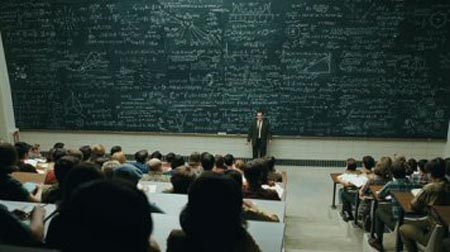
Still from A Serious Man (2009)

including a failing marriage, bratty kids, students willing to do anything for a passing grade, financial troubles, and a ne’er-do-well, mildly insane brother.

WHY IT’S ON THE BORDERLINE:  While the early leader for Weirdest Movie of 2009, A Serious Man won’t be eligible to be officially added to the List of the 366 Best Weird Movies of All Time until it receives its DVD release and the film can be pored over meticulously by our team of critics.  Okay, to be honest, the home video release requirement is a way to buy time, while I let the Coens’ latest ferment in the back cellar of my consciousness.  The conundrum is that, superficially, this movie is not that weird; there are a few dream sequences and nonsense parables, but unlike the Coens definitely weird Barton Fink, this story of a suburban Jewish man beset by an improbably mounting set of real life woes contains no surrealistic fireworks (although there is a conspicuous surrealistic pillow).  On the other hand, this movie has a skeletal undercurrent of  ambiguity and disturbance running through it like a bone cancer; it feels weird at its core.  Also, the way it’s currently unsettling and outraging square moviegoers points to a powerfully different movie.

COMMENTS:  A Serious Man is a retelling of that most fascinating parable in the Old Testament, the Book of Job, as a postmodern absurdist comedy.  The ancient Job was a good and prosperous man; God allowed Satan to test his faith by wiping out his flocks, killing his children, and smiting him with boils.  The beleaguered Job, bothered by visits from three unhelpful friends who try to console him with off-base theological speculations, eventually despairs, but never doubts God’s existence or goodness.  His only plea is to understand his misfortune, to be able to ask God directly, “Why me?”  God, appearing in a whirlwind, bitchslaps Job for his audacity: “who are you to question me, the Author of the Universe?  It’s your job to obey and suffer in silence.”  (I’m paraphrasing here).  After this reproof, God restores Job’s riches and lets him have new Continue reading BORDERLINE WEIRD: A SERIOUS MAN (2009) →

LIST CANDIDATE: GOD TOLD ME TO (1976)

366 Weird Movies may earn commissions from purchases made through product links.

AKA Demon; God Told Me to Kill

God Told Me To has been promoted to Apocryphally Weird status. Please read the Official entry.

DIRECTED BY: Larry Cohen

FEATURING: Tony Lo Bianco, Richard Lynch, Andy Kaufman, Deborah Raffin, Sandy Dennis, Sylvia Sidney, Sam Levene, Mike Kellin

PLOT: A rash of murders are committed by people who all give “God told me to do it” as their only motive. A New York City police detective must find out why.

Still from God Told Me To (1975)
WHY IT SHOULD MAKE THE LIST: A conventionally produced movie, God Told Me To has a bizarre story featuring some very strange characters, including an extraterrestrial man with a face that nobody can see clearly and a vagina in his ribcage.

COMMENTS: In this complex occult/sci-fi thriller, Tony Lo Bianco (The French Connection, The 7-Ups) plays police Lieutenant Nicholas, who unravels a mysterious spree of killings committed by fellow New Yorkers from all walks of life. Each claim that God compelled them to commit the crimes  Many kill themselves or die after immediately after making the the revelation, complicating Nicholas’ job.

The film opens with a sniper perched on a rooftop water tower. After he shoots random people in the street,  Nicholas climbs up to talk to him and the man jumps to his death.  Nicholas is contacted by a representative of a sinister cult who seems to understand what is behind the crimes. While the cop tries to track down the cult members, the investigation takes him on a twisted journey into the past, including, to his surprise, his own past as he strives to solve this dark and obfuscated mystery. Nothing is as it appears to be. As he soon discovers, Lt. Nicholas is also not who or what he seems to be either.

While he attempts to unravel the puzzle behind the killings, Nicholas investigates his own birth as well as other strange phenomenon from bygone years. The answer to the riddle is morbidly fascinating. God Told Me To is one of those unique, non-formulaic 1970’s films that just aren’t made anymore.

The enigmatic Richard Lynch (Bad Dreams) has one of his most interesting and bizarre roles ever in this exciting and odd film. The piece features an early, rare cinematic appearance by Andy Kaufman in a non comedic role.

WHAT THE CRITICS SAY:

“This cult-fave Larry Cohen epic, features his trademark NYC locations, vividly drawn characters, realistically handled situations and dialogue, and one hell of a weird premise.”—VideoHound’s Complete Guide to Cult Flicks and Trash Pics

THE CREMATOR [SPALOVAC MRTVOL] (1969)

The Cremator has been promoted onto the List of the Best Weird Movies Ever Made; the Certified Weird entry is here.

DIRECTED  BY: Juraj Herz

FEATURING: Rudolf Hrusínský, Ilja Prachar, Milos Vognic, and Zora Bozinová

PLOT: In this mesmerizing, Gothic horror film, a funerary specialist becomes obsessed with what he believes to be the nobility of his calling, with terrifyingly tragic and bizarre results.

THE CREMATOR

WHY IT SHOULD MAKE THE LIST: The Cremator treats unusual, morbid, taboo subject matter in a visually dreamy way that is artful without being  gimmicky.

COMMENTS: In late 1930’s Prague, Kopfrking (Hrusínský) is a misguided, enigmatic crematorium operator. He is an impeccably groomed, eerie, and meticulous figure, always talking in a hypnotic, soft spoken, poetic manner.  He is overly preoccupied with mortality, morbidity, and the human soul, and deeply devoted to the funerary arts.

Kopfrking feels a physical affection for the instrumentality of his trade, lovingly caressing the equipment of the crematory process.  He speaks constantly, literally and metaphorically, of death and the liberation of the soul through the process of cremation.

As the story progresses, he becomes increasingly obsessed with his work, finding it glorifying and cathartic.  He sees visions of the ghost of his living wife in her youth, along with his future incarnation, as he begins a spiraling descent into fantasy and madness.  He is on a mission to free the souls of the deceased (and in time the not-so deceased) through the pyrolization of human flesh, be it living or dead—just as long as that flesh is consumed and vaporized by fire.

The pre-WWII German propaganda machine is enveloping Eastern Europe, polarizing aspiring Nazis and oppositionists.  Drawn toward the philosophy of the Third Reich, Kopfrking becomes morbidly obsessed with racial purity and the percentage of German blood flowing within his own veins—literally, to the point of having his vessels opened and the contents examined.  While The Cremator is not a raving anti-Nazi film, it uses the political ideology as an allegory for exploring the phenomenon of sweeping, consuming mass delusion and insanity.

The gathering of Nazi forces on the border offers Kopfrking an opportunity to realize his misguided aspirations on a grand scale, one much larger than he could have ever hoped for, one seemingly without limit.  Before applying his fervor and passion to the task, he hatches a plan to betray and destroy his own acquaintances, colleagues and family.

While there are elements of black satire in the The Cremator, the movie is so compelling as to nearly overshadow it.  The film insidiously and steadily flows to its inevitable and horrifying conclusion like a hot rivulet of liquefied fat.

The production design is crisp and symmetrical.  Stanislav Milota’s stunning black and white cinematography is haunting and beautiful.  It features successions of extreme closeups that emphasize the slightly grotesque and disturbing features of the biological condition.  Milota’s use of black and white film stock’s enhanced tonal range is artfully employed to focus attention on rich textures and multitudes of shades.  This gives The Cremator a uniquely unsettling dreamlike quality.  The musical score by Zdenek Liska is alluring, phantasmic, and aesthetically intriguing. Viewing The Cremator is akin to experiencing a nightmare that one is reluctant to wake from.

The Cremator was a Czech nominee for the Best Foreign Film Oscar.

WHAT THE CRITICS SAY:

“…this 1968 black comedy in black and white is undeniably creepy—once director Juraj Herz enters the fractured mind of his protagonist, he refuses to budge.”–Jonathan Rosenbaum, Chicago Reader

RECOMMENDED AS WEIRD: THE NIGHT WALKER (1964)

DIRECTED BY:

FEATURING: , Robert Taylor, Irene Trent, Joyce Holland, Hayden Rorke. Written by horror master Robert (“Psycho”) Bloch.

PLOT: A woman has frightening, recurrent nightmares about being taken on surreal and horrifying nocturnal odysseys by an enigmatic stranger.

Still from The Night Walker (1964)

WHY IT SHOULD MAKE THE LIST: The film has an offbeat plot that has not been overused, and features bizarre scenes such as waxen animated mannequin entities conducting odd and sinister nighttime church services.  There are apparently illogical phenomenon such as the suspension of time.  The Night Walker is surreal due to the difficulty that the protagonist has in separating reality from fantasy.

COMMENTS:   After her covetous, jealous, and suspicious husband allegedly burns to death in a mysterious laboratory explosion, a wealthy widow (Stanwyck) has recurrent nightmares featuring an imaginary lover (Bochner).  He appears to her at night while she is dreaming and takes her on hellish journeys into the macabre.  She dreams repeatedly that she falls asleep and then “awakens” to this nightmare while still within a dream.

Each time, the nightmares begin with the lover awakening her at her bedside after she falls asleep.  Every night, her clocks indicate that she has awoken from her sleep into the recurrent nightmare at the same time that she went to bed.  Bochner eerily tells her, “Time stands still when you’re with me!”

The mysterious stranger drives her through a haunting Los Angeles nightscape to a a creepy, dilapidated chapel where sinister, animated wax figures play the organ and conduct a bizarre and puzzling wedding service.  One night she awakens from the recurrent nightmare, only to find Bochner again in her room.  She concludes that she has only dreamed that she has woken up, and is trapped in a nightmare from which there is no release.  Driven to the brink of madness by this ceaseless paradox, she dramatically screams over and over, “I can’t wake up!  I can’t wake up!”

Her scheming, apparently disbelieving lawyer attempts to help her unravel the mystery.  But does he know more than he is telling her?  Is everyone in her life really who they appear to be?  Is she going crazy?  Stanwyk’s character struggles to unravel the mystery of what she is experiencing as she attempts to retain her dwindling shreds of sanity.

William Castle employs no pedestrian gimmicks in this surreal, disturbing film.  By this point in his career he demonstrates that he has honed his skills as a competent director of horror.  Stanwyk carries herself with the same haunting presence with her role in this mysterious noir as she does in The Strange Love of Martha Ivers and Double Indemnity.

Unlike most of William Castle’s films, The Night Walker is not currently available on DVD.

WHAT THE CRITICS SAY:

“A few creepy touches—a cheaply surreal nightmare prologue and a scene that finds Barb sacred by a shish kebab—help relieve the tedium, but the self-styled ‘Master of Movie Horror’ is in far-from-top form here.”–Joe Kane, The Phantom of the Movies Videoscope