All posts by Gregory J. Smalley (366weirdmovies)

Gregory J. Smalley founded 366 Weird Movies in 2008 and has served as editor-in-chief since that time. He is a member of the Online Film Critics Society, and his film writing has appeared online in Pop Matters and The Spool.

CAPSULE: NINE (2009)

DIRECTED BY: Rob Marshall

FEATURING: Daniel Day-Lewis, Stacy Ferguson (“Fergie”), , , Judi Dench, Sophia Loren

PLOT: Celebrity director Guido Contini finds he can’t get started on his latest movie script because the women he’s romantically entangled with keep bursting into song whenever he’s around.
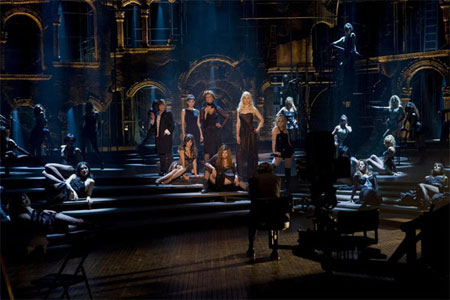
Still from Nine (2009)

WHY IT WON’T MAKE THE LIST: Musicals, by their very nature, are a little weird, because in everyday life people very rarely ask you for the time in the key of A-flat minor. The musical genre traditionally atones for the sin of departing from reality by doubling over backwards to be reassuringly conventional in narrative and thoughtlessly blithe in message. Nine is no exception to the general rule; we only cover it here because it was inspired loosely by the great weird film 8 1/2 and it’s fascinating director, .

COMMENTS: First things first: Nine, while inspired by Fellini’s 8 1/2, is obviously aimed at those who never saw the original film, or who saw it but didn’t like it much. Keeping that in mind off the bat makes the film feel much less like an insult to the maestro’s memory, and much more like what it is: a highly fictionalized puff piece that aims solely to entertain, while presenting the artist’s struggle to create as just another two-dimensional backdrop for the song-and-dance spectaculars. Except that these songs and dances are not really spectacular, so much as acceptable. The tableaux—which range from minimalist tinker-toy girders to a sequined Folies Bergère nightclub to a fashion runway strobe-lit by paparazzi flashes (the irony!)—are all flashy, pretty and eye-catching enough. The problem is that it would be, for the most part, an act of charity to describe the melodies as memorable, so that most of the numbers come across as all sparkle and no spark. The one exception is provided by Stacy Ferguson (better known as Fergie). Putting the only professional singer in the cast together with the movie’s only hummable melody (“Be Italian”) is an eggs-in-all-one-basket strategy that gives audiences something to remember, but also highlights the mediocrity of the rest of the musical performances.

As for the rest of the star-studded female cast, none can really sing or dance, and there is an unrelenting sameness to their lyrics (which are mostly about how each dame would rather be sleeping with Daniel Day-Lewis than doing whatever she’s doing now). At some point the musical numbers become numbing interruptions that make the melodrama interesting by comparison. Day-Lewis’ Italian accent is passable and he does invest his Guido with a charming childlike quality that almost makes his irresistibility to women believable; but, though he’s game enough, he just can’t carry a tune, and having him half-sing/half-talk through the climactic songs is no solution. Still, the razzle-dazzle of the production numbers, numerous cameos (i.e., Sophia Loren) and Fellini references, Fergie’s musical triumph, and a vampy song by Cruz—whose lingerie-clad tramp around a mirrored floor while wrapping pink ropes around her willowy frame is sultry enough to make her song and dance talents irrelevant—are enough to transform Nine into passable, if forgettable, entertainment. Plus, it features more corsets and fishnet stockings per minute than you’ll see outside of a fetish video, which can hardly be considered a bad thing.

Nine isn’t really inspired so much by 8 1/2 as it’s inspired by the most famous scene of 8 1/2, the harem/lion tamer sequence, where Guido famously envisions himself as being adored, then harried, by the various females in his life. The fact that the movie’s psychology ignores all other aspects of the director’s creativity and inner artistic torments in favor of the reductionist “it’s all because he’s conflicted about his unrealistic image of women” is disappointing, but hardly surprising considering this is squarely middlebrow Hollywood stuff. After all, what else would you expect from a movie whose title announces its intentions by rounding up an inconveniently weird partial number to a nice, easily digestible integer?

WHAT THE CRITICS SAY:

“The challenge for Marshall, following his Oscar-winning Chicago, was to bring another hallucinatory musical to the screen without repeating himself or dimming the material’s blazing, untamed theatricality. By my score card, Marshall hits more than he misses.”–Peter Travers, Rolling Stone

44. GREASER’S PALACE (1972)

Recommended

SEAWEEDHEAD GREASER: Coo Coo.  I wish I could put my arms around each and every one of them, and let them know that everything is going to be okay.

COO COO: Why don’t you, Sea?

SEAWEEDHEAD GREASER: I’m not bizarre enough.

COO COO: Who is?

–dialogue from Greaser’s Palace

DIRECTED BY:

FEATURING: Alan Arbus, Albert Henderson, Michael Sullivan,

PLOT: Perpetually constipated Seaweedhead Greaser and his gang of hired guns run a small Western village in the middle of the desert. One day Jessy, a mild-mannered hispter in a zoot suit, parachutes into the nearby countryside. Jessy, who is traveling to Jerusalem to become an actor/singer, stops in town to walk on water, repeatedly resurrect Greaser’s son Lamy Homo after Greaser has him killed, and do a boogie-woogie song and dance number before winding up crucified.

Still from Greaser's Palace (1972)

BACKGROUND:

  • Director Robert Downey began his filmmaking career in the early 1960s with a series of low-budget, absurdist short films that gained him a devoted following. His 1969 advertising/race relations satire Putney Swope brought him the adoration of the hippie counterculture. Greaser’s Palace is his only big-budget production, made with $1,000,000 invested by an independently wealthy Broadway producer.
  • Downey’s son is the now-famous actor Robert Downey Jr.; the younger Downey appears, uncredited, as a child in this movie.
  • The credits to this film begin to scroll before the movie starts instead of afterward, and many of them are illegible.
  • The topless, mute Indian girl is none other than Toni Basil, who later went on to fame with her gratingly catchy 1982 pop single “Mickey.”

INDELIBLE IMAGE: Jessy, still in his striped suit and white gloves and shoes, crucified, with his pink and lavender hat perched atop the cross.

WHAT MAKES IT WEIRD:  Set in a barren town in the old West, Greaser’s Palace is a series of bizarre sketches which run a gamut from arid comedy to hints of disturbing perversion. These absurd anecdotes hang off a storyline that loosely and enigmatically follows the outline of the New Testament. In a movie where the Holy Ghost appears as a cigar-smoking man wearing a bedsheet with eyeholes cut in it and a black stetson, whether the movie is weird or not is the last question you’re likely to be asking yourself.

Clip from Greaser’s Palace


COMMENTS: A man leaning on a crutch waits for the “messiah” to come and heal him. Continue reading 44. GREASER’S PALACE (1972) →

CAPSULE: MR. SADMAN (2009)

DIRECTED BY: Patrick Epino

FEATURING: Al No’mani, Scott McNairy, Rudy Ramos

PLOT: When he’s scarred in an assassination attempt on the eve of the Kuwait invasion, a mute Saddam Hussein body double with no skills or interests beyond impersonating the Iraqi dictator loses his job and moves to Los Angeles to start his life over.

Still from Mr. Sadman (2009)

WHY IT WON’T MAKE THE LIST:  More quirky than weird.  There are some offbeat montages, including a nutty but oddly appropriate music video stuck into the middle of the film, but not enough to elevate it to true weirdness.

COMMENTS: No doubt about it, it’s Al No’mani’s airy and amiable performance as Saddam Hussein impersonator Mounir that keeps Mr. Sadman, a low-key indie comedy with an inventive premise but not quite enough laughs or plot, afloat. No’mani is the requisite dead-ringer for the fascist dictator. But more importantly, with his arsenal of friendly, vulnerable, quizzical, and despondent expressions, Iraqi-born No’mani (who died soon after filming was complete) invests his silent character with a surprising amount of humanity, turning him into something like an unhinged but harmless and sweet uncle for whom the audience roots. It was a gamble to make Mounir mute, but it pays off; the handicap gives the character an unexpected everyman aura that makes his sparse backstory irrelevant. The film features some mild satirizing of the subculture of struggling L.A. actors and technicians trying to break into the Hollywood film industry; there’s a deeper warning about the absurdity of forging our own identities by emulating celebrities, but there’s no preaching. The message is implicit in the plot. The script scores occasional chuckles, particularly with a pair of pot-smoking Hollywood wannabes whose minds get blown when Mounir walks past them at a party as they’re watching Saddam on CNN, and a scene where the middle-aged Iraqi plays basketball with some homeboys. There are also a few groaners: Mounir’s antagonists are FBI Agents Wang and Johnson (a couple of dicks, get it?) True to the title, there is an undercurrent of melancholy, and Sadman is indebted as much to the classic alienation films of the late 1960s and early 1970s as it is to contemporary quirky indies. There’s an explicit citation to Taxi Driver, an obvious tribute to The Graduate, and scenes of a man-child in a ridiculous costume strolling down city streets oblivious to urban reactions can’t help but bring to mind Midnight Cowboy. The spirits of light comedy and despairing loneliness  sometimes mix uneasily—and the laughs are largely jettisoned by the finale—but for the most part, it works okay. The cinematography, music and editing are all professional. The script requires some leaps of faith: for example, I wasn’t convinced Mounir’s new-found Hollywood buddies would risk jail time to protect him from the FBI. With the exception of No’mani and Rudy Ramos as a hotel operator, the performances are spotty. But the Iraqi’s expressive facial acting lifts the film to something that, while uneven, is often touching.

As appears to be increasingly the case in a movie business convinced its customers are demanding fewer alternatives to repetitive Hollywood fare, Mr. Sadman has not found a distributor. The director is currently self-promoting the picture, and it can be downloaded for $8 from the Mr. Sadman site. The picture quality of the download is good, and I had no problem burning it to a standard DVD+RW for viewing on my television screen (individual results may vary).

WHAT THE CRITICS SAY:

“Fair warning: watching Mr. Sadman does require the viewer to suspend one’s disbelief entirely… [but] Ultimately, Mr. Sadman delivers what it promises: presenting a dark comedy about the face of evil who just wants to be loved.”–Jaimie Mendoza, Asia Pacific Arts (contemporaneous)

TOP 10 LIST EXTRAVAGANZA: TOP 10 WEIRD MOVIES OF THE YEAR, DECADE, AND MORE

Here’s my personal picks for top ten weird movies of the decade (setting aside the fact that it may be more reasonable to consider the decade as ending in 2010, rather than 2009).  This list only covers movies we’ve actually reviewed, so if you read on you’ll also find the top 10 movies we didn’t get to, the top 10 weird movies of 2009, and my top 10 picks for 2009 (regardless of weirdness).

TOP 10 WEIRD MOVIES OF THE DECADE (2000-2009)

10. Elevator Movie (2004) – A loser is trapped inside an elevator with a former slut turned Jesus freak, for months on end, in a compelling low-budget surrealist drama mixing No Exit and The Exterminating Angel with a touch of Eraserhead.

9. Funky Forest: The First Contact (2005) – A jumbled up series of surreal short movies and music videos, linked by common characters and themes, but refusing to make sense; no one forgets the scene where the schoolgirl inserts a tube in her navel to give birth to a miniature sushi chef.

8. I Can See You (2008) -A neurotic, romantically frustrated loner goes on a camping trip with his advertising company buddies, and loses complete contact with reality.  Features a wonderfully bizarre musical sequence; an oily, omnipotent ad pitchman who talks to the protagonist inside his head; and a 20 minute psychedelic freakout at the climax.

7. Tideland (2005) – Terry Gilliam’s dark and controversial riff on Alice in Wonderland tells a bleak and frightening story of a young girl abandoned to the world of her imagination. There’s nothing explicit shown, but the nuanced and challenging scenes implying child abuse and molestation were too intense and downbeat for mainstream viewers.

6. Ink (2009) – Visually impressive low-budget fantasy about a mysterious figure who snatches a sleeping girl into a world of dreams. The nightmarish incubuses, with their smiley-faced facades displayed on malfunctioning LCD screens attached to their heads, are unforgettable, and the payoff is emotionally satisfying.
Continue reading TOP 10 LIST EXTRAVAGANZA: TOP 10 WEIRD MOVIES OF THE YEAR, DECADE, AND MORE →

CAPSULE: PROMETHEUS TRIUMPHANT: A FUGUE IN THE KEY OF FLESH (2009)

Beware

DIRECTED BY: Mike McKown, Jim Towns

FEATURING: Josh Ebel, Kelly I. Lynn

PLOT: A mad doctor reanimates the body of his loved one who has died in a plague.

Still from Prometheus Triumphant: A Fugue in the Key of Flesh (2009)

WHY IT WON’T MAKE THE LIST: Silent films have an inherently dreamlike feel to them that gives them a leg up in the weird department. Prometheus Triumphant fails to capture and exploit this feeling, leaving us with a dull and lifeless film devoid of sound, color or interest.

COMMENTS: It’s tempting to give amateur films bonus points for good intentions, but with Prometheus Triumphant it seems like the filmmakers didn’t do due diligence to create something professional looking, thinking that a cool concept alone could carry the film. The first problem, as is usually the case, is the plot, a groaningly obvious and unoriginal mix of Frankenstein and The Phantom of the Opera that’s as thin as stage blood. Action is almost nonexistent: after embarking on his grave-robbing spree, it takes “The Creator” almost ten minutes to dig up and cart away his first corpse, and most of that time is spent watching him walk with a wheelbarrow across a bleak and uninteresting field with a few prop crucifixes in the foreground.

With no surprises or suspense in the story, Prometheus needs a strong visual look to compensate, one it’s incapable of generating on its budget. A few kind critics have implied that the film evokes the look of German Expressionism, but I’m led to wonder if they’ve ever actually seen a work of classic German expressionism. It’s true that both Prometheus and its inspirations are in black and white and use Gothic imagery, but it’s impossible to imagine anyone confusing a perfectly framed and detailed still from Nosferatu or Caligari with the mundane angles and dull sets of this one. Composer Lucein Desar clearly has some talent, but not enough ideas to stretch out over 80 minutes, and the score becomes repetitive and irritating.

Not all of Prometheus‘ flaws can be forgiven due to budgetary limitations; some of them come from an endemic lack of attention to detail. A shot containing a modern steel handrail and concrete steps in 1899 might be forgiven, but a navel ring on the corpse of a dead peasant girl can’t be. Even more revealing are the mistakes that show up in the intertitles. Many people confuse “throws” for “throes,” but in this day of automatic spellcheckers, how can anyone let a goof like “existance” slip into a project that’s intended to be professional? And if you’re going to misspell a term you’re only vaguely familiar with, such as “Bürgermeister,” at least be consistent: don’t use “Bergmeister” sometimes and “Burgmeister” other times.

It may seem picky, but these mistakes help explain why the flick is so listless in the end. Everyone seems so excited by the cool overarching concept of recreating a classic silent movie that they forgot to work on the little things that make a work breathe. It’s almost as if the camerawork, imagery, acting, script, action, sets, locations, costumes, and makeup all have no higher aspiration than to be usable, and the directors were satisfied if they turned out adequate. The end result isn’t a meaningful tribute to Murnau, Wiene and Lang; if it weren’t so sincerely intended, it would be an insult. Prometheus Triumphant reinforces every negative stereotype mainstream viewers have about silent films being boring and inferior. It’s what all bad, amateur horror movies would look like today if cinema had never developed sound, color, or slashers.

The DVD contains a short film by the same directorial team, “The Sleep of Reason,” that shows a bit more promise than Prometheus actually delivered. Despite the fact that the feature didn’t work on an entertainment or artistic level, I wouldn’t write Towns and McKown off as hacks. Sometimes things just don’t come together the way the creators imagined. At least they had some fun and hopefully learned some valuable lessons; but sadly, better-made independent features are sitting on shelves, while this failed experiment gets a relatively decent distribution deal.

WHAT THE CRITICS SAY:

“…for all its poetic visual bravura, seems distant when it should be dynamic, yet still worth the effort.”–Kevin Thomas, The Los Angeles Times