All posts by Gregory J. Smalley (366weirdmovies)

Gregory J. Smalley founded 366 Weird Movies in 2008 and has served as editor-in-chief since that time. He is a member of the Online Film Critics Society, and his film writing has appeared online in Pop Matters and The Spool.

LIST CANDIDATE: THE FILMS OF SUZAN PITT (1979/1995/2006)

RecommendedWeirdest!

DIRECTED BY: Suzan Pitt

FEATURING: Jose Luis Rodriguez Avalos (“El Doctor”)

PLOT: A collection of three surreal animated shorts.  In “El Doctor”, a Mexican doctor visits odd patients while dreaming of a long dead love.  “Joy Street” contrasts a the life of a whimsical anthropomorphic ashtray with its suicidally depressed owner.  “Asparagus” is a totally abstract surrealist film featuring a faceless woman and obscene iterations of the titular vegetable.

Still from Asparagus (1979)

WHY IT MIGHT MAKE THE LIST:  It’s a question of classification, not of weirdness or quality.  Counting these three short films, made decades apart, as one “movie” for List purposes would clearly be cheating.  That means that we’re really only considering the compilation’s main event, “Asparagus,” for inclusion on the List, which raises the metaphysical question: how good/weird does a short have to be take away a spot from a deserving feature length presentation?  Some shorts will eventually make the List.  “The Heart of the World,” though a “must see” weird film, was eliminated from consideration for being too slim at just over three minutes long.  Pitt’s impressive work clocks in at 18 minutes—should that be enough to put it on equal footing with films that run four or five times as long?

COMMENTS:  Considering the shorts included in The Films of Suzan Pitt from most recent to oldest, and coincidentally from least favorite to most highly recommended:

“El Doctor” sports the crudest animation of the three shorts; deliberately, because the style means to evoke Mexican folk art.  We find the title character slumped at a bar, dreaming of riding into the sunset on horseback with a señorita, but soon the world-weary médico is called away to his strange and melancholy rounds.  These appointments—which take the form of miracles—don’t do too much for the main narrative; mainly, they supply Pitt with the opportunity to take mini-flights of fancy.  There’s not much to the story other than these surreal digressions.  One patient is pocked with holes from which flowers grow, giving Pitt the opportunity to film a field of flowers as if they were a rainforest (an image which pervades all Continue reading LIST CANDIDATE: THE FILMS OF SUZAN PITT (1979/1995/2006) →

77. SONGS FROM THE SECOND FLOOR [Sånger från andra våningen] (2000)

“Beloved be those who sit down.”
–César Vallejo

“People have wondered how to classify my film. Absurdism or surrealism? What the hell is it?… This film introduces a style that I’d like to call ‘trivialism.’ Life is portrayed as a series of trivial components. My intention is to touch on bigger, more philosophical issues at the same time.”–Roy Andersson, DVD commentary to Songs from the Second Floor

Recommended

DIRECTED BY: Roy Andersson

FEATURING: Lars Nordh, Stefan Larsson

PLOT:  Set at the dawn of the millennium in a nameless city that seems to be undergoing an apocalyptic panic—traffic is at a standstill as people try to leave all at once, parades of flagellants march down the street, and the Church considers returning to human sacrifice—Songs unfolds as a series of brief, seemingly unrelated, vaguely surreal scenes.  Eventually a main thread emerges involving a family: the father’s furniture business has just burnt down, one son has gone insane from writing poetry, and the other son is a melancholy cab driver.  The father enters the retail crucifix business and begins seeing ghosts.

Still from Songs from the Second Floor (2000)

BACKGROUND:

  • The film was inspired by the verse of the relatively obscure avant-garde Peruvian poet César Vallejo (1892-1938), whose poem “Stumble between to stars” is quoted in the film.  Anyone who thinks Andersson is obscure would do well to avoid Vallejo, whose work—with its invented words and grammar and difficult symbolism—recalls James Joyce at his most impenetrable.
  • Songs  from the Second Floor was Andersson’s third feature film, and his first since 1975’s Giliap.  He spent most of the intervening time directing commercials, although he did complete two highly regarded short films.
  • Andersson discovered Lars Nordh shopping for furniture at an IKEA.
  • Many of the exterior shots were actually shot inside Andersson’s studio with trompe l’oeil paintings or three-dimensional models as backgrounds .
  • All scenes are completed in one take.  The camera only moves once (a calm tracking shot in the railway station).
  • At the time of the film’s release reviewers consistently marveled that none of the scenes had been scripted or storyboarded beforehand.  The method here shouldn’t suggest that Andersson simply made up the film as he went along, however, as unused footage shows that each scene was meticulously rehearsed and refined dozens of times, often on incomplete sets with stand-ins for the actors, over what must have been a period of weeks or months.  Andersson says they sometimes shot twenty to twenty five takes per scene to achieve the perfect performance.
  • The film took four years to complete.
  • Songs from the Second Floor tied for the jury prize at Cannes in 2000 (the jury prize is the third most prestigious award after the Palme D’Or and the Grand Prix).
  • Andersson followed up Songs with You, the Living [Du Levande] (2007) (also Certified Weird). The two movies are extremely similar both thematically (the comically apocalyptic mood) and stylistically (made up of intricately composed, brief vignettes). Andersson has said he intends to create a trilogy; however, he has suggested that the third film may not follow the same style as the first two.

INDELIBLE IMAGE: Fat Kalle standing at a deserted crossroads by the pile of discarded crucifixes, gazing at the figures approaching on the horizon, is an image worthy of European arthouse greats like Buñuel or Fellini.

WHAT MAKES IT WEIRD: There are a few moments of magical realism in Songs from the Second Floor, involving subway commuters bursting into classical verse and the matter-of-fact appearance of ghosts, but even if these interludes hadn’t been included, the movie would feel strange because of the high artificiality of Andersson’s style: the static camera, the constant crowds of expressionless figurants gazing dispassionately at the action in the foreground, the carefully controlled compositions filled with background detail. Adding deadpan absurd black humor, bleak existentialism, and a sense of looming catastrophe into the mix produces a singular concoction, one that captured Sweden’s—and the West’s—mood of anxious despair as the new millennium dawned.


Scene from Songs from the Second Floor

COMMENTS: Songs from the Second Floor uses deep focus—the photographic technique Continue reading 77. SONGS FROM THE SECOND FLOOR [Sånger från andra våningen] (2000) →

CAPSULE: FLOODING WITH LOVE FOR THE KID (2010)

DIRECTED BY: Zachary Oberzan

FEATURING: Zachary Oberzan

PLOT:  Small town Kentucky Sheriff Teasle picks up a shaggy vagrant, but finds that the kid is not as harmless as he initially appears; violent events lead the cop to stalk the resourceful fugitive through the forests toward a deadly showdown.

Still from Flooding with Love for the Kid (2010)

WHY IT MIGHT MAKE THE LIST:  Flooding With Love for the Kid actually breaks the Weirdometer.  A one-man retelling of David Morell’s pulp novel “First Blood,” made for $96, with toy snakes, teddy bears, and pine branches for props, shot entirely inside one Manhattan apartment, Flooding exists in its own universe: beyond weird or normal.

COMMENTS: In the category of “best feature film shot for under $100,” the winner, by a wide margin, is Flooding With Love for the Kid.  The end credits explain that the film was “adapted, produced, directed, designed, filmed, performed, edited, special effects and makeup by Zachary Oberzan”: an entire career résumé in one movie.  Primarily, the film’s an advertisement for Oberzan’s acting abilities.  Playing all the characters, his ingenuity is tested to its limits.  He generates significant empathy in the primary role of Teasle, the cop who looks like a man completely in command of his tiny police fiefdom, but who’s hiding personal pain and insecurity underneath the assured facade.  The kid, Rambo, is a more mysterious figure—almost Christlike in his passive resistance to authority at the film’s beginning, though he turns into a survivalist psychopath cypher by the end of the first act.  This portrayal focuses on the character’s mystical, symbolic side rather than on Rambo as a killing machine; Oberzan’s no Sylvester Stallone, and that’s meant as a compliment.  When clean-shaven Teasle acts in split screen beside the bearded kid, you realize that these seamless-looking scenes where Oberzan reacts to himself had to be shot months apart.  The auteur also plays the dozens of supporting characters, including an entire police squad, greasy spoon waitresses, Viet Cong torturers and, in his oddest role, a team of bloodhounds on Rambo’s trail.  Playing all these parts tax Oberzan’s art to its limit, but he manages at the very least to distinguish each character so we can always tell them apart.  Humorously, one of the deputies has slightly gay mannerisms (though we’re told he’s married).  Other minor characters don’t fare as well: Colonel Troutman is little more than a pair of mirrored shades Continue reading CAPSULE: FLOODING WITH LOVE FOR THE KID (2010) →

CAPSULE: JESUS CHRIST VAMPIRE HUNTER (2001)

DIRECTED BY: Lee Demarbre

FEATURING: Phil Caracas, Maria Moulton, Murielle Varhelyi

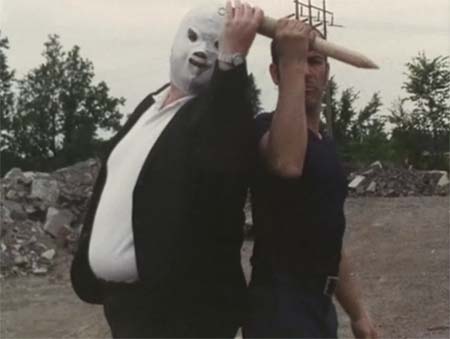
PLOT: The Son of God recruits retired Mexican wrestler “Santos” to help him defeat the

Still from Jesus Christ Vampire Hunter (2001)

vampires who are preying on Ottawa’s lesbian population.

WHY IT WON’T MAKE THE LIST:  It’s defiantly odd, but not consistently funny or entertaining enough to rank among the all-time greats.  If you saw any two-minute stretch of JCVH selected at random, you might be convinced that this was a work of camp genius; but string 45 such segments together, and the comedy value runs a little thin.  It’s a hard movie to peg: in its own way, given its low budget, its a sort of masterpiece, and at the same time it’s sort of a disaster.  I think that if it had offered us one less overlong kung fu battle, and one more song and dance number, it might have had a shot at exalted weirdness. Ultimately, though, just as the tone is more irreverent than blasphemous, the style is more zany than weird, and that should keep it off this particular List.

COMMENTS:  Jesus Christ Vampire Hunter is a stew of pop-cinema leftovers, mixing kung fu with horror, Mexican wrestling and even scraps of blaxploitation, all seasoned with a hint of sacrilege.  Like all peasant cuisine, it will be comfort food for many, but offend some refined palates—it’s definitely an acquired taste.  The technical aspects effectively evoke the feel of late seventies/early eighties exploitation movies, with drab urban cinematography, sound obviously added in post-production, and even a cheesy “waka-waka” funk theme as the heroes cruise down the highway. The action scenes are a problem here: for one thing, there are too many, and they’re too long. They’re just competent enough to remind us that they’re not quite up to snuff; Phil Caracas’ Jesus shows reasonable high-kicking athleticism, but he’s no action hero, and it would have been funnier and more endearing if he’d been clumsier. At any rate, the movie can’t be accused of false advertising. The campy/sacrilegious title scares off the squares and the fundies (though it’s obvious the filmmakers are clearly fans of JC’s philosophy of love and tolerance, if not proponents of his divinity). More to the Continue reading CAPSULE: JESUS CHRIST VAMPIRE HUNTER (2001) →

75. ALICE [NECO Z ALENKY] (1988)

“Alice thought to herself, ‘Now you will see a film made for children… perhaps.  But—I nearly forgot—you must close your eyes.  Otherwise, you won’t see anything.'”–Opening narration to Alice

Must SeeWeirdest!

DIRECTED BY: Jan Svankmajer

FEATURING: Kristýna Kohoutová, voice of Camilla Power (in English dubbed version)

PLOT: A bored young girl sits in a drab room throwing stones into a teacup when she suddenly sees a stuffed white rabbit in a display case come to life, pull a sawdust-covered stopwatch from inside its torso, and disappear into a desk drawer.  She follows it and winds up in a strange land full of talking socks, slithering steaks, and menacing skull-headed animals with razor sharp teeth.  The girl follows the white rabbit through a series of bizarre rooms until he leads her to a playing card king and queen who order the rabbit to cut off her head with the pair of scissors he carries.

Still from Alice (Neco z Alenky) (1988)

BACKGROUND:

  • Alice was Jan Svankmajer’s first feature length film after making award-winning short films for twenty-four years.  After Alice he returned to making shorts for six years before he made his next feature, Faust, in 1994.
  • Before branching out into filmmaking, Svankmajer’s primary training had been in building marionettes.
  • Svankmajer sneaks a couple of references to classic horror/suspense films into Alice: a scene where Alice is menaced by a flying creature is reminiscent of Hitchcock’s The Birds (1963), and a scene where the White Rabbit takes an axe to a door and then sticks his head through the hole is a blackly funny citation to Kubrick‘s The Shining (1980).

INDELIBLE IMAGE:  Although it’s difficult to top the bony “animals” that look like they were reassembled at random from a jumbled pile of a paleontologist’s relics, it’s the White Rabbit who makes the biggest impression, from the moment he comes to life and pulls his paws out from the display case floor where they had been nailed.  His strangest habit is licking sawdust (his own guts) off the pocket watch he keeps stashed inside a wound-like gash in his torso.

WHAT MAKES IT WEIRD:  “Alice in Wonderland” is a nonsense fantasy, a fairy tale of fractured reality; it makes a perfect template for a weird movie, but no adaptation has taken the story so deep into the frightening labyrinths of the subconscious as this uncanny animation. Carroll’s and Svankmajer’s opposite talents and sensibilities complement each other perfectly, like pure cane sugar mixed with white powder heroin.


Clip from Alice

COMMENTS:  “Alice in Wonderland” has been adapted for the screen a dozen times, and the Continue reading 75. ALICE [NECO Z ALENKY] (1988) →