All posts by Gregory J. Smalley (366weirdmovies)

Gregory J. Smalley founded 366 Weird Movies in 2008 and has served as editor-in-chief since that time. He is a member of the Online Film Critics Society, and his film writing has appeared online in Pop Matters and The Spool.

CAPSULE: SUDDENLY IN THE DARK (1981)

DIRECTED BY: Young Nam Ko

FEATURING: Kim Young-ae, Lee Ki-seon, Yoon Il-bong

PLOT: A Korean housewife believes that their new maid is having an affair with her husband; is it all in her imagination, or does it have something to do with the mysterious shaman’s doll the strange girl carries around everywhere?

Still from Suddenly in the Dark (1981)

WHY IT WON’T MAKE THE LIST: A rare Eighties horror from South Korea, recently “rediscovered” and released on Blu-ray by Mondo Macabro, Suddenly is not quite a lost classic (and not especially weird by our standards), but it is a solid psychological horror/drama with a unique focus on female sexual insecurity.

COMMENTS: Suddenly in the Dark is unusual not merely because it’s female-centered, but because it revolves around a very particular female anxiety—the fear that a wife’s slowly fading beauty will lead her husband to abandon her for a younger mate. The specialization of this obsession is a fertile soil for the movie to explore a broader and more universal theme of paranoia, with lots of different textures. Seon-hee’s fears may be totally unfounded, or they may be only partly true; she might be losing her mind due to out-of-control suspicions arising from neglect by her workaholic husband, or she might be the victim of a supernatural conspiracy to take her spouse from her and destroy the family structure. The audience is kept off balance about whom they should fear: Seon-hee, the paranoid wife, or Mi-ok, the seemingly innocent young maid who carries a bundled-up shaman’s doll everywhere. There are enough hints of supernatural agency—such as the appearance of a slide depicting the frowning doll in the lepidopterist’s presentation before the totem actually appears in the story—to make the audience wonder if the source of the disorder is witchcraft, insanity, or gaslighting.

Mi-ok’s coquettish expressions are good, finding the right guise of uncertainty midway between genuine simplicity and a cunning mask. The younger girl is frequently shown standing above the wife in the frame, on the balcony looking down on her older counterpart, to emphasize her recent ascendancy in the household. Her body is exploited—she has frequent nude scenes and upskirt shots—but the twist is that she’s the object of the female gaze, not the male. The husband barely gives the girl a second glance; it’s the wife’s eyes that linger on her exposed flesh, burning not with lust but with envy.

If you favor the use of a fractured camera to depict the disintegration of the female mind, you’re in luck: it seems like about ten percent of the film is shot through a kaleidoscope. Once, a kaleidoscopic dream is superimposed on an image of Seon-hee fitfully sleeping, a great effect. Other shots are distorted by the simple but effective trick of affixing a thick water glass to the lens, sometimes adding a green and/or red filter to the mix. The result is a disorienting visual mix where significant objects—the doll—appear rotating inside a shard swirling in a morass of psychedelic colors. Mixed with the female paranoia, the colorfully cockeyed visuals give the film a distinct giallo feel, with a Korean flair (a character descended from the “Sea God’s grandmother” is an exotic non-European element). The ending is too literal for my tastes, but features plenty of cathartic destruction. Suddenly in the Dark never made its way past Korea’s borders in its initial run, but it makes us wonder what other minor treasures may be hiding in the vaults of cinema’s outer rim.

An interview with the producer in the extras reveals that a remake is planned. The film itself is heavily influenced by the 1960 Korean drama/thriller The Housemaid, in which a seductive maid disrupts the balance of a happy family.

WHAT THE CRITICS SAY:
“Wow, this one is wild! A colorful, psychedelic supernatural shocker from Korea, this stylish offering is a hugely enjoyable mind twister that assaults the viewer with a seemingly endless variety of creative visuals that turn its seemingly routine story into something totally fresh and unpredictable.”–Nathaniel Thompson, Mondo Digital (Blu-ray)

285. DEAD LEAVES (2003)

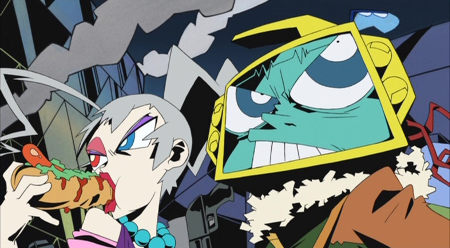
“A guy with a TV for a head and a girl with a panda-like mark on her face find themselves naked on Earth with no recollection of how they got there. After attempting to violently acquire food and clothes, they get arrested and sent to the Lunar prison Dead Leaves… and things get weirder from there.”–Dead Leaves synopsis from the listicle “15 Bizarre Anime That Make You Wonder ‘Wtf Did I Just Watch?’

DIRECTED BY: Hiroyuki Imaishi

FEATURING: Voices of Takako Honda, Kappei Yamaguchi; , Jason Lee (English dub)

PLOT: Pandy, a woman with mismatched eyes, and Retro, a man with a television for a head, awaken naked with no memories and immediately go on a crime spree. Quickly arrested, they are sent to Dead Leaves, a prison housed on what remained of the crumbling moon, where they have sex and then arrange a prison break. Pandy grows pregnant and comes to term in a day, and faces a giant caterpillar monster with the help of her precocious newborn son.

Still from Dead Leaves (2003)

BACKGROUND:

  • The directorial debut of Hiroyuki Imaishi, who had worked as an artist on many animes, including the TV version of “Neon Genesis Evangelion” and it’s bizarre theatrical incarnation.
  • Released as an OVA (original video animation, a common direct-to-video release strategy in Japan).
  • Dead Leaves was made with the American and European secondary markets in mind. The English dub was made contemporaneously with the Japanese version.

INDELIBLE IMAGE: Dead Leaves‘ images, while carefully painted, streak by almost too fast for the eye to register, leaving an impression of havoc rather than focusing on particular images. Since the main characters—especially monitor-faced Retro—appear most often, it’s their faces that stick most in the memory.

THREE WEIRD THINGS: TV-headed Retro-reprobate; penis drill; inexplicable psychedelic caterpillar

WHAT MAKES IT WEIRD: Dead Leaves moves so fast and makes so little sense that it’s the equivalent of putting an ultraviolent manga in a high-speed blender and trying to read it while the pieces swirl around. The plot is nearly incomprehensible, but somehow involves mutant clones and a psychedelic caterpillar. Weird? Hell yes. Recommended? Well, definitely not to epileptics. Even for older folks with a healthy neurobiology, the breakneck pacing is as likely to induce a headache as an adrenaline rush. It’s definitely one-of-a-kind, though, and as an experiment in compressing as much berserk and illogical anime flavor as possible into as short a running time as possible, it’s worth a look.


Short clip from Dead Leaves

COMMENTS: Although the director advised the audience at Dead Continue reading 285. DEAD LEAVES (2003) →

LIST CANDIDATE: TAMPOPO (1985)

Recommended

DIRECTED BY: Jûzô Itami

FEATURING: Tsutomu Yamazaki, Nobuko Miyamoto, , Fukumi Kuroda

PLOT: A stranger rides into town and helps a struggling widow to master the art of noodle preparation, while peripheral characters enact food-related comic sketches.

Still from Tampopo (1985)

WHY IT MIGHT MAKE THE LIST: Tampopo‘s parodic tale of noodle shop warfare is almost straightforward, if offbeat. Fortunately, there are enough surreal diversions—a fourth-wall breaking introduction where a gangster lectures the audience about eating too loudly during the movie and scenes exploring the erotic possibilities of live shrimp and egg yolks—to make this one worth a weird watch.

COMMENTS: Few movies can make you as hungry as Tampopo, the savory “noodle Western” (or “Eastern”) about an itinerant truck driver/gourmet who trains a mediocre cook to prepare the world’s greatest bowl of ramen. The main plot lightly parodies Westerns, with the stranger wandering into town to help (and woo) the local attractive widow, complete with showdowns with the local gang—although they battle not with guns, but with cutlery. In between advancing that storyline, the film takes time out for unrelated absurdist sketches revolving around food. (In the first of these, we visit a five star restaurant for a business meal where sycophantic salarymen order the same bland meal as the boss, while in another room a matronly etiquette maven tries in vain to teach young ladies to eat their spaghetti without slurping). The most of memorable of these excursions involves a mysterious yakuza in a white suit, who has kinky gourmet sex in a hotel room with his mistress. Come to think of it, the movie may make you as horny as it does hungry, although the sex is (almost) all done in good taste.

Not that it’s all fluffy, marshmallowy cinema. There are moments here that seem better fitted to a mondo film, such as the killing of a turtle (with one quick slice from a knife inserted under the shell), and the thematically meaningful yet taboo footage that plays while the credits roll. Many people find the egg yolk foreplay more yucky than erotic, while there’s another scene where the yakuza flirts with–and even French kisses—a dangerously underage oyster fisherwoman. These scenes are mildly shocking, although they’re neither mean-spirited nor deployed simply for the sake of shock. They add pungent, R-rated spice to a movie that might otherwise be too sweet and mild; with a few judicious cuts, it’s appropriate for a school-age crowd.

I first saw Tampopo (on VHS) when it came out thirty years ago, and although I had a generally good impression of it, I didn’t remember much beyond the basic premise. I’m surprised that I didn’t recall it as being especially strange or surreal. I found it a more interesting film this time around, which suggests that this may be a movie that takes some life seasoning to appreciate. It’s essentially a silly work, but as a paean to the pleasures of food and sex (and movies), it’s an easy one to champion.

The Criterion Collection released Tampopo on DVD in 2010, then finally upgraded it to Blu-ray this year (2017).

WHAT THE CRITICS SAY:

“…one of those utterly original movies that seems to exist in no known category…. the movie is so consumed and detailed, so completely submerged in noodleology, it takes on a kind of weird logic of its own.”–Roger Ebert, Chicago Sun-Times (contemporaneous)

(This movie was nominated for review by “upgrayedd,” who simply said “Tampopo is a weirdo.” Suggest a weird movie of your own here.)

284. BATMAN RETURNS (1992)

“Being the Batman fan that I am, I pretended to like the film. I passionately defended it to my ‘non-Batman’ friends who found it ‘weird’ or ‘dumb.’ But eventually, I gave in to the fact that this film plain sucked. This macabre, morose, dark abomination was a Batman film in name only. Frankly, I felt screwed by Warner Brothers and Mr. Burton.”–Bill “Jett” Ramey, “Batman on Film”

“It’s human nature to fear the unusual.”–The Penguin, Batman Returns

Recommended

DIRECTED BY:

FEATURING: , , Danny DeVito,

PLOT: The film sets Batman against three new villains: Oswald Cobblepot, a deformed outcast who lives in the sewers and adopts the name “the Penguin”; “Catwoman,” former secretary Selina Kyle turned feminist avenger after a near-death experience; and Max Shreck, a wealthy retailer who wants to build a power plant opposed by Gotham City’s mayor. With differing agendas and shifting loyalties, the three form a plan to run Cobblepot for mayor and to frame Batman for the city’s crime problem, while Batman’s alter-ego Bruce Wayne and Selina pursue a romance, not realizing that they are sworn enemies. After the superhero foils the initial plot, the Penguin pulls out a more elaborate, apocalyptic plan.

Still from Batman Returns (1992)

BACKGROUND:

  • Tim Burton, who had scored a blockbuster with the original Batman (1989),  was reluctant to produce a sequel. Warner Brothers convinced him to helm the film by giving him almost complete creative control. Heathers‘ Daniel Waters was brought in to shade Sam Hamm’s too-sunny original script. It was a move the studio came to regret (the film was profitable, but not as big a hit as its predecessor, and parental complaints that it was too violent/sexy/weird for kids spooked the suits). Neither Burton nor star Michael Keaton returned for the third movie in Warners’ Batman franchise, which went in a lighter, more family-friendly direction under Joel Schumacher.
  • Angry parents boycotted McDonalds for (unwisely) including Batman Returns action figures in Happy Meals, complaining that the movie was too violent for kids.
  • Oscar-nominated for Best Visual Effects and Best Makeup. Also nominated (unjustly, in our opinion) for a “Worst Supporting Actor” Razzie for Danny DeVito.

INDELIBLE IMAGE: I’m going to go with the army of penguins equipped with missiles striped like candy canes (remember, this is a Christmas movie).

THREE WEIRD THINGS: Kitty corpse revival; poodle with a hand grenade; missile penguin army

WHAT MAKES IT WEIRD: Let loose with a budget of $80 million and almost complete creative control in 1992, Tim Burton smuggled weirdness into the cineplex in the guise of a superhero sequel. The resulting picture has as many excesses as you can possibly sneak into a blockbuster: suggestive S&M duels between sexually repressed loners clad in fetish gear, a carnival-themed gang who unleash their surreal clown fury on Gotham at Christmas, and an army of penguins led by a deformed sociopath.


Original trailer for Batman Returns

COMMENTS: Earning over 260 million simoleons at the box office—although some ticket buyers probably asked for a refund—Batman Continue reading 284. BATMAN RETURNS (1992) →

282. DEMENTIA [DAUGHTER OF HORROR] (1955)

“Do you know what madness is, or how it strikes? Have you seen the demons that surge through the corridors of the crazed mind? Do you know that in the world of the insane you’ll find a kind of truth more terrifying than fiction? A truth… that will shock you!”–Opening narration from Daughter of Horror

Recommended

DIRECTED BY: John Parker

FEATURING: Adrienne Barret, Bruno VeSota, Ed MacMahon (voice in Daughter of Horror cut)

PLOT: A nameless woman awakens from a nightmare and makes her way out onto the city streets. She meets a wealthy man and agrees to go with him, and imagines a bloody family drama enacted in graveyard while riding in his limousine. Later, she stabs the man and throws his body off his penthouse balcony; she is then pursued by a cop with the face of her father, who chases her into a jazz club.

Still from Dementia (Daughter of Horror) (1955)

BACKGROUND:

  • The film contains no dialogue, although it’s not technically a silent film as some sound effects can be heard.
  • Director John Parker has only Dementia and one short film (a dry run for this feature) in his filmography. We know little about him except that his parents were in the film distribution business.
  • Star Adrienne Barrett was Parker’s secretary, and the film was inspired by a nightmare she related to Parker.
  • Co-star and associate producer Bruno VeSota is perhaps better known for his work as a character actor in numerous pictures, including a memorable turn as a cuckolded husband in Attack of the Giant Leeches. VeSota later claimed to have co-written and co-directed the film (no director is listed in the credits).
  • Cinematographer William C. Thompson also lensed Maniac (1934) and Glen or Glenda? (1953), making him the rare craftsman to serve on three separate Certified Weird movies (all for different directors).
  • Dwarf (Freaks) plays the uncredited “newsboy.”
  • The score was written by one-time bad boy composer George Antheil, whose career had plummeted into film and TV scoring after having once been the toast of Paris’ avant-garde with “Ballet Mechanique” (1924).
  • Dementia was submitted to the New York Censor’s board in 1953, and refused a certificate (they called it “inhuman, indecent, and the quintessence of gruesomeness”—which they didn’t mean as praise). It was approved in 1955 after cuts. (Reportedly they requested removal of shots of the severed hand). The film was banned in Britain until 1970 (!)
  • After failing to find success in its original dialogue-free form, Dementia was re-released in 1957 with narration (from future late night talk show sidekick Ed McMahon) and retitled Daughter of Horror.
  • Daughter of Horror is the movie teenagers are watching in the theater when the monster strikes in The Blob.

INDELIBLE IMAGE: Our protagonist (the “Gamin”) surrounded by faceless onlookers, who silently and motionlessly stare at her victim’s corpse. (Daughter of Horror‘s narrator unhelpfully informs us that these unearthly figurants are “the ghouls of insanity”).

THREE WEIRD THINGS: Precognitive headline; graveyard memories; throw on a dress

WHAT MAKES IT WEIRD: A skid row nightmare, Dementia dips into post-WWII repression and exposes the underbelly of the American night. It’s a boozy odyssey through a netherworld of newsboys, flower peddlers, pimps, murderers, and hot jazz, with our heroine pursued by cops and faceless demons. It’s noirish, expressionist, and nearly silent, except when Ed MacMahon interrupts the proceedings with pulpy purple prose. Perhaps it was not quite “the strangest motion picture ever offered for distribution,” as Variety famously claimed, but, warts and all, it’s like nothing else you’ve seen. It was too much naked id for its time, taking the spirit of Allen Ginsburg’s “Howl” and channeling it into a guilt-drenched B-movie dream.


Original trailer for Daughter of Horror

COMMENTS: The first thing the Gamin sees when she wakes from Continue reading 282. DEMENTIA [DAUGHTER OF HORROR] (1955) →