All posts by Gregory J. Smalley (366weirdmovies)

Gregory J. Smalley founded 366 Weird Movies in 2008 and has served as editor-in-chief since that time. He is a member of the Online Film Critics Society, and his film writing has appeared online in Pop Matters and The Spool.

APOCRYPHA CANDIDATE: I’M THINKING OF ENDING THINGS (2020)

I’m Thinking of Ending Things has been promoted to the Apocryphally Weird List. Please read the official entry.

366 Weird Movies may earn commissions from purchases made through product links.

DIRECTED BY:

FEATURING: , , , , Guy Boyd

PLOT: A young woman goes on a trip to meet her new boyfriend’s parents at their farmhouse on a night when a blizzard is brewing; the night grows increasingly strange and unsettling as it becomes unclear what is real and what is imaginary.
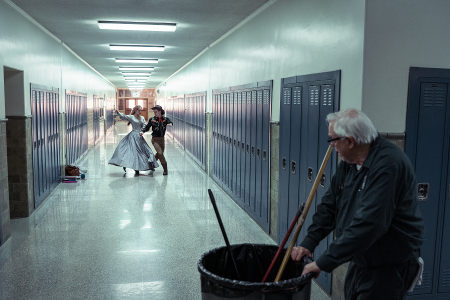
Still from I'm Thinking of Ending Things
I’m Thinking of Ending Things. Guy Boyd as Janitor in I’m Thinking of Ending Things. Cr. Mary Cybulski/NETFLIX © 2020

WHY IT MIGHT JOIN THE APOCRYPHA: By the time the pig shows up at Jake’s old high school, it becomes apparent that this maze of awkward interactions, faulty memories, and uncertain identities may just be Charlie Kaufman’s most surreal film.

COMMENTS: The first inkling that something is not quite right in I’m Thinking of Ending Things comes when the young woman (who is first introduced as “Lucy,” although it turns out that may not be her real name) thinks to herself, “I’m thinking of ending things.” “Huh?,” says Jake (that is his real name), from the driver’s seat. Can he hear her thoughts? She denies speaking. “Weird,” says Jake. “Yeah,” she answers.

Things will get weirder. She’s unsure why she wants to break up with him. Her backstory doesn’t add up. And she’s getting a lot of phone calls, which she’s not answering. When they arrive to meet Jake’s parents at their remote farmhouse, things get even stranger. As it turns out, Jake’s parents would creep out Henry Spencer‘s in-laws. Dinner is uncomfortable, full of small talk that often sounds like hidden accusations, and—once more—competing backstories that contradict each other. Jake’s parents age, almost before her eyes… Nothing explicitly supernatural or menacing happens, but the creaky farmhouse emanates a horror movie vibe, intensified by Jake’s passive-aggressive insistence that his girlfriend stay out of the basement. Meanwhile, Lucy—or whatever her name is—anxiously suggests that Jake take her home before the coming blizzard snows them in and traps her there.

Charlie Kaufman‘s latest mind-massager is another intensely subjective and literate tour of the lonely corridors of the mind, where nothing is as it seems. It’s one of his strangest offerings— particularly when it reaches an irrational finale that departs from the source novel—but perhaps what distinguishes it the most is the exceptional ensemble acting, best seen in the four-way sparring at the dinner table. Their expressions are priceless: Collette smiling to herself at private jokes only she can hear, Thewlis aggressively incredulous at the idea that a landscape could appear sad, Plemmons understandably embarrassed by his parent’s odd behavior, and trying to coax his girlfriend into revealing the correct details about how they met. We expect accomplished performances from those three celebrated actors, but relative newcomer Jessie Buckley is a revelation. She mutates throughout the film, portraying everything from a nervous recalcitrant girlfriend to an angry feminist to an apparent victim of very early-onset Alzheimer’s. She even slips into a Pauline Kael impression. Remarkable.

As with all the best trips, it’s the journey that’s most memorable, not the destination. There is a reveal at the end, but the twist, while satisfying, is hardly the point. Each scene is structured as an individually confounding moment: on the long ride there and back, Jake and his girlfriend discuss everything from the human experience of time, bad movies as viruses, with citations to Wordsworth, David Foster Wallace, Guy Debord, and musical theater (familiarity with “Oklahoma!” will enrich your experience). Jake says he like road trips because “it’s good to remind yourself that the world’s larger than the inside of your own head”—but does the movie believe this thesis? As they travel, the couple learn less about each other, and more about the slipperiness of human memory, fantasy, and identity.  It’s Kaufman’s favorite theme: the loneliness of our inherent interiority. The paradox is that our inescapable subjectivity is the one thing we all share and bond over.

WHAT THE CRITICS SAY:

“If that sounds confusing, or even downright hostile to the audience, well, that describes the Charlie Kaufman experience… There’s a weird thrill to getting lost inside this movie, only so you can study every odd detail from new angles, over and over again.”–David Sims, The Atlantic (contemporaneous)

9*. GEMINI (1999)

Sôseiji

366 Weird Movies may earn commissions from purchases made through product links.

Recommended

DIRECTED BY:

FEATURING: Masahiro Motoki, Ryô

PLOT: Yukio is a successful doctor, decorated for his service in the war. His wife Rin is an amnesiac. Yukio discovers he has an identical twin from whom he was separated at birth—a resentful and savage twin, bent on revenge.

Still from Gemini (1999)

BACKGROUND:

  • Tsukamoto adapted the story from a 1924 short story by Edogawa Rampo (“the Japanese Edgar Allan Poe”).
  • In an unusual move, fellow director assembled a 15-minute “making of” featurette to accompany the film on DVD.

INDELIBLE IMAGE: Our first glimpse of the twin in the shadows. He looks just like Yukio, but wears ragged robes and a bizarre fur earmuff that covers half of his face. He shakes like he’s having a fit, then approaches the camera by doing cartwheels. It’s scary enough to give someone a heart attack.

TWO WEIRD THINGS: Eyebrowless clan; somersaulting doppelganger

WHAT MAKES IT WEIRD: Pulling back from the unbridled mania of Tetsuo: The Iron Man and similar body-horror experiments, Shinya Tsukamoto proves that he can generate cold sweats with a more subtle, purely psychological approach. With its deep shadows and determined pace, Gemini generates an uncanny horror that seeps into your bones.

The opening minutes of “The Making of Gemini“

COMMENTS: Gemini begins with an abstract, ominous prologue. It Continue reading 9*. GEMINI (1999) →

FANTASIA FILM FESTIVAL 2020: #SHAKESPEARE’S SHITSTORM (2020)

Shakespeare’s Sh*tstorm

366 Weird Movies may earn commissions from purchases made through product links.

Screening online for Canadians at 2020’s online Fantasia Film Festival

Recommended

DIRECTED BY:

FEATURING: Lloyd Kaufman, Kate McGarrigle, Erin Miller, Monique Dupree, Abraham Sparrow, Amanda Flowers

PLOT: Very loosely following the plot of ‘s “The Tempest,” the story involves a party ship packed with pharmaceutical executives washed up on the shores of Troma, New Jersey, after a storm of whale feces.

Still from #SHAKESPEARE'S SHITSTORM (2020)

WHY IT MIGHT MAKE THE APOCRYPHA: You’ll get more out of it if you know “The Tempest” (and know Troma well enough to catch Easter eggs like the “Kabuki flip”)—but, Shakespeare’s Shitstorm should shock and amaze anyone with a sense of cinematic adventure and strong stomach. It’s one long hedonistic orgy of grossout comedy and Bardic references. It’s got Lloyd Kaufman in two roles, including one in drag (in a Snow White costume, for reasons never explained); William Shakespeare telling a donkey show joke to a panel of Ph.Ds; and a climax that is accurately characterized as “like a Hieronymus Bosch painting” (if Bosch had been just a bit fonder of green slime, prosthetic boobs, and punk rock anthems). It’s the stuff that dreams are made of—at least, the kind of dreams you might have if you ate an entire herring pizza laced with ketamine as a midnight snack before going to bed.

COMMENTS: “The Tempest” was not William Shakespeare’s final play, but it was his last masterpiece. Its closing acts are widely interpreted as the Bard’s farewell to the theater. At 74 years of age, Lloyd Kaufman has already outlived Shakespeare, but the feeling that Shakespeare’s Shitstorm is intended as his final trashterpiece is inescapable.

Something about Shakespeare inspires Kaufman and his Troma team to heights of lunacy even beyond their usual excesses. Shitstorm may not be quite as surreal as Troma’s weirdest feature, Tromeo & Juliet, but it represents a capstone of their transgressive punk aesthetic. One affinity between Stratford-upon-Avon’s favorite son and New Jersey’s least reputable film studio is the large cast of characters: Troma has always favored maxamilized plots and as many odd-looking extras as they can convince to work for a mention in the rolling credits. The discipline (such as it is) imposed by being forced to parody the Bard’s sprawling plots enforces some structure on Kaufman, whose tendency is to make his movies as digressive and improvised-looking as possible. And of course, the tension between Shakespeare’s humanistic aspirations and Troma’s scurrilous antics is inherently amusing. The combination gives the studio the chance to argue, “sure, we may be lowbrow… but we’re smart lowbrow.” After all, they quote from the play’s text and throw in references to other plays and sonnets (always undercut by a corny or obscene joke), along with bits of Shelley and bawdy couplets of their own devise. It reminds us that there is an intelligence hiding under the layers of shit jokes.

Shakespeare’s Shitstorm isn’t just offensive; it’s an ode to offensiveness. It starts off with a toddler spattered with blood from her mother’s suicide. There’s a “diversity hire” stripper in a wheelchair, two separate subplots involving crack whores (including one who sings a musical number with the lines “suck her in and blow her out, my crack pipe never screams and shouts”), and bloody oral rape scene performed by an animatronic chicken. After all that, the nauseating scenes of characters getting lapdances while being showered by brownish buckets of cetacean “fecal bloom” seem positively quaint. The only real suspense is whether—or rather, when and how—they’ll drop the N-word. That’s all standard practice for Troma, though I daresay that Shitstorm breaks all previous Tromatic records for repulsion. But this time, offensiveness itself is the front-and-center theme of the movie; it makes the studio’s boldest case that causing offense is a social service. Shitstorm‘s chief satirical targets are entitled “SJW” bloggers with no sense of humor. Shitstorm‘s final moral is delivered as a string of ethnic jokes—with accompanying visual metaphor—an argument that mocking everyone and everything equally is a better route to solidarity than contorting our speech awkwardly to avoid stepping on any one group’s toes. In other words, lighten up. We’re all here to laugh, and if your in-group gets lambasted, it will be someone else’s turn in about 30 seconds.

And thankfully, the movie is funny. They even insert what I think is a joke for early reviewers only. Often, when you watch pre-release screeners, there will be a legend that periodically appears warning “for review purposes only.” In Shitstorm, that reminder instead reads “for bootlegging purposes only.”

Shakespeare’s Shitstorm is a monumental movie. When you sit through the nine minutes of end credits—taking care to watch those amazing outtakes and read the jokes hidden in the text—you’ll realize that it takes an enormous pile of money to make something that looks this cheap. We are unlikely to see a Lloyd Kaufman movie on this scale ever again, and it’s a shame that Covid-19 prevented it from having the grandiose premiere to a packed house that it deserved. Troma has worked its way up from a disreputable B-movie studio to an underground institution. I haven’t always been the biggest fan of their approach, but Kaufman and team have worked ceaselessly doing their own thing their own way for 35 years now—and that deserves a celebration. Of course, Kaufman’s Prospero might actually like it better this way. He doesn’t deal well with sudden popularity near the end of Shitstorm: “You’re supposed to be triggered! Do not put me on a pedestal!” So instead, let’s send him off with a quote from Shakespeare: “As you from crimes would pardon’d be,/Let your indulgence set me free.” We’ll indulge you, Mr. Kaufman, in one last glorious barf fest.


FANTASIA FILM FESTIVAL 2020: LABYRINTH OF CINEMA (2019)

366 Weird Movies may earn commissions from purchases made through product links.

Recommended

DIRECTED BY:

FEATURING: Takuro Atsuki, Rei Yoshida, Yukihiro Takahashi, Takato Hosoyamada, Yoshihiko Hosoda,

PLOT: Japanese teenagers find themselves thrown into the movies screening at a cinema on the last night before it closes.

Still from Labyrinth of Cinema (2019)

WHY IT MIGHT MAKE THE APOCRYPHA LIST: Nobuhiko Obayashi’s final movie, completed only months before his death, is an exuberant, monumental, poetic and surreal ode to the power of cinema.

COMMENTS: I’d advise letting yourself get lost inside Nobuhiko Obayashi‘s Labyrinth of Cinema. Due to the way it hops around between eras and genres, the story may be easier to follow for those familiar with pre-WWII Japanese cinema; but given that the movie begins by introducing one Fanta G, a time-traveler who arrives in modern-day Onomichi, Japan, in a spaceship with goldfish floating inside it, it’s fair to say that narrative logic is not uppermost on Obayashi’s mind. This is a movie with atmosphere to absorb and imagery to intoxicate.

“Movies are a cutting edge time machine,” Fanta G tells us. “You’ll experience time lags in this movie.” You have been fairly warned. After he lands his spacecraft in the harbor and makes his way to Onomichi’s only cinema for the all-night war movie marathon, we’re introduced to the rest of the main characters. Noriko is a 13-year old schoolgirl from a nearby island who almost always appears onscreen bathed in an idyllic blue light. Teenage film buff “Mario Baba” is smitten with her; he sits in the audience with two companions, a nerdy aspiring historian and the son of a monk who intends to become a yakuza. As the first feature begins, Noriko climbs onstage and begins tap dancing in front of the screen; when she hops into the film itself, no one in the audience bats an eye. The three boys soon find themselves mysteriously absorbed into the screen, as well. But the movie keeps changing, and the trio find themselves involved in musicals, samurai films, and wartime adventures, playing out various scenarios, but always pursuing Noriko, who serves both as damsel in distress and an ever-receding symbol of the epiphanic power of cinema itself. The skipping-through-film-history format plays out like a live action variation on Millennium Actress, but with an even more dislocated plot.

Most long movies are slow-paced, languorously stretching out to fill the available time, but Labyrinth of Cinema jets like a rocket through its three-hour tour of Japanese cinema. This makes it exhilarating, but also a little exhausting. Besides the constantly shifting plots—the teenage trio find themselves in new roles, facing new adversaries, every five minutes or so—Obayashi constantly switches styles. He recreates traditional genres, but also throws his own immersion-breaking visual trickery onscreen: vertical wipes, big blocks of primary color, actors enclosed in circular irises that resemble the Japanese flag, blazing computer-generated sunsets, and sidebar text commenting on the action (when one character first appears, he shows us a legend cheekily explaining “we don’t know his name yet”). Along the way we get plenty of the surreal touches we’d expect from the mind that gave us Hausu, including a piano tune played by bullets, and an emotional death scene with a woman who just happens to be sporting a Hitler mustache. Many such surprises lurk inside this maze of movies.

The pace slows a bit after intermission as the story makes its way towards its climax at Hiroshima. A strong and consistently humanist anti-war theme runs through the entire film, but the main focus is always on the cinematic form itself. Labyrinth of Cinema is an ode to the ways in which movies both distort and inform reality; it’s Obayashi‘s love letter to the art to which he devoted his life, shown as much from the perspective of a fan as of a craftsman. While doubtlessly the epic could have been edited down for clarity—and might have been, had Obayashi survived to tinker with it further—much of the movie’s ramshackle extravagance would have been lost. I’m not sure we would want to lose a single second of Obayashi’s last gift to the world.

WHAT THE CRITICS SAY:

“…bursting with energy, passion and dreamlike invention… the border between reality and fantasy dissolves into a colorful alternative universe that is uniquely Obayashi’s.”–Mark Schilling, Japan Times (contemporaneous)